кабель для сцены

LIFT-2S (European) vs. LIFT-1S UL (North American): LIFT-2S characteristics: Voltage: 300/500V (European standard, lower voltage) Temperature: −40°C to +70°C (moderate range) Standards: VDE 0482 part 265-2-1, EN 50265-2-1, IEC 60332-1-2 Design philosophy: Safety by material redundancy (2 steel cores) Steel cores: 2× cores provide mechanical backup Conductor: Class 6 (European, ~150–200 wires per mm²) Cost: Lower (proven European manufacturing) Market: Europe, Asia-Pacific, most of world LIFT-1S UL characteristics: Voltage: 600V (North American standard, higher voltage) Temperature: −25°C to +105°C (extreme range, high-temp optimized) Standards: UL 2562, UL 62, CSA C22.2 No.210.2 Design philosophy: Safety by certification (single core + redundant control) Steel core: 1× core (sufficient with nylon covering) Conductor: Class M (UL, extra fine ~300+ wires per mm²) Cost: Higher (UL testing, certification documentation) Market: North America (USA, Canada), Mexico UL 2562 specialty certification: UL 2562 scope: Elevator and Dumbwaiter Cables Specific requirements: 1. Pendant cable design (cable hangs freely, no duct support) 2. Vertical orientation (designed for gravity-loaded suspension) 3. Repeated flex cycles (cable moves up/down frequently) 4. Safety-critical function (failure = personnel risk) Consequence: More stringent than general-purpose cables Testing includes: Bend cycle fatigue, heat aging, compression resistance Test procedures (unique to UL 2562): Bend cycle test: 1,000+ cycles at minimum bending radius Cable must pass insulation resistance after cycling Heat aging: 500+ hours at 105°C continuous Tensile strength retention minimum 70% Compression: 1,000+ hours under sustained compression Cable cross-section must not exceed 5% permanent deformation LIFT-2S (no UL 2562): Tests per VDE are less stringent on fatigue/cycling Assumes cable mostly static, not repeated flex Adequate for European elevator duty (lower speed, fewer cycles) LIFT-1S UL: All UL 2562 tests passed (proven for North American elevators) Faster cycle times, more frequent motion → more fatigue stress Extra testing ensures reliability under North American elevator duty Market requirement (regulatory): Europe/International: CE mark required (European conformity) VDE/EN/IEC standards sufficient No UL certification needed (not recognized in EU) LIFT-2S is sufficient North America (USA, Canada): UL certification mandatory for elevators UL 2562 specifically for elevator cables CSA dual certification required in Canada LIFT-2S NOT acceptable (lacks UL 2562) LIFT-1S UL mandatory Cost implication: UL certification: ~$5,000–15,000 per product per region Testing duration: 3–6 months per model Documentation: Comprehensive test reports, technical files Result: LIFT-1S UL 20–30% higher cost than equivalent European cable

DR 717 P Highflex: высокогибкий барабанный кабель PUR/TMPU для пружинных кабельных барабанов на сценах и в театрах

DR 717 P Highflex — это высокогибкий кабель для пружинных кабельных барабанов, применяемых на сценах и в театрах. Кабель разработан для намотки и размотки, имеет специально подобранную послойную скрутку вокруг центрального несущего элемента, оболочку PUR/TMPU, поддерживающий экран из высокотехнологичной нити, малый наружный диаметр, небольшой вес и высокую механическую стойкость.
BASKET SPREADER 750: Next-Generation Hoisting Cable Architecture The BASKET SPREADER 750 (3GSLTOE) represents a fundamental advancement in hoisting control cable design, specifically engineered for next-generation automated port crane systems operating under extreme environmental and operational constraints. Unlike the BASKET SPREADER 740's 300/500V AC specification, the 750 operates at 0.6/1kV AC with dual-voltage DC capability (0.9/1.8 kV)—a classification shift that enables: Higher power capacity – 2–3× greater amperage per conductor, enabling longer cable runs with lower voltage drop Medium-voltage infrastructure compatibility – Direct integration with port substation power distribution systems (0.6 kV = 600V three-phase industrial standard) DC dual-voltage operation – Simultaneous support for AC motor control and DC feedback/signaling circuits (0.9/1.8 kV DC margins) Extreme temperature capability – Operating range −50°C to +80°C (vs. SPREADER 740's −20°C to +60°C), addressing Arctic port terminals and tropical high-ambient scenarios Advanced insulation chemistry – GAALTHERM® 530 thermoplastic compound replaces standard PVC/PUR, delivering superior chemical resistance and thermal stability This cable bridges the gap between standard control cables (300/500V, limited temperature) and heavy industrial medium-voltage distribution cables, creating a purpose-built solution for modern automated gantry crane systems in global port terminals.

DR 718 CP Highflex Reeling Cable: экранированный высокогибкий PUR/TMPU кабель для spring cable reels, театральных сцен и крановых стрел

DR 718 CP Highflex — это reeling cable with overall copper screen для spring cable reels, например на сценах в театрах, а также для применения как control cable in crane arms. Кабель имеет жилы из bare copper strands class 5, special polymer insulation, специально подобранную скрутку вокруг центрального несущего элемента, PUR/TMPU inner sheath, tinned copper braiding screen и чёрную PUR/TMPU outer sheath RAL 9005.
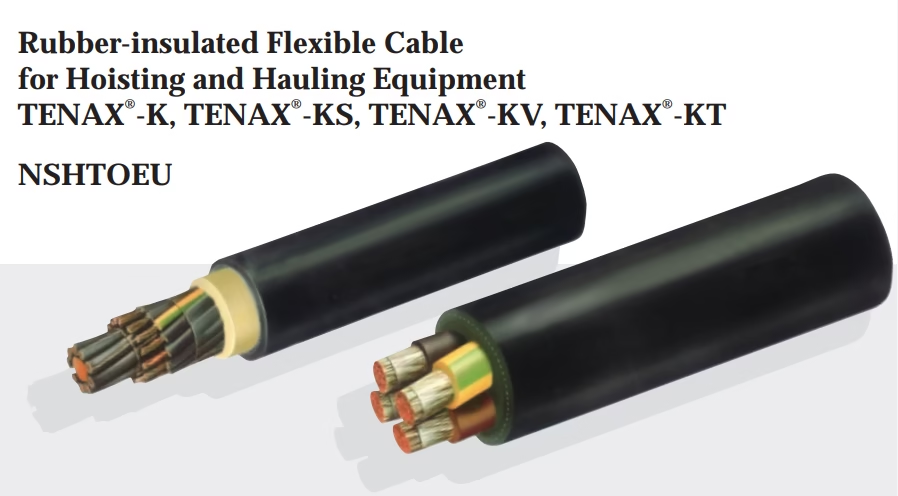
NSHTOEU (серия TENAX-K/KS/KV/KT) — это специализированные гибкие кабели с резиновой изоляцией, предназначенные для подключения подъемно-транспортных систем и аналогичного оборудования с принудительным направлением кабеля при высоких механических нагрузках. Кабели разработаны в соответствии с международным стандартом DIN VDE 0250, часть 814, который устанавливает требования к кабелям для подъемных механизмов.

Гибкий кабель с резиновой изоляцией для подъемно-транспортного оборудования

NSHTOEU (серия TENAX-K/KS/KV/KT) — это специализированные гибкие кабели с резиновой изоляцией, предназначенные для подключения подъемно-транспортных систем и аналогичного оборудования с принудительным направлением кабеля при высоких механических нагрузках. Кабели разработаны в соответствии с международным стандартом DIN VDE 0250, часть 814, который устанавливает требования к кабелям для подъемных механизмов.