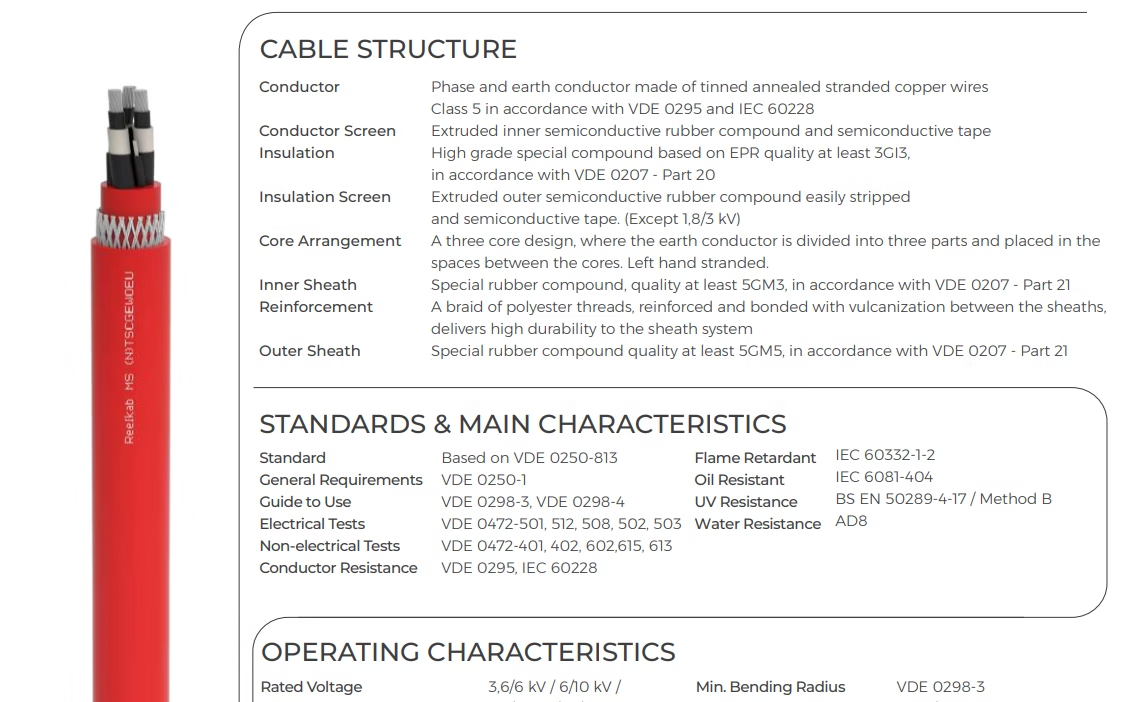
Reeling Cable

Extended technical guide for mining engineers, port equipment designers, electrical system integrators, and heavy-equipment OEMs. Covers: the physics of mechanical fatigue in high-speed reeling systems; BUFLEX® SC conductor architecture (IEC 60228 Class 5 ultra-fine stranding, lay-angle optimisation for bending compliance); EPR insulation design with semi-conductive field-control layers for efficient 1.8–24 kV electric-field distribution; copper-braid electromagnetic shielding and its interaction with high-current conduction; signature red PUR jacket chemistry (abrasion resistance, tear strength, UV stability, oil resistance); mechanical performance specifications (minimum bend radius, tensile load capacity, cyclic-flexure endurance); thermal management in continuous high-current operation (current rating derating as function of ambient temperature and installation method); comparative analysis of single-core vs. multi-core approaches; environmental durability (arctic cold, tropical heat, mine dust, coastal salt-fog); and practical specification and procurement frameworks for mining and port operator deployment.

BUFLEX® SC Single-Core Medium-Voltage Ultra-Flexible Reeling Cable: Complete Engineering Analysis, Advanced Conductor Architecture, EPR Insulation with Electrostatic Field Control, PUR Jacket Superior Abrasion & Tear Resistance, Mechanical Fatigue Engineering, Extreme Environment Durability, and Comprehensive Comparative Evaluation Against Multi-Core Industrial Cable Alternatives for Mining and Heavy Port Equipment

Extended technical guide for mining engineers, port equipment designers, electrical system integrators, and heavy-equipment OEMs. Covers: the physics of mechanical fatigue in high-speed reeling systems; BUFLEX® SC conductor architecture (IEC 60228 Class 5 ultra-fine stranding, lay-angle optimisation for bending compliance); EPR insulation design with semi-conductive field-control layers for efficient 1.8–24 kV electric-field distribution; copper-braid electromagnetic shielding and its interaction with high-current conduction; signature red PUR jacket chemistry (abrasion resistance, tear strength, UV stability, oil resistance); mechanical performance specifications (minimum bend radius, tensile load capacity, cyclic-flexure endurance); thermal management in continuous high-current operation (current rating derating as function of ambient temperature and installation method); comparative analysis of single-core vs. multi-core approaches; environmental durability (arctic cold, tropical heat, mine dust, coastal salt-fog); and practical specification and procurement frameworks for mining and port operator deployment.
Extended technical guide for port equipment engineers, smart port systems designers, equipment OEMs, and port automation specialists. Covers: the business case for integrated monitoring in port operations (equipment failure cost, maintenance response time, safety compliance); BUFLEX® SEM architecture (multi-conductor design, impedance matching, shielding strategies); BUFLEX® SEM OFE optical fibre integration (single-mode vs. multi-mode fibre selection, bend-loss mitigation, termination reliability); real-time sensor data collection systems (SHM architecture, IoT platform integration, edge computing); predictive maintenance algorithms and ROI models; comparative cost analysis of integrated vs. separate-system approaches; Industrial 4.0 and IIoT platform integration; safety interlocks and remote control architectures; cold-temperature and tropical performance specifications; and practical deployment frameworks for retrofit and new-build port equipment.

BUFLEX® SEM & BUFLEX® SEM OFE Integrated Optical Fibre Power Cable: Complete Engineering Analysis, Real-Time Equipment Monitoring, Predictive Maintenance, Industrial 4.0 IoT Integration, Hybrid Power-Data-Fibre Architecture, Comprehensive Comparative Evaluation Against Separate Power & Fibre Systems, and Practical Deployment Framework for Smart Port Operations

Extended technical guide for port equipment engineers, smart port systems designers, equipment OEMs, and port automation specialists. Covers: the business case for integrated monitoring in port operations (equipment failure cost, maintenance response time, safety compliance); BUFLEX® SEM architecture (multi-conductor design, impedance matching, shielding strategies); BUFLEX® SEM OFE optical fibre integration (single-mode vs. multi-mode fibre selection, bend-loss mitigation, termination reliability); real-time sensor data collection systems (SHM architecture, IoT platform integration, edge computing); predictive maintenance algorithms and ROI models; comparative cost analysis of integrated vs. separate-system approaches; Industrial 4.0 and IIoT platform integration; safety interlocks and remote control architectures; cold-temperature and tropical performance specifications; and practical deployment frameworks for retrofit and new-build port equipment.
Extended technical guide for harbour electrical engineers, crane OEMs, terminal procurement teams, and festoon/reeling system designers specifying round crane cables for marine service. Covers: the engineering rationale for marine-grade round festoon cable specification (why the RHEYFIRM®(SI) NTMCGCWOEUS platform degrades prematurely in tropical C5-M environments); detailed layer-by-layer deconstruction of FC-HFX-RND™ construction; the NTMCGCWOEUS designation decoded (material identity, construction standard, and design-era limitations); the critical role of round-cable sheath uniformity in chloride barrier performance and how RHEYFIRM®(SI)'s standard polychloroprene compound underperforms against FC-CSR™ enhanced chemistry; slip-ring contact corrosion in motorised reeling variants; festoon trolley lateral loading and sheath abrasion mechanisms; ISO 9227 salt spray and IEC 60068-2-52 cyclic salt mist testing methodology; comparative evaluation across 24 critical performance parameters; and practical specification, procurement, and lifetime cost analysis frameworks for port operators evaluating FC-HFX-RND™ as a direct replacement for RHEYFIRM®(SI) NTMCGCWOEUS round crane cables.

FC-HFX-RND™ Ultra-High-Flex Anti-Salt-Fog Round Festoon & Crane Cable for Port & Harbour Service: Complete Engineering Deconstruction, Round-Cable Architecture Optimisation for Marine Festoon, Reeling & Pendant Duty, Salt-Fog Corrosion Resistance Analysis, and Comprehensive Performance Comparison Against RHEYFIRM®(SI) NTMCGCWOEUS Round Crane Cables, with Field-Validated Service Life Data from Tropical Asia-Pacific Port Operations

Extended technical guide for harbour electrical engineers, crane OEMs, terminal procurement teams, and festoon/reeling system designers specifying round crane cables for marine service. Covers: the engineering rationale for marine-grade round festoon cable specification (why the RHEYFIRM®(SI) NTMCGCWOEUS platform degrades prematurely in tropical C5-M environments); detailed layer-by-layer deconstruction of FC-HFX-RND™ construction; the NTMCGCWOEUS designation decoded (material identity, construction standard, and design-era limitations); the critical role of round-cable sheath uniformity in chloride barrier performance and how RHEYFIRM®(SI)’s standard polychloroprene compound underperforms against FC-CSR™ enhanced chemistry; slip-ring contact corrosion in motorised reeling variants; festoon trolley lateral loading and sheath abrasion mechanisms; ISO 9227 salt spray and IEC 60068-2-52 cyclic salt mist testing methodology; comparative evaluation across 24 critical performance parameters; and practical specification, procurement, and lifetime cost analysis frameworks for port operators evaluating FC-HFX-RND™ as a direct replacement for RHEYFIRM®(SI) NTMCGCWOEUS round crane cables.
Extended technical guide for harbour engineers, ship system designers, offshore platform operators, and marine equipment OEMs. Covers: the engineering fundamentals of high-mechanical-strength cable design for sustained tensile loading in mobile applications; detailed deconstruction of RHEYFIRM(RTS) construction from reinforced conductor architecture through advanced oil-resistant insulation and chemical-resistant outer sheath; mechanical strength degradation mechanisms under sustained tensile stress, oil immersion, and chemical exposure; comparative performance evaluation of five leading marine cable platforms across 24 technical parameters; DIN VDE 0250 standard compliance and safety certifications; maritime-specific design considerations including salt-fog resistance, UV durability, and cold-temperature performance; and practical cable selection, procurement specification, and 20-year lifecycle cost analysis frameworks for harbour and offshore service.

RHEYFIRM®(RTS) (N)TSCGEWTOEUS High-Mechanical-Strength Mobile Port Cable: Complete Engineering Analysis, Superior Oil & Chemical Resistance, Tensile Load Capacity, Marine-Grade Durability, Comprehensive Comparative Evaluation Against Standard RHEYFIRM®, BOITALYON®, FC-HFX™, LAPPKABEL ÖLFLEX® for Harbour Mobile Equipment and Offshore Platform Service

Extended technical guide for harbour engineers, ship system designers, offshore platform operators, and marine equipment OEMs. Covers: the engineering fundamentals of high-mechanical-strength cable design for sustained tensile loading in mobile applications; detailed deconstruction of RHEYFIRM(RTS) construction from reinforced conductor architecture through advanced oil-resistant insulation and chemical-resistant outer sheath; mechanical strength degradation mechanisms under sustained tensile stress, oil immersion, and chemical exposure; comparative performance evaluation of five leading marine cable platforms across 24 technical parameters; DIN VDE 0250 standard compliance and safety certifications; maritime-specific design considerations including salt-fog resistance, UV durability, and cold-temperature performance; and practical cable selection, procurement specification, and 20-year lifecycle cost analysis frameworks for harbour and offshore service.
Extended technical guide for harbour electrical engineers, crane OEMs, terminal procurement teams, and marine infrastructure designers specifying flat festoon cable systems. Covers: the engineering rationale for marine-grade flat festoon cable specification (why standard (N)TSFLCGCWOEUS cables degrade 2–3× faster in tropical C5-M environments than in temperate European harbours); detailed layer-by-layer deconstruction of FC-HFX-FLAT™ construction from FC-FLX™ ultra-fine tinned conductor stranding through geometrically optimised flat-cable geometry and FC-CSR™ polychloroprene sheathing; the critical role of flat-cable web-bridge stress concentration in accelerating salt-fog-induced sheath cracking; chloride-induced conductor corrosion at festoon trolley cable-clamp interfaces; ISO 9227 salt spray and IEC 60068-2-52 cyclic salt mist testing methodology for flat-geometry cables; comparison of RHEYFIRM® (RS)-FLAT standard polychloroprene formulation vs. FC-CSR™ enhanced compound in combined UV–ozone–salt-fog exposure; DIN VDE 0250-814 and IEC 60245 compliance; and practical specification, procurement, and lifetime cost analysis frameworks for port operators transitioning from RHEYFIRM® (RS)-FLAT to FC-HFX-FLAT™ marine-grade flat festoon cable systems.

FC-HFX-FLAT™ Ultra-High-Flex Anti-Salt-Fog Flat Festoon Cable for Port & Harbour Crane Service: Complete Engineering Deconstruction, Flat-Cable Geometry Optimisation for Marine Festoon Trolley Systems, Salt-Fog Corrosion Resistance Analysis, and Comprehensive Performance Comparison Against RHEYFIRM® (RS)-FLAT (N)TSFLCGCWOEUS Flat Festoon Cables, with Field-Validated Service Life Data from Tropical Asia-Pacific Port Operations

Extended technical guide for harbour electrical engineers, crane OEMs, terminal procurement teams, and marine infrastructure designers specifying flat festoon cable systems. Covers: the engineering rationale for marine-grade flat festoon cable specification (why standard (N)TSFLCGCWOEUS cables degrade 2–3× faster in tropical C5-M environments than in temperate European harbours); detailed layer-by-layer deconstruction of FC-HFX-FLAT™ construction from FC-FLX™ ultra-fine tinned conductor stranding through geometrically optimised flat-cable geometry and FC-CSR™ polychloroprene sheathing; the critical role of flat-cable web-bridge stress concentration in accelerating salt-fog-induced sheath cracking; chloride-induced conductor corrosion at festoon trolley cable-clamp interfaces; ISO 9227 salt spray and IEC 60068-2-52 cyclic salt mist testing methodology for flat-geometry cables; comparison of RHEYFIRM® (RS)-FLAT standard polychloroprene formulation vs. FC-CSR™ enhanced compound in combined UV–ozone–salt-fog exposure; DIN VDE 0250-814 and IEC 60245 compliance; and practical specification, procurement, and lifetime cost analysis frameworks for port operators transitioning from RHEYFIRM® (RS)-FLAT to FC-HFX-FLAT™ marine-grade flat festoon cable systems.
Extended technical guide for harbour electrical engineers, crane OEMs, terminal procurement teams, and port equipment integrators. Covers: the engineering fundamentals of ultra-high-flex cable design and bend-cycle fatigue resistance; detailed deconstruction of RHEYCORD-OFE R construction from ultra-fine tinned conductors through anti-torsion braid, dual-layer insulation, and advanced polychloroprene sheath chemistry; flex-cycle degradation mechanisms and failure-mode analysis; comparative performance evaluation of five leading reeling cable platforms across 22 technical parameters; motorised reel slip-ring interface management and corrosion protection strategies; IEC 61089 bend-cycle testing methodology and tropical C5-M deployment considerations; and practical cable selection, procurement specification, and 20-year lifecycle cost analysis frameworks.

RHEYCORD®-OFE R Ultra-High-Flex Reeling Cable: Complete Engineering Analysis, Advanced Bend-Cycle Architecture, Motorised Reel Dynamics, Salt-Fog Resilience, Comprehensive Comparative Evaluation Against Standard RHEYCORD®, BOITALYON®R, FC-HFX™, and LAPPKABEL ÖLFLEX® Marine Systems for Tropical Port Service

Extended technical guide for harbour electrical engineers, crane OEMs, terminal procurement teams, and port equipment integrators. Covers: the engineering fundamentals of ultra-high-flex cable design and bend-cycle fatigue resistance; detailed deconstruction of RHEYCORD-OFE R construction from ultra-fine tinned conductors through anti-torsion braid, dual-layer insulation, and advanced polychloroprene sheath chemistry; flex-cycle degradation mechanisms and failure-mode analysis; comparative performance evaluation of five leading reeling cable platforms across 22 technical parameters; motorised reel slip-ring interface management and corrosion protection strategies; IEC 61089 bend-cycle testing methodology and tropical C5-M deployment considerations; and practical cable selection, procurement specification, and 20-year lifecycle cost analysis frameworks.
Extended technical guide for harbour electrical engineers, crane OEMs, terminal procurement teams, and marine infrastructure designers. Covers: the engineering rationale for dual-objective port cable specification (simultaneous pursuit of ultra-high flexibility and maximum salt-fog resistance); detailed layer-by-layer deconstruction of the FC-HFX™ construction from ultra-fine tinned conductor stranding through dual-layer polychloroprene sheathing; the FC-CSR™ compound innovation (enhanced chemical anti-ozonant system, precision UV absorber loading, water-absorption optimization); chloride-induced copper corrosion mechanisms at pendant terminations and reeling slip-ring contacts; comparative evaluation of BOITALYON®R (advanced PU-based insulation, limited salt fog endurance), RHEYFLEX® pendant/reeling platforms (polyamide strength members, standard 5GM3 polychloroprene), LAPPKABEL ÖLFLEX® marine cables (EPDM insulation, good UV resistance, suboptimal ozone chemistry), and CABLES ELÉCTRICOS CORTLAND® energy-chain systems (drag-chain optimization, limited termination protection); ISO 9227 salt spray and IEC 60068-2-52 cyclic salt mist testing methodology; DIN VDE 0250-602 and IEC 60245 compliance; and practical specification, procurement, and lifetime cost analysis frameworks for terminal operators.

FC-HFX™ Ultra-High-Flex Anti-Salt-Fog Port Control & Power Cable: Complete Engineering Deconstruction, Marine Corrosion Resistance Analysis, Comparative Performance Evaluation Against BOITALYON®R, RHEYFLEX®, LAPPKABEL ÖLFLEX®, and CABLES ELÉCTRICOS CORTLAND®, with Field-Validated Service Life Data from 15+ Years of Asia-Pacific Port Operations

Extended technical guide for harbour electrical engineers, crane OEMs, terminal procurement teams, and marine infrastructure designers. Covers: the engineering rationale for dual-objective port cable specification (simultaneous pursuit of ultra-high flexibility and maximum salt-fog resistance); detailed layer-by-layer deconstruction of the FC-HFX™ construction from ultra-fine tinned conductor stranding through dual-layer polychloroprene sheathing; the FC-CSR™ compound innovation (enhanced chemical anti-ozonant system, precision UV absorber loading, water-absorption optimization); chloride-induced copper corrosion mechanisms at pendant terminations and reeling slip-ring contacts; comparative evaluation of BOITALYON®R (advanced PU-based insulation, limited salt fog endurance), RHEYFLEX® pendant/reeling platforms (polyamide strength members, standard 5GM3 polychloroprene), LAPPKABEL ÖLFLEX® marine cables (EPDM insulation, good UV resistance, suboptimal ozone chemistry), and CABLES ELÉCTRICOS CORTLAND® energy-chain systems (drag-chain optimization, limited termination protection); ISO 9227 salt spray and IEC 60068-2-52 cyclic salt mist testing methodology; DIN VDE 0250-602 and IEC 60245 compliance; and practical specification, procurement, and lifetime cost analysis frameworks for terminal operators.
Extended technical guide for port electrical engineers, crane OEMs, ship unloader integrators, and terminal procurement teams covering: the engineering rationale for marine-grade pendant cable specification versus standard industrial pendant cable; detailed deconstruction of the RHEYFLEX-PN construction from conductor stranding through EPR insulation, polyamide strength member, and polychloroprene sheath; chloride-driven copper corrosion fatigue mechanisms at pendant cable terminations; comparative evaluation against H07RN-F (harmonised heavy-duty rubber), RHEYFLEX® 500 -Y- (PVC-insulated control), RHEYCORD® NSHTOEU-J (reeling cable platform), and BUFLEX® DGR (drag-chain rubber cable); 5GM3 versus 5GM5 polychloroprene sheath chemistry analysis; ISO 9227 and IEC 60068-2-52 salt fog test methodology; and FeiChun's FC-RHEYFLEX-PN-M equivalent with FC-FLX™ ultra-fine tinned conductors, aramid hydrolysis-immune strength member, and 5GM5 marine-grade polychloroprene outer sheath.

RHEYFIRM®(RTS) (N)TSCGEWTOEUS OF — The Ultimate Salt-Fog Upgraded Medium-Voltage Reeling Cable for Harbour Service: Layer-by-Layer Engineering Analysis, Comparative Performance Evaluation Against RHEYFIRM®(SI) NTMCGCWOEUS, Standard RHEYFIRM®(RTS), RHEYCORD®-OFE SR, and BUFLEX® SEM OFE, with FeiChun FC-RHEYFIRM-RTS-OF Enhanced Anti-Corrosion Equivalent

Extended technical guide for port electrical engineers, crane OEMs, ship unloader integrators, and terminal procurement teams covering: the engineering rationale for marine-grade pendant cable specification versus standard industrial pendant cable; detailed deconstruction of the RHEYFLEX-PN construction from conductor stranding through EPR insulation, polyamide strength member, and polychloroprene sheath; chloride-driven copper corrosion fatigue mechanisms at pendant cable terminations; comparative evaluation against H07RN-F (harmonised heavy-duty rubber), RHEYFLEX® 500 -Y- (PVC-insulated control), RHEYCORD® NSHTOEU-J (reeling cable platform), and BUFLEX® DGR (drag-chain rubber cable); 5GM3 versus 5GM5 polychloroprene sheath chemistry analysis; ISO 9227 and IEC 60068-2-52 salt fog test methodology; and FeiChun’s FC-RHEYFLEX-PN-M equivalent with FC-FLX™ ultra-fine tinned conductors, aramid hydrolysis-immune strength member, and 5GM5 marine-grade polychloroprene outer sheath.
Extended technical guide for port electrical engineers, fire safety officers, crane OEMs, and terminal procurement teams covering: the fire safety rationale for halogen-free construction in enclosed port environments — hydrogen chloride toxicity, electronic equipment corrosion, and smoke obscuration during fire events; complete nomenclature decoding of the YSLZ3SOE-J designation per German VDE convention; TPE (thermoplastic elastomer) insulation and sheathing compound chemistry and why it differs fundamentally from thermoset rubber (EPR, EPDM, CR) used in standard reeling cables; mechanical performance analysis of TPE versus EPDM in dynamic reeling applications — flex-cycle endurance, tensile strength, tear resistance, and cold-temperature flexibility; vertical free-fall basket operation mechanics — catenary stress, coiling geometry, impact loading, and why basket spreader cables require different engineering than drum-wound reeling cables; IEC 60332-3 (flame propagation in bunched cables), IEC 61034 (smoke density measurement), and IEC 60754-2 (gas acidity by pH and conductivity) compliance analysis; salt fog performance limitations of TPE compounds (400–700 hours per ISO 9227) versus polychloroprene alternatives (800–1,500 hours); comparative evaluation against RHEYCORD® NSHTOEU-J (standard CR reeling), RHEYCORD®(RTS) (N)SHTOEU-J (premium CR reeling), RHEYCORD®-OFE SR (oil-resistant CR spreader), and CORDAFLEX® SMK-V (aramid-core vertical spreader); and FeiChun FC-RHEYCORD-BS marine-grade halogen-free equivalent with enhanced moisture barrier, FC-FLX™ tinned conductors, and aramid strength member for coastal service.

RHEYCORD®(BS) YSLZ3SOE-J — The Halogen-Free Basket Spreader Reeling Cable for Fire-Regulated Port Environments: TPE Construction Analysis, Vertical Free-Fall Basket Engineering, IEC 60332-3 / IEC 61034 / IEC 60754-2 Fire Safety Compliance, Salt Fog Performance Trade-Offs in Harbour Service, and Comparative Evaluation Against RHEYCORD® NSHTOEU-J, RHEYCORD®(RTS), RHEYCORD®-OFE SR, and CORDAFLEX® SMK-V with FeiChun FC-RHEYCORD-BS Marine-Grade Enhanced Equivalent

Extended technical guide for port electrical engineers, fire safety officers, crane OEMs, and terminal procurement teams covering: the fire safety rationale for halogen-free construction in enclosed port environments — hydrogen chloride toxicity, electronic equipment corrosion, and smoke obscuration during fire events; complete nomenclature decoding of the YSLZ3SOE-J designation per German VDE convention; TPE (thermoplastic elastomer) insulation and sheathing compound chemistry and why it differs fundamentally from thermoset rubber (EPR, EPDM, CR) used in standard reeling cables; mechanical performance analysis of TPE versus EPDM in dynamic reeling applications — flex-cycle endurance, tensile strength, tear resistance, and cold-temperature flexibility; vertical free-fall basket operation mechanics — catenary stress, coiling geometry, impact loading, and why basket spreader cables require different engineering than drum-wound reeling cables; IEC 60332-3 (flame propagation in bunched cables), IEC 61034 (smoke density measurement), and IEC 60754-2 (gas acidity by pH and conductivity) compliance analysis; salt fog performance limitations of TPE compounds (400–700 hours per ISO 9227) versus polychloroprene alternatives (800–1,500 hours); comparative evaluation against RHEYCORD® NSHTOEU-J (standard CR reeling), RHEYCORD®(RTS) (N)SHTOEU-J (premium CR reeling), RHEYCORD®-OFE SR (oil-resistant CR spreader), and CORDAFLEX® SMK-V (aramid-core vertical spreader); and FeiChun FC-RHEYCORD-BS marine-grade halogen-free equivalent with enhanced moisture barrier, FC-FLX™ tinned conductors, and aramid strength member for coastal service.
RHEYFIRM®(RTS) (N)TSCGEWTOEUS OF encodes the cable's entire construction in German VDE convention. N — Normenleitung (standard cable). T — Trommelleitung (drum/reeling cable). S — Starkstrom (power current). C — Geschirmte Adern (screened cores, i.e., semi-conductive layers). G — Gummi-Isolation (rubber insulation). E — EPDM-based insulation compound. W — Wellenschlag (anti-torsion, wave-lay construction). T — Tragfähig (load-bearing, i.e., reinforced with high-tensile braid). O — Ohne Metallmantel (without metallic sheath). E — Elastomer-Außenmantel (elastomer outer sheath). U — Unbewehrt (unarmoured). S — Schlagwetterfest (resistant to explosive atmospheres/heavy-duty). OF — Öl- und Flammwidrig (oil- and flame-resistant enhanced). RTS — Rheyfirm Torsion Spezial (ultra-fine stranding optimised for torsion and high-speed reeling). Each element of this designation corresponds to a specific construction layer examined in the following sections.

RHEYFIRM®(RTS) (N)TSCGEWTOEUS OF — The Ultimate Salt-Fog Upgraded Medium-Voltage Reeling Cable for Harbour Service: Layer-by-Layer Engineering Analysis, Comparative Performance Evaluation Against RHEYFIRM®(SI) NTMCGCWOEUS, Standard RHEYFIRM®(RTS), RHEYCORD®-OFE SR, and BUFLEX® SEM OFE, with FeiChun FC-RHEYFIRM-RTS-OF Enhanced Anti-Corrosion Equivalent

RHEYFIRM®(RTS) (N)TSCGEWTOEUS OF encodes the cable’s entire construction in German VDE convention. N — Normenleitung (standard cable). T — Trommelleitung (drum/reeling cable). S — Starkstrom (power current). C — Geschirmte Adern (screened cores, i.e., semi-conductive layers). G — Gummi-Isolation (rubber insulation). E — EPDM-based insulation compound. W — Wellenschlag (anti-torsion, wave-lay construction). T — Tragfähig (load-bearing, i.e., reinforced with high-tensile braid). O — Ohne Metallmantel (without metallic sheath). E — Elastomer-Außenmantel (elastomer outer sheath). U — Unbewehrt (unarmoured). S — Schlagwetterfest (resistant to explosive atmospheres/heavy-duty). OF — Öl- und Flammwidrig (oil- and flame-resistant enhanced). RTS — Rheyfirm Torsion Spezial (ultra-fine stranding optimised for torsion and high-speed reeling). Each element of this designation corresponds to a specific construction layer examined in the following sections.
Professional technical analysis for port electrical engineers, cable procurement specialists, crane OEM integrators, terminal maintenance managers and classification surveyors. Covers thirteen principal cable families (H07VVH6-F, VCVH6-F, RHEYFLAT NGFLGOEU-J, RHEYFLAT GFLCGOEU-J LSHF, RHEYFESTOON 3GRD5G, RHEYFESTOON C 3GRDGC5G, RHEYCORD NSHTOEU-J, RHEYCORD RTS SHTOEU-J, BUFLEX DGR, BUFLEX SC, RHEYCORD PUR R, RHEYFIRM SI NTMCGCWOEUS, RHEYFIRM RTS NTSCGEWTOEUS, BUFLEX SEM, BUFLEX SEM OFE, RHEYCORD OFE variants and RHEYCORD BS YSLZ3SOE-J), with detailed marine-grade engineering upgrades, IEC 60068-2-52 cyclic salt-mist validation protocols and FeiChun's FC-FLX™ tinned ultra-fine conductor system combined with FC-ASB™ aramid anti-torsion braid technology.

Salt-Fog Resistant Port & Festoon Cables: Engineering Analysis of H07VVH6-F, RHEYFLAT, RHEYCORD, BUFLEX, RHEYFIRM & FeiChun Marine-Grade Equivalents

Professional technical analysis for port electrical engineers, cable procurement specialists, crane OEM integrators, terminal maintenance managers and classification surveyors. Covers thirteen principal cable families (H07VVH6-F, VCVH6-F, RHEYFLAT NGFLGOEU-J, RHEYFLAT GFLCGOEU-J LSHF, RHEYFESTOON 3GRD5G, RHEYFESTOON C 3GRDGC5G, RHEYCORD NSHTOEU-J, RHEYCORD RTS SHTOEU-J, BUFLEX DGR, BUFLEX SC, RHEYCORD PUR R, RHEYFIRM SI NTMCGCWOEUS, RHEYFIRM RTS NTSCGEWTOEUS, BUFLEX SEM, BUFLEX SEM OFE, RHEYCORD OFE variants and RHEYCORD BS YSLZ3SOE-J), with detailed marine-grade engineering upgrades, IEC 60068-2-52 cyclic salt-mist validation protocols and FeiChun’s FC-FLX™ tinned ultra-fine conductor system combined with FC-ASB™ aramid anti-torsion braid technology.
A comprehensive cable-by-cable technical upgrade guide for port electrical engineers, crane OEM integrators, terminal maintenance managers, procurement specialists and classification society surveyors. Covers: the electrochemistry of chloride-driven copper corrosion fatigue and why it invalidates service-life predictions made in dry-environment tests; the four-dimensional failure model (conductor corrosion fatigue, sheath compound shortfall, anti-torsion braid moisture degradation, termination ingress) that governs cable life in tropical and subtropical coastal terminals; FeiChun's specific marine-engineering answers to each failure mode; and a cable-by-cable upgrade specification for every major festoon and reeling designation in the European port-cable catalogue — from H07VVH6-F and VCVH6-F screened PVC flat cables through RHEYFLAT®-N NGFLGOEU-J and RHEYFLAT®-N (N)GFLCGOEU-J LSHF halogen-free flat festoon cables, RHEYFESTOON® (N)3GRD5G and RHEYFESTOON®(C) (N)3GRDGC5G round festoon cables, RHEYCORD®-OFE optical hybrid, BUFLEX® DGR and RHEYCORD®-PUR R polyurethane reeling cables, BUFLEX®-SC steel-reinforced reeling cable, the standard RHEYCORD® NSHTOEU-J and RHEYCORD®(RTS) (N)SHTOEU-J reeling cables, RHEYFIRM®(SI) NTMCGCWOEUS and BUFLEX® SEM and BUFLEX® SEM OFE medium-voltage variants, RHEYFIRM®(RTS) (N)TSCGEWTOEUS reduced-diameter MV reeling cable, RHEYFIRM® (RS)-FLAT (N)TSFLCGCWOEUS flat MV festoon cable, RHEYCORD®-OFE R and RHEYCORD®-OFE SR optical hybrid variants, and the speciality designations BOITALYON®R overhead crane pendant cable, RHEYFLEX®-PN strength-member control cable, RHEYCORD®(BS) YSLZ3SOE-J basket spreader cable and RHEYFIRM®(RTS) (N)TSCGEWTOEUS OF medium-voltage optical hybrid. Includes quantified IEC 60068-2-52 Severity 2 validation data, full-programme comparison tables, lifecycle cost modelling, and drop-in compatibility confirmation for all existing drum and festoon hardware.

Marine-Grade Salt-Fog Resistant Cable Upgrade Programme for Coastal Port Cranes: FeiChun FC-FLX™ and FC-ASB™ Technology Applied Across H07VVH6-F, VCVH6-F, RHEYFLAT®-N NGFLGOEU-J, RHEYFLAT®-N (N)GFLCGOEU-J LSHF, RHEYFESTOON® (N)3GRD5G, RHEYFESTOON®(C) (N)3GRDGC5G, RHEYCORD®-OFE, BUFLEX® DGR, RHEYCORD® NSHTOEU-J, RHEYCORD®(RTS) (N)SHTOEU-J, RHEYCORD®-PUR R, BUFLEX®-SC, RHEYFIRM®(SI) NTMCGCWOEUS, BUFLEX® SEM, BUFLEX® SEM OFE, RHEYFIRM®(RTS) (N)TSCGEWTOEUS, RHEYFIRM® (RS)-FLAT (N)TSFLCGCWOEUS, RHEYCORD®-OFE R, RHEYCORD®-OFE SR, BOITALYON®R, RHEYFLEX®-PN, RHEYCORD®(BS) YSLZ3SOE-J and RHEYFIRM®(RTS) (N)TSCGEWTOEUS OF

A comprehensive cable-by-cable technical upgrade guide for port electrical engineers, crane OEM integrators, terminal maintenance managers, procurement specialists and classification society surveyors. Covers: the electrochemistry of chloride-driven copper corrosion fatigue and why it invalidates service-life predictions made in dry-environment tests; the four-dimensional failure model (conductor corrosion fatigue, sheath compound shortfall, anti-torsion braid moisture degradation, termination ingress) that governs cable life in tropical and subtropical coastal terminals; FeiChun’s specific marine-engineering answers to each failure mode; and a cable-by-cable upgrade specification for every major festoon and reeling designation in the European port-cable catalogue — from H07VVH6-F and VCVH6-F screened PVC flat cables through RHEYFLAT®-N NGFLGOEU-J and RHEYFLAT®-N (N)GFLCGOEU-J LSHF halogen-free flat festoon cables, RHEYFESTOON® (N)3GRD5G and RHEYFESTOON®(C) (N)3GRDGC5G round festoon cables, RHEYCORD®-OFE optical hybrid, BUFLEX® DGR and RHEYCORD®-PUR R polyurethane reeling cables, BUFLEX®-SC steel-reinforced reeling cable, the standard RHEYCORD® NSHTOEU-J and RHEYCORD®(RTS) (N)SHTOEU-J reeling cables, RHEYFIRM®(SI) NTMCGCWOEUS and BUFLEX® SEM and BUFLEX® SEM OFE medium-voltage variants, RHEYFIRM®(RTS) (N)TSCGEWTOEUS reduced-diameter MV reeling cable, RHEYFIRM® (RS)-FLAT (N)TSFLCGCWOEUS flat MV festoon cable, RHEYCORD®-OFE R and RHEYCORD®-OFE SR optical hybrid variants, and the speciality designations BOITALYON®R overhead crane pendant cable, RHEYFLEX®-PN strength-member control cable, RHEYCORD®(BS) YSLZ3SOE-J basket spreader cable and RHEYFIRM®(RTS) (N)TSCGEWTOEUS OF medium-voltage optical hybrid. Includes quantified IEC 60068-2-52 Severity 2 validation data, full-programme comparison tables, lifecycle cost modelling, and drop-in compatibility confirmation for all existing drum and festoon hardware.
Extended technical guide for port engineers, crane integrators, container terminal operations managers, and marine electrical engineers covering: the electrochemistry of salt fog corrosion on copper conductors and polymer sheaths; chloride ion penetration mechanisms through polychloroprene, PUR, and silicone sheathing systems; ISO 9227 salt spray test methodology and its limitations for predicting real-world harbour cable life; comparative analysis of festoon cable families (H07VVH6-F / VCVH6-F screened PVC flat cables, RHEYFLAT®-N NGFLGOEU-J, RHEYFLAT®-N (N)GFLCGOEU-J LSHF halogen-free flat cables, RHEYFESTOON® (N)3GRD5G, RHEYFESTOON®(C) (N)3GRDGC5G, RHEYCORD®-OFE); comparative analysis of reeling cable families (BUFLEX® DGR, RHEYCORD® NSHTOEU-J, RHEYCORD®(RTS) (N)SHTOEU-J, RHEYCORD®-PUR R, BUFLEX®-SC, RHEYFIRM®(SI) NTMCGCWOEUS, BUFLEX® SEM, BUFLEX® SEM OFE, RHEYFIRM®(RTS) (N)TSCGEWTOEUS, RHEYFIRM® (RS)-FLAT (N)TSFLCGCWOEUS, RHEYCORD®-OFE R, RHEYCORD®-OFE SR, BOITALYON®R, RHEYFLEX®-PN, RHEYCORD®(BS) YSLZ3SOE-J, RHEYFIRM®(RTS) (N)TSCGEWTOEUS OF); and FeiChun's FC-PORT™ equivalent cable programme with enhanced anti-salt-fog technology.

Salt Fog Resistant High-Flexibility Port Cables: Comparative Engineering Analysis of Festoon Cables (RHEYFLAT®, RHEYFESTOON®, RHEYCORD®-OFE, H07VVH6-F) and Reeling Cables (BUFLEX®, RHEYCORD®, RHEYFIRM®, BOITALYON®) with Advanced Anti-Corrosion Sheathing for Harbour Crane and Container Terminal Applications

Extended technical guide for port engineers, crane integrators, container terminal operations managers, and marine electrical engineers covering: the electrochemistry of salt fog corrosion on copper conductors and polymer sheaths; chloride ion penetration mechanisms through polychloroprene, PUR, and silicone sheathing systems; ISO 9227 salt spray test methodology and its limitations for predicting real-world harbour cable life; comparative analysis of festoon cable families (H07VVH6-F / VCVH6-F screened PVC flat cables, RHEYFLAT®-N NGFLGOEU-J, RHEYFLAT®-N (N)GFLCGOEU-J LSHF halogen-free flat cables, RHEYFESTOON® (N)3GRD5G, RHEYFESTOON®(C) (N)3GRDGC5G, RHEYCORD®-OFE); comparative analysis of reeling cable families (BUFLEX® DGR, RHEYCORD® NSHTOEU-J, RHEYCORD®(RTS) (N)SHTOEU-J, RHEYCORD®-PUR R, BUFLEX®-SC, RHEYFIRM®(SI) NTMCGCWOEUS, BUFLEX® SEM, BUFLEX® SEM OFE, RHEYFIRM®(RTS) (N)TSCGEWTOEUS, RHEYFIRM® (RS)-FLAT (N)TSFLCGCWOEUS, RHEYCORD®-OFE R, RHEYCORD®-OFE SR, BOITALYON®R, RHEYFLEX®-PN, RHEYCORD®(BS) YSLZ3SOE-J, RHEYFIRM®(RTS) (N)TSCGEWTOEUS OF); and FeiChun’s FC-PORT™ equivalent cable programme with enhanced anti-salt-fog technology.
A practical reference for engineers responsible for maintaining and replacing port cable infrastructure, covering: the forensic mindset for cable failure investigation; the six primary failure signatures observed in marine reeling and festoon service; sheath, insulation, conductor, braid and termination failure modes with diagnostic photographs of each pattern; the bathtub curve as applied to industrial cable populations and how to recognise infant mortality, random failure and wear-out regimes; Weibull analysis of installed cable populations as a quantitative reliability tool; root-cause analysis using the five-whys methodology adapted for cable systems; field inspection protocols for active reeling and festoon installations; the replacement decision framework that distinguishes like-for-like substitution from upgrade specifications; and the FeiChun marine-grade port cable programme as the engineering response to the most frequently observed field-failure modes across the Nexans cable catalogue.

Reading the Failure: A Diagnostic Engineer’s Guide to Port Cable Forensics, Reliability Analysis and Replacement Specification — Field-Failure Patterns Across the Nexans RHEYCORD®, RHEYFLAT®, RHEYFESTOON®, BUFLEX® and RHEYFIRM® Catalogue

A practical reference for engineers responsible for maintaining and replacing port cable infrastructure, covering: the forensic mindset for cable failure investigation; the six primary failure signatures observed in marine reeling and festoon service; sheath, insulation, conductor, braid and termination failure modes with diagnostic photographs of each pattern; the bathtub curve as applied to industrial cable populations and how to recognise infant mortality, random failure and wear-out regimes; Weibull analysis of installed cable populations as a quantitative reliability tool; root-cause analysis using the five-whys methodology adapted for cable systems; field inspection protocols for active reeling and festoon installations; the replacement decision framework that distinguishes like-for-like substitution from upgrade specifications; and the FeiChun marine-grade port cable programme as the engineering response to the most frequently observed field-failure modes across the Nexans cable catalogue.
Protolon(SC)® (N)TSKWOEU is a 0.6/1 kV shore connection cable engineered by Anhui Feichun Special Cable Co., Ltd. for the single most important new cable application in the global maritime industry: cold ironing—the practice of connecting berthed ships to shore-side electrical power so they can shut down their diesel auxiliary engines during port stays, eliminating the thousands of tonnes of SOx, NOx, CO₂, and particulate matter that ships currently emit while sitting at berth.

Industrial Reeling Cable Supply Chain Resilience and Import Substitution Economics: A Business-Technical Framework for Sustainable Procurement Decisions in Port, Mining, and Heavy Equipment Operations

Comprehensive supply chain and procurement analysis covering: European supplier concentration risk quantification, documented supply disruption case studies (2023–2026), geopolitical risk factors (trade tensions, sanctions, tariff exposure), lead time economics and working capital impact, total cost of ownership (TCO) modelling framework, technical equivalence validation protocols for VDE/IEC-certified alternatives, quality assurance procedures for non-OEM suppliers, contract risk allocation strategies, inventory management optimization, production planning with extended lead times, currency and forex hedging considerations, regulatory compliance frameworks for import substitution in different jurisdictions, and practical implementation roadmap with realistic transition timelines.
A comprehensive technical reference for port electrical engineers, terminal maintenance managers, crane OEM integrators, classification surveyors and procurement specialists, covering: the dual mechanical regimes of festoon and drum reeling and how they impose different cable failure modes; the electrochemistry of salt-fog corrosion in tinned-copper conductors and why bare-copper variants fall short in coastal service; the FC-FLX™ ultra-fine N₂-annealed tinned conductor system built on Tongling Cu-CATH-1 cathode copper; the FC-ASB™ aramid anti-torsion braid as a structural alternative to conventional polyester textile braids found in RHEYCORD®(RTS) and RHEYFIRM®(RTS); marine-grade EPR 3GI3 insulation and 5GM5 polychloroprene sheath chemistry per DIN VDE 0207-21; PUR variants positioned against BUFLEX® DGR and RHEYCORD®-PUR R; halogen-free LSHF construction equivalent to RHEYFLAT®-N (N)GFLCGOEU-J LSHF; medium voltage screened reeling cables benchmarked against RHEYFIRM®(SI) NTMCGCWOEUS, BUFLEX® SEM and RHEYFIRM®(RTS) (N)TSCGEWTOEUS; optical-hybrid variants paralleling RHEYCORD®-OFE M / R / SR and BUFLEX® SEM OFE; speciality cables including BOITALYON®R pendant, RHEYFLEX®-PN strength-member control and RHEYCORD®(BS) YSLZ3SOE-J basket spreader cable; PVC flat festoon products H07VVH6-F and VCVH6-F; IEC 60068-2-52 cyclic salt-mist validation methodology; and full application guidance for STS, RTG, RMG, ship unloader, stacker-reclaimer and shore-power deployments.

Salt-Fog Resistant Festoon and Reeling Cables for Coastal Port Cranes: A Comparative Technical Study of FeiChun’s Marine-Grade Programme Against the Nexans RHEYCORD®, RHEYFLAT®, RHEYFESTOON®, BUFLEX® and RHEYFIRM® Catalogue

A comprehensive technical reference for port electrical engineers, terminal maintenance managers, crane OEM integrators, classification surveyors and procurement specialists, covering: the dual mechanical regimes of festoon and drum reeling and how they impose different cable failure modes; the electrochemistry of salt-fog corrosion in tinned-copper conductors and why bare-copper variants fall short in coastal service; the FC-FLX™ ultra-fine N₂-annealed tinned conductor system built on Tongling Cu-CATH-1 cathode copper; the FC-ASB™ aramid anti-torsion braid as a structural alternative to conventional polyester textile braids found in RHEYCORD®(RTS) and RHEYFIRM®(RTS); marine-grade EPR 3GI3 insulation and 5GM5 polychloroprene sheath chemistry per DIN VDE 0207-21; PUR variants positioned against BUFLEX® DGR and RHEYCORD®-PUR R; halogen-free LSHF construction equivalent to RHEYFLAT®-N (N)GFLCGOEU-J LSHF; medium voltage screened reeling cables benchmarked against RHEYFIRM®(SI) NTMCGCWOEUS, BUFLEX® SEM and RHEYFIRM®(RTS) (N)TSCGEWTOEUS; optical-hybrid variants paralleling RHEYCORD®-OFE M / R / SR and BUFLEX® SEM OFE; speciality cables including BOITALYON®R pendant, RHEYFLEX®-PN strength-member control and RHEYCORD®(BS) YSLZ3SOE-J basket spreader cable; PVC flat festoon products H07VVH6-F and VCVH6-F; IEC 60068-2-52 cyclic salt-mist validation methodology; and full application guidance for STS, RTG, RMG, ship unloader, stacker-reclaimer and shore-power deployments.
Comprehensive technical article for industrial automation engineers, crane integrators, control system designers, and equipment procurement teams covering: the physics of simultaneous tensile-torsion stress in motorised drum and drumspreader applications; RTS (Rheyflex Technical Standard) ultra-fine copper stranding technology with IEC 60228 Class 5 equivalent or superior performance; RHEYCLEAN EPDM insulation chemistry optimised for flex-cycle endurance and temperature extremes; VDE 0250-814 certification and 200–240 m/min high-speed reeling capability; mechanical stress analysis for motor-driven reels with acceleration/deceleration transients; drumspreader load distribution engineering; festoon system dynamics; and application-specific cable selection for spring-operated reels, emergency lowering systems, and hoisting equipment.

RHEYCORD® (RTS) (N)SHTOEU-J Extra Heavy Duty Reeling Cables: Advanced Engineering for Simultaneous Tensile and Torsion Stress in Motor-Driven Reels, Drumspreaders, and Automation Festoon Systems

Comprehensive technical article for industrial automation engineers, crane integrators, control system designers, and equipment procurement teams covering: the physics of simultaneous tensile-torsion stress in motorised drum and drumspreader applications; RTS (Rheyflex Technical Standard) ultra-fine copper stranding technology with IEC 60228 Class 5 equivalent or superior performance; RHEYCLEAN EPDM insulation chemistry optimised for flex-cycle endurance and temperature extremes; VDE 0250-814 certification and 200–240 m/min high-speed reeling capability; mechanical stress analysis for motor-driven reels with acceleration/deceleration transients; drumspreader load distribution engineering; festoon system dynamics; and application-specific cable selection for spring-operated reels, emergency lowering systems, and hoisting equipment.
A comprehensive technical article for port electrical engineers, terminal maintenance managers, crane OEM integrators, and procurement specialists covering: the electrochemical mechanism of salt-fog corrosion in copper conductors and its acceleration under cyclic mechanical stress; FC-FLX™ ultra-fine N₂-annealed tinned copper conductor technology with Tongling Cu-CATH-1 traceability; FC-ASB™ aramid/polyester anti-torsion braid for catenary load distribution; marine-grade 5GM5 polychloroprene vs. standard 5GM3 sheath chemistry; halogen-free polyurethane alternatives for enclosed environments; IEC 60068-2-52 cyclic salt-mist validation methodology; comparative benchmarking against Semoflex® Drum (Lapp), CORDAFLEX® (Prysmian), RHEYFIRM® (Nexans), and NSHTÖU commodity equivalents; application engineering for STS gantry cranes, RTG and RMG container cranes, stacker-reclaimers, ship unloaders, and shore-power systems.

Salt-Fog Resistant Port Crane Reeling Cables: Advanced Anti-Corrosion Engineering with FC-FLX™ Ultra-Fine Copper, FC-ASB™ Aramid Reinforcement, and Marine-Grade 5GM5 Sheath for Coastal Terminal Environments

A comprehensive technical article for port electrical engineers, terminal maintenance managers, crane OEM integrators, and procurement specialists covering: the electrochemical mechanism of salt-fog corrosion in copper conductors and its acceleration under cyclic mechanical stress; FC-FLX™ ultra-fine N₂-annealed tinned copper conductor technology with Tongling Cu-CATH-1 traceability; FC-ASB™ aramid/polyester anti-torsion braid for catenary load distribution; marine-grade 5GM5 polychloroprene vs. standard 5GM3 sheath chemistry; halogen-free polyurethane alternatives for enclosed environments; IEC 60068-2-52 cyclic salt-mist validation methodology; comparative benchmarking against Semoflex® Drum (Lapp), CORDAFLEX® (Prysmian), RHEYFIRM® (Nexans), and NSHTÖU commodity equivalents; application engineering for STS gantry cranes, RTG and RMG container cranes, stacker-reclaimers, ship unloaders, and shore-power systems.
(N)SSHCÖU представляет собой специально разработанный экранированный резиновый кабель, предназначенный для обеспечения надежного питания электродвигателей, управляемых частотными преобразователями в условиях горнодобывающей промышленности, туннелестроительных операций и других высокотребовательных промышленных приложений. Буквы в обозначении отражают его ключевые характеристики: экранирование от электромагнитных помех, стойкость к механическим нагрузкам и надежность при гибкой работе. Кабель разработан в соответствии с самыми строгими международными стандартами VDE, IEC и DIN, обеспечивая полную совместимость с преобразователями частоты и защиту от электромагнитных помех, которые могут вызвать сбои в системах управления скважинным оборудованием. Его архитектура включает медный плетеный экран, резиновую изоляцию с кросс-сшитыми эластомерными соединениями и проводники из люженой меди класса 5, обеспечивающие исключительную гибкость и долговечность. Номинальное напряжение 600/1000 В (U₀/U) и диапазон сечений от 2×1,5 мм² до 4×240 мм² делают (N)SSHCÖU универсальным решением для различных мощностей двигателей, от небольших буровых установок до крупных шахтных лебедок. Способность работать в диапазоне температур от −25°C при гибкой эксплуатации до +80°C и от −40°C до +80°C при неподвижном монтаже гарантирует надежность во всех климатических условиях.

(N)SSHCÖU®

(N)SSHCÖU представляет собой специально разработанный экранированный резиновый кабель, предназначенный для обеспечения надежного питания электродвигателей, управляемых частотными преобразователями в условиях горнодобывающей промышленности, туннелестроительных операций и других высокотребовательных промышленных приложений. Буквы в обозначении отражают его ключевые характеристики: экранирование от электромагнитных помех, стойкость к механическим нагрузкам и надежность при гибкой работе. Кабель разработан в соответствии с самыми строгими международными стандартами VDE, IEC и DIN, обеспечивая полную совместимость с преобразователями частоты и защиту от электромагнитных помех, которые могут вызвать сбои в системах управления скважинным оборудованием. Его архитектура включает медный плетеный экран, резиновую изоляцию с кросс-сшитыми эластомерными соединениями и проводники из люженой меди класса 5, обеспечивающие исключительную гибкость и долговечность. Номинальное напряжение 600/1000 В (U₀/U) и диапазон сечений от 2×1,5 мм² до 4×240 мм² делают (N)SSHCÖU универсальным решением для различных мощностей двигателей, от небольших буровых установок до крупных шахтных лебедок. Способность работать в диапазоне температур от −25°C при гибкой эксплуатации до +80°C и от −40°C до +80°C при неподвижном монтаже гарантирует надежность во всех климатических условиях.
Reelkab MSSFO® (N)TSCGEWOEU представляет собой вершину развития в проектировании портовых кабельных систем, объединяя в один кабель все лучшие особенности предыдущих поколений: экстремальную механическую прочность версии MSS (с тремя заземляющими проводниками и центральным арамидным жгутом), встроенную систему оптических волокон версии MSFO (с полной невосприимчивостью к электромагнитным помехам), и универсальную гибкость для портовых применений класса 5 из медных проводников. MSSFO расшифровывается как "Multi-Strand Super-Strength Fiber-Optic" (многопроводный ультрапрочный с оптическим волокном), что отражает комплексную архитектуру. Кабель разработан для портового оборудования нового поколения, где требуется одновременно максимальная механическая надежность при экстремальных нагрузках, экстремальное скручивание, высокоскоростная передача данных в реальном времени и полная невосприимчивость к электромагнитному загрязнению портовой среды. Максимальное скручивающее напряжение ±50°/м, максимальная растяжимая нагрузка 25 N/mm² при ускорении, поддержка до 24 оптических волокон для резервированной передачи критических данных безопасности, наличие трех заземляющих проводников для трехкратной избыточности при замыканиях на землю — все эти особенности делают Reelkab MSSFO идеальным выбором для портовых кранов и контейнерных систем, которые должны работать при максимальной интенсивности без каких-либо компромиссов в надежности.

Reelkab MSSFO® (N)TSCGEWOEU

Reelkab MSSFO® (N)TSCGEWOEU представляет собой вершину развития в проектировании портовых кабельных систем, объединяя в один кабель все лучшие особенности предыдущих поколений: экстремальную механическую прочность версии MSS (с тремя заземляющими проводниками и центральным арамидным жгутом), встроенную систему оптических волокон версии MSFO (с полной невосприимчивостью к электромагнитным помехам), и универсальную гибкость для портовых применений класса 5 из медных проводников. MSSFO расшифровывается как “Multi-Strand Super-Strength Fiber-Optic” (многопроводный ультрапрочный с оптическим волокном), что отражает комплексную архитектуру. Кабель разработан для портового оборудования нового поколения, где требуется одновременно максимальная механическая надежность при экстремальных нагрузках, экстремальное скручивание, высокоскоростная передача данных в реальном времени и полная невосприимчивость к электромагнитному загрязнению портовой среды. Максимальное скручивающее напряжение ±50°/м, максимальная растяжимая нагрузка 25 N/mm² при ускорении, поддержка до 24 оптических волокон для резервированной передачи критических данных безопасности, наличие трех заземляющих проводников для трехкратной избыточности при замыканиях на землю — все эти особенности делают Reelkab MSSFO идеальным выбором для портовых кранов и контейнерных систем, которые должны работать при максимальной интенсивности без каких-либо компромиссов в надежности.
Reelkab MSFO® (N)TSCGEWOEU представляет собой революционное решение для портовых контейнерных кранов, стейкеров и аналогичного высокотехнологичного переносного оборудования, которое требует одновременной подачи электроэнергии среднего напряжения, передачи управляющих сигналов и надежной высокоскоростной передачи данных в реальном времени. В отличие от традиционного подхода, при котором используются отдельные силовые кабели, кабели управления и оптические волокна, кабель Reelkab MSFO объединяет все необходимые элементы — трехфазное питание, управление и оптическую коммуникацию — в одной гибкой конструкции, специально оптимизированной для портовой среды. Аббревиатура MSFO расшифровывается как "Multi-Strand Fiber-Optic" (многопроводный с оптическим волокном), что указывает на комбинированную архитектуру, которая объединяет электромагнитные проводники с оптической передачей данных. TSCGEWOEU обозначает общую конструкцию типа для гибких кабелей среднего напряжения: "Trennung, Schirm, Control, Erdung, Werkstoffe, Öl-Resistenz, Universell" (разделение, экранирование, управление, заземление, материалы, устойчивость к маслам, универсальность). Эта конструкция разработана для работы при максимальных скоростях развертывания до 240 метров в минуту при полной рабочей нагрузке, что обеспечивает оптимальную производительность контейнерных терминалов. Встроенная система оптических волокон (до 24 жил) обеспечивает полностью независимый канал передачи данных, полностью невосприимчивый к электромагнитным помехам, характерным для портовой среды с интенсивным использованием электрооборудования, высокомощных приводов переменной частоты и радиопередатчиков. Это позволяет портальному оборудованию передавать критические данные о нагрузке, позиции, диагностике и безопасности без каких-либо помех, обеспечивая надежное автоматизированное управление контейнерными операциями.

Reelkab MSFO® (N)TSCGEWOEU

Reelkab MSFO® (N)TSCGEWOEU представляет собой революционное решение для портовых контейнерных кранов, стейкеров и аналогичного высокотехнологичного переносного оборудования, которое требует одновременной подачи электроэнергии среднего напряжения, передачи управляющих сигналов и надежной высокоскоростной передачи данных в реальном времени. В отличие от традиционного подхода, при котором используются отдельные силовые кабели, кабели управления и оптические волокна, кабель Reelkab MSFO объединяет все необходимые элементы — трехфазное питание, управление и оптическую коммуникацию — в одной гибкой конструкции, специально оптимизированной для портовой среды. Аббревиатура MSFO расшифровывается как “Multi-Strand Fiber-Optic” (многопроводный с оптическим волокном), что указывает на комбинированную архитектуру, которая объединяет электромагнитные проводники с оптической передачей данных. TSCGEWOEU обозначает общую конструкцию типа для гибких кабелей среднего напряжения: “Trennung, Schirm, Control, Erdung, Werkstoffe, Öl-Resistenz, Universell” (разделение, экранирование, управление, заземление, материалы, устойчивость к маслам, универсальность). Эта конструкция разработана для работы при максимальных скоростях развертывания до 240 метров в минуту при полной рабочей нагрузке, что обеспечивает оптимальную производительность контейнерных терминалов. Встроенная система оптических волокон (до 24 жил) обеспечивает полностью независимый канал передачи данных, полностью невосприимчивый к электромагнитным помехам, характерным для портовой среды с интенсивным использованием электрооборудования, высокомощных приводов переменной частоты и радиопередатчиков. Это позволяет портальному оборудованию передавать критические данные о нагрузке, позиции, диагностике и безопасности без каких-либо помех, обеспечивая надежное автоматизированное управление контейнерными операциями.
(N)TSCGEWOEU представляет собой специализированное решение для портальных кранов, стейкеров, контейнерных погрузчиков и аналогичного высокоскоростного переносного оборудования, которое требует одновременной подачи электроэнергии среднего напряжения и передачи управляющих сигналов при работе с динамическими механическими нагрузками, быстрыми циклами развертывания и скручивающими воздействиями. В отличие от традиционных одножильных силовых кабелей, кабель Reelkab MS объединяет все необходимые проводники питания и управления в одной гибкой структуре, оптимизированной для работы при скоростях развертывания до 240 метров в минуту. Аббревиатура Reelkab обозначает "Reel Cable" (кабель-барабан), указывая на оптимизацию для намотки и развертывания со скоростных барабанов, а "MS" означает "Multi-Strand" (многопроводный). TSCGEWOEU расшифровывается как "Trennung, Schirm, Control, Erdung, Werkstoffe, Öl-Resistenz, Universell" (разделение, экранирование, управление, заземление, материалы, устойчивость к маслам, универсальность). Эта конструкция разработана для выдержки чрезвычайных механических нагрузок, включая высокие скорости развертывания, динамические растягивающие нагрузки, многоплоскостные изменения направления движения, скребущие эффекты при проходе кабеля через ролики и непрерывные скручивающие напряжения.

(N)TSCGEWOEU

(N)TSCGEWOEU представляет собой специализированное решение для портальных кранов, стейкеров, контейнерных погрузчиков и аналогичного высокоскоростного переносного оборудования, которое требует одновременной подачи электроэнергии среднего напряжения и передачи управляющих сигналов при работе с динамическими механическими нагрузками, быстрыми циклами развертывания и скручивающими воздействиями. В отличие от традиционных одножильных силовых кабелей, кабель Reelkab MS объединяет все необходимые проводники питания и управления в одной гибкой структуре, оптимизированной для работы при скоростях развертывания до 240 метров в минуту. Аббревиатура Reelkab обозначает “Reel Cable” (кабель-барабан), указывая на оптимизацию для намотки и развертывания со скоростных барабанов, а “MS” означает “Multi-Strand” (многопроводный). TSCGEWOEU расшифровывается как “Trennung, Schirm, Control, Erdung, Werkstoffe, Öl-Resistenz, Universell” (разделение, экранирование, управление, заземление, материалы, устойчивость к маслам, универсальность). Эта конструкция разработана для выдержки чрезвычайных механических нагрузок, включая высокие скорости развертывания, динамические растягивающие нагрузки, многоплоскостные изменения направления движения, скребущие эффекты при проходе кабеля через ролики и непрерывные скручивающие напряжения.
(N)TSCGEWÖU® - FO представляет собой специализированное решение для горнодобывающей промышленности, туннелестроения и экскаваторов, которые требуют одновременной подачи электроэнергии среднего напряжения, передачи управляющих сигналов и высокоскоростной передачи данных через оптические каналы. В отличие от традиционного подхода, при котором используются отдельные силовые кабели, кабели управления и оптические волокна, монтируемые параллельно на системе кабельного барабана, кабель (N)TSCGEWÖU - FO объединяет все необходимые элементы в одном гибком кабеле с интегрированной оптической подсистемой. Аббревиатура TSCGEWÖU расшифровывается как "Trennung, Schirm, Control, Erdung, Werkstoffe, Öl-Resistenz, Universell" (разделение, экранирование, управление, заземление, материалы, устойчивость к маслам, универсальность), что указывает на комплексный дизайн, охватывающий все аспекты гибкого кабеля среднего напряжения для мобильного оборудования. Аббревиатура FO обозначает "Faseroptik" (оптическое волокно), подчеркивая уникальную особенность этого кабеля — встроенную систему передачи данных по оптическому волокну. Интегрированный подход (N)TSCGEWÖU - FO позволяет горнодобывающему оборудованию, такому как экскаваторы, краны и погрузчики, функционировать с улучшенной системой контроля и мониторинга в реальном времени. Оптические волокна невосприимчивы к электромагнитным помехам, что делает их идеальными для использования в условиях высокого электромагнитного загрязнения, характерных для портов и промышленных объектов с интенсивным электрооборудованием. Это позволяет передавать критические данные с гарантированной целостностью даже в самых сложных электромагнитных условиях.

(N)TSCGEWÖU® – FO

(N)TSCGEWÖU® – FO представляет собой специализированное решение для горнодобывающей промышленности, туннелестроения и экскаваторов, которые требуют одновременной подачи электроэнергии среднего напряжения, передачи управляющих сигналов и высокоскоростной передачи данных через оптические каналы. В отличие от традиционного подхода, при котором используются отдельные силовые кабели, кабели управления и оптические волокна, монтируемые параллельно на системе кабельного барабана, кабель (N)TSCGEWÖU – FO объединяет все необходимые элементы в одном гибком кабеле с интегрированной оптической подсистемой. Аббревиатура TSCGEWÖU расшифровывается как “Trennung, Schirm, Control, Erdung, Werkstoffe, Öl-Resistenz, Universell” (разделение, экранирование, управление, заземление, материалы, устойчивость к маслам, универсальность), что указывает на комплексный дизайн, охватывающий все аспекты гибкого кабеля среднего напряжения для мобильного оборудования. Аббревиатура FO обозначает “Faseroptik” (оптическое волокно), подчеркивая уникальную особенность этого кабеля — встроенную систему передачи данных по оптическому волокну. Интегрированный подход (N)TSCGEWÖU – FO позволяет горнодобывающему оборудованию, такому как экскаваторы, краны и погрузчики, функционировать с улучшенной системой контроля и мониторинга в реальном времени. Оптические волокна невосприимчивы к электромагнитным помехам, что делает их идеальными для использования в условиях высокого электромагнитного загрязнения, характерных для портов и промышленных объектов с интенсивным электрооборудованием. Это позволяет передавать критические данные с гарантированной целостностью даже в самых сложных электромагнитных условиях.
VCTF Cord Architecture & Appliance Integration Strategy Purpose & Appliance Application Scope: VCTF (Vinyl multi-Core Twisted Flexible) cord represents the engineered solution for consumer appliances, portable electronics, and indoor electrical devices requiring compact, flexible multi-core power distribution. Unlike specialized industrial or building wiring, VCTF cords are specifically engineered for portable consumer products where compact size, integrated multi-core convenience, and proven reliability through decades of consumer product manufacturing create essential requirements. Core Engineering Philosophy: VCTF cord design emphasizes compact size enabling practical appliance integration, multi-core convenience eliminating need for multiple separate wires, and proven reliability supporting consumer product longevity expectations (5–15 year product lifetimes). Class 5 ultra-flexible stranding enables practical routing within appliance enclosures around heat-generating components and mechanical systems. Standard PVC insulation and sheathing provide proven performance, cost-effective manufacturing, and compatibility with standard appliance manufacturing processes worldwide. Market Position & Global Standards: VCTF cords comply with KS C IEC 60227-5 international standard specifications—the recognized standard for appliance power cords and flexible multi-core consumer product cords worldwide. The 300/500V rating addresses low-voltage consumer product power systems (typically 230V single-phase residential supply). Global appliance manufacturers standardize on KS C IEC 60227-5 compliance enabling consistent cord integration across product lines and geographic markets.

KS IEC 60227-5 (VCTF) 300/500V Universal Vinyl Sheathed Cord

VCTF Cord Architecture & Appliance Integration Strategy Purpose & Appliance Application Scope: VCTF (Vinyl multi-Core Twisted Flexible) cord represents the engineered solution for consumer appliances, portable electronics, and indoor electrical devices requiring compact, flexible multi-core power distribution. Unlike specialized industrial or building wiring, VCTF cords are specifically engineered for portable consumer products where compact size, integrated multi-core convenience, and proven reliability through decades of consumer product manufacturing create essential requirements. Core Engineering Philosophy: VCTF cord design emphasizes compact size enabling practical appliance integration, multi-core convenience eliminating need for multiple separate wires, and proven reliability supporting consumer product longevity expectations (5–15 year product lifetimes). Class 5 ultra-flexible stranding enables practical routing within appliance enclosures around heat-generating components and mechanical systems. Standard PVC insulation and sheathing provide proven performance, cost-effective manufacturing, and compatibility with standard appliance manufacturing processes worldwide. Market Position & Global Standards: VCTF cords comply with KS C IEC 60227-5 international standard specifications—the recognized standard for appliance power cords and flexible multi-core consumer product cords worldwide. The 300/500V rating addresses low-voltage consumer product power systems (typically 230V single-phase residential supply). Global appliance manufacturers standardize on KS C IEC 60227-5 compliance enabling consistent cord integration across product lines and geographic markets.
HKIV Wire Architecture & Equipment Wiring Design Strategy Purpose & Application Scope: HKIV (Heat-resistant Flexible Vinyl Insulated wire) represents the engineered solution for electrical wiring inside appliances, equipment, and control circuits where compact size, heat resistance, and flexibility enable practical integration within device enclosures. Unlike power distribution cables designed for external installation, HKIV wires are specifically engineered for internal equipment routing where space constraints require compact conductor sizing, heat generation from nearby components demands superior temperature tolerance, and moisture/chemical exposure creates durability requirements. Core Engineering Philosophy: HKIV wire design emphasizes compact size, heat tolerance, and internal equipment integration rather than power transmission capacity. Class 5 ultra-flexible stranding enables routing through tortuous paths within appliance enclosures without mechanical damage. Heat-resistant PVC formulation maintains electrical and mechanical properties during sustained 90°C operation near heat-generating components (motors, transformers, resistive elements). Moisture and abrasion-resistant PVC enables reliable operation in humid appliance environments (kitchens, bathrooms, laundry) and within industrial equipment exposed to fluid splash and mechanical stress. Market Position & Regulatory Compliance: HKIV wires comply with K 60227 IEC 08 international standard specifications, equivalent to IEC 60227-2-4 standards addressing flexible cords for appliances and portable equipment. The 450/750V rating addresses internal equipment voltages up to 400V AC three-phase or approximately 230V single-phase—standard industrial and appliance supply voltages worldwide. Appliance manufacturing standards in most jurisdictions mandate heat-resistant wire for internal equipment wiring where sustained elevated temperatures could compromise insulation of conventional materials.

K 60227 IEC 08 (HKIV) 450/750V Heat-Resistant Flexible Single-Core Wire

HKIV Wire Architecture & Equipment Wiring Design Strategy Purpose & Application Scope: HKIV (Heat-resistant Flexible Vinyl Insulated wire) represents the engineered solution for electrical wiring inside appliances, equipment, and control circuits where compact size, heat resistance, and flexibility enable practical integration within device enclosures. Unlike power distribution cables designed for external installation, HKIV wires are specifically engineered for internal equipment routing where space constraints require compact conductor sizing, heat generation from nearby components demands superior temperature tolerance, and moisture/chemical exposure creates durability requirements. Core Engineering Philosophy: HKIV wire design emphasizes compact size, heat tolerance, and internal equipment integration rather than power transmission capacity. Class 5 ultra-flexible stranding enables routing through tortuous paths within appliance enclosures without mechanical damage. Heat-resistant PVC formulation maintains electrical and mechanical properties during sustained 90°C operation near heat-generating components (motors, transformers, resistive elements). Moisture and abrasion-resistant PVC enables reliable operation in humid appliance environments (kitchens, bathrooms, laundry) and within industrial equipment exposed to fluid splash and mechanical stress. Market Position & Regulatory Compliance: HKIV wires comply with K 60227 IEC 08 international standard specifications, equivalent to IEC 60227-2-4 standards addressing flexible cords for appliances and portable equipment. The 450/750V rating addresses internal equipment voltages up to 400V AC three-phase or approximately 230V single-phase—standard industrial and appliance supply voltages worldwide. Appliance manufacturing standards in most jurisdictions mandate heat-resistant wire for internal equipment wiring where sustained elevated temperatures could compromise insulation of conventional materials.
VCT Cabtyre Cable Architecture & Design Philosophy Purpose & Application Scope: VCT (Vinyl Insulated Vinyl Sheathed Cabtyre) cables represent engineered solutions for mobile electrical equipment requiring robust, flexible power distribution without permanent installation infrastructure. Unlike fixed installation cables designed for long-term underground or indoor wiring, VCT cables are specifically engineered for portable applications where cables experience frequent movement, mechanical stress, temporary disconnection/reconnection, and harsh operational environments typical of factories, mines, farms, construction sites, and emergency power systems. Core Engineering Philosophy: VCT cable design emphasizes mechanical durability and flexibility rather than thermal optimization or fire safety specifications. Heavy-duty PVC outer sheathing provides superior abrasion resistance, oil and solvent resistance, and mechanical toughness compared to conventional power cable sheaths. Class 5 extra-flexible stranding enables tight coiling, frequent movement through conduits and restrictive spaces, and repetitive bending cycles without insulation cracking or conductor breaking. This engineering approach prioritizes cable longevity in dynamic, portable applications over size optimization or thermal performance. Market Position & Regulatory Compliance: VCT cables comply with KS C IEC 60502-1 international standards and equivalent national specifications. The 0.6/1kV rating addresses portable equipment operating under 400V three-phase (approximately 230V single-phase) typical of industrial facilities worldwide. Portable power distribution standards in most jurisdictions permit VCT cables for temporary installations and mobile equipment connections where fixed infrastructure does not exist. The cabtyre cable design—with flexible stranding and durable sheathing—satisfies regulatory requirements for equipment that requires frequent electrical connection changes and mechanical movement.

0.6/1kV VCT Vinyl Insulated Vinyl Sheathed Cabtyre Cable

VCT Cabtyre Cable Architecture & Design Philosophy Purpose & Application Scope: VCT (Vinyl Insulated Vinyl Sheathed Cabtyre) cables represent engineered solutions for mobile electrical equipment requiring robust, flexible power distribution without permanent installation infrastructure. Unlike fixed installation cables designed for long-term underground or indoor wiring, VCT cables are specifically engineered for portable applications where cables experience frequent movement, mechanical stress, temporary disconnection/reconnection, and harsh operational environments typical of factories, mines, farms, construction sites, and emergency power systems. Core Engineering Philosophy: VCT cable design emphasizes mechanical durability and flexibility rather than thermal optimization or fire safety specifications. Heavy-duty PVC outer sheathing provides superior abrasion resistance, oil and solvent resistance, and mechanical toughness compared to conventional power cable sheaths. Class 5 extra-flexible stranding enables tight coiling, frequent movement through conduits and restrictive spaces, and repetitive bending cycles without insulation cracking or conductor breaking. This engineering approach prioritizes cable longevity in dynamic, portable applications over size optimization or thermal performance. Market Position & Regulatory Compliance: VCT cables comply with KS C IEC 60502-1 international standards and equivalent national specifications. The 0.6/1kV rating addresses portable equipment operating under 400V three-phase (approximately 230V single-phase) typical of industrial facilities worldwide. Portable power distribution standards in most jurisdictions permit VCT cables for temporary installations and mobile equipment connections where fixed infrastructure does not exist. The cabtyre cable design—with flexible stranding and durable sheathing—satisfies regulatory requirements for equipment that requires frequent electrical connection changes and mechanical movement.
SWA Cable Architecture & Engineering Design Strategy Purpose & Application Scope: Steel Wire Armored (SWA) cables represent the engineering solution for power distribution where mechanical protection, fire safety, and environmental resistance create absolute requirements. Unlike conventional cables relying solely on conduit or external protection, SWA cables integrate mechanical armoring as an integral structural component, offering permanent protection against physical damage, burrowing animals, excavation equipment, and external mechanical stress. Core Engineering Philosophy: SWA cable design employs multi-layer engineering architecture combining XLPE insulation excellence with steel wire mechanical protection and halogen-free outer sheathing. This integrated approach eliminates the need for external conduit in most underground, outdoor, and hazardous-area applications—reducing installation cost, complexity, and maintenance requirements while providing superior long-term reliability. Market Position & Regulatory Compliance: SWA cables comply with IEC 60502-1 international standards and equivalent national specifications including KS C specifications. These cables specifically address the requirements of the EN 50288 and equivalent standards covering cables with protective conductors and armored configurations. The combination of XLPE insulation with halogen-free sheathing provides automatic compliance with fire safety codes adopted across Europe, Asia, and industrial facilities worldwide where smoke emission and toxic fume generation create liability concerns.

0.6/1kV XLPE Insulated Halogen-Free Steel Wire Armored Cable

SWA Cable Architecture & Engineering Design Strategy Purpose & Application Scope: Steel Wire Armored (SWA) cables represent the engineering solution for power distribution where mechanical protection, fire safety, and environmental resistance create absolute requirements. Unlike conventional cables relying solely on conduit or external protection, SWA cables integrate mechanical armoring as an integral structural component, offering permanent protection against physical damage, burrowing animals, excavation equipment, and external mechanical stress. Core Engineering Philosophy: SWA cable design employs multi-layer engineering architecture combining XLPE insulation excellence with steel wire mechanical protection and halogen-free outer sheathing. This integrated approach eliminates the need for external conduit in most underground, outdoor, and hazardous-area applications—reducing installation cost, complexity, and maintenance requirements while providing superior long-term reliability. Market Position & Regulatory Compliance: SWA cables comply with IEC 60502-1 international standards and equivalent national specifications including KS C specifications. These cables specifically address the requirements of the EN 50288 and equivalent standards covering cables with protective conductors and armored configurations. The combination of XLPE insulation with halogen-free sheathing provides automatic compliance with fire safety codes adopted across Europe, Asia, and industrial facilities worldwide where smoke emission and toxic fume generation create liability concerns.
K 60227 IEC 02 (KIV) single-core flexible vinyl insulated wire represents the professional-grade approach to electrical building wiring and power distribution—engineered for flexibility, color-coded identification, extended conductor range, and reliability in indoor electrical installations. The KIV designation (Korean standard KS C designation for vinyl insulated flexible wire) indicates specific construction combining Class 5 flexible stranded copper conductors with polyvinyl chloride (PVC) insulation optimized for professional electrical work. Fundamental Design Philosophy: Unlike multi-core cords which consolidate multiple circuits into single assemblies, KIV single-core wires are designed as individual conductors enabling flexible circuit design in building electrical distribution systems. Electricians can select individual wires in appropriate colors and sizes, combining them according to specific installation requirements. This modular approach enables optimal cost and performance optimization for each application. Core Voltage Rating: 450/750V: The 450/750V rating indicates higher voltage capacity than consumer cords (300/500V)—appropriate for professional building wiring where 380–415V three-phase distribution or 230V single-phase supplies are standard. The 750V maximum overvoltage tolerance provides safety margin against transient surges and switching transients characteristic of professional electrical systems. Extended Conductor Range: KIV wires are available in conductor sizes 1.5–240 sq mm—substantially broader range than consumer cords. This extended sizing enables optimal specification from small auxiliary circuits (1.5 sq mm) through large primary power feeders (240 sq mm) within single product family.

KIV Single-Core Flexible Vinyl Insulated Wire

K 60227 IEC 02 (KIV) single-core flexible vinyl insulated wire represents the professional-grade approach to electrical building wiring and power distribution—engineered for flexibility, color-coded identification, extended conductor range, and reliability in indoor electrical installations. The KIV designation (Korean standard KS C designation for vinyl insulated flexible wire) indicates specific construction combining Class 5 flexible stranded copper conductors with polyvinyl chloride (PVC) insulation optimized for professional electrical work. Fundamental Design Philosophy: Unlike multi-core cords which consolidate multiple circuits into single assemblies, KIV single-core wires are designed as individual conductors enabling flexible circuit design in building electrical distribution systems. Electricians can select individual wires in appropriate colors and sizes, combining them according to specific installation requirements. This modular approach enables optimal cost and performance optimization for each application. Core Voltage Rating: 450/750V: The 450/750V rating indicates higher voltage capacity than consumer cords (300/500V)—appropriate for professional building wiring where 380–415V three-phase distribution or 230V single-phase supplies are standard. The 750V maximum overvoltage tolerance provides safety margin against transient surges and switching transients characteristic of professional electrical systems. Extended Conductor Range: KIV wires are available in conductor sizes 1.5–240 sq mm—substantially broader range than consumer cords. This extended sizing enables optimal specification from small auxiliary circuits (1.5 sq mm) through large primary power feeders (240 sq mm) within single product family.
PNCT-R high-voltage reel cables represent an advanced evolution in portable power distribution—engineered specifically for container cranes, ship unloaders, cargo handling systems, and bulk terminal equipment where electrical power must be delivered dynamically through mechanically spooled cable reels. Unlike stationary cable installations with fixed routing and stress patterns, reel-deployed cables experience continuous repetitive flex-cycling, abrupt acceleration/deceleration forces, and environmental exposure across multiple geographic locations and climate conditions. Fundamental Design Challenge: Traditional high-voltage cables designed for fixed installations fail catastrophically when deployed on mechanical reels. The repetitive flex-cycling—where individual cable cross-sections bend and straighten thousands of times per shift—creates progressive internal stress concentration and insulation degradation. External mechanical stresses from reel spooling, retraction, equipment vibration, and wind loading accelerate conductor separation and sheath cracking. Standard copper braiding provides insufficient tensile support for repeated dynamic loads. Engineering Solution — Kevlar-Reinforced Architecture: PNCT-R cables integrate specialized Kevlar aramid fiber reinforcement layers—a material system engineered to absorb mechanical stress and prevent internal conductor displacement during dynamic cycling. Rather than relying solely on copper or aluminum tensile components, Kevlar fibers provide sustained tensile support through tens of thousands of flex cycles, maintaining conductor geometry integrity and preventing the progressive insulation failure characteristic of standard high-voltage cables deployed on reels. Feichun engineers have developed proprietary Kevlar weaving methodologies that integrate the reinforcement material within the cable architecture—not as external wrapping (which adds excessive weight), but as strategically positioned internal tensile layers coordinated with specialized sheath formulations. This integrated architecture enables PNCT-R cables to withstand 2+ million repetitive flex cycles at full operational stress without performance degradation.

PNCT-R High-Voltage Reel Cable Family

PNCT-R high-voltage reel cables represent an advanced evolution in portable power distribution—engineered specifically for container cranes, ship unloaders, cargo handling systems, and bulk terminal equipment where electrical power must be delivered dynamically through mechanically spooled cable reels. Unlike stationary cable installations with fixed routing and stress patterns, reel-deployed cables experience continuous repetitive flex-cycling, abrupt acceleration/deceleration forces, and environmental exposure across multiple geographic locations and climate conditions. Fundamental Design Challenge: Traditional high-voltage cables designed for fixed installations fail catastrophically when deployed on mechanical reels. The repetitive flex-cycling—where individual cable cross-sections bend and straighten thousands of times per shift—creates progressive internal stress concentration and insulation degradation. External mechanical stresses from reel spooling, retraction, equipment vibration, and wind loading accelerate conductor separation and sheath cracking. Standard copper braiding provides insufficient tensile support for repeated dynamic loads. Engineering Solution — Kevlar-Reinforced Architecture: PNCT-R cables integrate specialized Kevlar aramid fiber reinforcement layers—a material system engineered to absorb mechanical stress and prevent internal conductor displacement during dynamic cycling. Rather than relying solely on copper or aluminum tensile components, Kevlar fibers provide sustained tensile support through tens of thousands of flex cycles, maintaining conductor geometry integrity and preventing the progressive insulation failure characteristic of standard high-voltage cables deployed on reels. Feichun engineers have developed proprietary Kevlar weaving methodologies that integrate the reinforcement material within the cable architecture—not as external wrapping (which adds excessive weight), but as strategically positioned internal tensile layers coordinated with specialized sheath formulations. This integrated architecture enables PNCT-R cables to withstand 2+ million repetitive flex cycles at full operational stress without performance degradation.
FC-PNCT-R and FC-PNCT(S)-R reinforced festoon cables represent the premium tier of overhead power distribution technology, engineered for next-generation crane systems demanding superior electrical performance, extended service life, electromagnetic compatibility, and multi-circuit power distribution capabilities. Reinforced festoon cables incorporate a fundamentally different architecture compared to standard festoon cables—adding mechanical reinforcement (braid-tape structure), overall electromagnetic shielding (in the shielded variant), and optimized multi-core configurations supporting independent circuit distribution. These enhancements address the operational requirements of modern automated port equipment, VFD-driven crane systems, and advanced cargo handling machinery. Key Design Innovations: • Integrated Reinforcement Layer: A tape-braid composite structure carrying a portion of mechanical stress, extending insulation life and reducing temperature rise during operation • Overall Screen Shielding: Tinned copper braid surrounding the entire cable assembly (in FC-PNCT(S)-R variant) providing complete electromagnetic protection • Multi-Core Architecture: 3–30 independent conductor cores enabling single-cable distribution for complex equipment with multiple independent motor systems • Size Flexibility: Three conductor size options (1.5, 2.5, 4.0) scaled to specific application requirements and current demands These innovations enable reinforced festoon cables to deliver 7–10 year service intervals in demanding applications—approximately 40–60% longer than standard festoon cables. For terminal operators prioritizing equipment reliability and minimizing replacement downtime, the premium investment in reinforced cables delivers outstanding value.

FC-PNCT-R/FC-PNCT(S)-R Reinforced Festoon Cables

FC-PNCT-R and FC-PNCT(S)-R reinforced festoon cables represent the premium tier of overhead power distribution technology, engineered for next-generation crane systems demanding superior electrical performance, extended service life, electromagnetic compatibility, and multi-circuit power distribution capabilities. Reinforced festoon cables incorporate a fundamentally different architecture compared to standard festoon cables—adding mechanical reinforcement (braid-tape structure), overall electromagnetic shielding (in the shielded variant), and optimized multi-core configurations supporting independent circuit distribution. These enhancements address the operational requirements of modern automated port equipment, VFD-driven crane systems, and advanced cargo handling machinery. Key Design Innovations: • Integrated Reinforcement Layer: A tape-braid composite structure carrying a portion of mechanical stress, extending insulation life and reducing temperature rise during operation • Overall Screen Shielding: Tinned copper braid surrounding the entire cable assembly (in FC-PNCT(S)-R variant) providing complete electromagnetic protection • Multi-Core Architecture: 3–30 independent conductor cores enabling single-cable distribution for complex equipment with multiple independent motor systems • Size Flexibility: Three conductor size options (1.5, 2.5, 4.0) scaled to specific application requirements and current demands These innovations enable reinforced festoon cables to deliver 7–10 year service intervals in demanding applications—approximately 40–60% longer than standard festoon cables. For terminal operators prioritizing equipment reliability and minimizing replacement downtime, the premium investment in reinforced cables delivers outstanding value.
HT-PNCT cable family represents a comprehensive, professional ecosystem of high-tension power distribution cables engineered to serve the complete spectrum of port equipment applications. Rather than a single cable type, HT-PNCT encompasses a carefully developed family of variants, each optimized for specific application requirements, electrical loads, environmental conditions, and operational constraints. The family architecture is organized around five core cable types: 1. HT-PNCT-RF — Reinforced Festoon variant with large conductor sizes (240–300 sq mm) and flexible sheath options (1.5, 2.5, 4.0 mm). Optimized for extended-span festoon applications with demanding tensile and environmental requirements. 2. HT-PNCT (Standard) — Non-shielded multi-core configuration (3–30 conductor cores) with optimized conductor size and sheath thickness combinations. Base specification for equipment without sensitive electronics or electromagnetic sensitivity. 3. HT-PNCT(S) — Shielded variant of standard cable featuring tinned copper braid shield. Engineered for equipment with variable frequency drive (VFD) motors, crane controls, and sensitive automation electronics requiring electromagnetic interference (EMI) attenuation. 4. HT-PNCT-R — Reinforced non-shielded variant with enhanced mechanical strength and extended tensile capacity. For applications requiring maximum tensile strength without electromagnetic protection needs. 5. HT-PNCT(S)-R — Premium reinforced-shielded variant combining maximum tensile strength with full electromagnetic protection. For next-generation high-power equipment with VFD systems and extreme service life requirements. This family structure enables terminal operators to select the optimal cable for each specific application—balancing performance, cost, environmental requirements, and operational constraints. The shared engineering platform across family members ensures interoperability and simplifies spare cable management.

Complete HT-PNCT High Tension Cable Family

HT-PNCT cable family represents a comprehensive, professional ecosystem of high-tension power distribution cables engineered to serve the complete spectrum of port equipment applications. Rather than a single cable type, HT-PNCT encompasses a carefully developed family of variants, each optimized for specific application requirements, electrical loads, environmental conditions, and operational constraints. The family architecture is organized around five core cable types: 1. HT-PNCT-RF — Reinforced Festoon variant with large conductor sizes (240–300 sq mm) and flexible sheath options (1.5, 2.5, 4.0 mm). Optimized for extended-span festoon applications with demanding tensile and environmental requirements. 2. HT-PNCT (Standard) — Non-shielded multi-core configuration (3–30 conductor cores) with optimized conductor size and sheath thickness combinations. Base specification for equipment without sensitive electronics or electromagnetic sensitivity. 3. HT-PNCT(S) — Shielded variant of standard cable featuring tinned copper braid shield. Engineered for equipment with variable frequency drive (VFD) motors, crane controls, and sensitive automation electronics requiring electromagnetic interference (EMI) attenuation. 4. HT-PNCT-R — Reinforced non-shielded variant with enhanced mechanical strength and extended tensile capacity. For applications requiring maximum tensile strength without electromagnetic protection needs. 5. HT-PNCT(S)-R — Premium reinforced-shielded variant combining maximum tensile strength with full electromagnetic protection. For next-generation high-power equipment with VFD systems and extreme service life requirements. This family structure enables terminal operators to select the optimal cable for each specific application—balancing performance, cost, environmental requirements, and operational constraints. The shared engineering platform across family members ensures interoperability and simplifies spare cable management.
Japanese Standard High Tension (HT) cables with Kevlar® reinforcement represent the pinnacle of specialized power distribution technology for demanding marine port applications. Engineered to conform to Japanese Industrial Standards (JIS C 3317, JIS C 3350), these cables incorporate integrated aramid reinforced layers that dramatically enhance tensile strength while maintaining the flexibility required for reel-mounted equipment operation. The term "high tension" in Japanese maritime engineering refers specifically to the mechanical tension and longitudinal stress experienced by cables subjected to extreme operational demands—including extended unsupported spans, repetitive reel cycling, heavy dynamic loading, and sustained exposure to marine environments. Unlike standard port cables, Japanese Standard HT cables with Kevlar® reinforcement are engineered for applications where: • Unsupported cable spans exceed 40–60 meters between ship and shore equipment or between reel stations • Combined electrical load and mechanical tension create dual stress conditions requiring advanced material science • Long service life expectancy (7–10+ years) justifies premium reinforcement material investment • Environmental exposure to saltwater aerosol, UV radiation, and thermal cycling demands superior polymer formulation • High-availability terminal operations cannot tolerate premature cable failure and operational downtime The integration of Kevlar® aramid reinforcement layers represents a fundamental departure from conventional cable design. Rather than relying solely on rubber insulation and polymer sheathing to provide mechanical strength, Kevlar-reinforced cables employ a specialized tension layer that carries a portion of the cable's weight and operational stress, thereby reducing stress on the insulation and extending overall cable service life by 40–60% compared to unreinforced designs.

Japanese Standard High Tension Cables with Kevlar® Reinforcement

Japanese Standard High Tension (HT) cables with Kevlar® reinforcement represent the pinnacle of specialized power distribution technology for demanding marine port applications. Engineered to conform to Japanese Industrial Standards (JIS C 3317, JIS C 3350), these cables incorporate integrated aramid reinforced layers that dramatically enhance tensile strength while maintaining the flexibility required for reel-mounted equipment operation. The term “high tension” in Japanese maritime engineering refers specifically to the mechanical tension and longitudinal stress experienced by cables subjected to extreme operational demands—including extended unsupported spans, repetitive reel cycling, heavy dynamic loading, and sustained exposure to marine environments. Unlike standard port cables, Japanese Standard HT cables with Kevlar® reinforcement are engineered for applications where: • Unsupported cable spans exceed 40–60 meters between ship and shore equipment or between reel stations • Combined electrical load and mechanical tension create dual stress conditions requiring advanced material science • Long service life expectancy (7–10+ years) justifies premium reinforcement material investment • Environmental exposure to saltwater aerosol, UV radiation, and thermal cycling demands superior polymer formulation • High-availability terminal operations cannot tolerate premature cable failure and operational downtime The integration of Kevlar® aramid reinforcement layers represents a fundamental departure from conventional cable design. Rather than relying solely on rubber insulation and polymer sheathing to provide mechanical strength, Kevlar-reinforced cables employ a specialized tension layer that carries a portion of the cable’s weight and operational stress, thereby reducing stress on the insulation and extending overall cable service life by 40–60% compared to unreinforced designs.