XLPE insulated mining cable

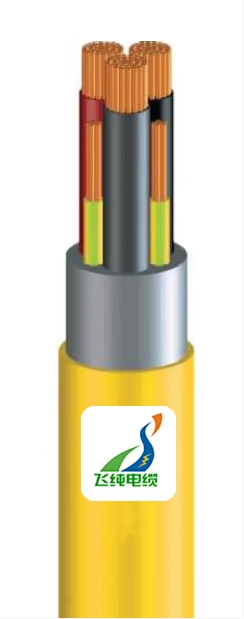
POLYFLEX MINE is a 0.6/1 kV heavy-duty polyurethane mining trailing cable engineered by Anhui Feichun Special Cable Co., Ltd. that achieves what no other mining cable in production today can match: a continuous operating temperature range spanning 150 degrees Celsius, from −60°C in the permanent darkness of an arctic winter to +90°C on the sun-baked surface of an equatorial open-cast mine. This is not a compromise specification achieved by derating at the extremes. Both the −60°C fixed-installation cold rating and the +90°C hot-environment rating are full continuous specifications, verified by independent testing, and backed by field operational data from the world's most demanding mining environments.

POLYFLEX MINE

POLYFLEX MINE is a 0.6/1 kV heavy-duty polyurethane mining trailing cable engineered by Anhui Feichun Special Cable Co., Ltd. that achieves what no other mining cable in production today can match: a continuous operating temperature range spanning 150 degrees Celsius, from −60°C in the permanent darkness of an arctic winter to +90°C on the sun-baked surface of an equatorial open-cast mine. This is not a compromise specification achieved by derating at the extremes. Both the −60°C fixed-installation cold rating and the +90°C hot-environment rating are full continuous specifications, verified by independent testing, and backed by field operational data from the world’s most demanding mining environments.
Geographic & Operational Context: Chuquicamata (Codelco) is transitioning from the world's largest open-pit copper mine to underground block caving (autonomous underground mining system). Depths: 700–1,500 meters below surface (Phase 1), expanding to 2,500+ meters (long-term). El Teniente (Codelco) is already operating at extreme depths: primary block caving at 2,000–2,500 m elevation below surface. Both mines employ: (1) Block caving gravity feed (fragmented ore flows down to cave level), (2) Mobile equipment (diesel-electric LHDs—Load-Haul-Dump vehicles, 30–50 ton capacity), (3) Fixed hoisting infrastructure (vertical shafts, incline decline haulage), (4) Extensive underground electrical distribution: 11 kV primary feeders, 6.6 kV secondaries, 3.3 kV distribution to mobile substations. 楚基卡马塔(国铜矿公司Codelco)正在从全球最大露天铜矿向地下自然崩落法(自主地下采矿系统)转型。深度:地表以下700-1,500米(第1阶段),长期扩展至2,500+米。El Teniente(Codelco)已在极端深度运营:地表下2,000-2,500m主自然崩落区。两座矿山采用:(1)重力进给式自然崩落(碎矿由高处流下至崩落区)、(2)移动设备(柴油-电动LHD-装-运-卸车、30-50吨容量)、(3)固定提升基础设施(竖井、倾斜下降运输)、(4)广泛的地下电气配电:11 kV一级馈电、6.6 kV二级、3.3 kV配电至移动变电站。 Type 2S Selection Rationale: Underground fixed-installation feeders (in contrast to dragline/shovel trailing cables) experience: (1) Rock fall hazard (loose fragments falling from roof, occasional collapses), (2) Equipment impact (LHD vehicles occasionally strike cable trays during positioning), (3) Long service life (5–10+ years without planned removal), (4) Static or semi-static routing (no continuous reel cycling). Type 2S SWA (Steel Wire Armoured) is optimal because: (1) Mechanical armour (galvanized steel wire spiral) provides exceptional impact protection, (2) Symmetrical earth architecture supports high-impedance grounded distribution systems, (3) Heavy construction (11 ton/km total weight) means higher copper content → lower resistance → reduced voltage drop over long feeder runs.

AS/NZS 1972 Type 2S 11kV 3x185mm² SWA Armoured Feeder Cable for Chile Underground Copper Mines

Geographic & Operational Context: Chuquicamata (Codelco) is transitioning from the world’s largest open-pit copper mine to underground block caving (autonomous underground mining system). Depths: 700–1,500 meters below surface (Phase 1), expanding to 2,500+ meters (long-term). El Teniente (Codelco) is already operating at extreme depths: primary block caving at 2,000–2,500 m elevation below surface. Both mines employ: (1) Block caving gravity feed (fragmented ore flows down to cave level), (2) Mobile equipment (diesel-electric LHDs—Load-Haul-Dump vehicles, 30–50 ton capacity), (3) Fixed hoisting infrastructure (vertical shafts, incline decline haulage), (4) Extensive underground electrical distribution: 11 kV primary feeders, 6.6 kV secondaries, 3.3 kV distribution to mobile substations. 楚基卡马塔(国铜矿公司Codelco)正在从全球最大露天铜矿向地下自然崩落法(自主地下采矿系统)转型。深度:地表以下700-1,500米(第1阶段),长期扩展至2,500+米。El Teniente(Codelco)已在极端深度运营:地表下2,000-2,500m主自然崩落区。两座矿山采用:(1)重力进给式自然崩落(碎矿由高处流下至崩落区)、(2)移动设备(柴油-电动LHD-装-运-卸车、30-50吨容量)、(3)固定提升基础设施(竖井、倾斜下降运输)、(4)广泛的地下电气配电:11 kV一级馈电、6.6 kV二级、3.3 kV配电至移动变电站。 Type 2S Selection Rationale: Underground fixed-installation feeders (in contrast to dragline/shovel trailing cables) experience: (1) Rock fall hazard (loose fragments falling from roof, occasional collapses), (2) Equipment impact (LHD vehicles occasionally strike cable trays during positioning), (3) Long service life (5–10+ years without planned removal), (4) Static or semi-static routing (no continuous reel cycling). Type 2S SWA (Steel Wire Armoured) is optimal because: (1) Mechanical armour (galvanized steel wire spiral) provides exceptional impact protection, (2) Symmetrical earth architecture supports high-impedance grounded distribution systems, (3) Heavy construction (11 ton/km total weight) means higher copper content → lower resistance → reduced voltage drop over long feeder runs.
To understand why extruded bedding is not merely a preference but an absolute requirement for flameproof (Ex d) cable systems, you must first grasp a counterintuitive physical reality: in an explosive atmosphere, a cable's internal structure is as critical to safety as its external armor. The voids, gaps, and air spaces that exist naturally between conductors during manufacturing are not benign features—they are potential pathways for flame propagation and explosive gas migration that can transform a localized fault into a catastrophic detonation. 要理解为什么挤包垫层不仅仅是一个偏好,而是防爆(Ex d)电缆系统的绝对要求,您必须首先掌握一个违反直觉的物理现实:在爆炸性气体环境中,电缆的内部结构与其外部铠装对安全的重要性一样关键。制造过程中自然存在于导体之间的间隙、缝隙和空气空间不是良性的特征——它们是火焰蔓延和爆炸性气体迁移的潜在通道,可能将局部故障转变为灾难性爆炸。 Picture an underground coal mine where methane-air mixture hovers at a concentration just below the Lower Explosive Limit (LEL) in certain drifts. The mine is equipped with continuous monitoring and ventilation to prevent accumulation, but a temporary variance in airflow creates a transient hazardous zone. Simultaneously, an electrical fault occurs inside a cable—perhaps insulation breakdown or a conductor-to-armor short circuit. The fault generates an arc and localized heat inside the cable, potentially igniting the explosive atmosphere within the machine it powers. The question is not whether the hazardous atmosphere will contact the arc; the question is how quickly it will propagate and whether it can escape confinement to detonate larger volumes of gas elsewhere in the mine.

Flameproof (Ex d) Systems: Why AS/NZS 1972 Type 3S Requires Extruded Bedding for Hazardous Glands

To understand why extruded bedding is not merely a preference but an absolute requirement for flameproof (Ex d) cable systems, you must first grasp a counterintuitive physical reality: in an explosive atmosphere, a cable’s internal structure is as critical to safety as its external armor. The voids, gaps, and air spaces that exist naturally between conductors during manufacturing are not benign features—they are potential pathways for flame propagation and explosive gas migration that can transform a localized fault into a catastrophic detonation. 要理解为什么挤包垫层不仅仅是一个偏好,而是防爆(Ex d)电缆系统的绝对要求,您必须首先掌握一个违反直觉的物理现实:在爆炸性气体环境中,电缆的内部结构与其外部铠装对安全的重要性一样关键。制造过程中自然存在于导体之间的间隙、缝隙和空气空间不是良性的特征——它们是火焰蔓延和爆炸性气体迁移的潜在通道,可能将局部故障转变为灾难性爆炸。 Picture an underground coal mine where methane-air mixture hovers at a concentration just below the Lower Explosive Limit (LEL) in certain drifts. The mine is equipped with continuous monitoring and ventilation to prevent accumulation, but a temporary variance in airflow creates a transient hazardous zone. Simultaneously, an electrical fault occurs inside a cable—perhaps insulation breakdown or a conductor-to-armor short circuit. The fault generates an arc and localized heat inside the cable, potentially igniting the explosive atmosphere within the machine it powers. The question is not whether the hazardous atmosphere will contact the arc; the question is how quickly it will propagate and whether it can escape confinement to detonate larger volumes of gas elsewhere in the mine.
Standards Clarification: AS/NZS 1972 defines Type 9 explicitly as a gas non-transmission cable, specifically engineered for flameproof (Ex d) electrical equipment enclosures. Type 9 cables are typically small-diameter, multi-core control or monitoring cables (0.5 mm², 1.5 mm², etc.)—never large power conductors like 3×95 mm². 标准澄清:AS/NZS 1972明确定义Type 9为防气体传输电缆,特别是为了防爆(Ex d)电气设备外壳而设计。Type 9电缆通常是小径、多芯的控制或监测电缆(0.5 mm²、1.5 mm²等)——绝对不是大功率导体如3×95 mm²。 Why the Confusion? The numbering system in AS/NZS 1972 progresses from Type 1 (fixed installation) through Type 8 (vertical shaft DWA cables). Type 9's designation comes last but reflects a specialized application (flameproof enclosures) rather than advancement in power capacity. Engineers sometimes assume higher type numbers equal higher voltage/current capacity—this assumption is incorrect for Type 9.

Tensile Load Limits: Calculating Maximum Suspension Depth for AS/NZS 1972 Mining Cables

Standards Clarification: AS/NZS 1972 defines Type 9 explicitly as a gas non-transmission cable, specifically engineered for flameproof (Ex d) electrical equipment enclosures. Type 9 cables are typically small-diameter, multi-core control or monitoring cables (0.5 mm², 1.5 mm², etc.)—never large power conductors like 3×95 mm². 标准澄清:AS/NZS 1972明确定义Type 9为防气体传输电缆,特别是为了防爆(Ex d)电气设备外壳而设计。Type 9电缆通常是小径、多芯的控制或监测电缆(0.5 mm²、1.5 mm²等)——绝对不是大功率导体如3×95 mm²。 Why the Confusion? The numbering system in AS/NZS 1972 progresses from Type 1 (fixed installation) through Type 8 (vertical shaft DWA cables). Type 9’s designation comes last but reflects a specialized application (flameproof enclosures) rather than advancement in power capacity. Engineers sometimes assume higher type numbers equal higher voltage/current capacity—this assumption is incorrect for Type 9.Standards Clarification: AS/NZS 1972 defines Type 9 explicitly as a gas non-transmission cable, specifically engineered for flameproof (Ex d) electrical equipment enclosures. Type 9 cables are typically small-diameter, multi-core control or monitoring cables (0.5 mm², 1.5 mm², etc.)—never large power conductors like 3×95 mm². 标准澄清:AS/NZS 1972明确定义Type 9为防气体传输电缆,特别是为了防爆(Ex d)电气设备外壳而设计。Type 9电缆通常是小径、多芯的控制或监测电缆(0.5 mm²、1.5 mm²等)——绝对不是大功率导体如3×95 mm²。 Why the Confusion? The numbering system in AS/NZS 1972 progresses from Type 1 (fixed installation) through Type 8 (vertical shaft DWA cables). Type 9’s designation comes last but reflects a specialized application (flameproof enclosures) rather than advancement in power capacity. Engineers sometimes assume higher type numbers equal higher voltage/current capacity—this assumption is incorrect for Type 9.
A pilot core is a small-diameter, individually insulated conductor that runs the full length of a Type 3S mining cable alongside the power conductors and earth cores. Its purpose is to carry a low-voltage supervisory signal from the substation to the remote equipment and back, allowing a monitoring relay at the substation to continuously verify that the cable's earth return path (the path through which fault currents flow to ground) remains intact and unbroken. In a Type 3S 6.6kV 3x150mm² cable, the pilot core is typically 10–25 mm² in cross-sectional area (much smaller than the 150 mm² power conductors), has its own color-coded insulation to distinguish it from the two earth cores, and is the critical difference that transforms a cable from simple power delivery (Type 2S) into a safety-monitored system (Type 3S). For equipment like continuous miners, pump stations, or large longwall systems that operate far from direct visual supervision, the pilot core provides the electrical equivalent of a "safety tether"—if that tether breaks, the system knows immediately and can shut down before a dangerous fault condition develops.

Earth Fault Monitoring: Identifying Pilot Cores in Type 3S 6.6kV 3x150mm² Feeder Cables

AS/NZS 1972, AS/NZS 1972 Type 3S, Type 3S cable, Type 3S 6.6kV, 6.6kV mining cable, earth fault monitoring mining, earth continuity monitoring, pilot core identification, 3x150mm2 mining cable, 150mm2 6.6kV cable, AS/NZS 2081, AS/NZS mining standards, underground coal mine cable, SWA mining cable, individual screen cable, XLPE insulated mining cable, medium voltage mining cable, mine power feeder, electrical safety mining, earth return path, interstitial pilot core, 300 MCM mining cable, AWG equivalent mining cable, cable outer diameter, mining cable copper weight, 6.6kV ampacity, cable selection mining, mine substation feeder, electrical engineering mining, Prysmian mining cable, Olex Type 3S, earth fault relay, mining cable specifications, semi-fixed mining cable, flame retardant PVC sheath, heavy duty mine cable, AS/NZS 1972 vs Type 2S, cable cross section 150mm2, pilot circuit monitoring, high voltage cable splicing, mining cable termination, earth core sizing, short circuit rating mining, mining infrastructure electrical, AS/NZS 3008 ampacity, underground equipment power supply, machine cable underground, mining cable technical data, fault protection mining, pilot wire relay
For a Type 3S 11kV feeder cable with 82–88 mm outer diameter (typically a 3x95mm² to 3x240mm² conductor), the appropriate Ex d cable gland must be sized to accommodate the cable's full outer diameter while maintaining the flange-threaded sealing design required by ATEX EN 60079-1 for Zone 1 explosive atmospheres. A typical selection for a 3x95mm² Type 3S cable would be an M100 or M105 flange-threaded gland rated for ATEX II 2G Ex d IIB T4, with a compressive sealing ring (typically 2 mm thick polyurethane or equivalent elastomer) that creates a pressure-tight barrier against explosive gas ingress, and a separate earthing screw or braided conductor that bonds the cable's steel wire armor directly to the enclosure's earth continuity. This is not simply a matter of finding any cable gland that fits the cable diameter—it is a critical safety component that must be certified, specified, and installed with precision.

Ex d Gland Matching: Terminating Type 3S 11kV SWA Armor in Hazardous Zone 1

For a Type 3S 11kV feeder cable with 82–88 mm outer diameter (typically a 3x95mm² to 3x240mm² conductor), the appropriate Ex d cable gland must be sized to accommodate the cable’s full outer diameter while maintaining the flange-threaded sealing design required by ATEX EN 60079-1 for Zone 1 explosive atmospheres. A typical selection for a 3x95mm² Type 3S cable would be an M100 or M105 flange-threaded gland rated for ATEX II 2G Ex d IIB T4, with a compressive sealing ring (typically 2 mm thick polyurethane or equivalent elastomer) that creates a pressure-tight barrier against explosive gas ingress, and a separate earthing screw or braided conductor that bonds the cable’s steel wire armor directly to the enclosure’s earth continuity. This is not simply a matter of finding any cable gland that fits the cable diameter—it is a critical safety component that must be certified, specified, and installed with precision.
The Type 2S 11kV 3x95mm² cable has a base ampacity of 285 amperes when installed in free air at 40°C ambient temperature. However, in a typical underground mine substation where three or more feeder cables are installed side-by-side on a cable ladder, the practical usable current is reduced to approximately 228 amperes through application of temperature and grouping derating factors. This 228 A figure is the number that should govern your design calculations and equipment sizing for the substation feeder. Type 2S 11kV 3x95mm² 电缆在 40°C 环境温度的自由空气中安装时,其基础载流量为 285 安培。但在地下矿山变电站中,三根或更多馈电电缆并排安装在电缆桥架上的典型情况下,通过应用温度和编组降额系数,实际可用电流减少至约 228 安培。这个 228 A 的数字应该管理您的设计计算和变电站馈电的设备选型。

Ampacity Derating: Sizing Type 2S 11kV 3x95mm² for Underground Mine Substations (Ambient 40°C)

The Type 2S 11kV 3x95mm² cable has a base ampacity of 285 amperes when installed in free air at 40°C ambient temperature. However, in a typical underground mine substation where three or more feeder cables are installed side-by-side on a cable ladder, the practical usable current is reduced to approximately 228 amperes through application of temperature and grouping derating factors. This 228 A figure is the number that should govern your design calculations and equipment sizing for the substation feeder. Type 2S 11kV 3x95mm² 电缆在 40°C 环境温度的自由空气中安装时,其基础载流量为 285 安培。但在地下矿山变电站中,三根或更多馈电电缆并排安装在电缆桥架上的典型情况下,通过应用温度和编组降额系数,实际可用电流减少至约 228 安培。这个 228 A 的数字应该管理您的设计计算和变电站馈电的设备选型。
The nominal weight of a Type 3S 3.3kV 3x240mm² steel wire armoured cable is approximately 13,200 to 13,800 kilograms per kilometer (kg/km), or roughly 13.2 to 13.8 kilograms per linear meter. For practical planning purposes, engineers working with Feichun's Type 3S 3x240mm² product should design logistics and installation equipment assuming 13.5 kg/m as the midpoint value. This is not a lightweight cable—a single 1,000-meter feeder run will weigh 13,500 kilograms (13.5 tonnes), demanding heavy-duty mechanical handling equipment and careful transport planning from the moment the cable leaves the manufacturing facility. Type 3S 3.3kV 3x240mm² 钢丝铠装电缆的标称重量约为 13,200 至 13,800 千克/公里 (kg/km),或粗略计算每线性米约 13.2 至 13.8 公斤。 为了实际规划目的,与 Feichun 的 Type 3S 3x240mm² 产品合作的工程师应该以 13.5 kg/m 作为中点值来设计物流和安装设备。这不是一根轻型电缆——单个 1,000 米的馈电敷设将重达 13,500 公斤(13.5 吨),从电缆离开制造厂的那一刻起就需要重型机械处理设备和仔细的运输规划。

Weight & Logistics: Calculating kg/km for Heavy-Duty Type 3S 3.3kV 3x240mm² Steel Wire Armoured Cables

The nominal weight of a Type 3S 3.3kV 3x240mm² steel wire armoured cable is approximately 13,200 to 13,800 kilograms per kilometer (kg/km), or roughly 13.2 to 13.8 kilograms per linear meter. For practical planning purposes, engineers working with Feichun’s Type 3S 3x240mm² product should design logistics and installation equipment assuming 13.5 kg/m as the midpoint value. This is not a lightweight cable—a single 1,000-meter feeder run will weigh 13,500 kilograms (13.5 tonnes), demanding heavy-duty mechanical handling equipment and careful transport planning from the moment the cable leaves the manufacturing facility. Type 3S 3.3kV 3x240mm² 钢丝铠装电缆的标称重量约为 13,200 至 13,800 千克/公里 (kg/km),或粗略计算每线性米约 13.2 至 13.8 公斤。 为了实际规划目的,与 Feichun 的 Type 3S 3x240mm² 产品合作的工程师应该以 13.5 kg/m 作为中点值来设计物流和安装设备。这不是一根轻型电缆——单个 1,000 米的馈电敷设将重达 13,500 公斤(13.5 吨),从电缆离开制造厂的那一刻起就需要重型机械处理设备和仔细的运输规划。
The nominal outer diameter (OD) of an AS/NZS 1972 Type 2S 11kV 3x185mm² feeder cable is 76.0 to 80.0 millimeters (3.0 to 3.15 inches). The typical design center for Feichun's Type 2S 3x185mm² product is approximately 78.6 mm. This measurement is taken across the outermost surface of the flame-retardant PVC sheath, which forms the final protective layer after the galvanized steel wire armour (SWA) and inner insulation geometry. 澳标 AS/NZS 1972 Type 2S 11kV 3x185mm² 馈电电缆的标称外径为 76.0 至 80.0 毫米(3.0 至 3.15 英寸)。 Feichun Type 2S 3x185mm² 产品的典型设计中心约为 78.6 mm。该测量是在钢丝铠装 (SWA) 和内层绝缘几何结构之后,在阻燃 PVC 外护套的最外表面进行的。 This 76–80 mm range is not arbitrary—it represents the accumulated thicknesses of multiple cable components layered concentrically around the three power conductors. To understand where this dimension comes from, an electrical engineer planning a mine installation must understand the contribution of each layer.

Outer Diameter Specs: What is the Nominal OD for AS/NZS 1972 Type 2S 11kV 3x185mm² Feeder Cable?

The nominal outer diameter (OD) of an AS/NZS 1972 Type 2S 11kV 3x185mm² feeder cable is 76.0 to 80.0 millimeters (3.0 to 3.15 inches). The typical design center for Feichun’s Type 2S 3x185mm² product is approximately 78.6 mm. This measurement is taken across the outermost surface of the flame-retardant PVC sheath, which forms the final protective layer after the galvanized steel wire armour (SWA) and inner insulation geometry. 澳标 AS/NZS 1972 Type 2S 11kV 3x185mm² 馈电电缆的标称外径为 76.0 至 80.0 毫米(3.0 至 3.15 英寸)。 Feichun Type 2S 3x185mm² 产品的典型设计中心约为 78.6 mm。该测量是在钢丝铠装 (SWA) 和内层绝缘几何结构之后,在阻燃 PVC 外护套的最外表面进行的。 This 76–80 mm range is not arbitrary—it represents the accumulated thicknesses of multiple cable components layered concentrically around the three power conductors. To understand where this dimension comes from, an electrical engineer planning a mine installation must understand the contribution of each layer.
The Single Most Important Cable Design Decision in Underground Coal Mining: Whether the cable employs collective screening (Type 2) or individual phase screening (Type 2S). This single engineering choice directly determines whether a mechanical cable failure will result in a phase-to-earth fault (detected and stopped in milliseconds) or a phase-to-phase fault with thousands of amperes of arc current (igniting methane explosions).

Type 2 vs Type 2S: Why the “S” (Individual Screen) is Mandatory for 11kV Underground Coal Mines

The Single Most Important Cable Design Decision in Underground Coal Mining: Whether the cable employs collective screening (Type 2) or individual phase screening (Type 2S). This single engineering choice directly determines whether a mechanical cable failure will result in a phase-to-earth fault (detected and stopped in milliseconds) or a phase-to-phase fault with thousands of amperes of arc current (igniting methane explosions).
The selection of appropriate submersible pump cables for acidic mine water dewatering applications represents a critical engineering decision that directly impacts operational safety, equipment longevity, and maintenance costs. While Type 441 cables may appear suitable for general submersible pump applications, the harsh chemical environment of acidic mine water typically necessitates the use of specialized EPR (Ethylene Propylene Rubber) or CSP (Chlorosulfonated Polyethylene) insulated cables specifically engineered for corrosive conditions. 为酸性矿井水脱水应用选择合适的潜水泵电缆是一项关键的工程决策,直接影响运行安全、设备寿命和维护成本。虽然441型电缆可能适用于一般潜水泵应用,但酸性矿井水的恶劣化学环境通常需要使用专门设计用于腐蚀性条件的EPR(乙丙橡胶)或CSP(氯磺化聚乙烯)绝缘电缆。

TUNNELFLEX-R-PUR HF with Antitwisting Protection 1 KV

TUNNELFLEX-R-PUR HF represents a specialized category of halogen-free, flame-retardant flexible power cables engineered specifically for the demanding requirements of underground mining and tunneling operations. This cable combines advanced polyurethane (PUR) sheathing technology with integrated antitwisting protection to deliver exceptional mechanical durability, environmental resistance, and most importantly, enhanced safety through its halogen-free construction that significantly reduces toxic gas emissions during fire incidents. TUNNELFLEX-R-PUR HF电缆是专为地下采矿和隧道作业的苛刻要求而设计的无卤阻燃柔性电力电缆。该电缆结合了先进的聚氨酯护套技术和集成的防扭转保护,提供卓越的机械耐久性、环境抵抗力,以及通过无卤结构在火灾事故中显著减少有毒气体排放的增强安全性。
When international cable manufacturers consider entering the Colombian market, particularly for mining applications, they encounter a comprehensive regulatory framework that may initially seem complex but serves a vital purpose. The Reglamento Técnico de Instalaciones Eléctricas, universally known by its Spanish acronym RETIE, represents Colombia's mandatory technical regulation governing all electrical installations and products. 当国际电缆制造商考虑进入哥伦比亚市场时,特别是针对矿业应用,他们会遇到一个全面的监管框架 Understanding RETIE is not merely a bureaucratic exercise but rather the foundation for successfully participating in one of South America's most dynamic electrical markets.

TROMMELFLEX-M-PUR D2X11Y I 1 KV

TROMMELFLEX-M-PUR represents a specialized class of flexible low voltage reeling cables engineered specifically for underground mining and tunnelling operations. This cable features optimized dimensions and incorporates a flame retardant, halogen-free polyurethane outer sheath, making it particularly suitable for demanding industrial environments where both mechanical durability and safety are paramount. The cable’s design addresses the unique challenges encountered in mining applications, where equipment must withstand frequent dynamic loads, abrasive conditions, and the rigorous demands of continuous reeling operations on drilling machines, scoops, and load-haul-dump vehicles. 卷筒柔性电缆专为地下采矿和隧道设备设计,具有优化的尺寸和阻燃无卤聚氨酯外护套。该电缆适用于钻机、铲运机和装载设备的频繁动态负载和卷筒操作。
(N)TSCGEWÖU 3x185+3x35/3 medium voltage flexible mining cable typically weighs between 8,500 and 10,200 kilograms per kilometer, depending on the specific construction variant, insulation thickness, sheathing materials, and whether additional features such as anti-torsion braiding or fiber optic cores are incorporated. This weight range represents the complete cable assembly including all conductors, insulation layers, screening, inner and outer sheaths, and structural elements required for demanding mining and industrial applications. (N)TSCGEWÖU 3x185+3x35/3中压柔性采矿电缆的重量通常在每公里8,500至10,200千克之间,具体取决于特定的结构变型、绝缘厚度、护套材料,以及是否包含防扭转编织或光纤芯等附加功能。

Weight Calculator: What is the Approximate Weight per Meter (kg/km) of (N)TSCGEWÖU 3×185+3×35/3?

(N)TSCGEWÖU 3×185+3×35/3 medium voltage flexible mining cable typically weighs between 8,500 and 10,200 kilograms per kilometer, depending on the specific construction variant, insulation thickness, sheathing materials, and whether additional features such as anti-torsion braiding or fiber optic cores are incorporated. This weight range represents the complete cable assembly including all conductors, insulation layers, screening, inner and outer sheaths, and structural elements required for demanding mining and industrial applications. (N)TSCGEWÖU 3×185+3×35/3中压柔性采矿电缆的重量通常在每公里8,500至10,200千克之间,具体取决于特定的结构变型、绝缘厚度、护套材料,以及是否包含防扭转编织或光纤芯等附加功能。
FG7ORPu-TUNNELFLEX is a specialized 0.6/1kV flexible power cable engineered specifically for mining and tunneling applications. This cable provides reliable power supply to mobile equipment operating in harsh underground environments where there is a high risk of mechanical damage. The TUNNELFLEX cable is suitable for applications where it is deflected in one plane only, with a maximum operating speed of 60 m/min.

What is FG7ORPu-TUNNELFLEX 0.6/1kV Cable?

FG7ORPu-TUNNELFLEX is a specialized 0.6/1kV flexible power cable engineered specifically for mining and tunneling applications. This cable provides reliable power supply to mobile equipment operating in harsh underground environments where there is a high risk of mechanical damage. The TUNNELFLEX cable is suitable for applications where it is deflected in one plane only, with a maximum operating speed of 60 m/min.
Polish Mining Cable

What is YHKGXSekyn, YHKGXSekFtZnyn, YHKGXSekFtyn, YHKGXSekFitlyn, YHKGXSekFoyn, and YHKGXSekFpyn Polish Mining Cable ?

Polish Mining Cable Code Designation System represents a comprehensive nomenclature standard used extensively throughout European mining operations, particularly in Poland’s extensive coal, copper, and mineral extraction industries. This systematic coding methodology enables engineers and procurement specialists to precisely specify cable configurations through alphanumeric designations that encode critical construction parameters, material specifications, and performance characteristics.