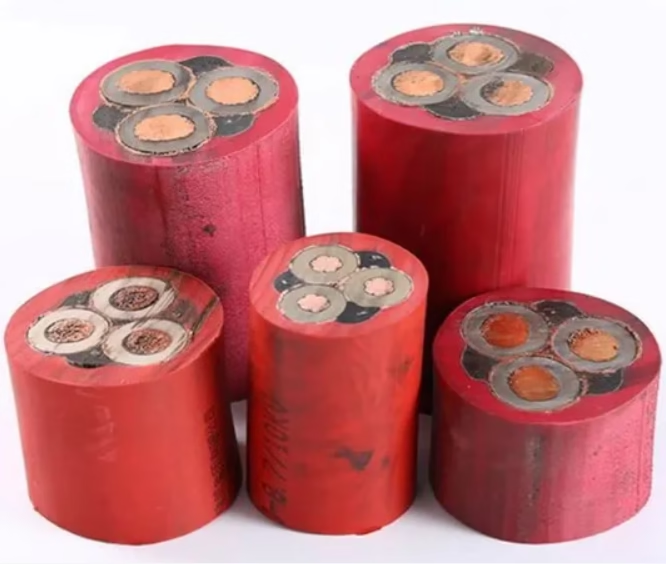
tropical cable

Extended technical guide for harbour electrical engineers, crane OEMs, and terminal procurement teams comparing polychloroprene-based reeling cable platforms for tropical marine service. Covers: the (N)SHTOEU-J designation decoded element-by-element; the (RTS) torsion-stabilised architecture and its polyester-braid hygroscopic vulnerability; standard 5GM3/5GM5 polychloroprene compound limitations versus FC-CSR™ enhanced chemistry in synergistic UV–ozone–salt-fog attack; multi-layer drum winding mechanics and inter-layer compression stress; earth conductor (J) corrosion vulnerability at termination interfaces; Class 5 vs. Class 6 conductor stranding for high-cycle reeling fatigue; standard tin vs. FC-TCB™ intermetallic coating at slip-ring contacts; ISO 9227 and IEC 60068-2-52 comparative salt-fog testing; and practical specification, procurement, and 25-year lifetime cost analysis for port operators selecting between standard-grade and marine-enhanced polychloroprene reeling cable platforms.

FC-HFX-REEL™ Ultra-High-Flex Anti-Salt-Fog Motorised Reeling Cable vs. RHEYCORD®(RTS) (N)SHTOEU-J: Standard Polychloroprene Compound Limitations in Tropical C5-M Service, (RTS) Torsion-Stabilised Architecture Deconstruction, Multi-Layer Drum Winding Stress Analysis, Earth-Conductor (J) Engineering, Slip-Ring Corrosion Science, and Comprehensive Field Performance Comparison from Asia-Pacific Port Drum-Reeling Operations

Extended technical guide for harbour electrical engineers, crane OEMs, and terminal procurement teams comparing polychloroprene-based reeling cable platforms for tropical marine service. Covers: the (N)SHTOEU-J designation decoded element-by-element; the (RTS) torsion-stabilised architecture and its polyester-braid hygroscopic vulnerability; standard 5GM3/5GM5 polychloroprene compound limitations versus FC-CSR™ enhanced chemistry in synergistic UV–ozone–salt-fog attack; multi-layer drum winding mechanics and inter-layer compression stress; earth conductor (J) corrosion vulnerability at termination interfaces; Class 5 vs. Class 6 conductor stranding for high-cycle reeling fatigue; standard tin vs. FC-TCB™ intermetallic coating at slip-ring contacts; ISO 9227 and IEC 60068-2-52 comparative salt-fog testing; and practical specification, procurement, and 25-year lifetime cost analysis for port operators selecting between standard-grade and marine-enhanced polychloroprene reeling cable platforms.
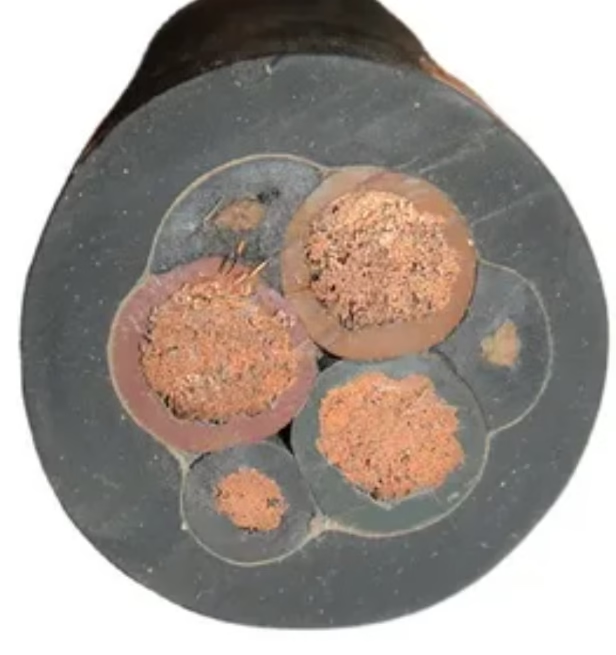
Extended technical guide for mining engineers, port equipment designers, electrical system integrators, and heavy-equipment OEMs. Covers: the physics of mechanical fatigue in high-speed reeling systems; BUFLEX® SC conductor architecture (IEC 60228 Class 5 ultra-fine stranding, lay-angle optimisation for bending compliance); EPR insulation design with semi-conductive field-control layers for efficient 1.8–24 kV electric-field distribution; copper-braid electromagnetic shielding and its interaction with high-current conduction; signature red PUR jacket chemistry (abrasion resistance, tear strength, UV stability, oil resistance); mechanical performance specifications (minimum bend radius, tensile load capacity, cyclic-flexure endurance); thermal management in continuous high-current operation (current rating derating as function of ambient temperature and installation method); comparative analysis of single-core vs. multi-core approaches; environmental durability (arctic cold, tropical heat, mine dust, coastal salt-fog); and practical specification and procurement frameworks for mining and port operator deployment.

BUFLEX® SC Single-Core Medium-Voltage Ultra-Flexible Reeling Cable: Complete Engineering Analysis, Advanced Conductor Architecture, EPR Insulation with Electrostatic Field Control, PUR Jacket Superior Abrasion & Tear Resistance, Mechanical Fatigue Engineering, Extreme Environment Durability, and Comprehensive Comparative Evaluation Against Multi-Core Industrial Cable Alternatives for Mining and Heavy Port Equipment

Extended technical guide for mining engineers, port equipment designers, electrical system integrators, and heavy-equipment OEMs. Covers: the physics of mechanical fatigue in high-speed reeling systems; BUFLEX® SC conductor architecture (IEC 60228 Class 5 ultra-fine stranding, lay-angle optimisation for bending compliance); EPR insulation design with semi-conductive field-control layers for efficient 1.8–24 kV electric-field distribution; copper-braid electromagnetic shielding and its interaction with high-current conduction; signature red PUR jacket chemistry (abrasion resistance, tear strength, UV stability, oil resistance); mechanical performance specifications (minimum bend radius, tensile load capacity, cyclic-flexure endurance); thermal management in continuous high-current operation (current rating derating as function of ambient temperature and installation method); comparative analysis of single-core vs. multi-core approaches; environmental durability (arctic cold, tropical heat, mine dust, coastal salt-fog); and practical specification and procurement frameworks for mining and port operator deployment.
Extended technical guide for port equipment engineers, smart port systems designers, equipment OEMs, and port automation specialists. Covers: the business case for integrated monitoring in port operations (equipment failure cost, maintenance response time, safety compliance); BUFLEX® SEM architecture (multi-conductor design, impedance matching, shielding strategies); BUFLEX® SEM OFE optical fibre integration (single-mode vs. multi-mode fibre selection, bend-loss mitigation, termination reliability); real-time sensor data collection systems (SHM architecture, IoT platform integration, edge computing); predictive maintenance algorithms and ROI models; comparative cost analysis of integrated vs. separate-system approaches; Industrial 4.0 and IIoT platform integration; safety interlocks and remote control architectures; cold-temperature and tropical performance specifications; and practical deployment frameworks for retrofit and new-build port equipment.

BUFLEX® SEM & BUFLEX® SEM OFE Integrated Optical Fibre Power Cable: Complete Engineering Analysis, Real-Time Equipment Monitoring, Predictive Maintenance, Industrial 4.0 IoT Integration, Hybrid Power-Data-Fibre Architecture, Comprehensive Comparative Evaluation Against Separate Power & Fibre Systems, and Practical Deployment Framework for Smart Port Operations

Extended technical guide for port equipment engineers, smart port systems designers, equipment OEMs, and port automation specialists. Covers: the business case for integrated monitoring in port operations (equipment failure cost, maintenance response time, safety compliance); BUFLEX® SEM architecture (multi-conductor design, impedance matching, shielding strategies); BUFLEX® SEM OFE optical fibre integration (single-mode vs. multi-mode fibre selection, bend-loss mitigation, termination reliability); real-time sensor data collection systems (SHM architecture, IoT platform integration, edge computing); predictive maintenance algorithms and ROI models; comparative cost analysis of integrated vs. separate-system approaches; Industrial 4.0 and IIoT platform integration; safety interlocks and remote control architectures; cold-temperature and tropical performance specifications; and practical deployment frameworks for retrofit and new-build port equipment.
Кабели марки КОГРВЭШ предназначены для присоединения шахтного бурильного электроинструмента на номинальное переменное напряжение 660В частоты 50 Гц с изолированной нейтралью. Кабели могут эксплуатироваться в подземных помещениях и шахтах с повышенной влажностью воздуха, в которых возможно длительное наличие воды или частая конденсация влаги. Электропроводящие экраны по изоляции жил обеспечивают опережающее отключение системы электроснабжения при повреждении кабеля, предупреждая возможный взрыв метана в шахтах.

КОГРВЭШ & КОГРВЭШ-Т

КОГРВЭШ, КОГРВЭШ-Т, KOGRVESH, KOGRVESH-T, кабель КОГРВЭШ, кабель КОГРВЭШ-Т, шахтный буровой кабель, mining drill cable, drilling equipment cable, гибкий шахтный кабель КОГРВЭШ, экранированный буровой кабель, шахтный электроинструмент кабель, 矿用钻机电缆, 礦用鑽機電纜, КОГРВЭШ 3×1.5, КОГРВЭШ 3×2.5, КОГРВЭШ 3×4, КОГРВЭШ 3×6
Кабель силовой шахтный и экскаваторный необходим для подключения горнодобывающего оборудования, экскаваторов и другого землеройного оборудования, электроинструментов, а также для проведения горных взрывных работ. Шахтные кабели используют для всех типов шахт: угольные, соляные, сланцевые, а также подходят для открытых карьерных разработок. Кабели эксплуатируются на напряжении переменного тока 660, 1140, 6000 В.

What is Кабель для шахт?

КГЭШ, КГЭШ-1140, КГЭ, КГЭ-6, КГЭ-Т, КГЭ-ХЛ, КГЭ-ХЛ-6, КГЭС, КГЭТ, КГВШ, КГРШ, КШВГТ, ЭВБВ, ЭВБВ-6, ЭВТ-1140, ЭВТ-6000, кабель КГЭШ, кабель КГЭ, кабель ЭВБВ, шахтный кабель КГЭШ, экскаваторный кабель, mining cable KGESH, excavator cable KGE, KGESH cable, KGE cable, EVBV cable