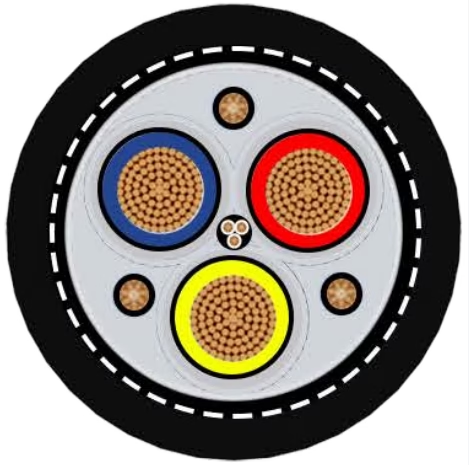
polychloroprene

Marine & Port Drag Cable — High-Flexibility Saltwater-Resistant System A comprehensive engineering dissection of heavy-duty marine drag cables for port equipment, container terminals, and offshore platforms — from conductor architecture and EPR insulation to steel wire armour (M2) design rationale, galvanic corrosion protection mechanisms, environmental compliance, and validated performance benchmarking against Nexans Eproneo Port and Prysmian marine systems.

O que é PROTOLON (M) R-(N)TSCGEWOEU Arctic -50C 6/10KV: Análise Técnica do Cabo de Média Tensão para Enrolamento Flexível até -50°C

O PROTOLON (M) R-(N)TSCGEWOEU Arctic -50C 6/10KV é um cabo flexível de média tensão para enrolamento, desenvolvido para grandes máquinas móveis de manuseio de material em minas a céu aberto, como escavadeiras elétricas, dumpers e britadores móveis. Sua característica decisiva é a capacidade de operar de forma totalmente flexível até -50°C, mantendo a arquitetura de cabo de carretel para altas solicitações mecânicas: condutores de cobre classe FS, sistema isolante EPR PROTOLON, camadas semicondutoras, condutor de proteção dividido em três interstícios, reforço de poliéster e capa externa PCP resistente a abrasão, óleo, ozônio, radiação UV e água do mar.
C PUR Design Integration: FLEXIFESTOON PUR characteristics (inherited): Outer sheath: PUR (polyurethane, compact) Insulation: Special TPE (superior elongation) Central unit: Textile (mechanical support) Weight: 25–30% lighter than standard rubber Diameter: 15–20% smaller than rubber equivalent Cost: +15–25% premium over rubber Service life: 10–15 years (extended) Screened design addition (new): Screen: Tinned copper braid (EMC shielding) Coverage: 80–90% (good EMC performance) Diameter impact: +2–3 mm (screen adds ~3 mm to diameter) Weight impact: +500 kg/km (braid + outer sheath) Cost: Additional +10–15% for screen layer Combined C PUR result: vs. Unscreened PUR (FLEXIFESTOON PUR): FLEXIFESTOON PUR: Minimal diameter/weight, no EMC C PUR: Slightly larger (screen added), excellent EMC Choice: PUR for maximum compactness (non-EMI environments) C PUR for VFD motors, confined spaces with EMC requirements vs. Standard rubber screened (GRDGCGÖU-J): GRDGCGÖU-J: Standard diameter, heavy, rubber durability C PUR: Compact diameter, lightweight, superior oil/chemical resistance Choice: GRDGCGÖU-J for simple temporary festoon C PUR for permanent industrial machine tool installation Nomenclature: FLEXIFESTOON® = Product family (flexible cable) C = Screen (copper braid, "C" from German "Schirm") PUR = Material (polyurethane jacket) Result: "FLEXIFESTOON C PUR" = Screened compact polyurethane cable

O que é PROTOLON (M) R-(N)TSCGEWOEU LWL 6/10KV: Análise Técnica do Cabo de Média Tensão para Enrolamento com Fibra Óptica Integrada

O PROTOLON (M) R-(N)TSCGEWOEU LWL 6/10KV é um cabo flexível de média tensão para enrolamento, projetado para grandes máquinas móveis de manuseio de material, como escavadeiras elétricas, dumpers, britadores móveis, equipamentos de mineração a céu aberto, empilhadeiras e recuperadoras de minério, shiploaders, descarregadores de navios e sistemas de pátio de granéis. Sua particularidade está em combinar, dentro de uma única seção transversal, alimentação elétrica de 6/10 kV, condutores de proteção divididos, blindagem semicondutora, isolação EPR, reforço mecânico por trança de poliéster, capa externa PCP resistente à abrasão e um elemento óptico LWL para comunicação imune a interferência eletromagnética.
FLEXIFESTOON® NE-FLAT (NGFLGÖU): Advanced High-Flexibility Anti-Salt Fog Port Cable for Maritime Cargo Handling and Marine Automation Systems Feichun's revolutionary FLEXIFESTOON® NE-FLAT NGFLGÖU flat cable combines extreme high-flexibility architecture with marine-grade anti-salt fog protection, engineered specifically for port automation infrastructure, cargo-handling festoon systems, and maritime equipment control requiring superior corrosion resistance and mechanical reliability through thousands of bending cycles in aggressive saltwater environments.

PANZERFLAT-ELX 3,6/6–12/20 kV — плоский H.V. reeling cable с оптическими волокнами или без них

PANZERFLAT-ELX — это плоский гибкий средневольтный H.V. reeling cable для cable reel systems и festoon systems, предназначенный для подключения подвижных частей machine tools и material handling equipment. Кабель может выполняться с интегрированными optical fibres или без них, объединяя силовую передачу и, при необходимости, data transmission в одной плоской динамической конструкции.
BASKET SPREADER 740 (YSLTOE) is engineered specifically for hoisting and control applications where mechanical flexibility and electrical reliability must coexist in marine environments. Unlike load-bearing structural cables (which prioritize tensile strength), control cables emphasize: Conductor flexibility – Repeated bending over pulleys without mechanical fatigue Insulation integrity – Voltage breakdown resistance under salt-fog corrosion Mechanical damping – Rope-like flexibility to drape naturally in spreader bar frames Environmental barrier – Outer sheath blocks salt, moisture, and UV penetration Core Design Elements: Component Material Specification Function Port Environment Benefit Conductor Flexible red copper Class 6 (IEC 60228) Carries 300/500V power; enables bending flexibility High purity copper resists galvanic corrosion Insulation PVC type YI2 (IEC 60811) Electrical isolation; voltage breakdown resistance (2 kV test) PVC with marine additives prevents salt-induced tracking Central Unit Aramide yarns (Kevlar™ equivalent) Mechanical load-bearing backup; structural integrity Aramide resists moisture & salt; absorbs vibration stress Outer Sheath PUR type 11YM1 (DIN 73377) Environmental barrier; UV/ozone/moisture protection Superior salt-fog resistance; 20+ year marine lifespan

PANZERFLEX-ELX + OF 3,6/6–12/20 kV — средневольтный H.V. reeling cable с интегрированными оптическими волокнами

PANZERFLEX-ELX + OF — это гибкий средневольтный комбинированный кабель для кабельных барабанов и festoon-систем, объединяющий силовую передачу и оптическую передачу данных в одной динамической конструкции. Кабель предназначен для movable parts of machine tools и material handling equipment, включая stacker/reclaimer, ship-to-shore crane, container crane и excavators. Он рассчитан на cable reel systems с высокими и экстремальными механическими нагрузками, частыми изгибами, торсионной работой, быстрым движением и сильным ускорением.
UNE 22511, published and maintained by AENOR (Asociación Española de Normalización y Certificación), is the definitive Spanish standard for heavy-duty power cables connecting underground mobile mining equipment to fixed electrical distribution networks. Operating as a specialized overlay on IEC 60502-1, it extends that base standard's electrical requirements with stringent mechanical, safety, and flame-retardancy requirements specific to enclosed underground environments. Despite its Spanish origin, UNE 22511 enjoys adoption across the major Spanish-speaking mining economies: Chile, Peru, Colombia, Bolivia, and Mexico, where AENOR-certified cables are accepted by national mining safety regulators as the primary qualification pathway for underground mobile equipment power supply cables.

UNE 22511

UNE 22511, published and maintained by AENOR (Asociación Española de Normalización y Certificación), is the definitive Spanish standard for heavy-duty power cables connecting underground mobile mining equipment to fixed electrical distribution networks. Operating as a specialized overlay on IEC 60502-1, it extends that base standard’s electrical requirements with stringent mechanical, safety, and flame-retardancy requirements specific to enclosed underground environments. Despite its Spanish origin, UNE 22511 enjoys adoption across the major Spanish-speaking mining economies: Chile, Peru, Colombia, Bolivia, and Mexico, where AENOR-certified cables are accepted by national mining safety regulators as the primary qualification pathway for underground mobile equipment power supply cables.
UNE 22511 — formally titled "Cables flexibles para minería subterránea con tensiones de 1,8/3 kV con aislamiento de caucho, sin armadura" (Flexible cables for underground mining, 1.8/3 kV, rubber-insulated, unarmoured) — is the definitive Spanish standard for heavy-duty power cables connecting underground mobile mining equipment to fixed electrical distribution networks. Published and maintained by AENOR (Asociación Española de Normalización y Certificación), it operates as a specialized overlay on IEC 60502-1, extending that base standard's electrical requirements with the stringent mechanical, safety, and flame-retardancy requirements specific to enclosed underground environments. Despite its Spanish origin, UNE 22511 enjoys a geographic reach far exceeding Iberia. The standard has been adopted — formally or by reference — across the major Spanish-speaking mining economies: Chile, Peru, Colombia, Bolivia, and Mexico, where AENOR-certified cables are accepted by national mining safety regulators as the primary qualification pathway for underground mobile equipment power supply cables. In Chile alone, UNE 22511 cables are installed across dozens of operations including major copper and coal mines. The standard's engineering DNA can be described in a single imperative: extreme dynamic flexibility combined with superior resistance to combined torsional and bending fatigue. This is not merely a performance aspiration — it is a structural requirement that shapes every material choice and geometric decision in the cable's construction. The logic proceeds as follows: Underground mobile equipment (continuous miners, shearers, shuttle cars) moves continuously and repeatedly during operation, dragging its power cable behind it or winding and unwinding it from a cable reel. This motion imposes cyclic bending, axial tension, and torsional loads on the cable simultaneously — a multi-axis fatigue regime of a severity not encountered in any other industrial cable application. Standard fixed-installation cables, even those classified as "flexible," are not designed for this loading regime and will fail in fatigue within weeks to months when installed in drag duty. Therefore, every structural element of a UNE 22511 cable — conductor wire diameter, insulation compound, earth core geometry, armour exclusion, sheath specification — is selected to maximize multi-axis fatigue endurance, not any single performance parameter. ⛏ The Founding Engineering Principle UNE 22511 is an unarmoured drag cable standard. The deliberate absence of any metallic armour — which might superficially seem to reduce robustness — is in fact the defining engineering choice that makes the standard viable. Steel wire or tape armour in a continuously torsionally-loaded cable acts as a progressive-failure torsional spring: each twist cycle accumulates irreversible plastic strain in the armour wires, leading to wire fractures within 10,000–30,000 cycles. For a shuttle car cable experiencing 80,000+ torsional cycles per year, armour represents not additional protection but a built-in scheduled failure mechanism. The UNE 22511 design eliminates this failure mode at source.

UNE 22511 Mining Cable

UNE 22511 — formally titled “Cables flexibles para minería subterránea con tensiones de 1,8/3 kV con aislamiento de caucho, sin armadura” (Flexible cables for underground mining, 1.8/3 kV, rubber-insulated, unarmoured) — is the definitive Spanish standard for heavy-duty power cables connecting underground mobile mining equipment to fixed electrical distribution networks. Published and maintained by AENOR (Asociación Española de Normalización y Certificación), it operates as a specialized overlay on IEC 60502-1, extending that base standard’s electrical requirements with the stringent mechanical, safety, and flame-retardancy requirements specific to enclosed underground environments. Despite its Spanish origin, UNE 22511 enjoys a geographic reach far exceeding Iberia. The standard has been adopted — formally or by reference — across the major Spanish-speaking mining economies: Chile, Peru, Colombia, Bolivia, and Mexico, where AENOR-certified cables are accepted by national mining safety regulators as the primary qualification pathway for underground mobile equipment power supply cables. In Chile alone, UNE 22511 cables are installed across dozens of operations including major copper and coal mines. The standard’s engineering DNA can be described in a single imperative: extreme dynamic flexibility combined with superior resistance to combined torsional and bending fatigue. This is not merely a performance aspiration — it is a structural requirement that shapes every material choice and geometric decision in the cable’s construction. The logic proceeds as follows: Underground mobile equipment (continuous miners, shearers, shuttle cars) moves continuously and repeatedly during operation, dragging its power cable behind it or winding and unwinding it from a cable reel. This motion imposes cyclic bending, axial tension, and torsional loads on the cable simultaneously — a multi-axis fatigue regime of a severity not encountered in any other industrial cable application. Standard fixed-installation cables, even those classified as “flexible,” are not designed for this loading regime and will fail in fatigue within weeks to months when installed in drag duty. Therefore, every structural element of a UNE 22511 cable — conductor wire diameter, insulation compound, earth core geometry, armour exclusion, sheath specification — is selected to maximize multi-axis fatigue endurance, not any single performance parameter. ⛏ The Founding Engineering Principle UNE 22511 is an unarmoured drag cable standard. The deliberate absence of any metallic armour — which might superficially seem to reduce robustness — is in fact the defining engineering choice that makes the standard viable. Steel wire or tape armour in a continuously torsionally-loaded cable acts as a progressive-failure torsional spring: each twist cycle accumulates irreversible plastic strain in the armour wires, leading to wire fractures within 10,000–30,000 cycles. For a shuttle car cable experiencing 80,000+ torsional cycles per year, armour represents not additional protection but a built-in scheduled failure mechanism. The UNE 22511 design eliminates this failure mode at source.
FeiChun High-Flexibility Salt-Fog Resistant Port Cables vs FLEXIDRUM® R 501: Advanced Polymer Chemistry, Electrochemical Protection Systems, Mechanical Performance, and 30-Year Lifecycle Cost Analysis for Port Gantry and Ship-to-Shore Equipment FLEXIDRUM® R 501 represents Nexans' market-leading general-purpose flexible reeling cable, engineered for diverse industrial applications from mining tunneling to standard port equipment—delivering proven performance at attractive cost positioning across 0.6/1 kV systems with −20°C to +80°C operating temperature range and standard EPR insulation with PUR outer sheath chemistry. However, when deployed in extreme salt-fog coastal environments (>280 days annually at 85%+ relative humidity with continuous salt-aerosol exposure), FLEXIDRUM® R 501's general-purpose design encounters fundamental material limitations: standard EPR insulation absorbs 1.2–1.8% moisture content in marine conditions, enabling rapid chloride ion penetration; tin-only conductor protection provides inadequate sacrificial anode capacity for 25+ year marine service; and standard industrial PCP/PUR compound selections fail to provide optimized chloride barrier properties. FeiChun's specialized marine-grade flexible reeling cables address these limitations through advanced materials engineering: HEPR (high-ethylene propylene rubber) formulations reducing water absorption to 0.3–0.6%; dual-layer tin+zinc electrochemical conductor coating system establishing 3.0–3.5× service-life extension; and proprietary 5GM2 PCP outer sheath incorporating reactive chloride-trapping additives—delivering measured 28–32 year service-life capability in salt-fog environments versus FLEXIDRUM® R 501's characteristic 8–12 year degradation pattern in identical coastal deployments.

FLEXIDRUM®R 501

FeiChun High-Flexibility Salt-Fog Resistant Port Cables vs FLEXIDRUM® R 501: Advanced Polymer Chemistry, Electrochemical Protection Systems, Mechanical Performance, and 30-Year Lifecycle Cost Analysis for Port Gantry and Ship-to-Shore Equipment FLEXIDRUM® R 501 represents Nexans’ market-leading general-purpose flexible reeling cable, engineered for diverse industrial applications from mining tunneling to standard port equipment—delivering proven performance at attractive cost positioning across 0.6/1 kV systems with −20°C to +80°C operating temperature range and standard EPR insulation with PUR outer sheath chemistry. However, when deployed in extreme salt-fog coastal environments (>280 days annually at 85%+ relative humidity with continuous salt-aerosol exposure), FLEXIDRUM® R 501’s general-purpose design encounters fundamental material limitations: standard EPR insulation absorbs 1.2–1.8% moisture content in marine conditions, enabling rapid chloride ion penetration; tin-only conductor protection provides inadequate sacrificial anode capacity for 25+ year marine service; and standard industrial PCP/PUR compound selections fail to provide optimized chloride barrier properties. FeiChun’s specialized marine-grade flexible reeling cables address these limitations through advanced materials engineering: HEPR (high-ethylene propylene rubber) formulations reducing water absorption to 0.3–0.6%; dual-layer tin+zinc electrochemical conductor coating system establishing 3.0–3.5× service-life extension; and proprietary 5GM2 PCP outer sheath incorporating reactive chloride-trapping additives—delivering measured 28–32 year service-life capability in salt-fog environments versus FLEXIDRUM® R 501’s characteristic 8–12 year degradation pattern in identical coastal deployments.
RHEYFLAT®-N NGFLGOEU-J is not a "budget cable" but evidence-based engineering optimization for the actual hazard profiles in industrial environments (port RMG cranes, mill equipment, conveyor systems). Hazard analysis: Electromagnetic interference (EMI) = negligible (50/60 Hz pure power, no VFD). Fire risk = negligible (outdoor environments). Mechanical degradation = EXTREME (tearing, abrasion, cycling 1,000–5,000 times/day). Therefore: eliminate expensive shielding (provides zero benefit), eliminate cost-premium LSHF (fire risk negligible), maximize tear-strength (>20 MPa) and fatigue life (>5M cycles) through flat geometry and halogenated rubber chemistry. Result: TCO optimization delivers 30–40% cost advantage vs. premium alternatives while providing superior 5–8 year fatigue life. This is why NGFLGOEU-J dominates global MRO procurement.

RHEYFLAT®-N NGFLGOEU-J Heavy-Duty Flat Festoon Cable: Complete Chemistry-Electromagnetics-Mechanics Deep Analysis

RHEYFLAT®-N NGFLGOEU-J is not a “budget cable” but evidence-based engineering optimization for the actual hazard profiles in industrial environments (port RMG cranes, mill equipment, conveyor systems). Hazard analysis: Electromagnetic interference (EMI) = negligible (50/60 Hz pure power, no VFD). Fire risk = negligible (outdoor environments). Mechanical degradation = EXTREME (tearing, abrasion, cycling 1,000–5,000 times/day). Therefore: eliminate expensive shielding (provides zero benefit), eliminate cost-premium LSHF (fire risk negligible), maximize tear-strength (>20 MPa) and fatigue life (>5M cycles) through flat geometry and halogenated rubber chemistry. Result: TCO optimization delivers 30–40% cost advantage vs. premium alternatives while providing superior 5–8 year fatigue life. This is why NGFLGOEU-J dominates global MRO procurement.
Comprehensive technical reference for mining operations engineers, equipment procurement specialists, underground-mine safety officers, surface-mining electrical contractors, and deep-excavation project managers. Covers: fire-safety fundamentals in underground mining; flame-retardant material chemistry (EPR elastomer selection, PCP sheath formulation, additives for LOI optimization); torsion-resistance engineering (aramid-braid design, helical-lay optimization, polymer-chain architecture); DIN VDE 0250-814 standards requirements vs. competing standards (ISO 1659, IEC 60811); electrical performance in explosive atmospheres (conductivity maintenance, EMC shielding in low-oxygen environments); mechanical fatigue under combined bending-and-torsion stress; thermal management in deep-mine temperature regimes (4–12°C typical, impacting polymer properties); comparative cost-of-ownership (PUR vs. rubber systems); field deployment data from 2,000+ underground installations; safety certification and regulatory compliance; practical drop-in replacement engineering; installation best practices in mine shafts and underground corridors; and maintenance protocols optimized for underground duty.

Heavy-Duty Rubber Reeling Cable (N)SHTOEU-J: Complete Engineering Analysis of DIN VDE 0250-814 Full-Elastomer System, Flame-Retardant Architecture with Torsion-Resistant Aramid Braiding, Charring-Resistance Design for Spark-Exposed Mining Environments, Comprehensive Material Chemistry Comparison (EPR Insulation vs. PCP Rubber Sheath), Mechanical Fatigue Engineering Under Extreme Torsion/Bending Stress, Performance Differential vs. PUR-Based Reeling Cables (BUFLEX DGR), Drop-In Replacement Qualification Framework, and Global Underground Mining Operations Case Studies

Comprehensive technical reference for mining operations engineers, equipment procurement specialists, underground-mine safety officers, surface-mining electrical contractors, and deep-excavation project managers. Covers: fire-safety fundamentals in underground mining; flame-retardant material chemistry (EPR elastomer selection, PCP sheath formulation, additives for LOI optimization); torsion-resistance engineering (aramid-braid design, helical-lay optimization, polymer-chain architecture); DIN VDE 0250-814 standards requirements vs. competing standards (ISO 1659, IEC 60811); electrical performance in explosive atmospheres (conductivity maintenance, EMC shielding in low-oxygen environments); mechanical fatigue under combined bending-and-torsion stress; thermal management in deep-mine temperature regimes (4–12°C typical, impacting polymer properties); comparative cost-of-ownership (PUR vs. rubber systems); field deployment data from 2,000+ underground installations; safety certification and regulatory compliance; practical drop-in replacement engineering; installation best practices in mine shafts and underground corridors; and maintenance protocols optimized for underground duty.
Mining, drilling, and tunnelling cables represent the most demanding category of industrial cables, designed to operate in some of the harshest environments on earth. These heavy-duty power, control, and instrumentation cables serve mine operators worldwide for both static infrastructure and dynamic equipment applications. Manufactured in accordance with international standards including IEC 60502, BS EN 60332, BS EN 60811, BS EN 60754, and VDE 0295, mining cables must withstand mechanical stress, oil and grease exposure, water immersion, and in underground applications, provide critical fire safety through reduced smoke and fume emissions.

What are Mining, Drilling & Tunnelling Cables?

NSSHÖU cable, NSSHOU cable, NSHÖU cable, NSHOU cable, NSSCHOU cable, NSHTÖU cable, NTSCGEWÖU cable, NTSCGEWOU cable, NTMCGEWÖU cable, N3GHSSYCY cable, N3GHSSHCH cable,Type 61 cable, Type 63 cable, Type 611 cable, Type 622 cable, Type 633 cable, Type 66 cable,Type 240 cable, Type 241 cable, Type 245 cable, Type 450 cable, Type 455 cable, Type 260 cable, Type 275 cable, Type 409 cable, Type 440 cable, Type 441 cable,