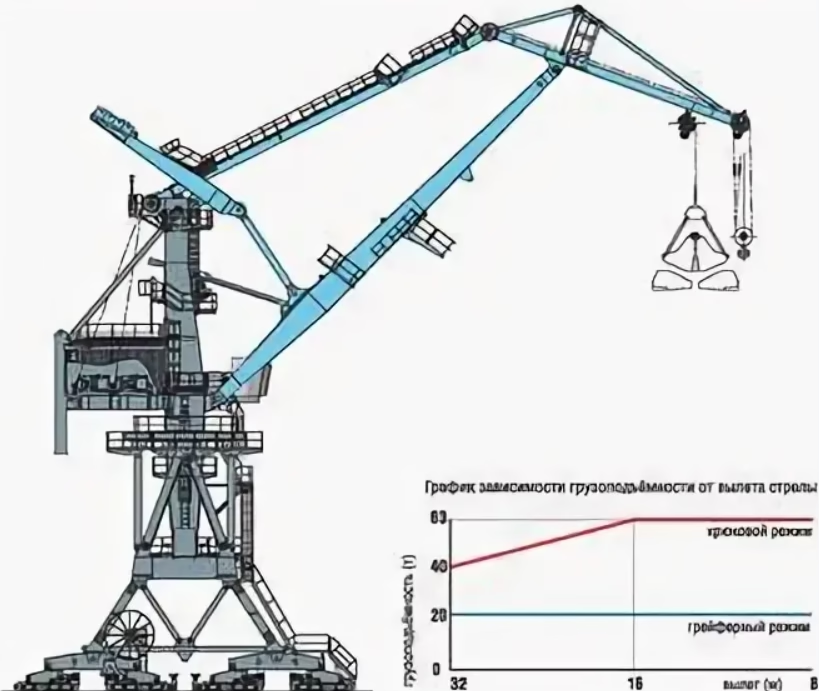
outdoor crane cable

The NSHTÖU-J designation represents a European family of flexible, unshielded, multi-core rubber-insulated cables specifically engineered for crane and lifting equipment applications. The "J" suffix indicates compliance with German industrial standards (DIN VDE 0250-814) and denotes cables optimized for continuous dynamic flexing environments. These cables are ubiquitous in European shipyards, containerports, and material handling facilities—and are widely deployed throughout Australian maritime infrastructure despite different environmental challenges. NSHTÖU-J标识代表专为起重和提升设备应用而设计的欧洲柔性、无屏蔽、多芯橡胶绝缘电缆系列。"J"后缀表示符合德国工业标准(DIN VDE 0250-814),表示为连续动态弯曲环境优化的电缆。这些电缆在欧洲造船厂、集装箱港口和物料搬运设施中随处可见——尽管存在不同的环保挑战,仍然在澳洲海事基础设施中广泛应用。 Core Design Principles: NSHTÖU-J cables are engineered for: (1) extreme flexibility—fine-stranded Class 5 copper conductors enable thousands of bend cycles without conductor fatigue, (2) continuous reeling operation—cable must flex repeatedly without insulation cracking or conductor breakage, (3) industrial duty—heavy PCP outer sheath resists abrasion from cable guides and mechanical equipment, (4) voltage flexibility—standard European specification of 0.6/1kV, with higher ratings (1.1/1.1kV) available for specific markets including Australia.

Australian Shipyards: Drop-in Replacement for NSHTÖU-J 4G50 1.1/1.1kV Crane Festoon Cable

The NSHTÖU-J designation represents a European family of flexible, unshielded, multi-core rubber-insulated cables specifically engineered for crane and lifting equipment applications. The “J” suffix indicates compliance with German industrial standards (DIN VDE 0250-814) and denotes cables optimized for continuous dynamic flexing environments. These cables are ubiquitous in European shipyards, containerports, and material handling facilities—and are widely deployed throughout Australian maritime infrastructure despite different environmental challenges. NSHTÖU-J标识代表专为起重和提升设备应用而设计的欧洲柔性、无屏蔽、多芯橡胶绝缘电缆系列。”J”后缀表示符合德国工业标准(DIN VDE 0250-814),表示为连续动态弯曲环境优化的电缆。这些电缆在欧洲造船厂、集装箱港口和物料搬运设施中随处可见——尽管存在不同的环保挑战,仍然在澳洲海事基础设施中广泛应用。 Core Design Principles: NSHTÖU-J cables are engineered for: (1) extreme flexibility—fine-stranded Class 5 copper conductors enable thousands of bend cycles without conductor fatigue, (2) continuous reeling operation—cable must flex repeatedly without insulation cracking or conductor breakage, (3) industrial duty—heavy PCP outer sheath resists abrasion from cable guides and mechanical equipment, (4) voltage flexibility—standard European specification of 0.6/1kV, with higher ratings (1.1/1.1kV) available for specific markets including Australia.
The nominal outer dimensions of the NGFLGÖU-J 4G16 flat rubber cable are 38.0 mm width × 13.0 mm thickness (approximately 1.50 inches × 0.51 inches). However, because industrial manufacturing is subject to tolerances, the practical specification range follows VDE 0250-809 standards and typically falls between 37.0–42.0 mm width and 12.5–14.0 mm thickness, depending on the manufacturer's rubber compound formulation and production control practices. This cable carries four cores of 16 mm² conductors each (including one green/yellow earth core), making it a 4G16 configuration rated for 300/500V continuous operation with a maximum test voltage of 3,000V. NGFLGÖU-J 4G16 扁形橡胶电缆的标称外部尺寸为**38.0 毫米宽 × 13.0 毫米厚**(约 1.50 英寸 × 0.51 英寸)。然而,因为工业制造受到公差的约束,实际规范范围遵循 VDE 0250-809 标准,通常在**37.0–42.0 毫米宽和 12.5–14.0 毫米厚**之间,取决于制造商的橡胶混合物配制和生产控制实践。这条电缆承载四个 16 毫米² 导体的芯(包括一个绿/黄接地芯),使其成为额定 300/500V 连续运行的 4G16 配置,最大测试电压为 3,000V。

NGFLGÖU-J 4G16 Flat Cable Dimensions: What is the Exact Width and Thickness?

The nominal outer dimensions of the NGFLGÖU-J 4G16 flat rubber cable are 38.0 mm width × 13.0 mm thickness (approximately 1.50 inches × 0.51 inches). However, because industrial manufacturing is subject to tolerances, the practical specification range follows VDE 0250-809 standards and typically falls between 37.0–42.0 mm width and 12.5–14.0 mm thickness, depending on the manufacturer’s rubber compound formulation and production control practices. This cable carries four cores of 16 mm² conductors each (including one green/yellow earth core), making it a 4G16 configuration rated for 300/500V continuous operation with a maximum test voltage of 3,000V. NGFLGÖU-J 4G16 扁形橡胶电缆的标称外部尺寸为**38.0 毫米宽 × 13.0 毫米厚**(约 1.50 英寸 × 0.51 英寸)。然而,因为工业制造受到公差的约束,实际规范范围遵循 VDE 0250-809 标准,通常在**37.0–42.0 毫米宽和 12.5–14.0 毫米厚**之间,取决于制造商的橡胶混合物配制和生产控制实践。这条电缆承载四个 16 毫米² 导体的芯(包括一个绿/黄接地芯),使其成为额定 300/500V 连续运行的 4G16 配置,最大测试电压为 3,000V。
To understand why the ÖLFLEX CRANE F 4G16 uses flat geometry rather than the round cross-sections we discussed in previous technical guides, let me start with a fundamental insight about space utilization and mechanical engineering. When a cable delivers electrical power through an overhead crane system—whether a gantry crane moving horizontally across a factory floor, a hoist lifting loads vertically, or an aerial work platform moving in multiple directions—the cable must be routed overhead through a confined space. Picture the challenge: the cable must travel along the length of the crane runway, then hang down to the moving load-handling equipment. This overhead routing space is precious and limited. The crane runway has architectural constraints from building structure. Weather protection enclosures limit available vertical space. Multiple independent circuits might need to be routed in parallel (one cable for hoist movement, another for load rotation, another for operator pendant communication). In this constrained space, a round cable is geometrically inefficient. A round cable with 76-ampere capacity might have a circular cross-section 30+ millimeters in diameter, requiring substantial overhead routing infrastructure and producing significant cable sag that stresses the support structure. A flat cable delivering identical 76-ampere capacity might have a rectangular cross-section of 38 millimeters wide by 13 millimeters thick—same electrical capacity, but dramatically better space utilization. The flat geometry fits within tighter vertical spaces. Multiple flat cables can be stacked side-by-side with their 38-millimeter widths taking minimal combined space. The reduced cable sag from the lighter, more compact design reduces stress on overhead support structures. This is the fundamental advantage of flat cable geometry: superior space utilization without sacrificing electrical performance. However, flat geometry introduces unique engineering challenges that round cables do not have. A round cable bends uniformly in all directions around its circular cross-section. A flat cable bends very differently depending on direction: bending along the wide dimension (38 millimeters) creates different mechanical stress than bending along the thick dimension (13 millimeters). The flat geometry creates stress concentration points at the corners where the wide flat surfaces meet the thin edges. The electrical current distribution becomes non-uniform across the flat conductor—current density is higher in the center of the flat surface and lower at the edges. Engineers must carefully design flat cables to manage these geometric-specific challenges while exploiting the space-utilization advantages. The ÖLFLEX CRANE F 4G16 represents sophisticated engineering optimization that takes advantage of flat geometry benefits while carefully addressing the unique challenges that rectangular cross-sections introduce.

Heavy Duty Festoon: Flat Cable Cross-Reference for LAPP ÖLFLEX CRANE F 4G16

To understand why the ÖLFLEX CRANE F 4G16 uses flat geometry rather than the round cross-sections we discussed in previous technical guides, let me start with a fundamental insight about space utilization and mechanical engineering. When a cable delivers electrical power through an overhead crane system—whether a gantry crane moving horizontally across a factory floor, a hoist lifting loads vertically, or an aerial work platform moving in multiple directions—the cable must be routed overhead through a confined space. Picture the challenge: the cable must travel along the length of the crane runway, then hang down to the moving load-handling equipment. This overhead routing space is precious and limited. The crane runway has architectural constraints from building structure. Weather protection enclosures limit available vertical space. Multiple independent circuits might need to be routed in parallel (one cable for hoist movement, another for load rotation, another for operator pendant communication). In this constrained space, a round cable is geometrically inefficient. A round cable with 76-ampere capacity might have a circular cross-section 30+ millimeters in diameter, requiring substantial overhead routing infrastructure and producing significant cable sag that stresses the support structure. A flat cable delivering identical 76-ampere capacity might have a rectangular cross-section of 38 millimeters wide by 13 millimeters thick—same electrical capacity, but dramatically better space utilization. The flat geometry fits within tighter vertical spaces. Multiple flat cables can be stacked side-by-side with their 38-millimeter widths taking minimal combined space. The reduced cable sag from the lighter, more compact design reduces stress on overhead support structures. This is the fundamental advantage of flat cable geometry: superior space utilization without sacrificing electrical performance. However, flat geometry introduces unique engineering challenges that round cables do not have. A round cable bends uniformly in all directions around its circular cross-section. A flat cable bends very differently depending on direction: bending along the wide dimension (38 millimeters) creates different mechanical stress than bending along the thick dimension (13 millimeters). The flat geometry creates stress concentration points at the corners where the wide flat surfaces meet the thin edges. The electrical current distribution becomes non-uniform across the flat conductor—current density is higher in the center of the flat surface and lower at the edges. Engineers must carefully design flat cables to manage these geometric-specific challenges while exploiting the space-utilization advantages. The ÖLFLEX CRANE F 4G16 represents sophisticated engineering optimization that takes advantage of flat geometry benefits while carefully addressing the unique challenges that rectangular cross-sections introduce.
The nominal width of a (N)TSFLCGEWÖU 4x120 0.6/1kV shielded flat trailing cable is approximately 91 mm (3.58 inches), with a tolerance window of ±3.5 mm producing a permissible range of 87.5–94.5 mm. The nominal thickness is approximately 27.5 mm (1.08 inches), with a tolerance window of ±1.5 mm producing a permissible range of 26.0–29.0 mm. The approximate total weight of this cable is 8,200 kg/km (5,500 lbs/1000 ft), with copper weight approximately 5,250 kg/km. It features four 120 mm² main power conductors rated for 321 amperes continuous operation at 30°C ambient, supplemented by individual copper braid shielding on each conductor for electromagnetic compatibility (EMC) with variable-frequency drives and other sensitive equipment. The distinction between width and thickness for flat cables differs fundamentally from round cable specifications because flat cables do not have a single outer diameter. Instead, engineers must manage two dimensions simultaneously, and these dimensions directly determine whether the cable will fit into festoon track systems, contact shoe assemblies, and guidance rail configurations commonly deployed in overhead crane systems and automated material handling equipment.

What is the Width and Thickness of (N)TSFLCGEWÖU 4×120 0.6/1kV Shielded Flat Cable?

The nominal width of a (N)TSFLCGEWÖU 4×120 0.6/1kV shielded flat trailing cable is approximately 91 mm (3.58 inches), with a tolerance window of ±3.5 mm producing a permissible range of 87.5–94.5 mm. The nominal thickness is approximately 27.5 mm (1.08 inches), with a tolerance window of ±1.5 mm producing a permissible range of 26.0–29.0 mm. The approximate total weight of this cable is 8,200 kg/km (5,500 lbs/1000 ft), with copper weight approximately 5,250 kg/km. It features four 120 mm² main power conductors rated for 321 amperes continuous operation at 30°C ambient, supplemented by individual copper braid shielding on each conductor for electromagnetic compatibility (EMC) with variable-frequency drives and other sensitive equipment. The distinction between width and thickness for flat cables differs fundamentally from round cable specifications because flat cables do not have a single outer diameter. Instead, engineers must manage two dimensions simultaneously, and these dimensions directly determine whether the cable will fit into festoon track systems, contact shoe assemblies, and guidance rail configurations commonly deployed in overhead crane systems and automated material handling equipment.
Festoon systems are critical components in industrial applications where power, control, and data cables must travel with moving equipment such as overhead cranes, gantry cranes, automated storage and retrieval systems (AS/RS), and material handling equipment. The selection of appropriate flat cables for these systems directly impacts operational reliability, maintenance costs, and system longevity.

Draka Buflex vs. (N)TSFLCGEWÖU: Which Flat Cable is Best for Festoon Systems?

Festoon systems are critical components in industrial applications where power, control, and data cables must travel with moving equipment such as overhead cranes, gantry cranes, automated storage and retrieval systems (AS/RS), and material handling equipment. The selection of appropriate flat cables for these systems directly impacts operational reliability, maintenance costs, and system longevity.
Crane cables represent a specialized category of heavy-duty flexible cables designed to power and control cranes, hoists, festoons, conveyors, and gantries. Used extensively across heavy industry including mining, marine ports, steel mills, and container terminals, these cables must be exceptionally robust and capable of handling both torsional (twisting) and tensile (pulling) stresses simultaneously. Unlike standard industrial cables, crane cables experience constant reeling, unreeling, and multi-directional movement, requiring specialized constructions with reinforced components and premium materials.

What are Crane Cables?

NTSCGEWÖU cable, TSCGEWÖU cable, TSKCGEWÖU cable, medium voltage crane, MV reeling cable, 6kV crane cable, 10kV crane cable, 20kV crane cable, anti-torsion cable, ATB cable, crane cable, crane power cable, hoist cable, gantry cable, lifting cable, overhead crane cable, tower crane cable, port crane cable, material handling cable, heavy duty crane cable
While circular cables have served the industry for decades, flat cable technology has emerged as a superior solution for specific applications where space constraints, frequent bending, and compact cable management systems are paramount. This comprehensive technical guide examines two of the most widely specified flat cable types in modern crane installations: the YFFB cable (nitrile rubber compound insulation and sheath) and the YVFB cable (PVC insulation with nitrile-PVC composite sheath).

YFFB & YVFB Flat Crane Cables: Comprehensive Engineering Guide for Festoon Systems

While circular cables have served the industry for decades, flat cable technology has emerged as a superior solution for specific applications where space constraints, frequent bending, and compact cable management systems are paramount. This comprehensive technical guide examines two of the most widely specified flat cable types in modern crane installations: the YFFB cable (nitrile rubber compound insulation and sheath) and the YVFB cable (PVC insulation with nitrile-PVC composite sheath).
The 600V 2TC-RB crane cable represents a specialized category of rubber-insulated flexible cables engineered specifically for mobile machinery applications in demanding industrial environments. The designation "2TC-RB" identifies this as a Class 2 conductor construction featuring tin-coated copper strands, ethylene propylene rubber (EPR) insulation, and a robust polychloroprene rubber (also known as neoprene) outer sheath.

What is 600V 2TC-RB Crane Cable?

The 600V 2TC-RB crane cable represents a specialized category of rubber-insulated flexible cables engineered specifically for mobile machinery applications in demanding industrial environments. The designation “2TC-RB” identifies this as a Class 2 conductor construction featuring tin-coated copper strands, ethylene propylene rubber (EPR) insulation, and a robust polychloroprene rubber (also known as neoprene) outer sheath.