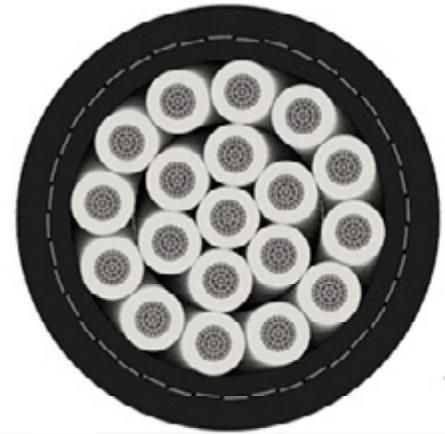
offshore power cable

The ampacity of NEK 606 RFOU 0.6/1kV 4G120 mm² cable in free air at the NEK 606 standard reference condition (45°C ambient, 90°C conductor temperature) is approximately 260 amperes for a single cable installed on an open support structure with unrestricted air circulation. When this same cable is installed in a two-tier (double-banked) configuration where one 4G120 cable sits directly above another with minimal vertical spacing (typical spacing 50–100 mm between outer sheaths), the ampacity of each cable must be derated to approximately 200–215 amperes, representing a derating factor of about 0.78–0.82 or roughly an 18–22% reduction from the free-air rating. When three cables are stacked vertically (three-tier configuration), the derating becomes more severe: the bottom cable sees approximately 0.68–0.72 factor (177–187 A), the middle cable experiences approximately 0.70–0.74 factor (182–192 A), and the top cable maintains approximately 0.80–0.85 factor (208–221 A). The fundamental reason for these derating reductions is that vertically stacked cables cannot dissipate heat as effectively as cables in free air because the upper cables partially shield the lower cables from direct air circulation, creating a thermally interactive system where the waste heat from upper cables warms the ambient environment around lower cables, reducing their cooling effectiveness and thereby their safe operating current capacity.

Double-Banked Cable Trays: What is the ampacity derating factor for NEK 606 RFOU 0.6/1kV 4G120 mm² cables installed in vertically stacked (double-banked) offshore platform configurations?

The ampacity of NEK 606 RFOU 0.6/1kV 4G120 mm² cable in free air at the NEK 606 standard reference condition (45°C ambient, 90°C conductor temperature) is approximately 260 amperes for a single cable installed on an open support structure with unrestricted air circulation. When this same cable is installed in a two-tier (double-banked) configuration where one 4G120 cable sits directly above another with minimal vertical spacing (typical spacing 50–100 mm between outer sheaths), the ampacity of each cable must be derated to approximately 200–215 amperes, representing a derating factor of about 0.78–0.82 or roughly an 18–22% reduction from the free-air rating. When three cables are stacked vertically (three-tier configuration), the derating becomes more severe: the bottom cable sees approximately 0.68–0.72 factor (177–187 A), the middle cable experiences approximately 0.70–0.74 factor (182–192 A), and the top cable maintains approximately 0.80–0.85 factor (208–221 A). The fundamental reason for these derating reductions is that vertically stacked cables cannot dissipate heat as effectively as cables in free air because the upper cables partially shield the lower cables from direct air circulation, creating a thermally interactive system where the waste heat from upper cables warms the ambient environment around lower cables, reducing their cooling effectiveness and thereby their safe operating current capacity.
The act of splicing a medium-voltage cable in the field—joining two cable ends after they have already been installed in a drilling derrick or FPSO electrical room—occupies a unique and critical position in offshore electrical engineering. Unlike cable terminations (where the cable end is terminated to a switchgear cabinet or transformer winding terminal), field splices create a permanently joined section within the cable run itself. This joint must perform as if it were part of the original manufactured cable, maintaining perfect electrical, mechanical, and dielectric integrity in one of the world's most hostile environments: the vibration-laden, salt-spray-corroded, perpetually humid confines of an offshore platform. When a splice fails, it often fails catastrophically, potentially causing equipment damage, electrical hazards to personnel, and operational shutdowns that can cost hundreds of thousands of dollars per day.

Splicing Type MMV (37-105) 8kV Cables: Managing Tape and Braided Shields Offshore with Field-Proven Termination Techniques

The act of splicing a medium-voltage cable in the field—joining two cable ends after they have already been installed in a drilling derrick or FPSO electrical room—occupies a unique and critical position in offshore electrical engineering. Unlike cable terminations (where the cable end is terminated to a switchgear cabinet or transformer winding terminal), field splices create a permanently joined section within the cable run itself. This joint must perform as if it were part of the original manufactured cable, maintaining perfect electrical, mechanical, and dielectric integrity in one of the world’s most hostile environments: the vibration-laden, salt-spray-corroded, perpetually humid confines of an offshore platform. When a splice fails, it often fails catastrophically, potentially causing equipment damage, electrical hazards to personnel, and operational shutdowns that can cost hundreds of thousands of dollars per day.
NEK TS 606 is the Norwegian offshore industry technical specification (TS) covering a range of power, instrumentation and earth cables that are halogen free and/or MUD resistant, protecting them against the type of hydrocarbon-laden drilling liquid used in drilling operations which can have an adverse effect on cable sheathing materials. Originally published in 1993 by the Norwegian Electrotechnical Committee (NEK) as a successor to the 'Recommended Practice for Specification of Cables' of the Norwegian Oil Industry Association, NEK 606 has evolved to become an internationally accepted standard for offshore cable applications.

What is NEK 606 Cable?

NEK 606, NEK TS 606, NEK 606 cable, offshore cable, BFOU cable, RFOU cable, Norwegian offshore standard, oil gas cable, mud resistant cable, fire resistant cable, halogen free cable, offshore power cable, offshore instrumentation cable, marine cable
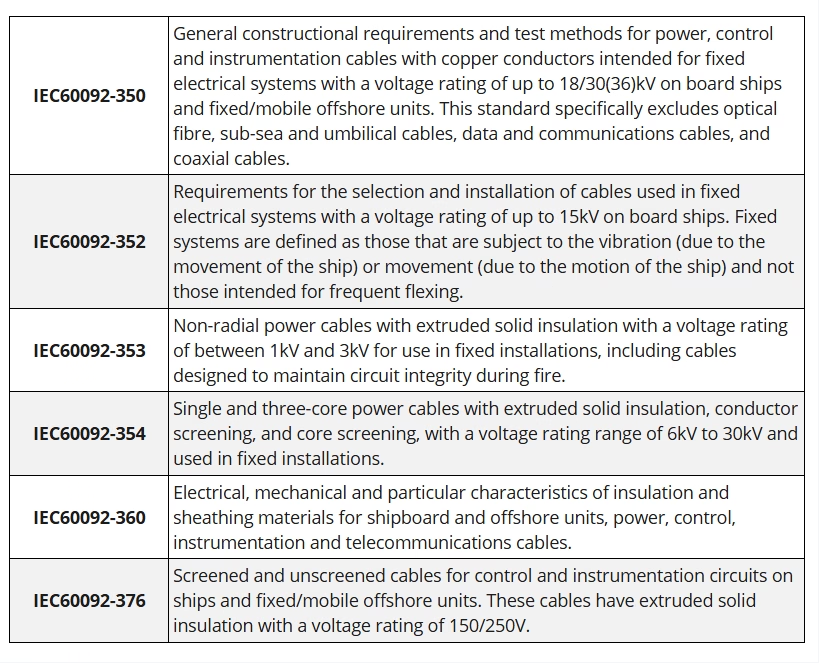
IEC 60092 is the international standard for electrical installations in ships and fixed/mobile marine applications. Ship wiring is covered by various national standards such as BS 6883 (British) and NEK 606 (Norwegian), and subject to third-party accreditations including Lloyd's Register, DNV (Det Norske Veritas), and ABS (American Bureau of Shipping). As an international standard, IEC 60092 covers power and instrumentation cables for use on ships and in mobile marine environments.

What is IEC 60092 Cable?

IEC 60092 cable, marine cable, shipboard cable, offshore cable, BS 6883 cable, NEK 606 cable, BFOU cable, RFOU cable, 657TQ cable, 658TQ cable, fire resistant marine cable, flame retardant cable, ship wiring, offshore platform cable, Lloyd’s Register approved, DNV certified, halogen free cable, LSZH marine cable, MUD resistant cable, IEC 60092-353, IEC 60092-354, IEC 60092-376, SW4 cable, EPR insulated, TCWB armoured, instrumentation cable, control cable, emergency power cable, oil rig cable, Feichun cable
DNV (Det Norske Veritas) is an international accredited registrar and classification society headquartered in Høvik, Norway. As one of the world's leading classification societies, DNV provides certification, verification, and risk management services for the maritime, oil & gas, renewable energy, and other industries. DNV approved cables are electrical cables that have been tested, verified, and certified by DNV to meet stringent safety, quality, and performance standards for use in marine and offshore applications.

What is DNV Approved Cable?

offshore platform cable, drilling platform cable, oil rig cable, FPSO cable, jackup rig cable, semi-submersible cable, drillship cable, offshore wind farm cable, wind turbine cable, subsea cable, underwater cable, shipboard wiring cable, ship electrical cable, naval vessel cable, cruise ship cable, ferry cable, offshore substation cable, offshore power distribution, marine electrical installation
British Standard BS6883 covers the specifications for elastomer insulated cables for fixed wiring in ships (shipwiring) and on mobile and fixed offshore marine units. This standard specifies the requirements and test methods for shipboard fixed wiring of lighting, power, control, instrumentation and propulsion circuits with a voltage rating of up to 8.7/15kV.

What is BS6883 Cable?

BS6883電纜, BS6883船用電纜, 船用電纜, 海上電纜, 船用佈線電纜, 船舶電纜, LSZH電纜, LSHF電纜, 低煙無鹵電纜, EPR船用電纜, 海上電力電纜, 船用電纜, 657TQ電纜, 658TQ電纜, SW4型電纜, SW3型電纜, SW2型電纜, 鎧裝船用電纜, 非鎧裝船用電纜, 鋼絲編織電纜, HOFR電纜, 無鹵電纜, 阻燃船用電纜, 勞氏船級社電纜, DNV電纜, UKOOA電纜, 600/1000V船用電纜, 船用儀表電纜, 海上平台電纜, 鑽井平台電纜, 石油平台電纜, FPSO電纜, 耐火電纜, BS7917電纜, 彈性體絕緣電纜, EPR絕緣電纜, 鍍錫銅船用電纜,BS6883, BS6883 cable, marine cable, offshore cable, shipwiring cable, ship cable, LSZH cable, LSHF cable, low smoke halogen free cable, EPR marine cable, offshore power cable, shipboard cable, 657TQ cable, 658TQ cable, Type SW4 cable, Type SW3 cable, Type SW2 cable, armoured marine cable, unarmoured marine cable, GSWB cable, steel wire braid cable, HOFR cable, halogen free cable, flame retardant marine cable
SINGLE CORE represents an advanced low smoke zero halogen (LSZH) power cable engineered by Anhui Feichun Special Cable Co., Ltd. for demanding industrial applications where fire safety, thermal performance, and electrical reliability are paramount. This cable series is manufactured in full compliance with Australian and New Zealand standards

What is ENVIROLEX® 110°C  SINGLE CORE?

SINGLE CORE cable is specifically engineered for applications requiring enhanced thermal performance and superior fire safety characteristics. The 110°C continuous operating temperature rating provides a significant thermal margin compared to standard 90°C rated cables, allowing for higher current density and more compact installations.