LSZH marine cable

FeiChun Advanced High-Flexibility Marine Salt-Fog Resistant Port Cable Systems (6–35 kV): Comprehensive Technical Analysis of Specialized Elastomer Formulations, Halogen-Free Flame-Retardant Sheath Materials, Electrochemical Barrier Architecture, Sulfidation Resistance Mechanisms, Long-Term Coastal Durability Engineering, Polymer Chemistry Deep-Dive Analysis, Electrical & Physical Property Optimization, Comparative Performance vs. Standard LSZH & Thermoplastic Alternatives, Field-Validated 25+ Year Service Life in Aggressive C4-C5M Coastal Environments, and Complete Technical Framework for Next-Generation Port Automation Infrastructure Supporting Ship-to-Shore Cranes, Mobile Reel-Deployment Systems, and Dynamic Maritime Equipment Operations Next-generation port infrastructure at maritime facilities managing container ships, bulk carriers, and mega-vessels increasingly demands specialized power cable systems combining extreme mechanical flexibility for reel-deployment applications, exceptional salt-fog corrosion resistance across C4-C5M coastal environments, halogen-free flame-retardant properties meeting port safety regulations, and electrochemical protection extending service life beyond 20 years in continuous exposure to ocean spray, salt-laden air, and sulfur-dioxide atmospheric pollution. FeiChun's advanced marine port cable systems represent cutting-edge material science and electrochemical engineering addressing unified requirements of modern maritime infrastructure, incorporating specialized elastomer formulations combining EPDM and synthetic rubber chemistry for simultaneous low-temperature flexibility and high-temperature stability, multilayer electrochemical protection including conductive barrier systems and reactive corrosion-inhibiting sheaths, halogen-free flame-retardant compounds engineered for zero-toxicity marine environments, and integrated moisture-barrier architectures preventing salt-fog penetration to conductor surfaces.

FLEXIDRUM® MEDIUM PLUS (N)TSCGEWÖU OPTICAL FIBER

FeiChun Advanced High-Flexibility Marine Salt-Fog Resistant Port Cable Systems (6–35 kV): Comprehensive Technical Analysis of Specialized Elastomer Formulations, Halogen-Free Flame-Retardant Sheath Materials, Electrochemical Barrier Architecture, Sulfidation Resistance Mechanisms, Long-Term Coastal Durability Engineering, Polymer Chemistry Deep-Dive Analysis, Electrical & Physical Property Optimization, Comparative Performance vs. Standard LSZH & Thermoplastic Alternatives, Field-Validated 25+ Year Service Life in Aggressive C4-C5M Coastal Environments, and Complete Technical Framework for Next-Generation Port Automation Infrastructure Supporting Ship-to-Shore Cranes, Mobile Reel-Deployment Systems, and Dynamic Maritime Equipment Operations Next-generation port infrastructure at maritime facilities managing container ships, bulk carriers, and mega-vessels increasingly demands specialized power cable systems combining extreme mechanical flexibility for reel-deployment applications, exceptional salt-fog corrosion resistance across C4-C5M coastal environments, halogen-free flame-retardant properties meeting port safety regulations, and electrochemical protection extending service life beyond 20 years in continuous exposure to ocean spray, salt-laden air, and sulfur-dioxide atmospheric pollution. FeiChun’s advanced marine port cable systems represent cutting-edge material science and electrochemical engineering addressing unified requirements of modern maritime infrastructure, incorporating specialized elastomer formulations combining EPDM and synthetic rubber chemistry for simultaneous low-temperature flexibility and high-temperature stability, multilayer electrochemical protection including conductive barrier systems and reactive corrosion-inhibiting sheaths, halogen-free flame-retardant compounds engineered for zero-toxicity marine environments, and integrated moisture-barrier architectures preventing salt-fog penetration to conductor surfaces.
The ampacity of NEK 606 RFOU 0.6/1kV 4G120 mm² cable in free air at the NEK 606 standard reference condition (45°C ambient, 90°C conductor temperature) is approximately 260 amperes for a single cable installed on an open support structure with unrestricted air circulation. When this same cable is installed in a two-tier (double-banked) configuration where one 4G120 cable sits directly above another with minimal vertical spacing (typical spacing 50–100 mm between outer sheaths), the ampacity of each cable must be derated to approximately 200–215 amperes, representing a derating factor of about 0.78–0.82 or roughly an 18–22% reduction from the free-air rating. When three cables are stacked vertically (three-tier configuration), the derating becomes more severe: the bottom cable sees approximately 0.68–0.72 factor (177–187 A), the middle cable experiences approximately 0.70–0.74 factor (182–192 A), and the top cable maintains approximately 0.80–0.85 factor (208–221 A). The fundamental reason for these derating reductions is that vertically stacked cables cannot dissipate heat as effectively as cables in free air because the upper cables partially shield the lower cables from direct air circulation, creating a thermally interactive system where the waste heat from upper cables warms the ambient environment around lower cables, reducing their cooling effectiveness and thereby their safe operating current capacity.

Double-Banked Cable Trays: What is the ampacity derating factor for NEK 606 RFOU 0.6/1kV 4G120 mm² cables installed in vertically stacked (double-banked) offshore platform configurations?

The ampacity of NEK 606 RFOU 0.6/1kV 4G120 mm² cable in free air at the NEK 606 standard reference condition (45°C ambient, 90°C conductor temperature) is approximately 260 amperes for a single cable installed on an open support structure with unrestricted air circulation. When this same cable is installed in a two-tier (double-banked) configuration where one 4G120 cable sits directly above another with minimal vertical spacing (typical spacing 50–100 mm between outer sheaths), the ampacity of each cable must be derated to approximately 200–215 amperes, representing a derating factor of about 0.78–0.82 or roughly an 18–22% reduction from the free-air rating. When three cables are stacked vertically (three-tier configuration), the derating becomes more severe: the bottom cable sees approximately 0.68–0.72 factor (177–187 A), the middle cable experiences approximately 0.70–0.74 factor (182–192 A), and the top cable maintains approximately 0.80–0.85 factor (208–221 A). The fundamental reason for these derating reductions is that vertically stacked cables cannot dissipate heat as effectively as cables in free air because the upper cables partially shield the lower cables from direct air circulation, creating a thermally interactive system where the waste heat from upper cables warms the ambient environment around lower cables, reducing their cooling effectiveness and thereby their safe operating current capacity.
BFOU 0.6/1kV P5/P12 fire-resistant offshore power cable with 3 × 95 mm² tinned copper conductors is approximately 45 mm (1.77 inches), with a standard tolerance window of ±2.0 mm producing a permissible range of 43.0–47.0 mm. This specification is critical for cable gland selection because offshore and marine cable glands are manufactured with specific bore diameters engineered to accommodate this dimensional range. The approximate total weight of this cable is 4,950 kg/km (3,330 lbs/1000 ft), with copper content approximately 3,350 kg/km. It features three 95 mm² Class 2 tinned copper main power conductors, a halogen-free EPR insulation system, a critical mica tape fire-resistance layer rated for 830°C continuous operation (IEC 60331 certified), tinned copper wire braid armor providing mechanical protection and electromagnetic shielding, and an SHF2 halogen-free thermosetting outer sheath rated for extreme marine and subsea conditions.

Cable Gland Sizing: Finding the OD Tolerance for BFOU 0.6/1kV P5/P12 3×95 mm² Offshore Power Cable

BFOU 0.6/1kV P5/P12 fire-resistant offshore power cable with 3 × 95 mm² tinned copper conductors is approximately 45 mm (1.77 inches), with a standard tolerance window of ±2.0 mm producing a permissible range of 43.0–47.0 mm. This specification is critical for cable gland selection because offshore and marine cable glands are manufactured with specific bore diameters engineered to accommodate this dimensional range. The approximate total weight of this cable is 4,950 kg/km (3,330 lbs/1000 ft), with copper content approximately 3,350 kg/km. It features three 95 mm² Class 2 tinned copper main power conductors, a halogen-free EPR insulation system, a critical mica tape fire-resistance layer rated for 830°C continuous operation (IEC 60331 certified), tinned copper wire braid armor providing mechanical protection and electromagnetic shielding, and an SHF2 halogen-free thermosetting outer sheath rated for extreme marine and subsea conditions.
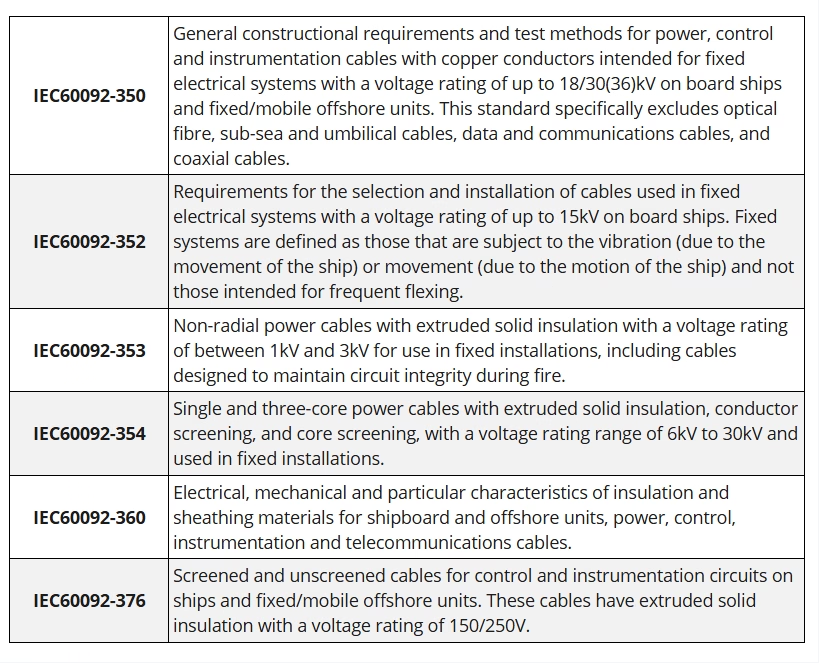
IEC 60092-354 mandates LSZH materials—typically halogen-free compounds based on thermoplastic polyethylene (HTPE), ethylene vinyl acetate (EVA), or polyurethane (PU). These materials meet stringent EN 61034 smoke emission criteria: less than 50% optical density when tested in a closed chamber, and minimal evolution of corrosive gases (measured as hydrochloric acid equivalent per EN 50267-2-1). For additional mechanical protection, ship cables are almost always specified with armoring: a steel wire or steel tape wrapping applied over the jacket.

IEC 60092 MV Cables vs. IEEE 1580 Type MMV: A Specifier’s Guide for Shipboard Power Distribution

IEC 60092-354 mandates LSZH materials—typically halogen-free compounds based on thermoplastic polyethylene (HTPE), ethylene vinyl acetate (EVA), or polyurethane (PU). These materials meet stringent EN 61034 smoke emission criteria: less than 50% optical density when tested in a closed chamber, and minimal evolution of corrosive gases (measured as hydrochloric acid equivalent per EN 50267-2-1). For additional mechanical protection, ship cables are almost always specified with armoring: a steel wire or steel tape wrapping applied over the jacket.
Shipwiring and offshore platform cables represent a specialized category of marine cables designed to perform reliably in the most demanding environments on earth—at sea. These cables must withstand extreme temperature variations (from Arctic cold to engine room heat), constant exposure to humidity, salt water, oils, acids, and drilling muds, while maintaining electrical integrity for power, control, signal, instrumentation, and communication applications. The primary international standards governing these cables include NEK 606 (Norwegian standard for offshore floating platforms), IEC 60092 (electrical installations in ships), BS 6883 (fixed wiring in offshore units), and BS 7917 (fire resistant cables for offshore applications).

What are Shipwiring & Offshore Platform Cables?

NEK 606 cable, BFOU cable, RFOU cable, NEK 606 BFOU, NEK 606 RFOU, offshore platform cable, MUD resistant cable, Norwegian offshore cable, floating platform cable, FPSO cable, marine cable, offshore cable, shipwiring cable, ship cable, offshore platform cable, marine power cable, ship electrical cable, naval cable, maritime cable, at-sea cable,RFOU P101, BFOU P105, RFOU S101, RFOU S102, BFOU S103, BFOU S104, UX P108, RFOU P102, RFOU P103, RFOU P104, RFOU P112, RFOU P113
IEC 60092 is the international standard for electrical installations in ships and fixed/mobile marine applications. Ship wiring is covered by various national standards such as BS 6883 (British) and NEK 606 (Norwegian), and subject to third-party accreditations including Lloyd's Register, DNV (Det Norske Veritas), and ABS (American Bureau of Shipping). As an international standard, IEC 60092 covers power and instrumentation cables for use on ships and in mobile marine environments.

What is IEC 60092 Cable?

IEC 60092 cable, marine cable, shipboard cable, offshore cable, BS 6883 cable, NEK 606 cable, BFOU cable, RFOU cable, 657TQ cable, 658TQ cable, fire resistant marine cable, flame retardant cable, ship wiring, offshore platform cable, Lloyd’s Register approved, DNV certified, halogen free cable, LSZH marine cable, MUD resistant cable, IEC 60092-353, IEC 60092-354, IEC 60092-376, SW4 cable, EPR insulated, TCWB armoured, instrumentation cable, control cable, emergency power cable, oil rig cable, Feichun cable
DNV (Det Norske Veritas) is an international accredited registrar and classification society headquartered in Høvik, Norway. As one of the world's leading classification societies, DNV provides certification, verification, and risk management services for the maritime, oil & gas, renewable energy, and other industries. DNV approved cables are electrical cables that have been tested, verified, and certified by DNV to meet stringent safety, quality, and performance standards for use in marine and offshore applications.

What is DNV Approved Cable?

offshore platform cable, drilling platform cable, oil rig cable, FPSO cable, jackup rig cable, semi-submersible cable, drillship cable, offshore wind farm cable, wind turbine cable, subsea cable, underwater cable, shipboard wiring cable, ship electrical cable, naval vessel cable, cruise ship cable, ferry cable, offshore substation cable, offshore power distribution, marine electrical installation
British Standard BS7917 covers a wide range of cable types used in fixed wiring applications in offshore units where additional fire resistant properties are required. It sets out the constructional requirements and additional tests under fire conditions. The purpose of producing BS7917 was to promote the use of cables with fire resistance in the event of fire, ensuring continued circuit integrity during emergency situations.

What is BS7917 Cable?

BS7917 cable, BS7917 fire resistant cable, BS7917 SW2, BS7917 SW3, BS7917 SW4, fire resistant offshore cable, elastomer insulated cable, EPR insulation cable, GSWB armoured cable, galvanized steel wire braid, 0.6/1kV offshore cable, 150/250V instrumentation cable, halogen free cable, LSZH marine cable, low smoke zero halogen, mica glass tape fire resistant, F0 fire rating 750°C, F1 fire rating 950°C, 3 hour fire resistance, circuit integrity cable, offshore platform cable, FPSO cable, marine vessel cable, ship wiring cable, oil platform cable, gas platform cable, tinned copper conductor, Class 5 flexible conductor, Class 2 stranded conductor, collective screen cable, individual screen cable, BS6883 cable, IEC 60331-21, IEC 60332-3-22, IEC 60754-1, oil resistant cable, flame retardant cable, heat resistant cable, offshore fixed wiring, mobile offshore unit, fixed offshore unit, TCu/MGT/EPR cable, ASHM GSWB cable, offshore crane cable, propulsion circuit cable, control instrumentation cable, emergency system cable, BS7917電纜, 防火電纜, 耐火電纜, 海上電纜, 船用電纜, 無鹵電纜, 低煙無鹵, 阻燃電纜, 耐油電纜, 海洋平台電纜, Anhui Feichun cable, Feichun Special Cable, 安徽飛純電纜