industrial power distribution

FeiChun vs CORDAFLEX: Comprehensive Specification Comparison, Performance Analysis, and Procurement Guidance for Industrial Reeling Cable Selection in Port, Manufacturing, Wastewater, and Underwater Applications CORDAFLEX (SMK) (N)SHTOEU represents the established industry standard for high-performance flexible reeling cables, earning its position through 30+ years of proven field deployment across global port operations, manufacturing automation, and demanding industrial applications. Yet FeiChun's specialized product line—engineered through 15+ years of competitive analysis and emerging-market focus—challenges the one-size-fits-all CORDAFLEX approach by offering differentiated solutions optimized for specific application needs: extreme salt-fog coastal environments (port marine cables), hazardous-area fire safety requirements (PUR-HF), standard industrial cost-optimization (NSHTOEU), and municipal budget constraints (EASYFLEX). This comprehensive analysis deconstructs the mechanical, thermal, electrical, and economic characteristics distinguishing these two cable manufacturers, enabling equipment engineers and procurement specialists with complete technical justification for specification decisions across diverse application scenarios where CORDAFLEX's premium general-purpose positioning may not deliver optimal value vs. FeiChun's specialized, application-focused engineering.

CORDAFLEX(SMK) (N)SHTOEU-J / -O

FeiChun vs CORDAFLEX: Comprehensive Specification Comparison, Performance Analysis, and Procurement Guidance for Industrial Reeling Cable Selection in Port, Manufacturing, Wastewater, and Underwater Applications CORDAFLEX (SMK) (N)SHTOEU represents the established industry standard for high-performance flexible reeling cables, earning its position through 30+ years of proven field deployment across global port operations, manufacturing automation, and demanding industrial applications. Yet FeiChun’s specialized product line—engineered through 15+ years of competitive analysis and emerging-market focus—challenges the one-size-fits-all CORDAFLEX approach by offering differentiated solutions optimized for specific application needs: extreme salt-fog coastal environments (port marine cables), hazardous-area fire safety requirements (PUR-HF), standard industrial cost-optimization (NSHTOEU), and municipal budget constraints (EASYFLEX). This comprehensive analysis deconstructs the mechanical, thermal, electrical, and economic characteristics distinguishing these two cable manufacturers, enabling equipment engineers and procurement specialists with complete technical justification for specification decisions across diverse application scenarios where CORDAFLEX’s premium general-purpose positioning may not deliver optimal value vs. FeiChun’s specialized, application-focused engineering.
Technical reference for industrial equipment procurement specialists, port operations engineers, heavy-lift crane maintenance teams, electrical infrastructure planners, OEM equipment designers, and supply-chain optimization professionals. Comprehensive coverage: polyurethane polymer architecture (polyol component selection, isocyanate structure, degree of crosslinking, impact on mechanical/thermal properties); halogen-free flame-retardant chemistry (phosphorus-based and mineral-filled additives for LOI ≥30 without halogenated compounds); aramid-fiber engineering (para-aramid vs. meta-aramid trade-offs, fiber tensile strength >3,500 MPa, braiding angle optimization, stress-distribution modeling); mechanical property optimization (tear-strength formulation, abrasion-resistance testing per ASTM D1044, puncture-resistance engineering); oil-resistance chemistry (polyether vs. polyester polyol base, plasticizer selection for long-term swelling resistance); UV-stabilizer package design (carbon-black loading vs. alternative UV absorbers); DIN VDE 0250-813 (multi-core cable) and 0250-814 (single-core reeling cable) standards technical requirements and test protocols; comparative benchmarking of TROMMELFLEX vs. BUFLEX DGR across 20+ performance parameters; field deployment data from industrial port cranes, mining drag-chains, and heavy-lift systems across Europe, Asia, and North America; manufacturing process optimization highlighting Anhui Feichun's polyurethane extrusion capabilities (precision temperature control, die design for void-free sheaths, quality assurance for tear-strength consistency); total-cost-of-ownership modeling including material cost, labour, equipment downtime, and service-life extension; OEM compatibility qualification; and installation best practices for high-stress industrial environments.

TROMMELFLEX PUR-HF Halogen-Free Polyurethane Reeling Cable: Complete Technical Engineering Analysis of Multi-Core and Single-Core Configurations, High-Strength Aramid Anti-Torsion Braiding Architecture, Superior Mechanical Abrasion Resistance (20 N/mm² Tear Strength Standard), Low and Medium-Voltage Power Distribution (0.6/1.0 kV), Polyurethane Polymer Chemistry with Halogen-Free Flame-Retardant Additives, DIN VDE 0250-813 and 0250-814 Standards Compliance, Comparative Performance Benchmarking Against BUFLEX DGR System, Chemical Cross-Linking Analysis and Stress-Strain Engineering, Port Crane and Heavy-Lift Equipment Integration, Field Durability in Extreme Industrial Environments, Drop-In Replacement Qualification Framework, Manufacturing Process Optimization by Anhui Feichun Special Cable (Optimized Extrusion, 20 N/mm² Equivalent Tear Strength, Accelerated Delivery), Lifecycle Cost-of-Ownership Analysis, and OEM Equipment Compatibility Documentation

Technical reference for industrial equipment procurement specialists, port operations engineers, heavy-lift crane maintenance teams, electrical infrastructure planners, OEM equipment designers, and supply-chain optimization professionals. Comprehensive coverage: polyurethane polymer architecture (polyol component selection, isocyanate structure, degree of crosslinking, impact on mechanical/thermal properties); halogen-free flame-retardant chemistry (phosphorus-based and mineral-filled additives for LOI ≥30 without halogenated compounds); aramid-fiber engineering (para-aramid vs. meta-aramid trade-offs, fiber tensile strength >3,500 MPa, braiding angle optimization, stress-distribution modeling); mechanical property optimization (tear-strength formulation, abrasion-resistance testing per ASTM D1044, puncture-resistance engineering); oil-resistance chemistry (polyether vs. polyester polyol base, plasticizer selection for long-term swelling resistance); UV-stabilizer package design (carbon-black loading vs. alternative UV absorbers); DIN VDE 0250-813 (multi-core cable) and 0250-814 (single-core reeling cable) standards technical requirements and test protocols; comparative benchmarking of TROMMELFLEX vs. BUFLEX DGR across 20+ performance parameters; field deployment data from industrial port cranes, mining drag-chains, and heavy-lift systems across Europe, Asia, and North America; manufacturing process optimization highlighting Anhui Feichun’s polyurethane extrusion capabilities (precision temperature control, die design for void-free sheaths, quality assurance for tear-strength consistency); total-cost-of-ownership modeling including material cost, labour, equipment downtime, and service-life extension; OEM compatibility qualification; and installation best practices for high-stress industrial environments.
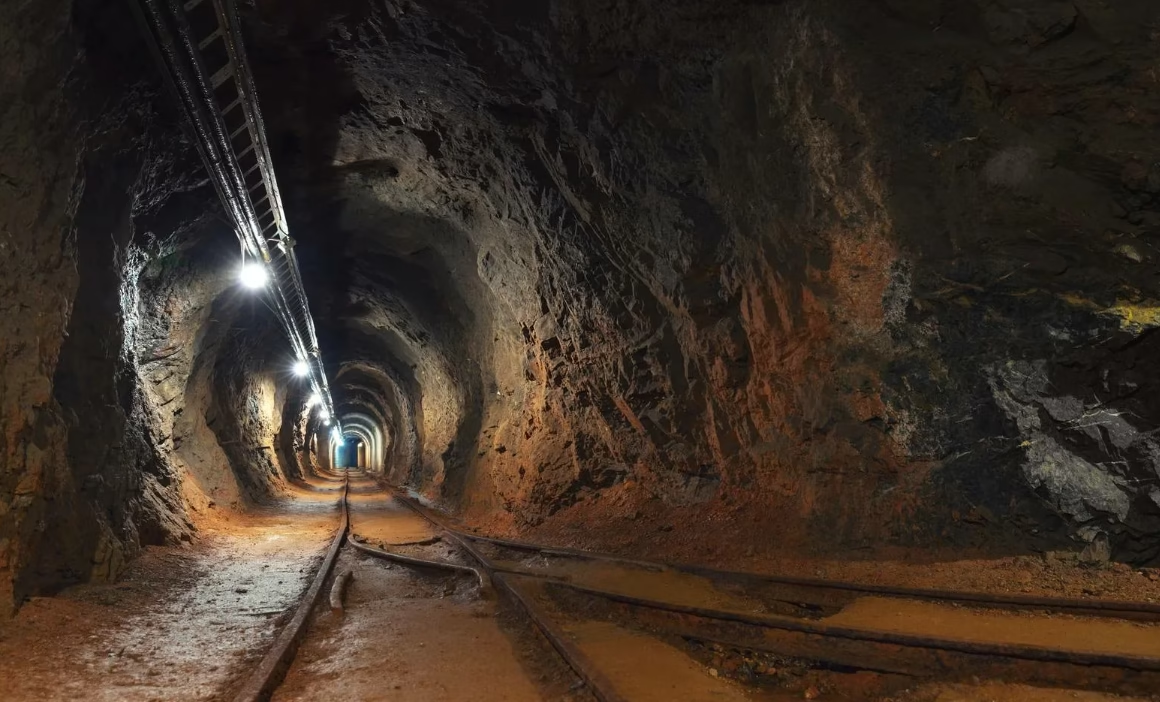
Geographic & Operational Context: Chuquicamata (Codelco) is transitioning from the world's largest open-pit copper mine to underground block caving (autonomous underground mining system). Depths: 700–1,500 meters below surface (Phase 1), expanding to 2,500+ meters (long-term). El Teniente (Codelco) is already operating at extreme depths: primary block caving at 2,000–2,500 m elevation below surface. Both mines employ: (1) Block caving gravity feed (fragmented ore flows down to cave level), (2) Mobile equipment (diesel-electric LHDs—Load-Haul-Dump vehicles, 30–50 ton capacity), (3) Fixed hoisting infrastructure (vertical shafts, incline decline haulage), (4) Extensive underground electrical distribution: 11 kV primary feeders, 6.6 kV secondaries, 3.3 kV distribution to mobile substations. 楚基卡马塔(国铜矿公司Codelco)正在从全球最大露天铜矿向地下自然崩落法(自主地下采矿系统)转型。深度:地表以下700-1,500米(第1阶段),长期扩展至2,500+米。El Teniente(Codelco)已在极端深度运营:地表下2,000-2,500m主自然崩落区。两座矿山采用:(1)重力进给式自然崩落(碎矿由高处流下至崩落区)、(2)移动设备(柴油-电动LHD-装-运-卸车、30-50吨容量)、(3)固定提升基础设施(竖井、倾斜下降运输)、(4)广泛的地下电气配电:11 kV一级馈电、6.6 kV二级、3.3 kV配电至移动变电站。 Type 2S Selection Rationale: Underground fixed-installation feeders (in contrast to dragline/shovel trailing cables) experience: (1) Rock fall hazard (loose fragments falling from roof, occasional collapses), (2) Equipment impact (LHD vehicles occasionally strike cable trays during positioning), (3) Long service life (5–10+ years without planned removal), (4) Static or semi-static routing (no continuous reel cycling). Type 2S SWA (Steel Wire Armoured) is optimal because: (1) Mechanical armour (galvanized steel wire spiral) provides exceptional impact protection, (2) Symmetrical earth architecture supports high-impedance grounded distribution systems, (3) Heavy construction (11 ton/km total weight) means higher copper content → lower resistance → reduced voltage drop over long feeder runs.

AS/NZS 1972 Type 2S 11kV 3x185mm² SWA Armoured Feeder Cable for Chile Underground Copper Mines

Geographic & Operational Context: Chuquicamata (Codelco) is transitioning from the world’s largest open-pit copper mine to underground block caving (autonomous underground mining system). Depths: 700–1,500 meters below surface (Phase 1), expanding to 2,500+ meters (long-term). El Teniente (Codelco) is already operating at extreme depths: primary block caving at 2,000–2,500 m elevation below surface. Both mines employ: (1) Block caving gravity feed (fragmented ore flows down to cave level), (2) Mobile equipment (diesel-electric LHDs—Load-Haul-Dump vehicles, 30–50 ton capacity), (3) Fixed hoisting infrastructure (vertical shafts, incline decline haulage), (4) Extensive underground electrical distribution: 11 kV primary feeders, 6.6 kV secondaries, 3.3 kV distribution to mobile substations. 楚基卡马塔(国铜矿公司Codelco)正在从全球最大露天铜矿向地下自然崩落法(自主地下采矿系统)转型。深度:地表以下700-1,500米(第1阶段),长期扩展至2,500+米。El Teniente(Codelco)已在极端深度运营:地表下2,000-2,500m主自然崩落区。两座矿山采用:(1)重力进给式自然崩落(碎矿由高处流下至崩落区)、(2)移动设备(柴油-电动LHD-装-运-卸车、30-50吨容量)、(3)固定提升基础设施(竖井、倾斜下降运输)、(4)广泛的地下电气配电:11 kV一级馈电、6.6 kV二级、3.3 kV配电至移动变电站。 Type 2S Selection Rationale: Underground fixed-installation feeders (in contrast to dragline/shovel trailing cables) experience: (1) Rock fall hazard (loose fragments falling from roof, occasional collapses), (2) Equipment impact (LHD vehicles occasionally strike cable trays during positioning), (3) Long service life (5–10+ years without planned removal), (4) Static or semi-static routing (no continuous reel cycling). Type 2S SWA (Steel Wire Armoured) is optimal because: (1) Mechanical armour (galvanized steel wire spiral) provides exceptional impact protection, (2) Symmetrical earth architecture supports high-impedance grounded distribution systems, (3) Heavy construction (11 ton/km total weight) means higher copper content → lower resistance → reduced voltage drop over long feeder runs.
The nominal weight of a Type 3S 3.3kV 3x240mm² steel wire armoured cable is approximately 13,200 to 13,800 kilograms per kilometer (kg/km), or roughly 13.2 to 13.8 kilograms per linear meter. For practical planning purposes, engineers working with Feichun's Type 3S 3x240mm² product should design logistics and installation equipment assuming 13.5 kg/m as the midpoint value. This is not a lightweight cable—a single 1,000-meter feeder run will weigh 13,500 kilograms (13.5 tonnes), demanding heavy-duty mechanical handling equipment and careful transport planning from the moment the cable leaves the manufacturing facility. Type 3S 3.3kV 3x240mm² 钢丝铠装电缆的标称重量约为 13,200 至 13,800 千克/公里 (kg/km),或粗略计算每线性米约 13.2 至 13.8 公斤。 为了实际规划目的,与 Feichun 的 Type 3S 3x240mm² 产品合作的工程师应该以 13.5 kg/m 作为中点值来设计物流和安装设备。这不是一根轻型电缆——单个 1,000 米的馈电敷设将重达 13,500 公斤(13.5 吨),从电缆离开制造厂的那一刻起就需要重型机械处理设备和仔细的运输规划。

Weight & Logistics: Calculating kg/km for Heavy-Duty Type 3S 3.3kV 3x240mm² Steel Wire Armoured Cables

The nominal weight of a Type 3S 3.3kV 3x240mm² steel wire armoured cable is approximately 13,200 to 13,800 kilograms per kilometer (kg/km), or roughly 13.2 to 13.8 kilograms per linear meter. For practical planning purposes, engineers working with Feichun’s Type 3S 3x240mm² product should design logistics and installation equipment assuming 13.5 kg/m as the midpoint value. This is not a lightweight cable—a single 1,000-meter feeder run will weigh 13,500 kilograms (13.5 tonnes), demanding heavy-duty mechanical handling equipment and careful transport planning from the moment the cable leaves the manufacturing facility. Type 3S 3.3kV 3x240mm² 钢丝铠装电缆的标称重量约为 13,200 至 13,800 千克/公里 (kg/km),或粗略计算每线性米约 13.2 至 13.8 公斤。 为了实际规划目的,与 Feichun 的 Type 3S 3x240mm² 产品合作的工程师应该以 13.5 kg/m 作为中点值来设计物流和安装设备。这不是一根轻型电缆——单个 1,000 米的馈电敷设将重达 13,500 公斤(13.5 吨),从电缆离开制造厂的那一刻起就需要重型机械处理设备和仔细的运输规划。
The (N)SSHÖU 3x50+3x25/3 1.1/1.1kV trailing cable represents far more than a simple voltage specification change from the standard European 0.6/1kV industrial flexible cable. When you examine New Zealand's mining, quarrying, and port operations, the environment is fundamentally different from European industrial applications. The country's open-cast mining sites experience extreme weather variations, high UV radiation, exposure to harsh corrosive mining chemicals, and require continuous mechanical durability in equipment that cannot afford operational downtime. New Zealand's electrical safety standards reflect this demanding reality through three core requirements. First, the nation's IT earthing system (isolated or high-resistance grounding) demands insulation rated for phase-to-earth voltage equal to phase-to-phase voltage (Uo = U), which necessitates the 1.1/1.1kV rating instead of 0.6/1kV. Second, the split symmetrical earth design with three individual 25mm² earth conductors placed symmetrically around the three 50mm² phase conductors provides unprecedented protection against unbalanced fault conditions that could otherwise result in lethal contact voltage hazards for equipment operators. Third, New Zealand's mining operations often involve long-distance power transmission—sometimes exceeding 800 meters from the surface substation to the underground working face—which creates severe voltage drop problems that cannot be adequately addressed by 0.6/1kV systems but are managed effectively by the higher 1.1/1.1kV rating. The (N)SSHÖU 3x50+3x25/3 1.1/1.1kV cable delivers a total weight of approximately 3550 kilograms per kilometer, carries a copper content of 1680 kg/km, maintains an ampacity of 182 amperes in free air at 30°C, features an outer diameter in the range of 42.0 to 47.0 millimeters, and is constructed from EPR rubber insulation with a heavy-duty CPE outer sheath specifically formulated to resist the abrasion, tearing, oil penetration, and ultraviolet degradation characteristic of New Zealand's unforgiving mining and quarry environments.

Voltage Upgrade: Why Replace Standard 0.6/1kV with (N)SSHÖU 3×50+3×25/3 1.1/1.1kV in New Zealand?

The (N)SSHÖU 3×50+3×25/3 1.1/1.1kV trailing cable represents far more than a simple voltage specification change from the standard European 0.6/1kV industrial flexible cable. When you examine New Zealand’s mining, quarrying, and port operations, the environment is fundamentally different from European industrial applications. The country’s open-cast mining sites experience extreme weather variations, high UV radiation, exposure to harsh corrosive mining chemicals, and require continuous mechanical durability in equipment that cannot afford operational downtime. New Zealand’s electrical safety standards reflect this demanding reality through three core requirements. First, the nation’s IT earthing system (isolated or high-resistance grounding) demands insulation rated for phase-to-earth voltage equal to phase-to-phase voltage (Uo = U), which necessitates the 1.1/1.1kV rating instead of 0.6/1kV. Second, the split symmetrical earth design with three individual 25mm² earth conductors placed symmetrically around the three 50mm² phase conductors provides unprecedented protection against unbalanced fault conditions that could otherwise result in lethal contact voltage hazards for equipment operators. Third, New Zealand’s mining operations often involve long-distance power transmission—sometimes exceeding 800 meters from the surface substation to the underground working face—which creates severe voltage drop problems that cannot be adequately addressed by 0.6/1kV systems but are managed effectively by the higher 1.1/1.1kV rating. The (N)SSHÖU 3×50+3×25/3 1.1/1.1kV cable delivers a total weight of approximately 3550 kilograms per kilometer, carries a copper content of 1680 kg/km, maintains an ampacity of 182 amperes in free air at 30°C, features an outer diameter in the range of 42.0 to 47.0 millimeters, and is constructed from EPR rubber insulation with a heavy-duty CPE outer sheath specifically formulated to resist the abrasion, tearing, oil penetration, and ultraviolet degradation characteristic of New Zealand’s unforgiving mining and quarry environments.
Type SHD-GC 3/C #1 AWG 8kV trailing cable has a DC resistance of approximately 0.161 ohms per kilometer measured at the reference temperature of 20°C (68°F). This DC resistance value represents the pure ohmic resistance of the copper conductor when direct current flows through it—a condition that occurs in short-circuit analysis and DC testing procedures. However, when this same cable carries the alternating current typical of mining equipment operations (at the standard operating temperature of 90°C), the AC resistance increases to approximately 0.363 ohms per kilometer due to the combined effects of temperature rise and skin effect phenomena. The substantial difference between 0.161 Ω/km (DC, 20°C) and 0.363 Ω/km (AC, 90°C)—more than a 2.25 times increase—demonstrates a critical principle that engineers must account for in real-world voltage drop calculations: laboratory DC resistance values are not directly applicable to field voltage drop analysis. The cable features three 107.2 mm² (1 AWG equivalent) phase conductors of Class 5 tinned copper, with an additional ground-check conductor for continuous monitoring of cable integrity during operation, an outer diameter of approximately 53–58 mm, and a total weight of approximately 6,200–6,800 kg/km. Understanding both the DC baseline resistance and the elevated AC resistance at operating temperature is essential for accurately predicting voltage drop over long cable runs in open-pit mining operations where power distribution distances frequently exceed 500 meters.

Voltage Drop Calculation: Resistance (Ohms/km) for Type SHD-GC 3/C #1 AWG 8kV Trailing Cable

Type SHD-GC 3/C #1 AWG 8kV trailing cable has a DC resistance of approximately 0.161 ohms per kilometer measured at the reference temperature of 20°C (68°F). This DC resistance value represents the pure ohmic resistance of the copper conductor when direct current flows through it—a condition that occurs in short-circuit analysis and DC testing procedures. However, when this same cable carries the alternating current typical of mining equipment operations (at the standard operating temperature of 90°C), the AC resistance increases to approximately 0.363 ohms per kilometer due to the combined effects of temperature rise and skin effect phenomena. The substantial difference between 0.161 Ω/km (DC, 20°C) and 0.363 Ω/km (AC, 90°C)—more than a 2.25 times increase—demonstrates a critical principle that engineers must account for in real-world voltage drop calculations: laboratory DC resistance values are not directly applicable to field voltage drop analysis. The cable features three 107.2 mm² (1 AWG equivalent) phase conductors of Class 5 tinned copper, with an additional ground-check conductor for continuous monitoring of cable integrity during operation, an outer diameter of approximately 53–58 mm, and a total weight of approximately 6,200–6,800 kg/km. Understanding both the DC baseline resistance and the elevated AC resistance at operating temperature is essential for accurately predicting voltage drop over long cable runs in open-pit mining operations where power distribution distances frequently exceed 500 meters.
Bucket wheel excavators represent the pinnacle of continuous mining machinery, combining exceptional scale with remarkable engineering precision. These colossal machines, primarily manufactured by TAKRAF (formerly an East German Kombinat, now part of the Tenova Group) and ThyssenKrupp, have revolutionized surface mining operations since their introduction in the 1920s. Modern bucket wheel excavators serve as the primary overburden removal equipment in large-scale open-pit mining operations, capable of excavating thousands of tons of material per hour with continuous, uninterrupted operation. The operational principle of these machines centers on a large rotating wheel equipped with multiple buckets that continuously scoop material as the wheel rotates. Unlike batch-loading equipment such as traditional excavators or draglines, bucket wheel excavators provide truly continuous material flow, making them ideally suited for high-volume operations where consistent production rates are paramount. The excavated material transfers through the boom system to discharge conveyors, creating an integrated material handling chain that can extend for kilometers across mining sites.

Bucket Wheel Excavators (Takraf/ThyssenKrupp): Managing Cable Tension on Massive Reels

Bucket wheel excavators represent the pinnacle of continuous mining machinery, combining exceptional scale with remarkable engineering precision. These colossal machines, primarily manufactured by TAKRAF (formerly an East German Kombinat, now part of the Tenova Group) and ThyssenKrupp, have revolutionized surface mining operations since their introduction in the 1920s. Modern bucket wheel excavators serve as the primary overburden removal equipment in large-scale open-pit mining operations, capable of excavating thousands of tons of material per hour with continuous, uninterrupted operation. The operational principle of these machines centers on a large rotating wheel equipped with multiple buckets that continuously scoop material as the wheel rotates. Unlike batch-loading equipment such as traditional excavators or draglines, bucket wheel excavators provide truly continuous material flow, making them ideally suited for high-volume operations where consistent production rates are paramount. The excavated material transfers through the boom system to discharge conveyors, creating an integrated material handling chain that can extend for kilometers across mining sites.