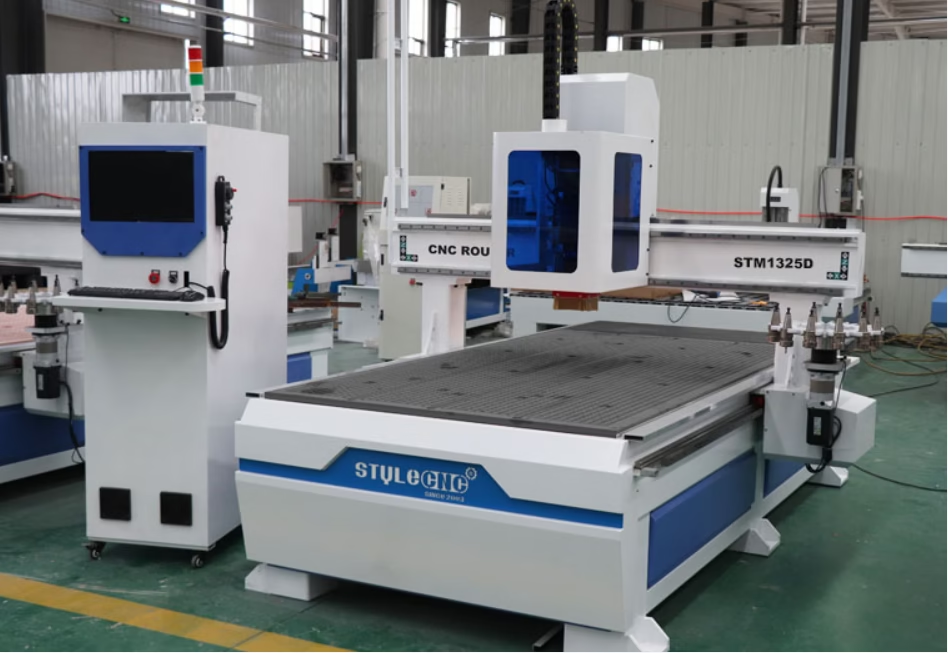
Engineered for Robotic Drag Chains (E-Chains), Spring-Operated and Motorized Reels, Transfer Cars, CNC Machine Tools, Gantry Robots, AGVs/AMRs, Automated Warehouses, Packaging Lines, and Every High-Speed Industrial Automation System Where Conductor Fatigue and Jacket Abrasion Destroy Ordinary Cables
A comprehensive technical guide to DIN VDE 0250 German industrial standards, central support core engineering, mechanical load distribution, real-time control reliability, and factory-floor deployment strategies for Feichun’s heavy-duty round pendant cable system across crane, hoist, and elevator electrification networks.
A comprehensive technical guide to the engineering, mechanical properties, material science, and real-world deployment of Feichun’s industrial-grade RHEYFIRM® flexible reeling cable system across the 3–30 kV voltage spectrum.
A technical guide to the anatomy, self-powered LED integration, mechanical reliability, and real-world deployment of Feichun’s self-luminous RHEYCORD® pendant control system.
Full technical breakdown of Nexans (Rheydt) RHEYFIRM®(SI) NTMCGCWOEUS series — the benchmark flexible single-core medium voltage cable for movable connections between circuit breakers and mobile transformers at open-pit mines, underground mines, and industrial power installations. VDE marking NTMCGCWOEUS, voltages 6/10 kV and 12/20 kV, cross-sections 16–240 mm². Conductor: flexible tinned copper class 5 per IEC 60228. Insulation: proprietary RHEYCLEAN compound based on EPDM, exceeding DIN VDE 0207-20. Outer semiconducting screen RHEYSTRIP with easy-strip design. Screen: close-spinning tinned copper wires/strands. Outer sheath: heavy-duty abrasion & notch-resistant rubber compound 5GM5 per DIN VDE 0207-21, red colour. Max conductor temp +90°C (service) / +200°C (short circuit). OD 20–45 mm. Weight 690–3,660 kg/km. Oil, UV, ozone, moisture resistant. Flame retardant IEC 60332-1. Indoor/outdoor. Standards: DIN VDE 0250-813, DIN VDE 0298, DIN VDE 0298-4. Anhui Feichun offers certified drop-in replacement FC-RHEYFIRM with identical layer construction, EPDM insulation, copper screen, and 5GM5 sheath per VDE — import substitution for Russian mines, energy, and industry.
To understand torsion and why it matters for robotic cables, let me start with a physical experience you might relate to. Imagine holding both ends of a rubber hose and twisting it—rotating one end clockwise while holding the other end still. The hose twists around its axis, and if you twist hard enough, it eventually fails and splits. This twisting action is torsion, and it creates mechanical stress fundamentally different from bending stress. When a cable bends, the stress is primarily tensile and compressive—the outside of the bend stretches while the inside compresses. Torsional stress, by contrast, is a shear stress that acts to rotate the material around the cable’s central axis. Imagine the cable’s cross-section divided into tiny segments like pie slices. Torsion causes these segments to shear relative to each other—each segment twists slightly relative to its neighbors, accumulating to create total rotation around the cable axis. Now imagine a cable that has never been designed for torsion. A standard control cable like the ÖLFLEX FD series is engineered for bending in drag chain systems—the cable flexes up and down, navigates tight curves, but does not typically experience twisting. The conductor stranding, insulation thickness, and outer sheath are optimized for bending stress tolerance but not designed to handle torsional shear stress. When such a cable is subjected to torsion, internal layers within the cable experience shearing forces that exceed their tolerance. The conductors twist relative to the insulation. The insulation twists relative to the outer sheath. The material bonds between layers experience shear stress. Eventually, micro-cracks develop, the conductor integrity degrades, and the cable fails. Robotic systems create a unique challenge that standard flex cables cannot handle: they require simultaneous bending and torsion. Consider a six-axis industrial robot arm. The arm rotates around multiple joints, and the cable attached to the arm must bend as the arm flexes and also twist as the arm rotates around its axis. At the elbow joint, the cable simultaneously bends and twists. This combined stress is far more demanding than either bending or torsion alone. The ÖLFLEX ROBOT 900 P is specifically engineered to handle this simultaneous bending and torsion through sophisticated material selection and construction design that will be the focus of this technical guide.
A high-flex control cable is a specialized electrical cable designed to carry low-voltage control signals, sensor data, and feedback information in industrial automation equipment that requires mechanical flexibility for repeated bending and flexing. Unlike power cables that carry large amounts of electrical energy with relatively straightforward requirements, control cables face a different set of engineering challenges: they must maintain signal integrity (the accuracy and clarity of transmitted information) while navigating tight curves in drag chain systems, remain flexible enough to route through space-constrained equipment, and do so at a cost point that makes equipment economically viable for manufacturers and end users. The cost dimension is fundamentally important because control cables represent a significant portion of bill-of-materials cost in industrial automation equipment, especially when a single machine might require dozens of separate control cable runs for sensors, positioning systems, safety interlocks, and feedback mechanisms. Equipment manufacturers constantly seek cost-effective solutions that maintain necessary performance while reducing material expenses. The LAPP ÖLFLEX FD CLASSIC 810 CY 12G1 cable represents a carefully engineered balance point in this cost-performance spectrum: it delivers the essential high-flex capabilities and EMC shielding required for reliable control signal transmission while utilizing material selections and conductor geometries that keep cost significantly lower than premium servo or power cables. Understanding how to specify this cable appropriately, and how to evaluate cost-effective alternatives, enables equipment designers to reduce equipment cost without compromising reliability or performance. This is the practical reality of industrial engineering: making tradeoff decisions that deliver acceptable performance at sustainable cost. The ÖLFLEX FD CLASSIC 810 CY cable is specifically engineered to excel in this practical middle ground between maximum performance and minimum cost.