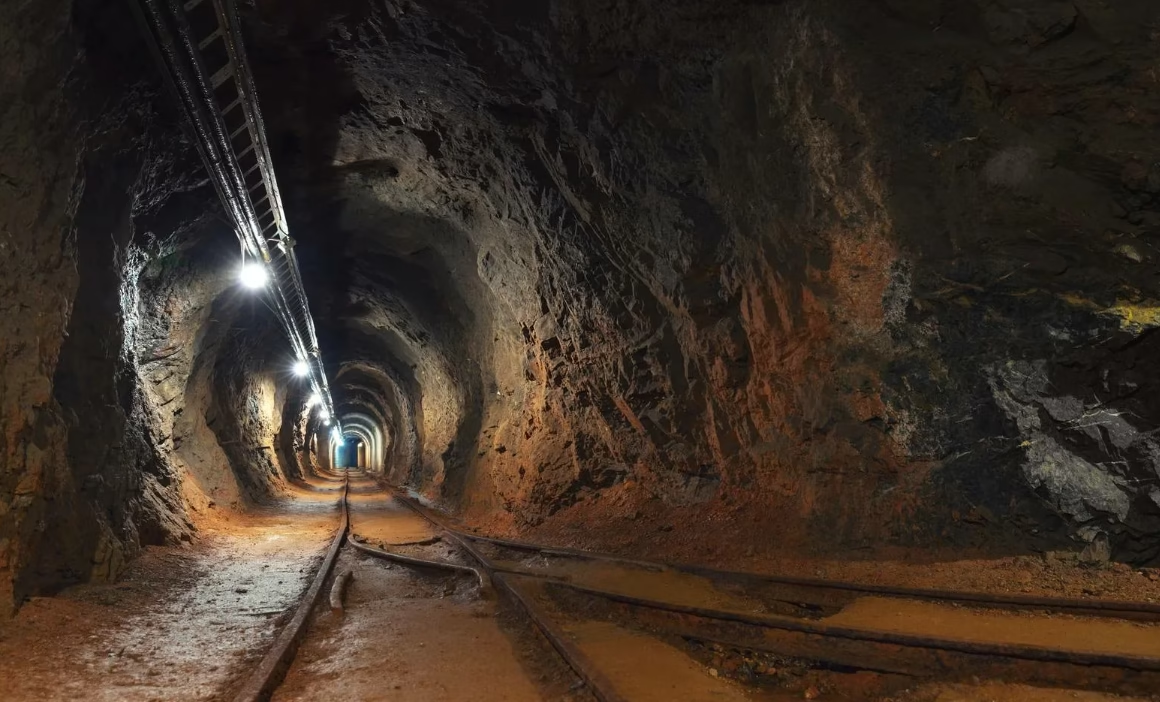
electrical engineering mining

Российская Федерация эксплуатирует ~200 действующих угольных шахт с подземной добычей, расположенных в пяти основных угольных бассейнах: Кузбасс (Кемеровская область, ~50% подземной добычи), Печорский бассейн (Республика Коми, ~15%), Донбасс (Луганская и Донецкая области, контролируемая часть), Южно-Якутский бассейн (Сахалин, малая доля), и экспортно-ориентированные шахты Сахалина. Суммарное потребление гибких электрических кабелей среднего напряжения 1.14–6.3kV в подземных выработках оценивается в 800–1 200 отрезков в год — производство сосредоточено на трёх заводах: Кольчугинский завод (Владимирская область), Камкабель (Пермь), и ЗАО «Уралкабель» (Екатеринбург). Логистическое плечо от центральных заводов до шахт Кузбасса составляет 3 500–4 500 км по железной дороге, добавляя 10–14 дней к сроку поставки. В критические периоды (предоплановые ремонты, аварийные замены) срок ожидания кабеля КГЭШ 1.14kV достигает 18–26 недель.

VDE 0250 Part 812 vs ГОСТ: Может ли (N)SSHÖU 1.14kV заменить российский КГЭШ 1.14kV в подземных угольных шахтах?Полное инженерно-закупочное руководство

Российская Федерация эксплуатирует ~200 действующих угольных шахт с подземной добычей, расположенных в пяти основных угольных бассейнах: Кузбасс (Кемеровская область, ~50% подземной добычи), Печорский бассейн (Республика Коми, ~15%), Донбасс (Луганская и Донецкая области, контролируемая часть), Южно-Якутский бассейн (Сахалин, малая доля), и экспортно-ориентированные шахты Сахалина. Суммарное потребление гибких электрических кабелей среднего напряжения 1.14–6.3kV в подземных выработках оценивается в 800–1 200 отрезков в год — производство сосредоточено на трёх заводах: Кольчугинский завод (Владимирская область), Камкабель (Пермь), и ЗАО «Уралкабель» (Екатеринбург). Логистическое плечо от центральных заводов до шахт Кузбасса составляет 3 500–4 500 км по железной дороге, добавляя 10–14 дней к сроку поставки. В критические периоды (предоплановые ремонты, аварийные замены) срок ожидания кабеля КГЭШ 1.14kV достигает 18–26 недель.
Сибирский и Дальневосточный федеральные округа России — от Кузбасса на западе до Магаданской области на востоке — включают более 400 горнодобывающих предприятий открытого и подземного типа: угольные разрезы Кемеровской области (СУЭК, Кузбассразрезуголь), золотодобывающие предприятия Красноярского края и Магадана (Полюс, Полиметалл), алмазные рудники Якутии (АЛРОСА), медно-никелевые предприятия Норильского промышленного района (Норникель) и железорудные карьеры Иркутской области. Суммарное потребление гибких экранированных кабелей среднего напряжения 6кВ (марки КГЭ-ХЛ, КГЭШ-ХЛ) оценивается в 1 200–2 000 отрезков в год — при этом производство сосредоточено на трёх заводах в Центральной России: Кольчугинский завод «Электрокабель» (Владимирская область), ОАО «Камкабель» (Пермский край) и ЗАО «Уралкабель» (Екатеринбург). Логистическое плечо от этих заводов до потребителей в Якутии или Магадане составляет 5 000–8 000 км, добавляя 2–4 недели к сроку поставки только на транспортировку. В пиковые периоды полный цикл «заказ → доставка на рудник» для КГЭ-ХЛ 6кВ 3×95мм² растягивается с номинальных 10–12 недель до 16–22 недель.

VDE 0250 vs ГОСТ: Может ли (N)TSCGEWÖU 6/10kV заменить российский КГЭ-ХЛ 6кВ в сибирских рудниках?Полное инженерно-закупочное руководство

Сибирский и Дальневосточный федеральные округа России — от Кузбасса на западе до Магаданской области на востоке — включают более 400 горнодобывающих предприятий открытого и подземного типа: угольные разрезы Кемеровской области (СУЭК, Кузбассразрезуголь), золотодобывающие предприятия Красноярского края и Магадана (Полюс, Полиметалл), алмазные рудники Якутии (АЛРОСА), медно-никелевые предприятия Норильского промышленного района (Норникель) и железорудные карьеры Иркутской области. Суммарное потребление гибких экранированных кабелей среднего напряжения 6кВ (марки КГЭ-ХЛ, КГЭШ-ХЛ) оценивается в 1 200–2 000 отрезков в год — при этом производство сосредоточено на трёх заводах в Центральной России: Кольчугинский завод «Электрокабель» (Владимирская область), ОАО «Камкабель» (Пермский край) и ЗАО «Уралкабель» (Екатеринбург). Логистическое плечо от этих заводов до потребителей в Якутии или Магадане составляет 5 000–8 000 км, добавляя 2–4 недели к сроку поставки только на транспортировку. В пиковые периоды полный цикл «заказ → доставка на рудник» для КГЭ-ХЛ 6кВ 3×95мм² растягивается с номинальных 10–12 недель до 16–22 недель.
Standards Clarification: AS/NZS 1972 defines Type 9 explicitly as a gas non-transmission cable, specifically engineered for flameproof (Ex d) electrical equipment enclosures. Type 9 cables are typically small-diameter, multi-core control or monitoring cables (0.5 mm², 1.5 mm², etc.)—never large power conductors like 3×95 mm². 标准澄清:AS/NZS 1972明确定义Type 9为防气体传输电缆,特别是为了防爆(Ex d)电气设备外壳而设计。Type 9电缆通常是小径、多芯的控制或监测电缆(0.5 mm²、1.5 mm²等)——绝对不是大功率导体如3×95 mm²。 Why the Confusion? The numbering system in AS/NZS 1972 progresses from Type 1 (fixed installation) through Type 8 (vertical shaft DWA cables). Type 9's designation comes last but reflects a specialized application (flameproof enclosures) rather than advancement in power capacity. Engineers sometimes assume higher type numbers equal higher voltage/current capacity—this assumption is incorrect for Type 9.

Tensile Load Limits: Calculating Maximum Suspension Depth for AS/NZS 1972 Mining Cables

Standards Clarification: AS/NZS 1972 defines Type 9 explicitly as a gas non-transmission cable, specifically engineered for flameproof (Ex d) electrical equipment enclosures. Type 9 cables are typically small-diameter, multi-core control or monitoring cables (0.5 mm², 1.5 mm², etc.)—never large power conductors like 3×95 mm². 标准澄清:AS/NZS 1972明确定义Type 9为防气体传输电缆,特别是为了防爆(Ex d)电气设备外壳而设计。Type 9电缆通常是小径、多芯的控制或监测电缆(0.5 mm²、1.5 mm²等)——绝对不是大功率导体如3×95 mm²。 Why the Confusion? The numbering system in AS/NZS 1972 progresses from Type 1 (fixed installation) through Type 8 (vertical shaft DWA cables). Type 9’s designation comes last but reflects a specialized application (flameproof enclosures) rather than advancement in power capacity. Engineers sometimes assume higher type numbers equal higher voltage/current capacity—this assumption is incorrect for Type 9.Standards Clarification: AS/NZS 1972 defines Type 9 explicitly as a gas non-transmission cable, specifically engineered for flameproof (Ex d) electrical equipment enclosures. Type 9 cables are typically small-diameter, multi-core control or monitoring cables (0.5 mm², 1.5 mm², etc.)—never large power conductors like 3×95 mm². 标准澄清:AS/NZS 1972明确定义Type 9为防气体传输电缆,特别是为了防爆(Ex d)电气设备外壳而设计。Type 9电缆通常是小径、多芯的控制或监测电缆(0.5 mm²、1.5 mm²等)——绝对不是大功率导体如3×95 mm²。 Why the Confusion? The numbering system in AS/NZS 1972 progresses from Type 1 (fixed installation) through Type 8 (vertical shaft DWA cables). Type 9’s designation comes last but reflects a specialized application (flameproof enclosures) rather than advancement in power capacity. Engineers sometimes assume higher type numbers equal higher voltage/current capacity—this assumption is incorrect for Type 9.
Type 7S cables are specifically engineered for mining applications where equipment must operate in wet, chemically hostile, and mechanically demanding underground environments. The designation "7S" indicates a cable designed for high mechanical stress combined with submersion protection—the perfect specification for permanent dewatering pump installations in deep mine shafts. Type 7S电缆专门为必须在潮湿、化学腐蚀性和机械要求苛刻的地下环境中运行的采矿应用而设计。术语"7S"表示一种为高机械应力结合浸没保护而设计的电缆——是深矿井永久降水泵安装的完美规范。

Dewatering Pumps: Is Type 7S 1.1kV 3x50mm² Suitable for Permanent Submerged Connections?

Type 7S cables are specifically engineered for mining applications where equipment must operate in wet, chemically hostile, and mechanically demanding underground environments. The designation “7S” indicates a cable designed for high mechanical stress combined with submersion protection—the perfect specification for permanent dewatering pump installations in deep mine shafts. Type 7S电缆专门为必须在潮湿、化学腐蚀性和机械要求苛刻的地下环境中运行的采矿应用而设计。术语”7S”表示一种为高机械应力结合浸没保护而设计的电缆——是深矿井永久降水泵安装的完美规范。
A pilot core is a small-diameter, individually insulated conductor that runs the full length of a Type 3S mining cable alongside the power conductors and earth cores. Its purpose is to carry a low-voltage supervisory signal from the substation to the remote equipment and back, allowing a monitoring relay at the substation to continuously verify that the cable's earth return path (the path through which fault currents flow to ground) remains intact and unbroken. In a Type 3S 6.6kV 3x150mm² cable, the pilot core is typically 10–25 mm² in cross-sectional area (much smaller than the 150 mm² power conductors), has its own color-coded insulation to distinguish it from the two earth cores, and is the critical difference that transforms a cable from simple power delivery (Type 2S) into a safety-monitored system (Type 3S). For equipment like continuous miners, pump stations, or large longwall systems that operate far from direct visual supervision, the pilot core provides the electrical equivalent of a "safety tether"—if that tether breaks, the system knows immediately and can shut down before a dangerous fault condition develops.

Earth Fault Monitoring: Identifying Pilot Cores in Type 3S 6.6kV 3x150mm² Feeder Cables

AS/NZS 1972, AS/NZS 1972 Type 3S, Type 3S cable, Type 3S 6.6kV, 6.6kV mining cable, earth fault monitoring mining, earth continuity monitoring, pilot core identification, 3x150mm2 mining cable, 150mm2 6.6kV cable, AS/NZS 2081, AS/NZS mining standards, underground coal mine cable, SWA mining cable, individual screen cable, XLPE insulated mining cable, medium voltage mining cable, mine power feeder, electrical safety mining, earth return path, interstitial pilot core, 300 MCM mining cable, AWG equivalent mining cable, cable outer diameter, mining cable copper weight, 6.6kV ampacity, cable selection mining, mine substation feeder, electrical engineering mining, Prysmian mining cable, Olex Type 3S, earth fault relay, mining cable specifications, semi-fixed mining cable, flame retardant PVC sheath, heavy duty mine cable, AS/NZS 1972 vs Type 2S, cable cross section 150mm2, pilot circuit monitoring, high voltage cable splicing, mining cable termination, earth core sizing, short circuit rating mining, mining infrastructure electrical, AS/NZS 3008 ampacity, underground equipment power supply, machine cable underground, mining cable technical data, fault protection mining, pilot wire relay
A Type 2S 3.3kV XLPE mining cable with a 3×95mm² conductor cross-section has two completely independent short circuit ratings: the phase conductor short circuit rating of approximately 13.6 kiloamperes (meaning the three phase conductors can withstand a three-phase symmetrical fault current of 13.6 kA for up to one second before reaching their 250°C thermal limit), and the earth screen fault capacity of approximately 5.0 kiloamperes (meaning the individual copper or copper-alloy screening layer surrounding each phase conductor can safely conduct a phase-to-earth fault current of 5.0 kA for the duration of a protective relay response, typically 50–100 milliseconds). These two ratings are not alternatives or overlapping specifications—they describe different physical paths through which fault current flows, different insulation stress scenarios, and different design objectives. Understanding why these two ratings exist, how they differ, and how they interact with mine protection systems is essential for any electrical engineer designing or specifying cable systems in underground coal mines.

Short Circuit Rating: Earth Screen Fault Capacity for AS/NZS 1972 Type 2S XLPE Cables

A Type 2S 3.3kV XLPE mining cable with a 3×95mm² conductor cross-section has two completely independent short circuit ratings: the phase conductor short circuit rating of approximately 13.6 kiloamperes (meaning the three phase conductors can withstand a three-phase symmetrical fault current of 13.6 kA for up to one second before reaching their 250°C thermal limit), and the earth screen fault capacity of approximately 5.0 kiloamperes (meaning the individual copper or copper-alloy screening layer surrounding each phase conductor can safely conduct a phase-to-earth fault current of 5.0 kA for the duration of a protective relay response, typically 50–100 milliseconds). These two ratings are not alternatives or overlapping specifications—they describe different physical paths through which fault current flows, different insulation stress scenarios, and different design objectives. Understanding why these two ratings exist, how they differ, and how they interact with mine protection systems is essential for any electrical engineer designing or specifying cable systems in underground coal mines.
The Type 2S 11kV 3x95mm² cable has a base ampacity of 285 amperes when installed in free air at 40°C ambient temperature. However, in a typical underground mine substation where three or more feeder cables are installed side-by-side on a cable ladder, the practical usable current is reduced to approximately 228 amperes through application of temperature and grouping derating factors. This 228 A figure is the number that should govern your design calculations and equipment sizing for the substation feeder. Type 2S 11kV 3x95mm² 电缆在 40°C 环境温度的自由空气中安装时,其基础载流量为 285 安培。但在地下矿山变电站中,三根或更多馈电电缆并排安装在电缆桥架上的典型情况下,通过应用温度和编组降额系数,实际可用电流减少至约 228 安培。这个 228 A 的数字应该管理您的设计计算和变电站馈电的设备选型。

Ampacity Derating: Sizing Type 2S 11kV 3x95mm² for Underground Mine Substations (Ambient 40°C)

The Type 2S 11kV 3x95mm² cable has a base ampacity of 285 amperes when installed in free air at 40°C ambient temperature. However, in a typical underground mine substation where three or more feeder cables are installed side-by-side on a cable ladder, the practical usable current is reduced to approximately 228 amperes through application of temperature and grouping derating factors. This 228 A figure is the number that should govern your design calculations and equipment sizing for the substation feeder. Type 2S 11kV 3x95mm² 电缆在 40°C 环境温度的自由空气中安装时,其基础载流量为 285 安培。但在地下矿山变电站中,三根或更多馈电电缆并排安装在电缆桥架上的典型情况下,通过应用温度和编组降额系数,实际可用电流减少至约 228 安培。这个 228 A 的数字应该管理您的设计计算和变电站馈电的设备选型。
The nominal weight of a Type 3S 3.3kV 3x240mm² steel wire armoured cable is approximately 13,200 to 13,800 kilograms per kilometer (kg/km), or roughly 13.2 to 13.8 kilograms per linear meter. For practical planning purposes, engineers working with Feichun's Type 3S 3x240mm² product should design logistics and installation equipment assuming 13.5 kg/m as the midpoint value. This is not a lightweight cable—a single 1,000-meter feeder run will weigh 13,500 kilograms (13.5 tonnes), demanding heavy-duty mechanical handling equipment and careful transport planning from the moment the cable leaves the manufacturing facility. Type 3S 3.3kV 3x240mm² 钢丝铠装电缆的标称重量约为 13,200 至 13,800 千克/公里 (kg/km),或粗略计算每线性米约 13.2 至 13.8 公斤。 为了实际规划目的,与 Feichun 的 Type 3S 3x240mm² 产品合作的工程师应该以 13.5 kg/m 作为中点值来设计物流和安装设备。这不是一根轻型电缆——单个 1,000 米的馈电敷设将重达 13,500 公斤(13.5 吨),从电缆离开制造厂的那一刻起就需要重型机械处理设备和仔细的运输规划。

Weight & Logistics: Calculating kg/km for Heavy-Duty Type 3S 3.3kV 3x240mm² Steel Wire Armoured Cables

The nominal weight of a Type 3S 3.3kV 3x240mm² steel wire armoured cable is approximately 13,200 to 13,800 kilograms per kilometer (kg/km), or roughly 13.2 to 13.8 kilograms per linear meter. For practical planning purposes, engineers working with Feichun’s Type 3S 3x240mm² product should design logistics and installation equipment assuming 13.5 kg/m as the midpoint value. This is not a lightweight cable—a single 1,000-meter feeder run will weigh 13,500 kilograms (13.5 tonnes), demanding heavy-duty mechanical handling equipment and careful transport planning from the moment the cable leaves the manufacturing facility. Type 3S 3.3kV 3x240mm² 钢丝铠装电缆的标称重量约为 13,200 至 13,800 千克/公里 (kg/km),或粗略计算每线性米约 13.2 至 13.8 公斤。 为了实际规划目的,与 Feichun 的 Type 3S 3x240mm² 产品合作的工程师应该以 13.5 kg/m 作为中点值来设计物流和安装设备。这不是一根轻型电缆——单个 1,000 米的馈电敷设将重达 13,500 公斤(13.5 吨),从电缆离开制造厂的那一刻起就需要重型机械处理设备和仔细的运输规划。
The nominal outer diameter (OD) of an AS/NZS 1972 Type 2S 11kV 3x185mm² feeder cable is 76.0 to 80.0 millimeters (3.0 to 3.15 inches). The typical design center for Feichun's Type 2S 3x185mm² product is approximately 78.6 mm. This measurement is taken across the outermost surface of the flame-retardant PVC sheath, which forms the final protective layer after the galvanized steel wire armour (SWA) and inner insulation geometry. 澳标 AS/NZS 1972 Type 2S 11kV 3x185mm² 馈电电缆的标称外径为 76.0 至 80.0 毫米(3.0 至 3.15 英寸)。 Feichun Type 2S 3x185mm² 产品的典型设计中心约为 78.6 mm。该测量是在钢丝铠装 (SWA) 和内层绝缘几何结构之后,在阻燃 PVC 外护套的最外表面进行的。 This 76–80 mm range is not arbitrary—it represents the accumulated thicknesses of multiple cable components layered concentrically around the three power conductors. To understand where this dimension comes from, an electrical engineer planning a mine installation must understand the contribution of each layer.

Outer Diameter Specs: What is the Nominal OD for AS/NZS 1972 Type 2S 11kV 3x185mm² Feeder Cable?

The nominal outer diameter (OD) of an AS/NZS 1972 Type 2S 11kV 3x185mm² feeder cable is 76.0 to 80.0 millimeters (3.0 to 3.15 inches). The typical design center for Feichun’s Type 2S 3x185mm² product is approximately 78.6 mm. This measurement is taken across the outermost surface of the flame-retardant PVC sheath, which forms the final protective layer after the galvanized steel wire armour (SWA) and inner insulation geometry. 澳标 AS/NZS 1972 Type 2S 11kV 3x185mm² 馈电电缆的标称外径为 76.0 至 80.0 毫米(3.0 至 3.15 英寸)。 Feichun Type 2S 3x185mm² 产品的典型设计中心约为 78.6 mm。该测量是在钢丝铠装 (SWA) 和内层绝缘几何结构之后,在阻燃 PVC 外护套的最外表面进行的。 This 76–80 mm range is not arbitrary—it represents the accumulated thicknesses of multiple cable components layered concentrically around the three power conductors. To understand where this dimension comes from, an electrical engineer planning a mine installation must understand the contribution of each layer.
The Single Most Important Cable Design Decision in Underground Coal Mining: Whether the cable employs collective screening (Type 2) or individual phase screening (Type 2S). This single engineering choice directly determines whether a mechanical cable failure will result in a phase-to-earth fault (detected and stopped in milliseconds) or a phase-to-phase fault with thousands of amperes of arc current (igniting methane explosions).

Type 2 vs Type 2S: Why the “S” (Individual Screen) is Mandatory for 11kV Underground Coal Mines

The Single Most Important Cable Design Decision in Underground Coal Mining: Whether the cable employs collective screening (Type 2) or individual phase screening (Type 2S). This single engineering choice directly determines whether a mechanical cable failure will result in a phase-to-earth fault (detected and stopped in milliseconds) or a phase-to-phase fault with thousands of amperes of arc current (igniting methane explosions).
Direct Answer: Standard (N)TSCGEWÖU cables based on DIN VDE 0250-813 are not compliant with AS/NZS 1802 underground coal mining standards. The non-compliance is not merely a matter of standard jurisdiction—it reflects fundamental physical and electrical differences in cable structure, particularly regarding pilot core design and semiconductive cradle technology. 直接答案:基于DIN VDE 0250-813的标准(N)TSCGEWÖU电缆不符合AS/NZS 1802井下煤矿标准。非合规性不仅仅是标准管辖权的问题——它反映了电缆结构的根本物理和电气差异,特别是关于导引线设计和半导体支架技术。 Consequence: Using (N)TSCGEWÖU cables on Australian or New Zealand underground coal mining equipment violates workplace safety regulations and mining electrical codes. It also renders the equipment's earth fault detection system non-functional, eliminating critical protection against explosion and electrical hazards.

Is (N)TSCGEWÖU Compliant with AS/NZS 1802 Coal Mining Standards? Understanding the Pilot Core Issue

Direct Answer: Standard (N)TSCGEWÖU cables based on DIN VDE 0250-813 are not compliant with AS/NZS 1802 underground coal mining standards. The non-compliance is not merely a matter of standard jurisdiction—it reflects fundamental physical and electrical differences in cable structure, particularly regarding pilot core design and semiconductive cradle technology. 直接答案:基于DIN VDE 0250-813的标准(N)TSCGEWÖU电缆不符合AS/NZS 1802井下煤矿标准。非合规性不仅仅是标准管辖权的问题——它反映了电缆结构的根本物理和电气差异,特别是关于导引线设计和半导体支架技术。 Consequence: Using (N)TSCGEWÖU cables on Australian or New Zealand underground coal mining equipment violates workplace safety regulations and mining electrical codes. It also renders the equipment’s earth fault detection system non-functional, eliminating critical protection against explosion and electrical hazards.
Yes, properly-specified generic (N)TSCGEWÖU 3x70+3x35/3 6/10kV cables can reliably replace Sandvik OEM cables on underground load-haul-dump loaders, with realistic cost savings of 20 to 40 percent over the cable's service life, provided that five critical verification steps are completed before installation. The generic cable must have an outer diameter not exceeding 59.1 millimeters (matching or staying within the original cable's drum clearance envelope), must feature verified anti-torsion braid rated for minimum ±25° per meter torsional resistance (preventing corkscrewing failures), must specify an outer jacket of either premium 5GM5 elastomer or polyurethane formulation confirmed for underground abrasion resistance (not standard CPE), must carry a maximum tensile load rating of at least 3,150 to 4,200 newtons (matching Sandvik's duty cycle), and must include complete technical documentation of insulation thickness and conductor stranding patterns (enabling proper splicing compatibility). Additionally, the cable supplier must provide type-test certification according to DIN VDE 0250-813 and ideally field-proven performance data from comparable underground mining installations. When these five criteria are met, field experience from underground mines across Scandinavia, North America, and Australia demonstrates that properly-specified generic cables achieve service lives of 3 to 5 years—matching or occasionally exceeding OEM cable longevity—while reducing procurement costs by $80,000 to $150,000 per cable depending on the specific LHD model and regional pricing. However, many suppliers offering cables under the "(N)TSCGEWÖU" designation do not actually meet these technical requirements. Low-cost variants that compromise on anti-torsion structure, use inadequate jacket material, or provide incomplete documentation will fail within 6 to 12 months of underground operation, creating safety hazards and erasing the cost savings through premium pricing for emergency replacement cables and associated downtime. Therefore, the straightforward answer "yes, generic cables can work" comes with an essential caveat: success requires rigorous verification of the specific generic cable specification before procurement, not blind assumption that any product bearing the (N)TSCGEWÖU designation meets the technical requirements of underground LHD operation.

Underground LHD Loaders: Replacing OEM Sandvik Cables with Generic (N)TSCGEWÖU 3×70+3×35/3

Yes, properly-specified generic (N)TSCGEWÖU 3×70+3×35/3 6/10kV cables can reliably replace Sandvik OEM cables on underground load-haul-dump loaders, with realistic cost savings of 20 to 40 percent over the cable’s service life, provided that five critical verification steps are completed before installation. The generic cable must have an outer diameter not exceeding 59.1 millimeters (matching or staying within the original cable’s drum clearance envelope), must feature verified anti-torsion braid rated for minimum ±25° per meter torsional resistance (preventing corkscrewing failures), must specify an outer jacket of either premium 5GM5 elastomer or polyurethane formulation confirmed for underground abrasion resistance (not standard CPE), must carry a maximum tensile load rating of at least 3,150 to 4,200 newtons (matching Sandvik’s duty cycle), and must include complete technical documentation of insulation thickness and conductor stranding patterns (enabling proper splicing compatibility). Additionally, the cable supplier must provide type-test certification according to DIN VDE 0250-813 and ideally field-proven performance data from comparable underground mining installations. When these five criteria are met, field experience from underground mines across Scandinavia, North America, and Australia demonstrates that properly-specified generic cables achieve service lives of 3 to 5 years—matching or occasionally exceeding OEM cable longevity—while reducing procurement costs by $80,000 to $150,000 per cable depending on the specific LHD model and regional pricing. However, many suppliers offering cables under the “(N)TSCGEWÖU” designation do not actually meet these technical requirements. Low-cost variants that compromise on anti-torsion structure, use inadequate jacket material, or provide incomplete documentation will fail within 6 to 12 months of underground operation, creating safety hazards and erasing the cost savings through premium pricing for emergency replacement cables and associated downtime. Therefore, the straightforward answer “yes, generic cables can work” comes with an essential caveat: success requires rigorous verification of the specific generic cable specification before procurement, not blind assumption that any product bearing the (N)TSCGEWÖU designation meets the technical requirements of underground LHD operation.