DIN VDE 0282

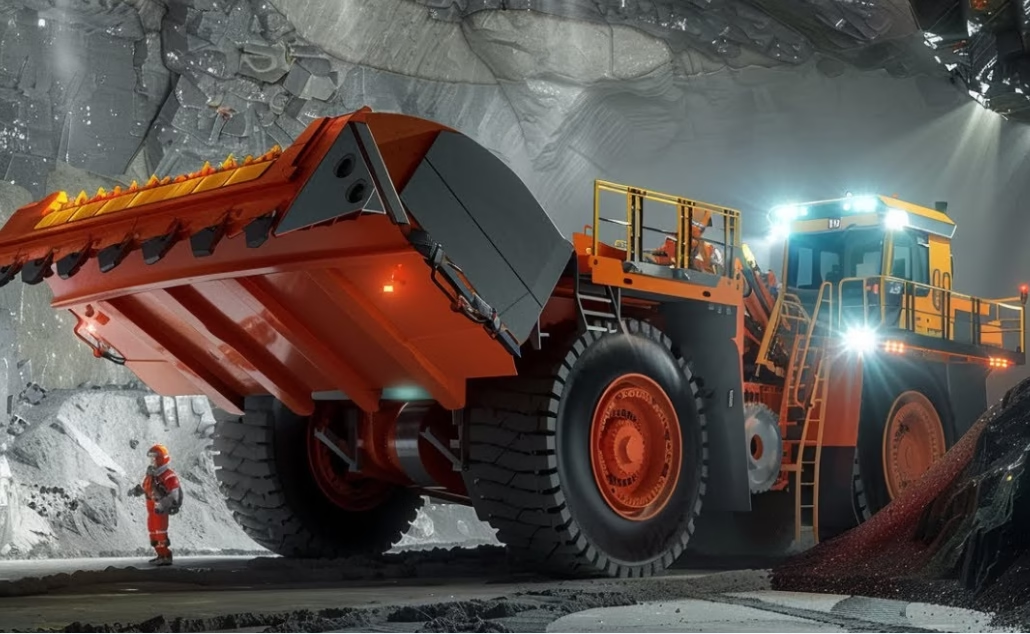
飞纯 Type 209 是飞纯电缆基于 AS/NZS 1802:2003 卷筒与拖曳电缆 体系设计的矿用柔性馈电与拖曳电缆系列,电压范围覆盖 1.1 至 11KV。根据产品资料,Type 209 系列电缆主要作为矿山机械柔性馈电电缆使用,更适合作为拖曳电缆而不是高频卷筒电缆。较小规格适用于钻机、手持工具和移动设备。 这一定义是理解 Type 209 的关键。Type 209 不是普通工业橡套软电缆,也不只是单纯的矿山供电线。它的核心定位是 矿山机械柔性馈电电缆,也就是为矿山机械提供可移动、可拖曳、可适应复杂作业路径的供电系统。同时,它更适合作为 拖曳电缆,即跟随设备移动的电缆,而不是长期高频卷绕使用的卷筒电缆。

什么是 H07RN8-F 450/750V Harmonized Rubber Cables

H07RN8-F 450/750V Harmonized Rubber Cables 是一种用于潜水泵和类似工业水下应用的重型柔性橡套电缆。根据资料说明,该电缆可用于工业用水环境,适用水深最高可达 10 m,水温范围最高可达 40℃,同时也适用于干燥、潮湿和湿润应用。Feichun 将其定位于矿山排水、地下工程排涝、港口泵站、码头检修排水、工业水池和移动潜水泵供电等场景。它的工程价值不是单纯“能进水”,而是在水压、潮湿、移动、拉拽、磨损和低压动力传输同时存在时,仍能通过 Class 5 多股铜导体、EI4 橡胶绝缘、EM2/EM3 内护套与 EM2 外护套形成稳定的电气与机械防护系统。
BASKET SPREADER 740 (YSLTOE) is engineered specifically for hoisting and control applications where mechanical flexibility and electrical reliability must coexist in marine environments. Unlike load-bearing structural cables (which prioritize tensile strength), control cables emphasize: Conductor flexibility – Repeated bending over pulleys without mechanical fatigue Insulation integrity – Voltage breakdown resistance under salt-fog corrosion Mechanical damping – Rope-like flexibility to drape naturally in spreader bar frames Environmental barrier – Outer sheath blocks salt, moisture, and UV penetration Core Design Elements: Component Material Specification Function Port Environment Benefit Conductor Flexible red copper Class 6 (IEC 60228) Carries 300/500V power; enables bending flexibility High purity copper resists galvanic corrosion Insulation PVC type YI2 (IEC 60811) Electrical isolation; voltage breakdown resistance (2 kV test) PVC with marine additives prevents salt-induced tracking Central Unit Aramide yarns (Kevlar™ equivalent) Mechanical load-bearing backup; structural integrity Aramide resists moisture & salt; absorbs vibration stress Outer Sheath PUR type 11YM1 (DIN 73377) Environmental barrier; UV/ozone/moisture protection Superior salt-fog resistance; 20+ year marine lifespan

YSLTOE

BASKET SPREADER 740 (YSLTOE) is engineered specifically for hoisting and control applications where mechanical flexibility and electrical reliability must coexist in marine environments. Unlike load-bearing structural cables (which prioritize tensile strength), control cables emphasize: Conductor flexibility – Repeated bending over pulleys without mechanical fatigue Insulation integrity – Voltage breakdown resistance under salt-fog corrosion Mechanical damping – Rope-like flexibility to drape naturally in spreader bar frames Environmental barrier – Outer sheath blocks salt, moisture, and UV penetration Core Design Elements: Component Material Specification Function Port Environment Benefit Conductor Flexible red copper Class 6 (IEC 60228) Carries 300/500V power; enables bending flexibility High purity copper resists galvanic corrosion Insulation PVC type YI2 (IEC 60811) Electrical isolation; voltage breakdown resistance (2 kV test) PVC with marine additives prevents salt-induced tracking Central Unit Aramide yarns (Kevlar™ equivalent) Mechanical load-bearing backup; structural integrity Aramide resists moisture & salt; absorbs vibration stress Outer Sheath PUR type 11YM1 (DIN 73377) Environmental barrier; UV/ozone/moisture protection Superior salt-fog resistance; 20+ year marine lifespan
H07BN4-F HAR Nomenclature Breakdown (per CEI 20-20/20-19): H = Harmonized standard designation (IEC 60227 compliance) Indicates cable meets international safety standards Full compatibility with European electrical regulations 07 = Voltage designation (Uo/U = 450/750V) 07 = 450/750V nominal voltage class (other classes: 03 = 300/500V, 04 = 400/690V) Testing: 3 kV test voltage (10 times nominal) B = Special feature (Flexible/Benign environment) B typically indicates bare or flexible conductor design (Standard = no letter designation) N = Rubber type designation N = Normally-proportioned sheath thickness (S = Slim/reduced, T = Thick/reinforced) For H07BN4-F: N = Standard thickness for 450/750V industrial use Insulation thickness: 1.2 mm per DIN VDE 0282 Sheath thickness: 1.0–1.5 mm per DIN VDE 0293 4 = Number of principal tests/features Typically indicates: (1) Temperature range, (2) Insulation type, (3) Sheath composition, (4) Mechanical properties certification F = Flexibility designation F = Fully flexible (can be wound on reels) (Other: S = Service-cord, C = Cable) H07BN4-F can be: Coiled on reel: Yes (reelable) Bent radius: Down to 4×D (normal use) to 2×D (close to terminal) Repeated winding: Yes (drum rating available) Continuous flexing: Yes (up to 50+ million cycles per EN 50266) HAR = Harmonics-compatible technology designation HAR = High-frequency harmonic and transient rated Specifically designed for: - VFD (variable frequency drive) motor circuits (up to 20 kHz switching) - Welding equipment (high current transients, multi-frequency content) - Industrial power electronics environments (distorted waveforms) HAR testing per EN 50334: Transient overvoltage withstand: 3× nominal voltage, sustained Harmonic content up to 50th harmonic: Fully rated Dv/dt immunity: >3 kV/µs (fast switching events) Comparison: Standard vs. HAR designation Standard H07BN4-F (without HAR): Frequency: Single 50/60 Hz only Total harmonic distortion (THD) limit: 20% acceptable (VFD typical) Transient immunity: Enhanced (3+ kV nominal test) Suitable for: VFD motors, welding, power electronics Cost: +8–12% premium over standard Application advantage: Single cable type serves both conventional and VFD circuits

FLEXIFESTOON® H07BN4-F

H07BN4-F HAR Nomenclature Breakdown (per CEI 20-20/20-19): H = Harmonized standard designation (IEC 60227 compliance) Indicates cable meets international safety standards Full compatibility with European electrical regulations 07 = Voltage designation (Uo/U = 450/750V) 07 = 450/750V nominal voltage class (other classes: 03 = 300/500V, 04 = 400/690V) Testing: 3 kV test voltage (10 times nominal) B = Special feature (Flexible/Benign environment) B typically indicates bare or flexible conductor design (Standard = no letter designation) N = Rubber type designation N = Normally-proportioned sheath thickness (S = Slim/reduced, T = Thick/reinforced) For H07BN4-F: N = Standard thickness for 450/750V industrial use Insulation thickness: 1.2 mm per DIN VDE 0282 Sheath thickness: 1.0–1.5 mm per DIN VDE 0293 4 = Number of principal tests/features Typically indicates: (1) Temperature range, (2) Insulation type, (3) Sheath composition, (4) Mechanical properties certification F = Flexibility designation F = Fully flexible (can be wound on reels) (Other: S = Service-cord, C = Cable) H07BN4-F can be: Coiled on reel: Yes (reelable) Bent radius: Down to 4×D (normal use) to 2×D (close to terminal) Repeated winding: Yes (drum rating available) Continuous flexing: Yes (up to 50+ million cycles per EN 50266) HAR = Harmonics-compatible technology designation HAR = High-frequency harmonic and transient rated Specifically designed for: – VFD (variable frequency drive) motor circuits (up to 20 kHz switching) – Welding equipment (high current transients, multi-frequency content) – Industrial power electronics environments (distorted waveforms) HAR testing per EN 50334: Transient overvoltage withstand: 3× nominal voltage, sustained Harmonic content up to 50th harmonic: Fully rated Dv/dt immunity: >3 kV/µs (fast switching events) Comparison: Standard vs. HAR designation Standard H07BN4-F (without HAR): Frequency: Single 50/60 Hz only Total harmonic distortion (THD) limit: 20% acceptable (VFD typical) Transient immunity: Enhanced (3+ kV nominal test) Suitable for: VFD motors, welding, power electronics Cost: +8–12% premium over standard Application advantage: Single cable type serves both conventional and VFD circuits
GAALFLEX® CONTROL 500 CP Lean: Advanced EMI-Suppressed Oil-Resistant Multi-Core Control Cable for Harsh Industrial Environments (300/500 V Nominal, 3 kV Test Voltage per DIN VDE 0281, −40 to +80°C Fixed Installation / −5 to +70°C Flexible Application, Class 5 Flexible Red Bare Copper per IEC 60228 and DIN VDE 0295, PETP Foil Wrapping Plus Overall Tinned Copper Wire Braid Screen Providing ≥85 dB EMI Attenuation Across Industrial Frequency Spectrum, Grey PUR Special Compound Outer Sheath (RAL 7001) Delivering Superior Oil Resistance

GAALFLEX® CONTROL 500 CP Lean

GAALFLEX® CONTROL 500 CP Lean: Advanced EMI-Suppressed Oil-Resistant Multi-Core Control Cable for Harsh Industrial Environments (300/500 V Nominal, 3 kV Test Voltage per DIN VDE 0281, −40 to +80°C Fixed Installation / −5 to +70°C Flexible Application, Class 5 Flexible Red Bare Copper per IEC 60228 and DIN VDE 0295, PETP Foil Wrapping Plus Overall Tinned Copper Wire Braid Screen Providing ≥85 dB EMI Attenuation Across Industrial Frequency Spectrum, Grey PUR Special Compound Outer Sheath (RAL 7001) Delivering Superior Oil Resistance
Feichun FLEXIFESTOON® H07BN4-F HAR: Advanced EPR Rubber Industrial Flexible Control Cables for European Heavy-Duty Crane, Festoon, and Mobile Equipment Applications (450/750V Rated, −45 to +90°C Continuous Service, Extreme Short-Circuit Temperature Resistance +250°C Thermal Shock, EPR Rubber Insulation with Elastomer Outer Sheath, Specialized Multi-Scenario Bending Radius Engineering 4×D to 8×D Application-Dependent, Exceptional Torsion Resistance ±150°/m for Sling Applications, Crane-Sling Festoon-Rated, CEI 20-19/20-20, DIN VDE 0282-part-1, CENELEC HD 22.2 Full Compliance, Self-Extinguishing Flame-Retardant Per EN 50265-2-1/IEC 60332-1-2, RoHS/CE Approved, Complete 1.5–630 mm² Conductor Range with 45 SKU Configurations): Comprehensive Rubber Materials Science and Thermal-Shock Engineering Analysis Integrating Advanced EPR Polymer Architecture, Short-Circuit Temperature Tolerance Mechanisms, Flame-Retardant Chemical Systems, Multi-Application Bending-Radius Optimization, Torsion-Fatigue Resistance Engineering, and European Heavy-Duty Industrial Integration European heavy-duty industrial automation—overhead traveling cranes in manufacturing plants, ship-deck crane systems, festoon cable reeling systems for mobile equipment, traction-powered work platforms, automated handling systems in factories, mining conveyor supports, and construction site hoisting equipment—demands electrical control cabling engineered to withstand the combined mechanical and thermal stresses found nowhere else in industrial service: extreme short-circuit current thermal shock (+250°C instantaneous temperature rise, lasting milliseconds during fault conditions, requiring polymer thermal stability and rapid thermal recovery without degradation or mechanical property loss), continuous mechanical flexure from repeated coiling/uncoiling on festoon reels and bending around pulleys (millions of flex cycles annually), torsional stress from cable twist and rotational equipment motion (±150°/meter maximum torsion specifications for sling applications), multi-scenario bending-radius requirements varying from 4×D (fixed installation) to 8×D (high-speed festoon reeling, pulley systems) depending on mechanical context), and stringent flame-retardancy mandates for enclosed factory environments with combustible materials nearby. Conventional industrial cables fail catastrophically under short-circuit thermal shock: PVC insulation softens and loses dimensional stability; standard EPDM undergoes permanent cross-link degradation and reversion loss. FLEXIFESTOON® H07BN4-F HAR represents a specialized European industrial cable engineered through advanced EPR (ethylene-propylene rubber) polymer chemistry combined with sophisticated flame-retardant additives, delivering simultaneous optimization across all five performance domains: extreme short-circuit temperature tolerance (+250°C thermal recovery without property loss), exceptional mechanical flexure endurance (millions of bend cycles), superior torsion resistance (±150°/m continuous), application-adaptive bending-radius engineering (4–8×D scenario-specific design), and comprehensive flame-retardancy compliance per European standards—enabling European industrial engineers, heavy-equipment manufacturers, and factory automation integrators to deploy a unified advanced cable solution across the complete spectrum of demanding crane, festoon, and mobile equipment applications with proven durability and safety across extreme-stress scenarios.

FLEXIFESTOON® H07BN4-F

Feichun FLEXIFESTOON® H07BN4-F HAR: Advanced EPR Rubber Industrial Flexible Control Cables for European Heavy-Duty Crane, Festoon, and Mobile Equipment Applications (450/750V Rated, −45 to +90°C Continuous Service, Extreme Short-Circuit Temperature Resistance +250°C Thermal Shock, EPR Rubber Insulation with Elastomer Outer Sheath, Specialized Multi-Scenario Bending Radius Engineering 4×D to 8×D Application-Dependent, Exceptional Torsion Resistance ±150°/m for Sling Applications, Crane-Sling Festoon-Rated, CEI 20-19/20-20, DIN VDE 0282-part-1, CENELEC HD 22.2 Full Compliance, Self-Extinguishing Flame-Retardant Per EN 50265-2-1/IEC 60332-1-2, RoHS/CE Approved, Complete 1.5–630 mm² Conductor Range with 45 SKU Configurations): Comprehensive Rubber Materials Science and Thermal-Shock Engineering Analysis Integrating Advanced EPR Polymer Architecture, Short-Circuit Temperature Tolerance Mechanisms, Flame-Retardant Chemical Systems, Multi-Application Bending-Radius Optimization, Torsion-Fatigue Resistance Engineering, and European Heavy-Duty Industrial Integration European heavy-duty industrial automation—overhead traveling cranes in manufacturing plants, ship-deck crane systems, festoon cable reeling systems for mobile equipment, traction-powered work platforms, automated handling systems in factories, mining conveyor supports, and construction site hoisting equipment—demands electrical control cabling engineered to withstand the combined mechanical and thermal stresses found nowhere else in industrial service: extreme short-circuit current thermal shock (+250°C instantaneous temperature rise, lasting milliseconds during fault conditions, requiring polymer thermal stability and rapid thermal recovery without degradation or mechanical property loss), continuous mechanical flexure from repeated coiling/uncoiling on festoon reels and bending around pulleys (millions of flex cycles annually), torsional stress from cable twist and rotational equipment motion (±150°/meter maximum torsion specifications for sling applications), multi-scenario bending-radius requirements varying from 4×D (fixed installation) to 8×D (high-speed festoon reeling, pulley systems) depending on mechanical context), and stringent flame-retardancy mandates for enclosed factory environments with combustible materials nearby. Conventional industrial cables fail catastrophically under short-circuit thermal shock: PVC insulation softens and loses dimensional stability; standard EPDM undergoes permanent cross-link degradation and reversion loss. FLEXIFESTOON® H07BN4-F HAR represents a specialized European industrial cable engineered through advanced EPR (ethylene-propylene rubber) polymer chemistry combined with sophisticated flame-retardant additives, delivering simultaneous optimization across all five performance domains: extreme short-circuit temperature tolerance (+250°C thermal recovery without property loss), exceptional mechanical flexure endurance (millions of bend cycles), superior torsion resistance (±150°/m continuous), application-adaptive bending-radius engineering (4–8×D scenario-specific design), and comprehensive flame-retardancy compliance per European standards—enabling European industrial engineers, heavy-equipment manufacturers, and factory automation integrators to deploy a unified advanced cable solution across the complete spectrum of demanding crane, festoon, and mobile equipment applications with proven durability and safety across extreme-stress scenarios.
The VDE (Verband der Elektrotechnik) designation system is widely adopted across Europe for identifying cable properties and specifications. According to the DIN VDE 0292 standard, type designation codes provide systematic identification of cable characteristics including conductor material, insulation type, and structural features. (VDE命名系统在欧洲广泛采用,用于标识电缆特性和规格。根据DIN VDE 0292标准,型号代码系统性地标识电缆特性,包括导体材料、绝缘类型和结构特征。)

VDE Cable Designation: Understanding “G”, “2G”, and “3G” Insulation Material Codes

The VDE (Verband der Elektrotechnik) designation system is widely adopted across Europe for identifying cable properties and specifications. According to the DIN VDE 0292 standard, type designation codes provide systematic identification of cable characteristics including conductor material, insulation type, and structural features. (VDE命名系统在欧洲广泛采用,用于标识电缆特性和规格。根据DIN VDE 0292标准,型号代码系统性地标识电缆特性,包括导体材料、绝缘类型和结构特征。)
Сварочные кабели серии TENAX®-SL H01N2-D и H01N2-E производятся в соответствии с международным стандартом DIN VDE 0282, часть 6. Данный стандарт определяет требования к конструкции, материалам и электрическим характеристикам гибких кабелей для сварочного оборудования.

Сварочные кабели TENAX®-SL H01N2-D H01N2-E

сварочный кабель H01N2-D, сварочный кабель TENAX, гибкий сварочный кабель, кабель для дуговой сварки, кабель для сварочного аппарата, кабель сварочный медный, кабель сварочный резиновый, токовая нагрузка сварочного кабеля, сечение сварочного кабеля, кабель КГ сварочный, кабель для электродной сварки, кабель сварочный маслостойкий, кабель сварочный морозостойкий
Polyurethane cables, commonly abbreviated as PUR cables, represent a specialized category of industrial wiring solutions engineered with thermoplastic polyurethane sheathing materials. These cables are characterized by their halogen-free composition, exceptional flame resistance properties, and superior mechanical and chemical resistance capabilities, which collectively render them optimal for deployment in demanding industrial environments where conventional PVC or rubber-sheathed cables would experience premature degradation.

What is PUR Cable?

H05BQ-F cable, H07BQ-F cable, H05BZ5-F cable, H07BZ5-F cable, PUR-JZ cable, PUR-HF cable, Veriflex PUR cable, Powerchain PUR cable, PUR Ethernet cable, screened PUR cable, PUR trommel cable, PUR festoon cable, Mode 4 EV cable, DC EV charging cable