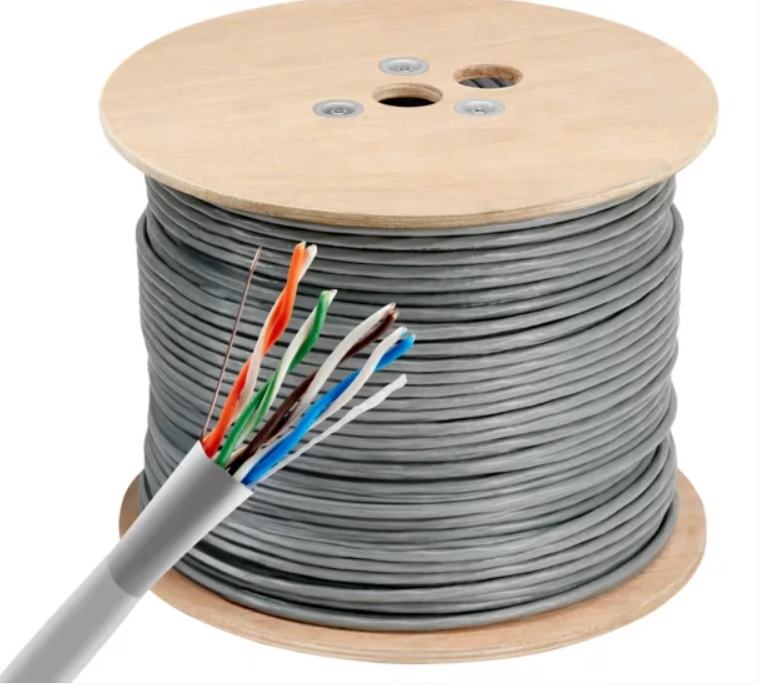
data cable

BASKET SPREADER 750: Next-Generation Hoisting Cable Architecture The BASKET SPREADER 750 (3GSLTOE) represents a fundamental advancement in hoisting control cable design, specifically engineered for next-generation automated port crane systems operating under extreme environmental and operational constraints. Unlike the BASKET SPREADER 740's 300/500V AC specification, the 750 operates at 0.6/1kV AC with dual-voltage DC capability (0.9/1.8 kV)—a classification shift that enables: Higher power capacity – 2–3× greater amperage per conductor, enabling longer cable runs with lower voltage drop Medium-voltage infrastructure compatibility – Direct integration with port substation power distribution systems (0.6 kV = 600V three-phase industrial standard) DC dual-voltage operation – Simultaneous support for AC motor control and DC feedback/signaling circuits (0.9/1.8 kV DC margins) Extreme temperature capability – Operating range −50°C to +80°C (vs. SPREADER 740's −20°C to +60°C), addressing Arctic port terminals and tropical high-ambient scenarios Advanced insulation chemistry – GAALTHERM® 530 thermoplastic compound replaces standard PVC/PUR, delivering superior chemical resistance and thermal stability This cable bridges the gap between standard control cables (300/500V, limited temperature) and heavy industrial medium-voltage distribution cables, creating a purpose-built solution for modern automated gantry crane systems in global port terminals.

Что такое ÖLFLEX® INSTRUM RE-Y(ST)YRY: инженерный анализ армированного heat resistant PVC кабеля с общим экраном

ÖLFLEX® INSTRUM RE-Y(ST)YRY — это армированный heat resistant PVC instrumentation/data cable с PVC (V-90HT) core insulation, overall screen, PVC inner sheath, galvanized steel wire armour and PVC outer sheath. Кабель предназначен для communication, data and voice transmission signal в industrial process manufacturing plants, Oil and Gas industry and petrochemical industry. По предоставленным данным он основан на EN 50288-7, имеет flame retardance according to IEC 60332-3-24, stranded plain annealed copper wires according to BS 6360 / IEC 60228 Class 2, aluminium polyester tape collective screen, tinned copper drain wire, black PVC inner sheath and black or blue PVC outer sheath.
PUR vs. Rubber Sheath Comparison: EPR/PCP rubber (traditional festoon): Base polymer: Ethylene-propylene or chloroprene rubber Density: ~1.2 g/cm³ (light) Young's modulus: ~2–8 MPa (soft, flexible) Tear strength: 15–30 kN/m (adequate) Tensile strength: 8–12 MPa (moderate) Oil resistance: Fair (EPR), Good (CPE) Cost: Low (commodity material) Typical life: 5–10 years PUR (polyurethane, FLEXIFESTOON PUR): Base polymer: Polyol + isocyanate urethane linkage Density: ~1.25 g/cm³ (slightly heavier per unit volume, but better properties) Young's modulus: ~10–15 MPa (stiffer, stronger) Tear strength: 30–50 kN/m (2–3× better than rubber) Tensile strength: 12–18 MPa (much stronger) Oil resistance: Excellent (far superior to rubber) Cost: Medium (specialty material) Typical life: 10–15 years (50–100% longer) PUR performance advantages: (1) Tear resistance: Mechanism: Urethane linkages form strong hydrogen bonds More rigid polymer network, resists crack propagation Consequence: Cable survives snagging on sharp edges Abrasion resistance 2–3× better than rubber Application: Machine tool environments (sharp metal edges, high speed) (2) Oil immersion durability: Rubber swelling in oil: 8–15% volume increase PUR swelling in oil: 2–5% volume increase (excellent stability) Result: Cable diameter remains stable, connections don't loosen No electrical performance degradation from oil ingress (3) Ozone & UV resistance: Rubber degradation rate: 10–20% strength loss per 5 years outdoor PUR degradation rate: 5–10% strength loss per 5 years outdoor Application: Outdoor machine tools, conveying systems in sunlight (4) Mechanical stress recovery: Rubber behavior: After bending, slow recovery (viscoelastic) PUR behavior: Rapid recovery, lower hysteresis loss Benefit: Lower heating during high-speed cycling 240 m/min reeling applications tolerate higher duty cycles Cost-benefit trade-off: PUR premium cost: +15–25% vs. standard rubber festoon cable Justification for premium: - 2× longer service life (10–15 years vs. 5–10 years) - Reduced maintenance/replacement downtime in industrial operations - Superior performance in aggressive environments (oil, chemicals) - Better value when cost-of-downtime is high (machine tools, production lines)

Что такое ÖLFLEX INSTRUM RE-2X(ST)YRY PiMF: бронированный инструментальный кабель с XLPE-изоляцией и PiMF-экранированием

ÖLFLEX INSTRUM RE-2X(ST)YRY PiMF — это бронированный инструментальный кабель с XLPE-изоляцией, индивидуальным экраном каждой пары, общим экраном, PVC внутренней оболочкой, оцинкованной стальной проволочной бронёй и PVC наружной оболочкой black или blue. Он предназначен для передачи communication, data and voice transmission signals in industrial process manufacturing plants, особенно в Oil and Gas industry, petrochemical industry и промышленных системах КИПиА, где требуется одновременно сигнальная стабильность, EMC-защита и повышенная механическая стойкость кабельной трассы.
High-speed, high-quality end-to-end data transmission cables for communication technology applications including data transfer, sound and video communications, signalling and instrumentation. Our range covers EIA-232, EIA-422, EIA-423 and EIA-485 standards with LSF, LSZH, PE and PVC sheathing options offering superior performance characteristics.

Belden and Alternative / Equivalent Cables

Belden 9841, Belden 9842, Belden 9843, Belden 9844, Belden 8723, Belden 8728, Belden 8777, Belden 8778, Belden 9501, Belden 9502, Belden 9503, Belden 9504, Belden 9506, Belden 9508, Belden 9510, Belden 8760, Belden 8761, Belden 8762, Belden 8102, Belden 8103, Belden 8104, Belden 8105, Belden 8106, Belden 8162, Belden 8163, Belden 1502R, Belden 8770, Belden 9927, Belden 9929, Belden 9934, Belden 9936
DIN VDE 0812 is a German national standard issued in 1988 that contains specifications for equipment wires and stranded equipment wires used within telecommunications and data processing systems. The standard covers flexible, multi-conductor cables designed for electronic control system connections, voice frequency transmission, and signal communications in fixed installations. These cables represent popular European alternatives to American-style data and control cables, featuring cores twisted into pairs to reduce crosstalk and electromagnetic interference.

What is DIN VDE 0812 Cable?

DIN VDE 0812 cables are designed for electronic control system connections, voice frequency transmission, and signal communications in fixed installations. They are widely used across various industries where reliable data and signal transmission is required in environments requiring flexibility and compact cable routing.
CEI 20-27 CENELEC HD361 Cable

What is CEI 20-27 CENELEC HD361 Cable?

CEI 20-27 CENELEC HD361 represents a standardized cable designation system developed by the European Committee for Electrotechnical Standardisation (CENELEC) to provide uniform identification and classification of harmonized power cables and cords across European markets. This systematic coding methodology enables engineers, procurement specialists, and electrical contractors to precisely identify cable specifications including voltage ratings, insulation materials, conductor types, and sheathing compounds through a structured alphanumeric designation format.