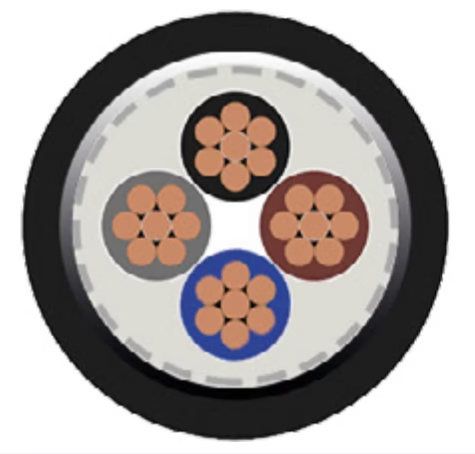
cable libre de halógenos

Technical reference for industrial equipment procurement specialists, port operations engineers, heavy-lift crane maintenance teams, electrical infrastructure planners, OEM equipment designers, and supply-chain optimization professionals. Comprehensive coverage: polyurethane polymer architecture (polyol component selection, isocyanate structure, degree of crosslinking, impact on mechanical/thermal properties); halogen-free flame-retardant chemistry (phosphorus-based and mineral-filled additives for LOI ≥30 without halogenated compounds); aramid-fiber engineering (para-aramid vs. meta-aramid trade-offs, fiber tensile strength >3,500 MPa, braiding angle optimization, stress-distribution modeling); mechanical property optimization (tear-strength formulation, abrasion-resistance testing per ASTM D1044, puncture-resistance engineering); oil-resistance chemistry (polyether vs. polyester polyol base, plasticizer selection for long-term swelling resistance); UV-stabilizer package design (carbon-black loading vs. alternative UV absorbers); DIN VDE 0250-813 (multi-core cable) and 0250-814 (single-core reeling cable) standards technical requirements and test protocols; comparative benchmarking of TROMMELFLEX vs. BUFLEX DGR across 20+ performance parameters; field deployment data from industrial port cranes, mining drag-chains, and heavy-lift systems across Europe, Asia, and North America; manufacturing process optimization highlighting Anhui Feichun's polyurethane extrusion capabilities (precision temperature control, die design for void-free sheaths, quality assurance for tear-strength consistency); total-cost-of-ownership modeling including material cost, labour, equipment downtime, and service-life extension; OEM compatibility qualification; and installation best practices for high-stress industrial environments.

TROMMELFLEX PUR-HF Halogen-Free Polyurethane Reeling Cable: Complete Technical Engineering Analysis of Multi-Core and Single-Core Configurations, High-Strength Aramid Anti-Torsion Braiding Architecture, Superior Mechanical Abrasion Resistance (20 N/mm² Tear Strength Standard), Low and Medium-Voltage Power Distribution (0.6/1.0 kV), Polyurethane Polymer Chemistry with Halogen-Free Flame-Retardant Additives, DIN VDE 0250-813 and 0250-814 Standards Compliance, Comparative Performance Benchmarking Against BUFLEX DGR System, Chemical Cross-Linking Analysis and Stress-Strain Engineering, Port Crane and Heavy-Lift Equipment Integration, Field Durability in Extreme Industrial Environments, Drop-In Replacement Qualification Framework, Manufacturing Process Optimization by Anhui Feichun Special Cable (Optimized Extrusion, 20 N/mm² Equivalent Tear Strength, Accelerated Delivery), Lifecycle Cost-of-Ownership Analysis, and OEM Equipment Compatibility Documentation

Technical reference for industrial equipment procurement specialists, port operations engineers, heavy-lift crane maintenance teams, electrical infrastructure planners, OEM equipment designers, and supply-chain optimization professionals. Comprehensive coverage: polyurethane polymer architecture (polyol component selection, isocyanate structure, degree of crosslinking, impact on mechanical/thermal properties); halogen-free flame-retardant chemistry (phosphorus-based and mineral-filled additives for LOI ≥30 without halogenated compounds); aramid-fiber engineering (para-aramid vs. meta-aramid trade-offs, fiber tensile strength >3,500 MPa, braiding angle optimization, stress-distribution modeling); mechanical property optimization (tear-strength formulation, abrasion-resistance testing per ASTM D1044, puncture-resistance engineering); oil-resistance chemistry (polyether vs. polyester polyol base, plasticizer selection for long-term swelling resistance); UV-stabilizer package design (carbon-black loading vs. alternative UV absorbers); DIN VDE 0250-813 (multi-core cable) and 0250-814 (single-core reeling cable) standards technical requirements and test protocols; comparative benchmarking of TROMMELFLEX vs. BUFLEX DGR across 20+ performance parameters; field deployment data from industrial port cranes, mining drag-chains, and heavy-lift systems across Europe, Asia, and North America; manufacturing process optimization highlighting Anhui Feichun’s polyurethane extrusion capabilities (precision temperature control, die design for void-free sheaths, quality assurance for tear-strength consistency); total-cost-of-ownership modeling including material cost, labour, equipment downtime, and service-life extension; OEM compatibility qualification; and installation best practices for high-stress industrial environments.
Extended technical guide for port electrical engineers, fire safety officers, crane OEMs, and terminal procurement teams covering: the fire safety rationale for halogen-free construction in enclosed port environments — hydrogen chloride toxicity, electronic equipment corrosion, and smoke obscuration during fire events; complete nomenclature decoding of the YSLZ3SOE-J designation per German VDE convention; TPE (thermoplastic elastomer) insulation and sheathing compound chemistry and why it differs fundamentally from thermoset rubber (EPR, EPDM, CR) used in standard reeling cables; mechanical performance analysis of TPE versus EPDM in dynamic reeling applications — flex-cycle endurance, tensile strength, tear resistance, and cold-temperature flexibility; vertical free-fall basket operation mechanics — catenary stress, coiling geometry, impact loading, and why basket spreader cables require different engineering than drum-wound reeling cables; IEC 60332-3 (flame propagation in bunched cables), IEC 61034 (smoke density measurement), and IEC 60754-2 (gas acidity by pH and conductivity) compliance analysis; salt fog performance limitations of TPE compounds (400–700 hours per ISO 9227) versus polychloroprene alternatives (800–1,500 hours); comparative evaluation against RHEYCORD® NSHTOEU-J (standard CR reeling), RHEYCORD®(RTS) (N)SHTOEU-J (premium CR reeling), RHEYCORD®-OFE SR (oil-resistant CR spreader), and CORDAFLEX® SMK-V (aramid-core vertical spreader); and FeiChun FC-RHEYCORD-BS marine-grade halogen-free equivalent with enhanced moisture barrier, FC-FLX™ tinned conductors, and aramid strength member for coastal service.

RHEYCORD®(BS) YSLZ3SOE-J — The Halogen-Free Basket Spreader Reeling Cable for Fire-Regulated Port Environments: TPE Construction Analysis, Vertical Free-Fall Basket Engineering, IEC 60332-3 / IEC 61034 / IEC 60754-2 Fire Safety Compliance, Salt Fog Performance Trade-Offs in Harbour Service, and Comparative Evaluation Against RHEYCORD® NSHTOEU-J, RHEYCORD®(RTS), RHEYCORD®-OFE SR, and CORDAFLEX® SMK-V with FeiChun FC-RHEYCORD-BS Marine-Grade Enhanced Equivalent

Extended technical guide for port electrical engineers, fire safety officers, crane OEMs, and terminal procurement teams covering: the fire safety rationale for halogen-free construction in enclosed port environments — hydrogen chloride toxicity, electronic equipment corrosion, and smoke obscuration during fire events; complete nomenclature decoding of the YSLZ3SOE-J designation per German VDE convention; TPE (thermoplastic elastomer) insulation and sheathing compound chemistry and why it differs fundamentally from thermoset rubber (EPR, EPDM, CR) used in standard reeling cables; mechanical performance analysis of TPE versus EPDM in dynamic reeling applications — flex-cycle endurance, tensile strength, tear resistance, and cold-temperature flexibility; vertical free-fall basket operation mechanics — catenary stress, coiling geometry, impact loading, and why basket spreader cables require different engineering than drum-wound reeling cables; IEC 60332-3 (flame propagation in bunched cables), IEC 61034 (smoke density measurement), and IEC 60754-2 (gas acidity by pH and conductivity) compliance analysis; salt fog performance limitations of TPE compounds (400–700 hours per ISO 9227) versus polychloroprene alternatives (800–1,500 hours); comparative evaluation against RHEYCORD® NSHTOEU-J (standard CR reeling), RHEYCORD®(RTS) (N)SHTOEU-J (premium CR reeling), RHEYCORD®-OFE SR (oil-resistant CR spreader), and CORDAFLEX® SMK-V (aramid-core vertical spreader); and FeiChun FC-RHEYCORD-BS marine-grade halogen-free equivalent with enhanced moisture barrier, FC-FLX™ tinned conductors, and aramid strength member for coastal service.
Rolling stock cables are specialized electrical cables designed for use in railway vehicles, including trains, metros, trams, and underground rail systems. These cables form part of a comprehensive product range encompassing all cables used by moving vehicles across railway, metro, and underground rail infrastructures. According to international railway standards, rolling stock cables must meet stringent requirements for fire safety, mechanical durability, and electrical performance.

What is Rolling Stock Cable?

LFH Rail Rolling Stock Part 6 Type I Cable, LFH Rail Rolling Stock Part 6 Type II Cable, LFH Rail Rolling Stock Part 6 Type III Cable, LFH Rail Rolling Stock Part 6 Type IV Cable, LFH Rail Rolling Stock Part 6 Type V Cable, LFH Rail Rolling Stock Part 6 Type VI Cable, LFH Rail Rolling Stock Part 6 Type VII Cable, LFH Rail Rolling Stock Part 6 Type VIII Cable, LFH Rail Rolling Stock Part 6 Type IX Cable, LFH Rail Rolling Stock Part 6 Type XI Cable, LFH Rail Rolling Stock Part 6 Type XII Cable, LFH Rail Rolling Stock Part 6 Type XIII Cable
Solar cables (also known as photovoltaic or PV cables) are specialized cables designed to interconnect the various components of photovoltaic power generation systems. These cables cover the full range of connections from solar panels to combiner boxes, inverters, transformers, and ultimately to local grid substations. Manufactured in accordance with EN 50618 (the current European harmonised standard, designated H1Z2Z2-K), modern solar cables are engineered to withstand severe environmental conditions including extreme UV exposure, wide temperature variations, moisture, and mechanical stress over an anticipated service life of approximately 25 years.

What are Solar Cables?

solar cable、PV cable、H1Z2Z2-K、EN 50618、NAYY cable、photovoltaic cable、TUV solar cable、aluminium solar cable、N2XY cable、N2XH cable、NA2XY cable、RZ1-K cable、NA2XH cable、NA2X2Y cable、NA2XSY cable、RZ1-K AS cable
UNE 21123 standard refers to the design and cross-sectional area specifications for cables used by utilities on power distribution circuits with voltage ratings up to and including 600/1000V (0.6/1kV). UNE standards are released by AENOR (Asociación Española de Normalización y Certificación), the Spanish Association for Standardisation and Certification. As AENOR is a member of ISO, IEC, and CENELEC, many of its standards are harmonized with European and international conventions.

What is UNE 21123 Cable?

UNE 21123 standard refers to the design and cross-sectional area specifications for cables used by utilities on power distribution circuits with voltage ratings up to and including 600/1000V (0.6/1kV). UNE standards are released by AENOR (Asociación Española de Normalización y Certificación), the Spanish Association for Standardisation and Certification. As AENOR is a member of ISO, IEC, and CENELEC, many of its standards are harmonized with European and international conventions.
IEC 60502 is an international standard published by the International Electrotechnical Commission (IEC) that sets out the specification for power cables with extruded insulation. The standard covers cables with voltage ratings from 1 kV (Um = 1.2 kV) up to 30 kV (Um = 36 kV), designed for fixed installations such as distribution networks and industrial installations. This widely recognized standard serves as a primary reference for cable manufacturers worldwide and forms the basis for numerous national and regional cable standards.

What is IEC 60502 Cable?

IEC 60502 對導體類型、絕緣材料和護套化合物提供了詳細規格。絕緣材料包括 PVC(最高溫度 70°C)、XLPE、EPR 和 HEPR(均為最高 90°C)。導體類別包括第 1 類(實心)、第 2 類(絞合)和第 5 類(柔性),尺寸範圍從 1.5 mm² 到 1600 mm²。護套化合物包括 PVC、PE 和用於防火敏感區域的無鹵素材料。XLPE 絕緣的標稱厚度從 0.6/1 kV 的 1.0 mm 到 18/30 kV 的 8.0 mm 不等。
EN 50525 cable, H07V-K cable, H07RN-F cable, H05VV-F cable, 6491X cable, 6491B cable, tri-rated cable, H07V2-K, H05V2-K, 318Y cable, 2491X cable, 2192Y cable, H07Z1-K LSZH cable, H03VV-F cable, H05RR-F cable, H07BN4-F 6381TQ, H01N2-D welding cable, H05S-K silicone cable, EN 50525-2-11, EN 50525-2-21, EN 50525-2-31, EN 50525-3-31, BS6500 replacement, CENELEC harmonized cable, low voltage cable 450/750V, European cable standard, PVC insulated cable, LSZH cable specification, elastomeric cable industrial, flexible thermoplastic cable, cable para instalación fija, cable libre de halógenos, cable de silicona alta temperatura, cable soldadura EN 50525, norma europea cables, cable armonizado CENELEC, cable baja tensión 750V, especificación cable EN 50525, cable industrial pesado H07RN-F, cable doméstico H05VV-F, cable tri-rated automotriz, EN 50525電纜, 歐洲統一電纜標準, 低壓電纜450/750V, LSZH無鹵電纜, 矽膠高溫電纜, 工業用橡膠電纜

¿Qué es el Cable EN 50525?

EN 50525 cable, H07V-K cable, H07RN-F cable, H05VV-F cable, 6491X cable, 6491B cable, tri-rated cable, H07V2-K, H05V2-K, 318Y cable, 2491X cable, 2192Y cable, H07Z1-K LSZH cable, H03VV-F cable, H05RR-F cable, H07BN4-F 6381TQ, H01N2-D welding cable, H05S-K silicone cable, EN 50525-2-11, EN 50525-2-21, EN 50525-2-31, EN 50525-3-31, BS6500 replacement, CENELEC harmonized cable, low voltage cable 450/750V, European cable standard, PVC insulated cable, LSZH cable specification, elastomeric cable industrial, flexible thermoplastic cable, cable para instalación fija, cable libre de halógenos, cable de silicona alta temperatura, cable soldadura EN 50525, norma europea cables, cable armonizado CENELEC, cable baja tensión 750V, especificación cable EN 50525, cable industrial pesado H07RN-F, cable doméstico H05VV-F, cable tri-rated automotriz, EN 50525電纜, 歐洲統一電纜標準, 低壓電纜450/750V, LSZH無鹵電纜, 矽膠高溫電纜, 工業用橡膠電纜