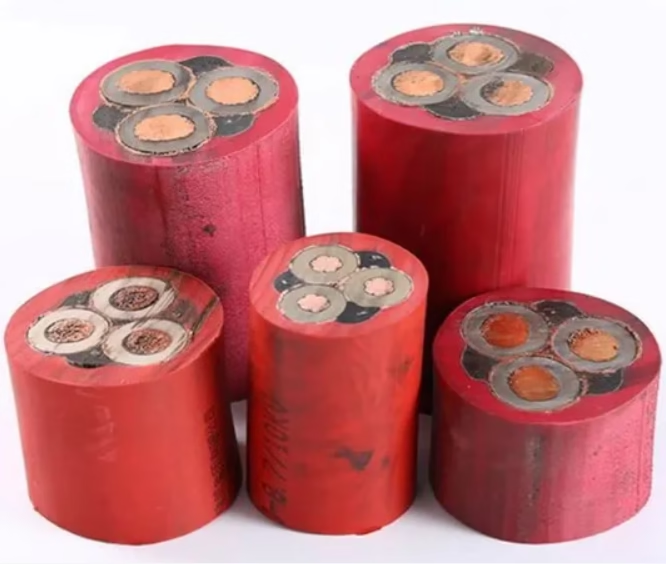
armored cable

SWA Cable Architecture & Engineering Design Strategy Purpose & Application Scope: Steel Wire Armored (SWA) cables represent the engineering solution for power distribution where mechanical protection, fire safety, and environmental resistance create absolute requirements. Unlike conventional cables relying solely on conduit or external protection, SWA cables integrate mechanical armoring as an integral structural component, offering permanent protection against physical damage, burrowing animals, excavation equipment, and external mechanical stress. Core Engineering Philosophy: SWA cable design employs multi-layer engineering architecture combining XLPE insulation excellence with steel wire mechanical protection and halogen-free outer sheathing. This integrated approach eliminates the need for external conduit in most underground, outdoor, and hazardous-area applications—reducing installation cost, complexity, and maintenance requirements while providing superior long-term reliability. Market Position & Regulatory Compliance: SWA cables comply with IEC 60502-1 international standards and equivalent national specifications including KS C specifications. These cables specifically address the requirements of the EN 50288 and equivalent standards covering cables with protective conductors and armored configurations. The combination of XLPE insulation with halogen-free sheathing provides automatic compliance with fire safety codes adopted across Europe, Asia, and industrial facilities worldwide where smoke emission and toxic fume generation create liability concerns.

0.6/1kV XLPE Insulated Halogen-Free Steel Wire Armored Cable

SWA Cable Architecture & Engineering Design Strategy Purpose & Application Scope: Steel Wire Armored (SWA) cables represent the engineering solution for power distribution where mechanical protection, fire safety, and environmental resistance create absolute requirements. Unlike conventional cables relying solely on conduit or external protection, SWA cables integrate mechanical armoring as an integral structural component, offering permanent protection against physical damage, burrowing animals, excavation equipment, and external mechanical stress. Core Engineering Philosophy: SWA cable design employs multi-layer engineering architecture combining XLPE insulation excellence with steel wire mechanical protection and halogen-free outer sheathing. This integrated approach eliminates the need for external conduit in most underground, outdoor, and hazardous-area applications—reducing installation cost, complexity, and maintenance requirements while providing superior long-term reliability. Market Position & Regulatory Compliance: SWA cables comply with IEC 60502-1 international standards and equivalent national specifications including KS C specifications. These cables specifically address the requirements of the EN 50288 and equivalent standards covering cables with protective conductors and armored configurations. The combination of XLPE insulation with halogen-free sheathing provides automatic compliance with fire safety codes adopted across Europe, Asia, and industrial facilities worldwide where smoke emission and toxic fume generation create liability concerns.
AmerCable 37-105319BS cable, which typically represents a three-conductor configuration of approximately 1/0 AWG (53.5 mm²) per conductor in the GEXOL® Type P series, has a maximum continuous ampacity of approximately 199 amperes under IEEE 45-2002 marine standards. This rating assumes the reference ambient condition of 45°C (113°F) in free air installation and assumes the conductors operate at the maximum allowable continuous temperature of 100°C (212°F). The "319" component of the model designation represents an internal AmerCable size code that corresponds to this 1/0 AWG conductor configuration, though the exact cross-sectional area may vary slightly depending on stranding geometry and manufacturing tolerances. The "BS" suffix designates the bronze sheath armor, a copper-based braided layer that provides exceptional corrosion resistance in marine, coastal, and underground environments while also offering superior grounding and electromagnetic shielding properties compared to steel-armored alternatives. The cable achieves its advantageous 100°C conductor rating through the use of GEXOL®, a cross-linked polyolefin insulation material engineered specifically for marine applications, providing superior thermal stability, flame resistance, and chemical resistance compared to conventional rubber or PVC insulation. The 199-ampere continuous rating represents the maximum safe sustained current the cable can carry indefinitely under the specified reference conditions without exceeding the insulation's thermal design limit. Understanding how this ampacity rating is derived from first principles and how it changes under different installation conditions is essential for electrical engineers designing marine power distribution systems and procurement specialists evaluating cable choices for offshore drilling, port operations, and industrial power applications.

Maximum Continuous Ampacity: What is the Ampacity for AmerCable 37-105319BS Under IEEE 45 Standards?

AmerCable 37-105319BS cable, which typically represents a three-conductor configuration of approximately 1/0 AWG (53.5 mm²) per conductor in the GEXOL® Type P series, has a maximum continuous ampacity of approximately 199 amperes under IEEE 45-2002 marine standards. This rating assumes the reference ambient condition of 45°C (113°F) in free air installation and assumes the conductors operate at the maximum allowable continuous temperature of 100°C (212°F). The “319” component of the model designation represents an internal AmerCable size code that corresponds to this 1/0 AWG conductor configuration, though the exact cross-sectional area may vary slightly depending on stranding geometry and manufacturing tolerances. The “BS” suffix designates the bronze sheath armor, a copper-based braided layer that provides exceptional corrosion resistance in marine, coastal, and underground environments while also offering superior grounding and electromagnetic shielding properties compared to steel-armored alternatives. The cable achieves its advantageous 100°C conductor rating through the use of GEXOL®, a cross-linked polyolefin insulation material engineered specifically for marine applications, providing superior thermal stability, flame resistance, and chemical resistance compared to conventional rubber or PVC insulation. The 199-ampere continuous rating represents the maximum safe sustained current the cable can carry indefinitely under the specified reference conditions without exceeding the insulation’s thermal design limit. Understanding how this ampacity rating is derived from first principles and how it changes under different installation conditions is essential for electrical engineers designing marine power distribution systems and procurement specialists evaluating cable choices for offshore drilling, port operations, and industrial power applications.
Offshore drilling mud pumps represent some of the most mission-critical equipment on modern drilling platforms. These pumps are driven by variable frequency drive (VFD) systems that optimize power consumption and equipment performance through sophisticated electronic switching, yet this advanced power control technology introduces an insidious threat: VFD-induced electrical discharge machining (EDM) damage to motor bearings, known as fluting. When mud pumps experience unexpected bearing failure due to EDM fluting, unplanned downtime costs platform operators hundreds of thousands of dollars per day in lost production capacity.

Type MMV-VFD (15kV): Managing High-Frequency EMI in Medium Voltage Offshore Drives

Offshore drilling mud pumps represent some of the most mission-critical equipment on modern drilling platforms. These pumps are driven by variable frequency drive (VFD) systems that optimize power consumption and equipment performance through sophisticated electronic switching, yet this advanced power control technology introduces an insidious threat: VFD-induced electrical discharge machining (EDM) damage to motor bearings, known as fluting. When mud pumps experience unexpected bearing failure due to EDM fluting, unplanned downtime costs platform operators hundreds of thousands of dollars per day in lost production capacity.

2kV Type P VFD Cables: Preventing Motor Bearing Damage on Offshore Mud Pumps

Offshore drilling mud pumps represent some of the most mission-critical equipment on modern drilling platforms. These pumps are driven by variable frequency drive (VFD) systems that optimize power consumption and equipment performance through sophisticated electronic switching, yet this advanced power control technology introduces an insidious threat: VFD-induced electrical discharge machining (EDM) damage to motor bearings, known as fluting. When mud pumps experience unexpected bearing failure due to EDM fluting, unplanned downtime costs platform operators hundreds of thousands of dollars per day in lost production capacity.
The selection of industrial power cables represents one of the most critical engineering decisions in drilling operations, whether on land or offshore. Two cable types dominate this application space: the Type SHD-GC (重型屏蔽接地检查电缆), designed primarily for mobile mining and terrestrial drilling equipment, and the Type P (海洋平台电缆), engineered specifically for harsh offshore and fixed platform environments. Though both cables operate at similar voltage ratings, they embody fundamentally different design philosophies that reflect the distinct mechanical, electrical, and safety demands of their respective application domains.

Type SHD-GC vs. Type P: Selecting the Right Trailing Cable for Land and Offshore Drilling 

The selection of industrial power cables represents one of the most critical engineering decisions in drilling operations, whether on land or offshore. Two cable types dominate this application space: the Type SHD-GC (重型屏蔽接地检查电缆), designed primarily for mobile mining and terrestrial drilling equipment, and the Type P (海洋平台电缆), engineered specifically for harsh offshore and fixed platform environments. Though both cables operate at similar voltage ratings, they embody fundamentally different design philosophies that reflect the distinct mechanical, electrical, and safety demands of their respective application domains.
The European and American approaches to cable engineering reflect fundamentally different environmental threat models. BFOU cables manufactured to NEK 606 specifications incorporate halogen-free insulation, SHF2 H-M compound sheathing, and mica glass tape (MGT) as a fire barrier, enabling uninterrupted power delivery during fire situations in accordance with IEC 60331-21. This design prioritizes survival of critical systems during extreme thermal events—a recognized hazard in confined spaces such as engine rooms and living quarters aboard offshore vessels.

Why Your BFOU Cable Needs a Type N Jacket Upgrade?

The European and American approaches to cable engineering reflect fundamentally different environmental threat models. BFOU cables manufactured to NEK 606 specifications incorporate halogen-free insulation, SHF2 H-M compound sheathing, and mica glass tape (MGT) as a fire barrier, enabling uninterrupted power delivery during fire situations in accordance with IEC 60331-21. This design prioritizes survival of critical systems during extreme thermal events—a recognized hazard in confined spaces such as engine rooms and living quarters aboard offshore vessels.
The question of whether a Type 450 33kV cable requires a bending radius of twelve times or fifteen times its overall diameter when installed on a monospiral reel is not merely an academic exercise but a critical consideration that directly impacts cable longevity, system reliability, and operational safety in medium-voltage power distribution networks. Understanding the correct specification requires examining the interplay between international standards, cable construction characteristics, and the specific mechanical conditions imposed by monospiral reel systems. Type 450 33kV电缆在单螺旋卷筒上安装时,其弯曲半径是需要12倍还是15倍外径,这不仅仅是一个学术问题,而是直接影响电缆寿命、系统可靠性和中压配电网络运行安全的关键考虑因素。理解正确的规范需要研究国际标准、电缆结构特性以及单螺旋卷筒系统施加的特定机械条件之间的相互作用。

Bending Radius for Type 450 33kV Cables on Monospiral Reels: 12xOD or 15xOD?

The question of whether a Type 450 33kV cable requires a bending radius of twelve times or fifteen times its overall diameter when installed on a monospiral reel is not merely an academic exercise but a critical consideration that directly impacts cable longevity, system reliability, and operational safety in medium-voltage power distribution networks. Understanding the correct specification requires examining the interplay between international standards, cable construction characteristics, and the specific mechanical conditions imposed by monospiral reel systems. Type 450 33kV电缆在单螺旋卷筒上安装时,其弯曲半径是需要12倍还是15倍外径,这不仅仅是一个学术问题,而是直接影响电缆寿命、系统可靠性和中压配电网络运行安全的关键考虑因素。理解正确的规范需要研究国际标准、电缆结构特性以及单螺旋卷筒系统施加的特定机械条件之间的相互作用。
When you look at a modern mining cable cross-section, you'll notice it contains more than just the power conductors that deliver electricity to mining equipment. Among these additional elements are one or more pilot cores—specialized conductors that serve critical safety and monitoring functions. While these pilot cores might seem like simple extra wires at first glance, they represent sophisticated monitoring infrastructure that enables mining operations to detect dangerous conditions before they cause injuries, equipment damage, or production interruptions.1 当您查看现代矿用电缆横截面时,您会注意到它包含的不仅仅是向采矿设备输送电力的电力导体。在这些附加元件中有一个或多个引导芯——服务于关键安全和监控功能的专用导体。

Digital Monitoring: Using Pilot Cores for Real-Time Temperature and Damage Detection

When you look at a modern mining cable cross-section, you’ll notice it contains more than just the power conductors that deliver electricity to mining equipment. Among these additional elements are one or more pilot cores—specialized conductors that serve critical safety and monitoring functions. While these pilot cores might seem like simple extra wires at first glance, they represent sophisticated monitoring infrastructure that enables mining operations to detect dangerous conditions before they cause injuries, equipment damage, or production interruptions.1 当您查看现代矿用电缆横截面时,您会注意到它包含的不仅仅是向采矿设备输送电力的电力导体。在这些附加元件中有一个或多个引导芯——服务于关键安全和监控功能的专用导体。
(N)TSKCGEWÖU specifications. This protective layer serves multiple critical functions within the cable assembly, with mechanical stress redistribution being among its most important roles. According to research published by Sibelco, the bedding compound is defined as the material applied around insulated conductors to maintain their position and provide bedding for protective armoring.[1] This layer functions as an intermediary component positioned between the laid-up cores and the metallic armor, creating what cable engineers describe as a separation sheath that fundamentally alters how mechanical forces are distributed throughout the cable structure.

Inner Sheath Function: Mechanical Stress Redistribution in (N)TSKCGEWÖU Cables

(N)TSKCGEWÖU specifications. This protective layer serves multiple critical functions within the cable assembly, with mechanical stress redistribution being among its most important roles. According to research published by Sibelco, the bedding compound is defined as the material applied around insulated conductors to maintain their position and provide bedding for protective armoring.[1] This layer functions as an intermediary component positioned between the laid-up cores and the metallic armor, creating what cable engineers describe as a separation sheath that fundamentally alters how mechanical forces are distributed throughout the cable structure.
Кабель силовой шахтный и экскаваторный необходим для подключения горнодобывающего оборудования, экскаваторов и другого землеройного оборудования, электроинструментов, а также для проведения горных взрывных работ. Шахтные кабели используют для всех типов шахт: угольные, соляные, сланцевые, а также подходят для открытых карьерных разработок. Кабели эксплуатируются на напряжении переменного тока 660, 1140, 6000 В.

What is Кабель для шахт?

КГЭШ, КГЭШ-1140, КГЭ, КГЭ-6, КГЭ-Т, КГЭ-ХЛ, КГЭ-ХЛ-6, КГЭС, КГЭТ, КГВШ, КГРШ, КШВГТ, ЭВБВ, ЭВБВ-6, ЭВТ-1140, ЭВТ-6000, кабель КГЭШ, кабель КГЭ, кабель ЭВБВ, шахтный кабель КГЭШ, экскаваторный кабель, mining cable KGESH, excavator cable KGE, KGESH cable, KGE cable, EVBV cable
Armoured cables, commonly referred to as SWA (Steel Wire Armoured) or AWA (Aluminium Wire Armoured) cables, are robust power cables designed with metallic armour protection for demanding installation environments. The armour provides mechanical protection where physical stress could damage the cable, such as direct burial underground, outdoor installations, or industrial environments. These cables are manufactured in accordance with British, European, and International standards including BS 5467, BS 6724, BS 6622, BS 7835, and IEC 60502.

What are Armoured Cables SWA & AWA?

SWA cable, AWA cable, armoured cable, steel wire armoured, aluminium wire armoured, BS 5467, BS 6724, BS 6622, BS 7835, IEC 60502, BASEC approved, XLPE cable, LSZH cable, underground cable, 0.6/1kV, 11kV cable, 33kV cable, N2XRY, NYFGBY, power cable, industrial cable, direct burial, 鎧裝電纜, 鋼絲鎧裝, cable blindado