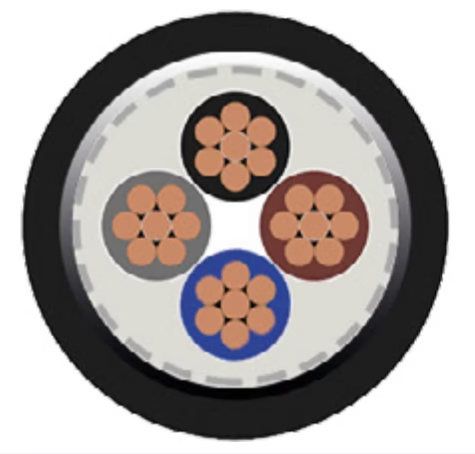
3.6/6kV cable

PNCT-R high-voltage reel cables represent an advanced evolution in portable power distribution—engineered specifically for container cranes, ship unloaders, cargo handling systems, and bulk terminal equipment where electrical power must be delivered dynamically through mechanically spooled cable reels. Unlike stationary cable installations with fixed routing and stress patterns, reel-deployed cables experience continuous repetitive flex-cycling, abrupt acceleration/deceleration forces, and environmental exposure across multiple geographic locations and climate conditions. Fundamental Design Challenge: Traditional high-voltage cables designed for fixed installations fail catastrophically when deployed on mechanical reels. The repetitive flex-cycling—where individual cable cross-sections bend and straighten thousands of times per shift—creates progressive internal stress concentration and insulation degradation. External mechanical stresses from reel spooling, retraction, equipment vibration, and wind loading accelerate conductor separation and sheath cracking. Standard copper braiding provides insufficient tensile support for repeated dynamic loads. Engineering Solution — Kevlar-Reinforced Architecture: PNCT-R cables integrate specialized Kevlar aramid fiber reinforcement layers—a material system engineered to absorb mechanical stress and prevent internal conductor displacement during dynamic cycling. Rather than relying solely on copper or aluminum tensile components, Kevlar fibers provide sustained tensile support through tens of thousands of flex cycles, maintaining conductor geometry integrity and preventing the progressive insulation failure characteristic of standard high-voltage cables deployed on reels. Feichun engineers have developed proprietary Kevlar weaving methodologies that integrate the reinforcement material within the cable architecture—not as external wrapping (which adds excessive weight), but as strategically positioned internal tensile layers coordinated with specialized sheath formulations. This integrated architecture enables PNCT-R cables to withstand 2+ million repetitive flex cycles at full operational stress without performance degradation.

PNCT-R High-Voltage Reel Cable Family

PNCT-R high-voltage reel cables represent an advanced evolution in portable power distribution—engineered specifically for container cranes, ship unloaders, cargo handling systems, and bulk terminal equipment where electrical power must be delivered dynamically through mechanically spooled cable reels. Unlike stationary cable installations with fixed routing and stress patterns, reel-deployed cables experience continuous repetitive flex-cycling, abrupt acceleration/deceleration forces, and environmental exposure across multiple geographic locations and climate conditions. Fundamental Design Challenge: Traditional high-voltage cables designed for fixed installations fail catastrophically when deployed on mechanical reels. The repetitive flex-cycling—where individual cable cross-sections bend and straighten thousands of times per shift—creates progressive internal stress concentration and insulation degradation. External mechanical stresses from reel spooling, retraction, equipment vibration, and wind loading accelerate conductor separation and sheath cracking. Standard copper braiding provides insufficient tensile support for repeated dynamic loads. Engineering Solution — Kevlar-Reinforced Architecture: PNCT-R cables integrate specialized Kevlar aramid fiber reinforcement layers—a material system engineered to absorb mechanical stress and prevent internal conductor displacement during dynamic cycling. Rather than relying solely on copper or aluminum tensile components, Kevlar fibers provide sustained tensile support through tens of thousands of flex cycles, maintaining conductor geometry integrity and preventing the progressive insulation failure characteristic of standard high-voltage cables deployed on reels. Feichun engineers have developed proprietary Kevlar weaving methodologies that integrate the reinforcement material within the cable architecture—not as external wrapping (which adds excessive weight), but as strategically positioned internal tensile layers coordinated with specialized sheath formulations. This integrated architecture enables PNCT-R cables to withstand 2+ million repetitive flex cycles at full operational stress without performance degradation.
The minimum bending radius for the (N)TSKCGEWÖU 3x95+3x16/3 3.6/6kV cable ranges from a minimum of approximately 348 millimeters for fixed installations to a maximum of 1,160 millimeters for S-curve transitions and forced-bend applications, with the most common reeling drum application falling in the 725–870 millimeter range. However, these numbers are meaningful only if you understand what they represent, why different installation types require different radii, and what happens to your cable if you bend it tighter than the specified limit. 最小弯曲半径范围从固定敷设的 348 毫米到 S 型转弯的 1,160 毫米不等,卷筒应用通常为 725–870 毫米。

Minimum Bending Radius: How Tight Can You Bend a (N)TSKCGEWÖU 3×95+3×16/3 3.6/6kV Cable?

The minimum bending radius for the (N)TSKCGEWÖU 3×95+3×16/3 3.6/6kV cable ranges from a minimum of approximately 348 millimeters for fixed installations to a maximum of 1,160 millimeters for S-curve transitions and forced-bend applications, with the most common reeling drum application falling in the 725–870 millimeter range. However, these numbers are meaningful only if you understand what they represent, why different installation types require different radii, and what happens to your cable if you bend it tighter than the specified limit. 最小弯曲半径范围从固定敷设的 348 毫米到 S 型转弯的 1,160 毫米不等,卷筒应用通常为 725–870 毫米。
Overland conveyor systems represent critical infrastructure for bulk material handling across mining, quarrying, and heavy industrial operations. When these systems extend beyond 5 kilometers, the selection of appropriate power distribution cables becomes a paramount engineering decision that directly impacts operational reliability, maintenance costs, and system longevity. According to industry standards published by the International Electrotechnical Commission, power cables for such applications must meet rigorous mechanical and electrical performance criteria to withstand the demanding operational environment. This technical analysis examines two primary cable architectures utilized in extended overland conveyor applications: armoured cables and flexible cables. Each design philosophy addresses specific operational requirements, with armoured configurations prioritizing mechanical protection for fixed installations, while flexible designs accommodate dynamic loading and continuous motion requirements. The selection between these cable types fundamentally depends on installation methodology, environmental conditions, mechanical stress profiles, and long-term operational economics.

Overland Conveyor Systems: Armoured vs. Flexible Cables for 5km+ Power Distribution

Overland conveyor systems represent critical infrastructure for bulk material handling across mining, quarrying, and heavy industrial operations. When these systems extend beyond 5 kilometers, the selection of appropriate power distribution cables becomes a paramount engineering decision that directly impacts operational reliability, maintenance costs, and system longevity. According to industry standards published by the International Electrotechnical Commission, power cables for such applications must meet rigorous mechanical and electrical performance criteria to withstand the demanding operational environment. This technical analysis examines two primary cable architectures utilized in extended overland conveyor applications: armoured cables and flexible cables. Each design philosophy addresses specific operational requirements, with armoured configurations prioritizing mechanical protection for fixed installations, while flexible designs accommodate dynamic loading and continuous motion requirements. The selection between these cable types fundamentally depends on installation methodology, environmental conditions, mechanical stress profiles, and long-term operational economics.
Variable frequency drives (VFDs) have revolutionized industrial motor control by enabling precise speed regulation and significant energy savings. However, these benefits come with a serious technical challenge that many facilities overlook until catastrophic failure occurs. When VFDs control AC motors through pulse width modulation (PWM), they create high-frequency electrical disturbances that can destroy motor bearings in a matter of months or even weeks, rather than the expected operational lifetime of years.

VFD Motor Bearing Damage: Why You Need (N)3GHSSYCY Screened Mining Cables?

Variable frequency drives (VFDs) have revolutionized industrial motor control by enabling precise speed regulation and significant energy savings. However, these benefits come with a serious technical challenge that many facilities overlook until catastrophic failure occurs. When VFDs control AC motors through pulse width modulation (PWM), they create high-frequency electrical disturbances that can destroy motor bearings in a matter of months or even weeks, rather than the expected operational lifetime of years.
The question of whether (N)TSKCGEWÖU medium-voltage mining cables can serve as direct replacements for the original equipment manufacturer cables on Epiroc Boomer E2 face drilling rigs requires careful examination of multiple technical, operational, and warranty considerations. This analysis becomes particularly important for mining operations seeking to optimize their cable procurement strategies through alternative suppliers while maintaining equipment performance, safety compliance, and operational reliability. The Epiroc Boomer E2 represents a sophisticated two-boom hydraulic face drill designed for medium to large drift applications with coverage areas up to one hundred twelve square meters, and its electrical power supply system demands cables that can withstand the rigorous mechanical stresses of underground drilling operations. 关于(N)TSKCGEWÖU中压矿用电缆能否作为Epiroc Boomer E2掘进钻机上的原始设备制造商电缆的直接替代品的问题,需要仔细审查多个技术、操作和保修考虑因素。这一分析对于寻求通过替代供应商优化其电缆采购策略,同时保持设备性能、安全合规性和操作可靠性的采矿作业尤为重要。Epiroc Boomer E2代表了一种精密的双臂液压掘进钻机,设计用于覆盖面积达112平方米的中型到大型巷道应用,其电力供应系统需要能够承受地下钻孔作业严格机械应力的电缆。

Can (N)TSKCGEWÖU Cables Be Used as a Direct Replacement for the OEM Reeling Cable on Epiroc Boomer E2 Drill Rigs?

The question of whether (N)TSKCGEWÖU medium-voltage mining cables can serve as direct replacements for the original equipment manufacturer cables on Epiroc Boomer E2 face drilling rigs requires careful examination of multiple technical, operational, and warranty considerations. This analysis becomes particularly important for mining operations seeking to optimize their cable procurement strategies through alternative suppliers while maintaining equipment performance, safety compliance, and operational reliability. The Epiroc Boomer E2 represents a sophisticated two-boom hydraulic face drill designed for medium to large drift applications with coverage areas up to one hundred twelve square meters, and its electrical power supply system demands cables that can withstand the rigorous mechanical stresses of underground drilling operations. 关于(N)TSKCGEWÖU中压矿用电缆能否作为Epiroc Boomer E2掘进钻机上的原始设备制造商电缆的直接替代品的问题,需要仔细审查多个技术、操作和保修考虑因素。这一分析对于寻求通过替代供应商优化其电缆采购策略,同时保持设备性能、安全合规性和操作可靠性的采矿作业尤为重要。Epiroc Boomer E2代表了一种精密的双臂液压掘进钻机,设计用于覆盖面积达112平方米的中型到大型巷道应用,其电力供应系统需要能够承受地下钻孔作业严格机械应力的电缆。
Determining the appropriate cable size for the main reel power supply of a Sandvik DD421 Development Jumbo requires a comprehensive analysis of the equipment's electrical power requirements, operational characteristics, and the specific technical parameters of German mining cable standards. The Sandvik DD421 is a two-boom electro-hydraulic development drill designed for fast and accurate drilling in tunneling and drifting operations covering cross-sectional areas from eight to sixty square meters. Understanding the relationship between this equipment's power consumption profile and the current-carrying capacity of (N)TSCGEWÖU medium-voltage trailing cables is essential for ensuring safe, reliable, and efficient operation in demanding underground mining environments.

Sandvik DD421: Which (N)TSCGEWÖU Cable Size is Suitable for the Main Reel of a Sandvik DD421 Development Jumbo?

Determining the appropriate cable size for the main reel power supply of a Sandvik DD421 Development Jumbo requires a comprehensive analysis of the equipment’s electrical power requirements, operational characteristics, and the specific technical parameters of German mining cable standards. The Sandvik DD421 is a two-boom electro-hydraulic development drill designed for fast and accurate drilling in tunneling and drifting operations covering cross-sectional areas from eight to sixty square meters. Understanding the relationship between this equipment’s power consumption profile and the current-carrying capacity of (N)TSCGEWÖU medium-voltage trailing cables is essential for ensuring safe, reliable, and efficient operation in demanding underground mining environments.
(N)TSCGEWÖU 3x185+3x35/3 medium voltage flexible mining cable typically weighs between 8,500 and 10,200 kilograms per kilometer, depending on the specific construction variant, insulation thickness, sheathing materials, and whether additional features such as anti-torsion braiding or fiber optic cores are incorporated. This weight range represents the complete cable assembly including all conductors, insulation layers, screening, inner and outer sheaths, and structural elements required for demanding mining and industrial applications. (N)TSCGEWÖU 3x185+3x35/3中压柔性采矿电缆的重量通常在每公里8,500至10,200千克之间,具体取决于特定的结构变型、绝缘厚度、护套材料,以及是否包含防扭转编织或光纤芯等附加功能。

Weight Calculator: What is the Approximate Weight per Meter (kg/km) of (N)TSCGEWÖU 3×185+3×35/3?

(N)TSCGEWÖU 3×185+3×35/3 medium voltage flexible mining cable typically weighs between 8,500 and 10,200 kilograms per kilometer, depending on the specific construction variant, insulation thickness, sheathing materials, and whether additional features such as anti-torsion braiding or fiber optic cores are incorporated. This weight range represents the complete cable assembly including all conductors, insulation layers, screening, inner and outer sheaths, and structural elements required for demanding mining and industrial applications. (N)TSCGEWÖU 3×185+3×35/3中压柔性采矿电缆的重量通常在每公里8,500至10,200千克之间,具体取决于特定的结构变型、绝缘厚度、护套材料,以及是否包含防扭转编织或光纤芯等附加功能。
Before we can properly discuss earthing techniques, we need to build a solid understanding of what (N)TSCGECEWÖU cables are and why their semiconductive screens require such careful attention. These cables represent one of the most sophisticated designs in medium voltage flexible power transmission, and understanding their construction will help you see why proper earthing is not just important but absolutely critical for safe operation.

How to properly earth the semiconductive screen of an (N)TSCGECEWÖU cable to prevent arcing?

Before we can properly discuss earthing techniques, we need to build a solid understanding of what (N)TSCGECEWÖU cables are and why their semiconductive screens require such careful attention. These cables represent one of the most sophisticated designs in medium voltage flexible power transmission, and understanding their construction will help you see why proper earthing is not just important but absolutely critical for safe operation.
Variable frequency drives represent critical components in modern industrial automation systems, enabling precise control of AC motor speed and torque through pulse width modulation technology. According to research from Nexans, VFD systems inherently create challenging operating conditions including high voltage spikes, electromagnetic interference, and radio frequency noise that standard power cables cannot adequately manage.[1] The selection of appropriate VFD-rated cables becomes essential for system reliability and longevity. 变频驱动器是现代工业自动化系统中的关键部件,通过脉宽调制技术实现对交流电机转速和扭矩的精确控制。根据耐克森公司的研究,变频系统固有地产生具有挑战性的运行条件,包括高电压尖峰、电磁干扰和射频噪声,标准电力电缆无法充分管理。选择合适的变频额定电缆对系统可靠性和使用寿命至关重要。

VFD Cable Compatibility Analysis

Variable frequency drives represent critical components in modern industrial automation systems, enabling precise control of AC motor speed and torque through pulse width modulation technology. According to research from Nexans, VFD systems inherently create challenging operating conditions including high voltage spikes, electromagnetic interference, and radio frequency noise that standard power cables cannot adequately manage.[1] The selection of appropriate VFD-rated cables becomes essential for system reliability and longevity. 变频驱动器是现代工业自动化系统中的关键部件,通过脉宽调制技术实现对交流电机转速和扭矩的精确控制。根据耐克森公司的研究,变频系统固有地产生具有挑战性的运行条件,包括高电压尖峰、电磁干扰和射频噪声,标准电力电缆无法充分管理。选择合适的变频额定电缆对系统可靠性和使用寿命至关重要。
Cable ampacity derating represents a fundamental consideration in electrical system design, particularly for mobile equipment and crane applications where environmental conditions deviate significantly from standard reference values. The ampacity, or current-carrying capacity, of a conductor must be adjusted based on actual installation conditions to prevent insulation degradation, ensure safety compliance, and maintain system reliability over the operational lifetime of the installation. 电缆载流量降额是电气系统设计中的一个基本考虑因素,特别是对于移动设备和起重机应用,其中环境条件显著偏离标准参考值。导体的载流量或电流承载能力必须根据实际安装条件进行调整,以防止绝缘退化,确保安全合规性,并在安装的整个使用寿命期间保持系统可靠性。

Ampacity Derating: What Causes “Z-kinking” in (N)TSFLCGEWÖU Flat Cables, and How to Adjust Festoon Trolleys?

Cable ampacity derating represents a fundamental consideration in electrical system design, particularly for mobile equipment and crane applications where environmental conditions deviate significantly from standard reference values. The ampacity, or current-carrying capacity, of a conductor must be adjusted based on actual installation conditions to prevent insulation degradation, ensure safety compliance, and maintain system reliability over the operational lifetime of the installation. 电缆载流量降额是电气系统设计中的一个基本考虑因素,特别是对于移动设备和起重机应用,其中环境条件显著偏离标准参考值。导体的载流量或电流承载能力必须根据实际安装条件进行调整,以防止绝缘退化,确保安全合规性,并在安装的整个使用寿命期间保持系统可靠性。
Variable Frequency Drive systems have revolutionized industrial motor control by offering precise speed regulation and significant energy savings. However, the high-frequency switching characteristics inherent to VFD operation introduce complex electrical phenomena that demand specialized cable designs and installation practices. The (N)3GHSSYCY cable, manufactured according to DIN VDE 0250 Part 605 standard, represents a specialized medium-voltage flexible cable designed for mobile operating equipment in mining and tunneling applications with voltage ratings from 3.6/6 kV to 12/20 kV.

Ampacity Derating: Why do (N)3GHSSYCY VFD Cables Fail Prematurely if the EMC Grounding is Not Installed Correctly?

Variable Frequency Drive systems have revolutionized industrial motor control by offering precise speed regulation and significant energy savings. However, the high-frequency switching characteristics inherent to VFD operation introduce complex electrical phenomena that demand specialized cable designs and installation practices. The (N)3GHSSYCY cable, manufactured according to DIN VDE 0250 Part 605 standard, represents a specialized medium-voltage flexible cable designed for mobile operating equipment in mining and tunneling applications with voltage ratings from 3.6/6 kV to 12/20 kV.
(N)TMCGEWÖU and reeling cables designated (N)TSCGEWÖU represents more than nomenclature. These cable types embody fundamentally different engineering approaches to managing mechanical stress, electrical performance, and operational reliability. While both cables conform to DIN VDE 0250 Part 813 standards and share similar voltage ratings from 3.6/6 kV to 18/30 kV, their construction reflects distinct design philosophies optimized for specific movement patterns and stress profiles. 在中压矿用电缆应用中,(N)TMCGEWÖU拖曳电缆和(N)TSCGEWÖU卷筒电缆之间的区别不仅仅是命名差异。这些电缆类型体现了管理机械应力、电气性能和运行可靠性的根本不同的工程方法。

(N)TMCGEWÖU vs. (N)TSCGEWÖU: Can I use a Medium Voltage Trailing cable for a Reeling application?

(N)TMCGEWÖU and reeling cables designated (N)TSCGEWÖU represents more than nomenclature. These cable types embody fundamentally different engineering approaches to managing mechanical stress, electrical performance, and operational reliability. While both cables conform to DIN VDE 0250 Part 813 standards and share similar voltage ratings from 3.6/6 kV to 18/30 kV, their construction reflects distinct design philosophies optimized for specific movement patterns and stress profiles. 在中压矿用电缆应用中,(N)TMCGEWÖU拖曳电缆和(N)TSCGEWÖU卷筒电缆之间的区别不仅仅是命名差异。这些电缆类型体现了管理机械应力、电气性能和运行可靠性的根本不同的工程方法。
(N)TSCGEWÖU cable designation follows VDE naming conventions, where each letter represents specific cable characteristics. These medium-voltage cables are specifically engineered for power distribution to heavy-duty equipment in mining and industrial applications, available in voltage ratings of 3.6/6kV, 6/10kV, 8.7/15kV, and 12/20kV. The cable features tinned copper conductors (Class 5 according to DIN VDE 0295), rubber insulation (3GI3 compound per DIN VDE 0207 Part 20), and a heavy-duty elastomer outer sheath (5GM5 compound per DIN VDE 0207 Part 21).

Cold Impact Test: How (N)TSCGEWÖU Cables Are Certified as “Cold Resistant” at -40°C Under VDE Guidelines

(N)TSCGEWÖU cable designation follows VDE naming conventions, where each letter represents specific cable characteristics. These medium-voltage cables are specifically engineered for power distribution to heavy-duty equipment in mining and industrial applications, available in voltage ratings of 3.6/6kV, 6/10kV, 8.7/15kV, and 12/20kV. The cable features tinned copper conductors (Class 5 according to DIN VDE 0295), rubber insulation (3GI3 compound per DIN VDE 0207 Part 20), and a heavy-duty elastomer outer sheath (5GM5 compound per DIN VDE 0207 Part 21).
When specifying medium-voltage mining cables for international projects, engineers frequently encounter seemingly incompatible voltage ratings between European VDE standards and Commonwealth AS/NZS standards. A common point of confusion arises when comparing the 3.6/6kV rating found in DIN VDE 0250-813 flexible mining cables with the 3.3/3.3kV rating specified for AS/NZS 2802 Type 441 cables used extensively in Australian, New Zealand, and South African mining operations. 在为国际项目指定中压矿用电缆时,工程师经常遇到欧洲VDE标准与英联邦AS/NZS标准之间看似不兼容的电压等级。一个常见的困惑点是比较DIN VDE 0250-813柔性矿用电缆中的3.6/6kV额定电压与澳大利亚、新西兰和南非采矿作业广泛使用的AS/NZS 2802 Type 441电缆规定的3.3/3.3kV额定电压。

Voltage Rating Comparison: How Does the 3.6/6kV Rating in VDE 0250 Standards Compare to the 3.3/3.3kV Rating Used for Type 441 Cables in Commonwealth Mining?

When specifying medium-voltage mining cables for international projects, engineers frequently encounter seemingly incompatible voltage ratings between European VDE standards and Commonwealth AS/NZS standards. A common point of confusion arises when comparing the 3.6/6kV rating found in DIN VDE 0250-813 flexible mining cables with the 3.3/3.3kV rating specified for AS/NZS 2802 Type 441 cables used extensively in Australian, New Zealand, and South African mining operations. 在为国际项目指定中压矿用电缆时,工程师经常遇到欧洲VDE标准与英联邦AS/NZS标准之间看似不兼容的电压等级。一个常见的困惑点是比较DIN VDE 0250-813柔性矿用电缆中的3.6/6kV额定电压与澳大利亚、新西兰和南非采矿作业广泛使用的AS/NZS 2802 Type 441电缆规定的3.3/3.3kV额定电压。
In the design of medium voltage mining and reeling cables such as the (N)TSCGECEWÖU, the short-circuit temperature rating of the insulation material fundamentally determines the cable's fault current withstand capability. The 3GI3 EPR (Ethylene Propylene Rubber) compound specified in DIN VDE 0207 Part 20 has a maximum permissible short-circuit temperature of 250°C, which directly influences how engineers must size the metallic screen to safely conduct earth fault currents without thermal damage. 在设计诸如(N)TSCGECEWÖU等中压矿用和卷筒电缆时,绝缘材料的短路温度额定值从根本上决定了电缆的故障电流承受能力。DIN VDE 0207第20部分规定的3GI3 EPR(乙丙橡胶)化合物的最大允许短路温度为250°C,这直接影响工程师必须如何确定金属屏蔽层的尺寸,以安全传导接地故障电流而不会造成热损坏。

Short-Circuit Rating: Why is the Short-Circuit Temperature for 3GI3 EPR-Insulated VDE Cables Set at 250°C, and How Does This Impact Screen Sizing for (N)TSCGECEWÖU?

In the design of medium voltage mining and reeling cables such as the (N)TSCGECEWÖU, the short-circuit temperature rating of the insulation material fundamentally determines the cable’s fault current withstand capability. The 3GI3 EPR (Ethylene Propylene Rubber) compound specified in DIN VDE 0207 Part 20 has a maximum permissible short-circuit temperature of 250°C, which directly influences how engineers must size the metallic screen to safely conduct earth fault currents without thermal damage. 在设计诸如(N)TSCGECEWÖU等中压矿用和卷筒电缆时,绝缘材料的短路温度额定值从根本上决定了电缆的故障电流承受能力。DIN VDE 0207第20部分规定的3GI3 EPR(乙丙橡胶)化合物的最大允许短路温度为250°C,这直接影响工程师必须如何确定金属屏蔽层的尺寸,以安全传导接地故障电流而不会造成热损坏。
The (N)TSCGEWÖU cable manufactured to DIN VDE 0250-813 and the standard power cable manufactured to IEC 60502-2 serve fundamentally different purposes despite both being medium voltage cables. The most critical distinction lies in their mechanical durability design philosophy: VDE 0250 mining cables are engineered for continuous dynamic stress in mobile applications, while IEC 60502-2 cables are optimized for static fixed installations. 按照DIN VDE 0250-813标准生产的(N)TSCGEWÖU电缆与按照IEC 60502-2标准生产的标准电力电缆,尽管都是中压电缆,但其根本用途完全不同。最关键的区别在于它们的机械耐久性设计理念:VDE 0250矿用电缆是为移动应用中的持续动态应力而设计的,而IEC 60502-2电缆则针对静态固定安装进行了优化。

(N)TSCGEWÖU vs. IEC 60502-2: What is the Fundamental Difference in Mechanical Durability?

The (N)TSCGEWÖU cable manufactured to DIN VDE 0250-813 and the standard power cable manufactured to IEC 60502-2 serve fundamentally different purposes despite both being medium voltage cables. The most critical distinction lies in their mechanical durability design philosophy: VDE 0250 mining cables are engineered for continuous dynamic stress in mobile applications, while IEC 60502-2 cables are optimized for static fixed installations. 按照DIN VDE 0250-813标准生产的(N)TSCGEWÖU电缆与按照IEC 60502-2标准生产的标准电力电缆,尽管都是中压电缆,但其根本用途完全不同。最关键的区别在于它们的机械耐久性设计理念:VDE 0250矿用电缆是为移动应用中的持续动态应力而设计的,而IEC 60502-2电缆则针对静态固定安装进行了优化。
N3GHSSYCY — это экранированный высоковольтный гибкий кабель промышленного класса, специально разработанный для подключения мобильного оборудования в шахтах и подземных выработках со взрывоопасной средой. Кабель соответствует международному стандарту DIN VDE 0250, часть 605 и выпускается в двух номинальных напряжениях: 3.6/6 кВ и 6/10 кВ. Особенностью конструкции является наличие фазоконцентрического заземляющего проводника и общего концентрического экрана мониторинга, которые в сочетании со схемой высоковольтной защиты позволяют контролировать кабель на наличие дефектов изоляции и повреждений от внешних воздействий.

Что такое тяговый кабель среднего напряжения (N)TS…WOEU?

(N)TSCGEWOEU — это высокопроизводительный гибкий тяговый кабель среднего напряжения, разработанный в соответствии со стандартом DIN VDE 0250, часть 813 для подключения крупного передвижного оборудования, работающего в условиях экстремальных механических нагрузок. Данный кабель представляет собой стандартную конструкцию серии TENAX-T, оптимизированную для применения в открытых горных разработках, на экскаваторах, самосвалах и дробилках.
Высоковольтный гибкий кабель с мониторинговым экраном TENAX-H/HP NTSCGECWOEU NTSCGECCWOEU | DIN VDE 0250-813 | 高壓監控屏蔽拖曳電纜 | High-voltage Trailing Cable

Высоковольтный гибкий кабель с мониторинговым экраном

NTSCGECWOEU (TENAX-H) и NTSCGECCWOEU (TENAX-HP) — это специализированные высоковольтные гибкие кабели с мониторинговым экраном, предназначенные для подключения электрооборудования в шахтах и подземных выработках с опасной средой при особо высоких механических нагрузках. Кабели разработаны в соответствии с международным стандартом DIN VDE 0250, часть 813, который устанавливает требования к высоковольтным кабелям для горнодобывающей промышленности.
IEC 60502 is an international standard published by the International Electrotechnical Commission (IEC) that sets out the specification for power cables with extruded insulation. The standard covers cables with voltage ratings from 1 kV (Um = 1.2 kV) up to 30 kV (Um = 36 kV), designed for fixed installations such as distribution networks and industrial installations. This widely recognized standard serves as a primary reference for cable manufacturers worldwide and forms the basis for numerous national and regional cable standards.

What is IEC 60502 Cable?

IEC 60502 對導體類型、絕緣材料和護套化合物提供了詳細規格。絕緣材料包括 PVC(最高溫度 70°C)、XLPE、EPR 和 HEPR(均為最高 90°C)。導體類別包括第 1 類(實心)、第 2 類(絞合)和第 5 類(柔性),尺寸範圍從 1.5 mm² 到 1600 mm²。護套化合物包括 PVC、PE 和用於防火敏感區域的無鹵素材料。XLPE 絕緣的標稱厚度從 0.6/1 kV 的 1.0 mm 到 18/30 kV 的 8.0 mm 不等。
HD 620 is commonly linked to the German national standard DIN VDE 0276 Part 620 and is harmonized with international standard IEC 60502-2. The standard establishes comprehensive construction requirements, dimensional specifications, and test methods that exceed the baseline requirements of IEC 60502-2. Both HD 620 and IEC 60502-2 require compulsory conductor and insulation screening, typically applied through a triple extrusion process with the insulation layer. The test methodology for compliance is set out in HD 605 subclause 2.1.1 for insulation material and HD 605 subclause 2.1.2 for sheath material.

What is HD620 Standard Cable?

HD 620 cables are designed for power distribution networks, industrial installations, and infrastructure applications. These medium voltage cables are suitable for permanent installation in various environments including underground, outdoor, and cable ducting installations.
FELTOFLEX NTMCWOEU 3.6/6KV represents a revolutionary advancement in medium voltage cable technology, engineered specifically for applications requiring extreme flexibility and minimal bending radius. As documented in industry technical resources[1], these ultra-bendable single-core cables constitute highly flexible connections for switchgear, transformers, generators, and motors in the medium voltage range.

What is FELTOFLEX NTMCWOEU 3.6/6KV Ultra-Bendable Single Core MV Cable?

FELTOFLEX NTMCWOEU 3.6/6KV represents a revolutionary advancement in medium voltage cable technology, engineered specifically for applications requiring extreme flexibility and minimal bending radius. As documented in industry technical resources[1], these ultra-bendable single-core cables constitute highly flexible connections for switchgear, transformers, generators, and motors in the medium voltage range.
EPN 78 3,6/6 kV is a medium voltage (MV) flexible reeling cable specifically engineered for open-cast mining operations. This cable features a three-core design with three protective-earth conductors positioned in the outer interstices, providing reliable grounding protection for heavy mobile equipment. The designation "EPN 78" follows the Serbian/Yugoslav cable designation system (SRPS N.C5.374), indicating its robust construction for demanding mining environments.

What is EPN 78 3,6/6 kV Mining & Tunneling MV Flexible Reeling Cable?

EPN 78 3,6/6 kV is a medium voltage (MV) flexible reeling cable specifically engineered for open-cast mining operations. This cable features a three-core design with three protective-earth conductors positioned in the outer interstices, providing reliable grounding protection for heavy mobile equipment. The designation “EPN 78” follows the Serbian/Yugoslav cable designation system (SRPS N.C5.374), indicating its robust construction for demanding mining environments.
NTSCGEWÖW cable, torsion cable, wind turbine cable, EPR insulation, loop cable, mining trailing cable, medium voltage torsion cable

What is NTSCGEWÖW Cable?

The NTSCGEWÖW cable (also written as NTSCGEWOEW when substituting the umlaut for ‘OE’) represents a specialized category of medium voltage power cables engineered specifically to withstand torsional stresses inherent in dynamic industrial applications. This cable designation follows the standardized German DIN VDE nomenclature system, with each letter indicating specific construction characteristics optimized for rotational stress environments.
SUPROMONT (N)3GHSSYCY 6 kV – 30 kV Medium Voltage Mining Cable: Technical Guide for Transformer and Shiftable Equipment Applications

SUPROMONT (N)3GHSSYCY 6 kV – 30 kV

The evolution of underground mining operations toward increasingly mechanized production methods and deeper extraction depths has driven corresponding evolution in electrical infrastructure requirements, progressively expanding from early kilowatt-scale low voltage systems toward modern megawatt-scale installations requiring medium voltage power distribution. The fundamental electrical engineering principle underlying this evolution recognizes that power transmission capacity equals voltage multiplied by current, enabling equivalent power delivery at substantially reduced current levels through voltage increase from conventional low voltage levels of six hundred sixty to one thousand one hundred forty volts to medium voltage levels ranging from three point six kilovolts to thirty kilovolts. This current reduction delivers multiple operational advantages including proportional reduction in conductor cross-sectional area requirements decreasing cable weight and installation cost, reduced resistive losses improving energy efficiency and decreasing cooling requirements, and enhanced power quality through reduced voltage drop across transmission distances extending hundreds of meters or kilometers in modern mining operations.
NTMCGCWOEU 1x240_25 KON, 12_20kV

What is PROTOLON(SB) NTSCGEWOEU 6 kV – 20 kV Cable for Excavators in Open-Cast Mining?

PROTOLON(SB) NTSCGEWOEU cable represents a specialized category of medium voltage trailing cables engineered specifically for the most demanding mining applications. As power supply and connection cables for large material handling machines such as excavators in open-cast mines, these cables must withstand extremely high mechanical stresses where abrasion and chaffing stresses are expected in trailing operation.
PROTOLON(M) R-(N)TSCGEWOEU

What is PROTOLON(M) R-(N)TSCGEWOEU 6 kV – 35 kV Reeling Cable?

PROTOLON(M) R-(N)TSCGEWOEU represents a highly engineered family of medium voltage flexible reeling cables specifically designed for demanding applications in open-cast mining, heavy industrial operations, and material handling equipment. Manufactured according to DIN VDE 0250-813 standards and certified by multiple international regulatory bodies including GOST-R and Fire Certificates of Russian Federation, these cables deliver exceptional performance under extreme mechanical stresses characteristic of mining environments. These cables are engineered for connection of large material handling machines such as excavators, dumpers, and mobile crushers in open-cast mines, where equipment must maintain continuous power supply while subjected to high mechanical stresses, extreme temperature variations, and harsh environmental conditions. The cable construction features a three-core design with split earth conductors positioned in the interstices, providing enhanced safety and grounding performance critical for mining operations.