中压电缆

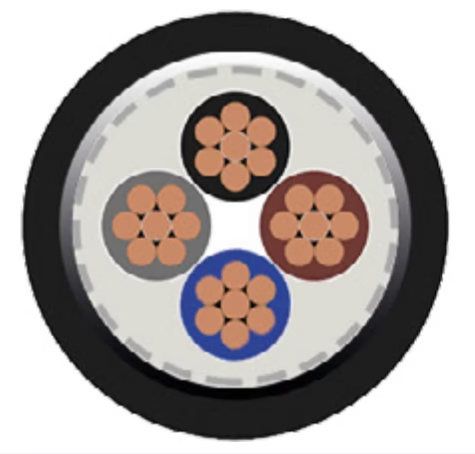
Single core cables are engineered for distribution of electrical power with nominal voltages ranging from 1.8/3kV to 36kV and beyond. From a design point of view, medium-voltage cables are of three types: single-core cable, three single-core cables laid-up, and three-core cable. This technical guide examines two prominent cable solutions for demanding industrial applications requiring high flexibility and electrical performance. 单芯电缆专为输配电系统设计,额定电压从1.8/3kV至36kV及以上。本技术指南对比分析两种适用于高柔性工业应用的电缆方案。

Single Core Cables: Nexans RHEYCLEAN® (MV) vs. (N)TSCGEWÖU Single Core

Single core cables are engineered for distribution of electrical power with nominal voltages ranging from 1.8/3kV to 36kV and beyond. From a design point of view, medium-voltage cables are of three types: single-core cable, three single-core cables laid-up, and three-core cable. This technical guide examines two prominent cable solutions for demanding industrial applications requiring high flexibility and electrical performance. 单芯电缆专为输配电系统设计,额定电压从1.8/3kV至36kV及以上。本技术指南对比分析两种适用于高柔性工业应用的电缆方案。
TSCGECEWÖU, NTSCGECEWÖU, TSKCGECWOEU, TSCGEWOEU, NSSHOEU, NTSCGEWOEU-CH, German mining cable, DIN cable, VDE cable, German cable standard, coal cutter cable CH, festoon cable FN, trailing cable W, screened cable designation, EPR mining cable

Joy Global (Komatsu) 7LS Longwall Shearer: (N)TSCGECEWÖU Drag Chain Cable Robustness Analysis

TSCGECEWÖU, NTSCGECEWÖU, TSKCGECWOEU, TSCGEWOEU, NSSHOEU, NTSCGEWOEU-CH, German mining cable, DIN cable, VDE cable, German cable standard, coal cutter cable CH, festoon cable FN, trailing cable W, screened cable designation, EPR mining cable
(N)TSCGEWÖU medium voltage reeling cable represents a specialized engineering solution designed for extreme mechanical stress applications in mining, material handling, and heavy industrial operations. When evaluating performance in Arctic environments with sustained temperatures of negative forty degrees Celsius, the cable's construction and material specifications demonstrate compliance with international cold performance standards, making it technically suitable for continuous operation in such demanding conditions.

Can (N)TSCGEWÖU Cables Handle Continuous Operation in -40°C Arctic Environments (Cold Impact Test)?

(N)TSCGEWÖU medium voltage reeling cable represents a specialized engineering solution designed for extreme mechanical stress applications in mining, material handling, and heavy industrial operations. When evaluating performance in Arctic environments with sustained temperatures of negative forty degrees Celsius, the cable’s construction and material specifications demonstrate compliance with international cold performance standards, making it technically suitable for continuous operation in such demanding conditions.
When you look at a cable from the outside, you see a smooth, round cylinder. This simple appearance conceals a complex engineering challenge. Inside that cylindrical exterior are multiple insulated conductors of various sizes arranged together. Without proper design, these internal components would naturally create an irregular, lumpy cross-section rather than the uniform circular shape we expect from a professional cable. This is where rubber fillers play their essential role, and understanding their function requires us to think about the geometric and mechanical realities of cable construction.

Rubber Filler Role: Understanding How Fillers Maintain Cylindrical Shape in NSSHÖU Cables Under Crushing Loads

When you look at a cable from the outside, you see a smooth, round cylinder. This simple appearance conceals a complex engineering challenge. Inside that cylindrical exterior are multiple insulated conductors of various sizes arranged together. Without proper design, these internal components would naturally create an irregular, lumpy cross-section rather than the uniform circular shape we expect from a professional cable. This is where rubber fillers play their essential role, and understanding their function requires us to think about the geometric and mechanical realities of cable construction.
Semiconductive tape, also known as semiconducting screening tape or stress control tape, serves as a specialized component applied during cable termination and jointing procedures to maintain uniform electric field distribution and prevent localized voltage concentrations that could lead to partial discharge and insulation failure.

Semiconductive Tape: Purpose and Application Over Earth Conductor Connections in High-Voltage Cable Designs

Semiconductive tape, also known as semiconducting screening tape or stress control tape, serves as a specialized component applied during cable termination and jointing procedures to maintain uniform electric field distribution and prevent localized voltage concentrations that could lead to partial discharge and insulation failure.
(N)TSKCGEWÖU specifications. This protective layer serves multiple critical functions within the cable assembly, with mechanical stress redistribution being among its most important roles. According to research published by Sibelco, the bedding compound is defined as the material applied around insulated conductors to maintain their position and provide bedding for protective armoring.[1] This layer functions as an intermediary component positioned between the laid-up cores and the metallic armor, creating what cable engineers describe as a separation sheath that fundamentally alters how mechanical forces are distributed throughout the cable structure.

Inner Sheath Function: Mechanical Stress Redistribution in (N)TSKCGEWÖU Cables

(N)TSKCGEWÖU specifications. This protective layer serves multiple critical functions within the cable assembly, with mechanical stress redistribution being among its most important roles. According to research published by Sibelco, the bedding compound is defined as the material applied around insulated conductors to maintain their position and provide bedding for protective armoring.[1] This layer functions as an intermediary component positioned between the laid-up cores and the metallic armor, creating what cable engineers describe as a separation sheath that fundamentally alters how mechanical forces are distributed throughout the cable structure.
The tunnelling and underground mining industries have traditionally relied on heavy-duty rubber-sheathed cables manufactured according to DIN VDE 0250 standards. However, a significant shift is occurring as polyurethane (PUR) sheathed cables, designated with the VDE code "11Y" and "12Y" (for TPE-E variants), are increasingly specified for demanding tunnel boring machine (TBM) applications and underground operations. 隧道和地下采矿行业传统上依赖于按照DIN VDE 0250标准生产的重型橡胶护套电缆。然而,随着聚氨酯(PUR)护套电缆(VDE代码为"11Y",TPE-E变体为"12Y")在隧道掘进机(TBM)和地下作业等高要求应用中越来越多被指定使用,一个重大转变正在发生。

Why Are Polyurethane (PUR) Sheathed Cables Becoming Popular Alternatives to Standard VDE Rubber Cables in Tunnelling?

The tunnelling and underground mining industries have traditionally relied on heavy-duty rubber-sheathed cables manufactured according to DIN VDE 0250 standards. However, a significant shift is occurring as polyurethane (PUR) sheathed cables, designated with the VDE code “11Y” and “12Y” (for TPE-E variants), are increasingly specified for demanding tunnel boring machine (TBM) applications and underground operations. 隧道和地下采矿行业传统上依赖于按照DIN VDE 0250标准生产的重型橡胶护套电缆。然而,随着聚氨酯(PUR)护套电缆(VDE代码为”11Y”,TPE-E变体为”12Y”)在隧道掘进机(TBM)和地下作业等高要求应用中越来越多被指定使用,一个重大转变正在发生。
NTSCGEWÖU and NTMCGEWÖU cables represent critical technical solutions for powering mobile machinery in mining, heavy industry, and material handling environments. Both cable types are manufactured according to the German DIN VDE 0250 standard, which is globally recognized as the definitive benchmark for tough rubber-sheathed flexible cables designed for cranes and material handling equipment. The fundamental distinction lies in their sheath construction: the "S" in NTSCGEWÖU indicates a double rubber sheath (Schwer = heavy-duty) providing enhanced mechanical protection for reeling applications, while "M" in NTMCGEWÖU denotes a single sheath with single-core design optimized for short-length medium voltage connections. According to industry specifications, Germany remains the only country to have issued special design regulations for flexible electrical cables covering cranes and material handling equipment, making DIN VDE 0250 the ultimate international standard for these demanding applications.

كيف تختار بين NTSCGEWÖU و NTMCGEWÖU للآلات المتحركة؟

NTSCGEWÖU and NTMCGEWÖU cables represent critical technical solutions for powering mobile machinery in mining, heavy industry, and material handling environments. Both cable types are manufactured according to the German DIN VDE 0250 standard, which is globally recognized as the definitive benchmark for tough rubber-sheathed flexible cables designed for cranes and material handling equipment. The fundamental distinction lies in their sheath construction: the “S” in NTSCGEWÖU indicates a double rubber sheath (Schwer = heavy-duty) providing enhanced mechanical protection for reeling applications, while “M” in NTMCGEWÖU denotes a single sheath with single-core design optimized for short-length medium voltage connections. According to industry specifications, Germany remains the only country to have issued special design regulations for flexible electrical cables covering cranes and material handling equipment, making DIN VDE 0250 the ultimate international standard for these demanding applications.
PE cable, polyethylene cable, XLPE cable, medium voltage cable, N2XS2Y, NA2XS2Y, N2XS(F)2Y, N2XS(FL)2Y, BS 6622 cable, MDPE cable, HDPE cable, 6/10kV cable, 12/20kV cable, 18/30kV cable, underground cable, direct burial cable, duct grade cable, IEC 60502, VDE 0276, copper conductor cable, aluminium cable, waterblock cable, UV resistant cable, Cat 6 PE cable, Cat 5E external cable, oil resistant cable, industrial power cable, railway cable, mining cable, petrochemical cable, 聚乙烯电缆, 中压电缆, PE電纜, cable de polietileno, cable XLPE, outdoor power cable, MV cable manufacturer, Anhui Feichun cable, 安徽飞纯电缆, special cable manufacturer China

What is PE Cable?

N2XS2Y cable, NA2XS2Y cable, N2XS(F)2Y cable, N2XS(FL)2Y cable, NA2XS(F)2Y cable, NA2XS(FL)2Y cable, NY2Y cable, NAY2Y cable, BS 6622 cable, A2XS(F)2Y cable, A2XS(FL)2Y cable, PE cable, polyethylenMDPE cable, HDPE cable, XLPE insulated cable, PE sheathed cable, polyethylene insulation cable, cross-linked polyethylene cable, thermoplastic cable sheathe cable, XLPE cable, medium voltage cable, power cable, outdoor cable, underground cable, MV cable specifications
Armoured cables, commonly referred to as SWA (Steel Wire Armoured) or AWA (Aluminium Wire Armoured) cables, are robust power cables designed with metallic armour protection for demanding installation environments. The armour provides mechanical protection where physical stress could damage the cable, such as direct burial underground, outdoor installations, or industrial environments. These cables are manufactured in accordance with British, European, and International standards including BS 5467, BS 6724, BS 6622, BS 7835, and IEC 60502.

What are Armoured Cables SWA & AWA?

SWA cable, AWA cable, armoured cable, steel wire armoured, aluminium wire armoured, BS 5467, BS 6724, BS 6622, BS 7835, IEC 60502, BASEC approved, XLPE cable, LSZH cable, underground cable, 0.6/1kV, 11kV cable, 33kV cable, N2XRY, NYFGBY, power cable, industrial cable, direct burial, 鎧裝電纜, 鋼絲鎧裝, cable blindado
The NF C 33-226 standard cables, designated as FR-N20XA8E (12/20kV) and FR-N30XA8E (18/30kV), represent the French reference specification for medium voltage (MV) power distribution cables. These cables are commonly referred to as "HTA cables" (Haute Tension A) in France and are engineered for critical power infrastructure applications requiring exceptional reliability and performance.

What is NF C 33-226 Cables FR-N20XA8E & FR-N30XA8E -R/AR?

NF C 33-226, FR-N20XA8E, FR-N30XA8E, FR-N20XA8E-R, FR-N20XA8E-AR, FR-N30XA8E-R, FR-N30XA8E-AR, 12/20kV cable, 18/30kV cable, IEC 60502-2, medium voltage cable, XLPE insulation cable, MV cable, HTA cable, copper conductor cable, aluminium conductor cable, direct burial cable, underground power cable, French standard cable, NF C 33-226 cable specification, XLPE medium voltage cable, Class 2 stranded conductor, semi-conductive screen, water blocking tape, MDPE sheath, primary distribution cable, secondary distribution cable, power cable China manufacturer, 中压电缆, 中壓電纜, cable media tensión, cable de distribución, NF C33-226, 24kV cable, 36kV cable, industrial power cable, substation cable, ring main unit cable, trefoil cable, triplex cable, single core MV cable, cable current rating, cable ampacity, halogen free cable, AD7 water resistant, European MV cable, utility power cable, renewable energy cable, XLPE 90°C rating, cable datasheet, MV cable price, special cable manufacturer
IEC 60502 is an international standard published by the International Electrotechnical Commission (IEC) that sets out the specification for power cables with extruded insulation. The standard covers cables with voltage ratings from 1 kV (Um = 1.2 kV) up to 30 kV (Um = 36 kV), designed for fixed installations such as distribution networks and industrial installations. This widely recognized standard serves as a primary reference for cable manufacturers worldwide and forms the basis for numerous national and regional cable standards.

What is IEC 60502 Cable?

IEC 60502 對導體類型、絕緣材料和護套化合物提供了詳細規格。絕緣材料包括 PVC(最高溫度 70°C)、XLPE、EPR 和 HEPR(均為最高 90°C)。導體類別包括第 1 類(實心)、第 2 類(絞合)和第 5 類(柔性),尺寸範圍從 1.5 mm² 到 1600 mm²。護套化合物包括 PVC、PE 和用於防火敏感區域的無鹵素材料。XLPE 絕緣的標稱厚度從 0.6/1 kV 的 1.0 mm 到 18/30 kV 的 8.0 mm 不等。