Symmetrical Earth Cores

Regulatory & Logistical Reality—European Cable Import Barriers: Pre-2022: Russian mining operations routinely imported VDE 0250-compliant trailing cables from German/Austrian suppliers (e.g., Lappkabel, Elka, Sark) via standard EU-Russia trade channels. Post-2022 sanctions regime: (1) EU supply chain restrictions on "dual-use" high-voltage cables (designation as potential military-relevant infrastructure), (2) Banking/payment system complications (SWIFT alternative systems cumbersome, payment settlement 6–12 month delays), (3) Long lead times (European suppliers prioritizing EU/NATO markets, Russia queued behind 18+ month backlogs), (4) Cost escalation (freight via Central Asia +150–200% vs pre-2022 rates, tariff uncertainty), (5) Technical certification bottlenecks (European factories revoked Russian QA partner access, verification documentation no longer issued). Net result: European VDE cables become 3–4× more expensive + 12–18 month delivery vs domestic alternative 6–8 weeks, $200–300 K/km. Russian Strategic Response—Импортозамещение (Import Substitution): Russian industrial policy (decree 2014 onward, accelerated 2022+) mandates "import substitution" (Импортозамещение): preference for domestic suppliers where technically feasible. Mining sector specifically: Federal mining companies (Gazprom, UMMC, Rosneft, state-owned regional operators) directed to prioritize domestic cable sourcing. Consequence: Korean, Chinese, Turkish cable suppliers also increasingly sidelined (foreign ownership concerns). Genuine GOST-standard Russian manufacturers (Kamkabel, Sibkabel, Roskabel, etc.) now de facto monopoly suppliers with government implicit backing. For procurement officers: domestic GOST cable sourcing is NOT a "compromise"—it is strategic mandate + technical feasibility combined.

Import Substitution: VDE 0250 (N)TSCGEWÖU to GOST КГЭ-ХЛ 6/10kV Russian Mining Cable

Regulatory & Logistical Reality—European Cable Import Barriers: Pre-2022: Russian mining operations routinely imported VDE 0250-compliant trailing cables from German/Austrian suppliers (e.g., Lappkabel, Elka, Sark) via standard EU-Russia trade channels. Post-2022 sanctions regime: (1) EU supply chain restrictions on “dual-use” high-voltage cables (designation as potential military-relevant infrastructure), (2) Banking/payment system complications (SWIFT alternative systems cumbersome, payment settlement 6–12 month delays), (3) Long lead times (European suppliers prioritizing EU/NATO markets, Russia queued behind 18+ month backlogs), (4) Cost escalation (freight via Central Asia +150–200% vs pre-2022 rates, tariff uncertainty), (5) Technical certification bottlenecks (European factories revoked Russian QA partner access, verification documentation no longer issued). Net result: European VDE cables become 3–4× more expensive + 12–18 month delivery vs domestic alternative 6–8 weeks, $200–300 K/km. Russian Strategic Response—Импортозамещение (Import Substitution): Russian industrial policy (decree 2014 onward, accelerated 2022+) mandates “import substitution” (Импортозамещение): preference for domestic suppliers where technically feasible. Mining sector specifically: Federal mining companies (Gazprom, UMMC, Rosneft, state-owned regional operators) directed to prioritize domestic cable sourcing. Consequence: Korean, Chinese, Turkish cable suppliers also increasingly sidelined (foreign ownership concerns). Genuine GOST-standard Russian manufacturers (Kamkabel, Sibkabel, Roskabel, etc.) now de facto monopoly suppliers with government implicit backing. For procurement officers: domestic GOST cable sourcing is NOT a “compromise”—it is strategic mandate + technical feasibility combined.
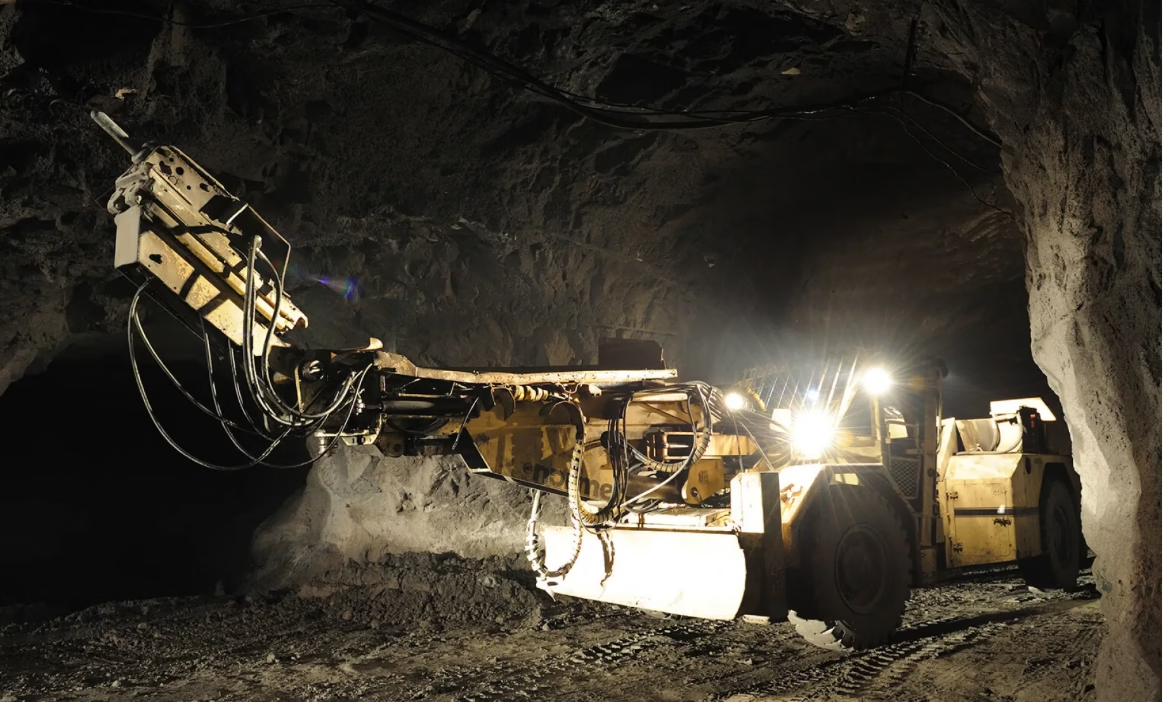
Казахстанские открытые медные рудники (особенно Bozshakol с глубокими карьерами и Aktogay в степной зоне) испытывают зимние температуры −35…−45°C регулярно. Снег и лёд покрывают оборудование и кабельные линии. Электросварочные экскаваторы (Shovel) и буровые установки продолжают работать 24/7, потому что остановка добычи неприемлема. Это означает, что кабели подвергаются динамической нагрузке (вытягивание и наматывание на барабан) при температурах, при которых их оболочка находится в хрупком состоянии. Опасность в том, что отказ не виден визуально до того, как произойдёт электрический пробой. Микротрещины образуются в первые часы эксплуатации, но вода и электрический ток попадают в них только через 12–48 часов. Затем наступает внезапный отказ: слышен треск электрической дуги, видна вспышка, оборудование отключается, и вся подстанция теряет питание.

Glass Transition Trap: Why Standard VDE 0250 Cables Shatter at −40°C in Kazakhstan Copper MinesArctic-Grade (N)TSCGEWÖU Polymer Engineering Deep Dive

Казахстанские открытые медные рудники (особенно Bozshakol с глубокими карьерами и Aktogay в степной зоне) испытывают зимние температуры −35…−45°C регулярно. Снег и лёд покрывают оборудование и кабельные линии. Электросварочные экскаваторы (Shovel) и буровые установки продолжают работать 24/7, потому что остановка добычи неприемлема. Это означает, что кабели подвергаются динамической нагрузке (вытягивание и наматывание на барабан) при температурах, при которых их оболочка находится в хрупком состоянии. Опасность в том, что отказ не виден визуально до того, как произойдёт электрический пробой. Микротрещины образуются в первые часы эксплуатации, но вода и электрический ток попадают в них только через 12–48 часов. Затем наступает внезапный отказ: слышен треск электрической дуги, видна вспышка, оборудование отключается, и вся подстанция теряет питание.
The continuous ampacity of (N)TSCGEWÖU 3x120+3x70/3 12/20kV flexible reeling cable is 360 amperes when operating as a single conductor run in free air at the reference condition of 30°C ambient temperature and 90°C conductor operating temperature according to VDE 0250-813 and DIN VDE 0298-4 standards. For tunnel boring machine cutterhead power supply applications where the cable is installed in the constrained environment of a TBM backup gantry system—bundled alongside control cables, communication lines, and other power feeders—and subjected to frequent mechanical stress from dragging and reeling operations, the practical safe ampacity derates to approximately 260–285 amperes depending on specific installation geometry, tunnel temperature profile, and frequency of mechanical cycling. These two ampacity values represent the boundary between theoretical maximum current capacity and the practical operating limit for reliable power delivery to a 2–3 megawatt main cutterhead drive motor in a hard-rock tunneling or soft-ground excavation system. Understanding where these values come from and how they apply to specific TBM configurations is essential for preventing unexpected power loss to the cutterhead, which could force a full machine shutdown and result in schedule delays of weeks or months in confined underground construction.

TBM Cutterhead Power Supply: How to correctly size (N)TSCGEWÖU 3×120+3×70/3 12/20kV flexible reeling cable for tunnel boring machine main drive systems 

The continuous ampacity of (N)TSCGEWÖU 3×120+3×70/3 12/20kV flexible reeling cable is 360 amperes when operating as a single conductor run in free air at the reference condition of 30°C ambient temperature and 90°C conductor operating temperature according to VDE 0250-813 and DIN VDE 0298-4 standards. For tunnel boring machine cutterhead power supply applications where the cable is installed in the constrained environment of a TBM backup gantry system—bundled alongside control cables, communication lines, and other power feeders—and subjected to frequent mechanical stress from dragging and reeling operations, the practical safe ampacity derates to approximately 260–285 amperes depending on specific installation geometry, tunnel temperature profile, and frequency of mechanical cycling. These two ampacity values represent the boundary between theoretical maximum current capacity and the practical operating limit for reliable power delivery to a 2–3 megawatt main cutterhead drive motor in a hard-rock tunneling or soft-ground excavation system. Understanding where these values come from and how they apply to specific TBM configurations is essential for preventing unexpected power loss to the cutterhead, which could force a full machine shutdown and result in schedule delays of weeks or months in confined underground construction.
The dielectric constant of the 3GI3 elastomeric insulation used in (N)3GHSSYCY 3x150+3x25/3 cable is approximately 6.2 to 6.8 at standard reference frequency of 1 kHz, with typical measured value around 6.5 for new cable material. The insulation breakdown voltage (also called dielectric strength or withstand voltage) exceeds 30 kV when measured under controlled laboratory conditions on fresh cable samples with 8 mm insulation thickness, typically achieving 32–38 kV before electrical breakdown occurs.

Dielectric Constant Specs: What is the exact dielectric constant and insulation breakdown voltage for (N)3GHSSYCY 3×150+3×25/3 medium-voltage cable in long VFD motor runs? 

The dielectric constant of the 3GI3 elastomeric insulation used in (N)3GHSSYCY 3×150+3×25/3 cable is approximately 6.2 to 6.8 at standard reference frequency of 1 kHz, with typical measured value around 6.5 for new cable material. The insulation breakdown voltage (also called dielectric strength or withstand voltage) exceeds 30 kV when measured under controlled laboratory conditions on fresh cable samples with 8 mm insulation thickness, typically achieving 32–38 kV before electrical breakdown occurs.