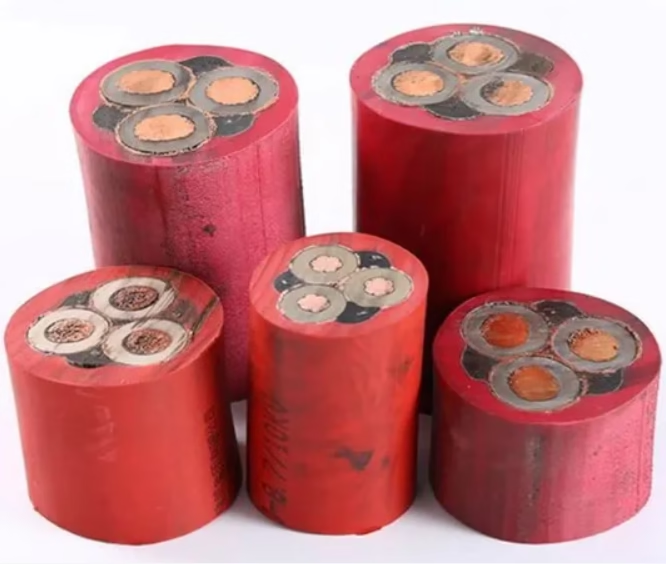
rock drill cable

Underground coal mining operations in Australia present unique electrical safety challenges that require specialized cable systems and protection strategies. The presence of methane gas, coal dust, confined spaces, and high humidity creates an environment where electrical faults can potentially trigger catastrophic explosions. To mitigate these risks, Australian coal mines employ earth fault limitation systems that restrict fault currents to very low levels, typically 5 amperes (5A) for systems below 4,000 volts. 澳大利亚地下煤矿作业面临独特的电气安全挑战,需要专门的电缆系统和保护策略。甲烷气体、煤尘、狭窄空间和高湿度的存在造就了一个电气故障可能引发灾难性爆炸的环境。为降低这些风险,澳大利亚煤矿采用接地故障限制系统,将故障电流限制在非常低的水平,对于4000伏以下的系统,通常为5安培(5A)。

Earth Fault Limitation: How Does the 5A Earth Fault Limit in Australian Coal Mines Affect the Sizing of Earth Conductors in Type 241 Cables?

Underground coal mining operations in Australia present unique electrical safety challenges that require specialized cable systems and protection strategies. The presence of methane gas, coal dust, confined spaces, and high humidity creates an environment where electrical faults can potentially trigger catastrophic explosions. To mitigate these risks, Australian coal mines employ earth fault limitation systems that restrict fault currents to very low levels, typically 5 amperes (5A) for systems below 4,000 volts. 澳大利亚地下煤矿作业面临独特的电气安全挑战,需要专门的电缆系统和保护策略。甲烷气体、煤尘、狭窄空间和高湿度的存在造就了一个电气故障可能引发灾难性爆炸的环境。为降低这些风险,澳大利亚煤矿采用接地故障限制系统,将故障电流限制在非常低的水平,对于4000伏以下的系统,通常为5安培(5A)。
The operational profile of handheld drilling equipment demands cables that can withstand millions of flex cycles without mechanical or electrical failure. A handheld rock drill or roof bolter may be repositioned dozens of times per hour during active operation, with each repositioning imposing multiple flex cycles on the trailing cable. Over the lifetime of the cable, this translates to extreme flex cycle demands that far exceed those imposed on cables serving more stationary equipment. The AS/NZS 1802:2003 standard recognizes this requirement by specifying Type 209 cables as "more suitable as a trailing cable rather than for reeling" and noting that "smaller cables are used for drills and hand held tools and equipment."[9] (手持钻孔设备的操作特性要求电缆能够承受数百万次弯曲循环而不发生机械或电气故障)

Hand-Held Borers: Why is Type 209 (Individually Screened) Mandatory for Handheld Drilling Equipment Instead of Type 275?

The operational profile of handheld drilling equipment demands cables that can withstand millions of flex cycles without mechanical or electrical failure. A handheld rock drill or roof bolter may be repositioned dozens of times per hour during active operation, with each repositioning imposing multiple flex cycles on the trailing cable. Over the lifetime of the cable, this translates to extreme flex cycle demands that far exceed those imposed on cables serving more stationary equipment. The AS/NZS 1802:2003 standard recognizes this requirement by specifying Type 209 cables as “more suitable as a trailing cable rather than for reeling” and noting that “smaller cables are used for drills and hand held tools and equipment.”[9] (手持钻孔设备的操作特性要求电缆能够承受数百万次弯曲循环而不发生机械或电气故障)
Кабель силовой шахтный и экскаваторный необходим для подключения горнодобывающего оборудования, экскаваторов и другого землеройного оборудования, электроинструментов, а также для проведения горных взрывных работ. Шахтные кабели используют для всех типов шахт: угольные, соляные, сланцевые, а также подходят для открытых карьерных разработок. Кабели эксплуатируются на напряжении переменного тока 660, 1140, 6000 В.

What is Кабель для шахт?

КГЭШ, КГЭШ-1140, КГЭ, КГЭ-6, КГЭ-Т, КГЭ-ХЛ, КГЭ-ХЛ-6, КГЭС, КГЭТ, КГВШ, КГРШ, КШВГТ, ЭВБВ, ЭВБВ-6, ЭВТ-1140, ЭВТ-6000, кабель КГЭШ, кабель КГЭ, кабель ЭВБВ, шахтный кабель КГЭШ, экскаваторный кабель, mining cable KGESH, excavator cable KGE, KGESH cable, KGE cable, EVBV cable
ANSI/NEMA WC 58 / ICEA S-75-381: Portable and Power Feeder Cables for Mining Applications

ANSI/NEMA WC 58 / ICEA S-75-381: Portable and Power Feeder Cables for Mining Applications

ANSI/NEMA WC 58 / ICEA S-75-381 standard represents one of the most comprehensive specifications for portable and power feeder cables used in mining environments. According to industry analysis, this standard represents one of the most rigorous cable specifications ever developed, specifically addressing the unique challenges encountered in both surface and underground mining operations where equipment reliability directly impacts production efficiency and worker safety.