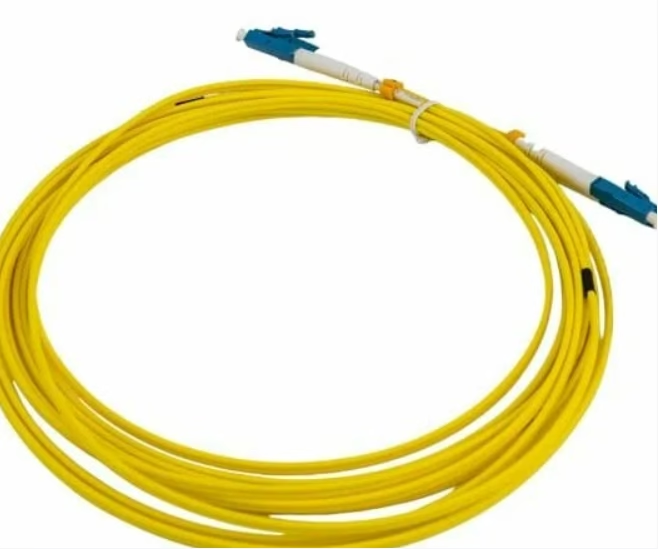
optical fiber cable

FLEXIFESTOON® SEOOW YELLOW represents FeiChun's entry into the low-voltage festoon and temporary power market. The nomenclature requires careful explanation to distinguish this product from the high-voltage FLEXIDRUM series: FLEXIFESTOON Product Nomenclature: FLEXIFESTOON® = Product family name Flex = Flexible (emphasis on bending & handling) Festoon = Strung overhead in continuous runs (typical festoon lighting application) SEOOW = Industry-standard designation S = Service cord (temporary, not permanent installation) E = Elastomer jacket (flexible sheath) OO = Oil-resistant conductor insulation (TPE qualifies as oil-resistant) W = Weather-resistant sheath (water, ozone, UV resistant) SEOOW is defined in: UL 62 (Standard for Flexible Cords and Cables) CSA 22.2 No. 49 (Canadian equivalent) NFPA 70 National Electrical Code (NEC) Article 400 YELLOW designation: Color: RAL 1021 (traffic yellow, high visibility) Safety significance: Yellow cords attract attention in job sites Practical purpose: Easy to identify, prevent trips/entanglement Contrast with FLEXIDRUM series: FLEXIDRUM (High-Voltage MV Cable): Voltage: 3.6 kV to 20/35 kV (power distribution) Temperature: −40 to +80°C (standard industrial) Application: Mobile mining/tunneling equipment (capital-intensive) Size: Large diameter, heavy (3–12 kg/km) FLEXIFESTOON (Low-Voltage Service Cord): Voltage: 600V (light/power temporary use) Temperature: −60 to +105°C (extreme environmental range) Application: Festoon lighting, temporary site power, outdoor events Size: Small diameter, lightweight (0.05–0.3 kg/m) Cost: Consumer/contractor-grade (not specialty industrial)

FIBER FLEX PUR-FO:面向强制导向与高机械载荷的 PUR 护套光纤电缆深度解析

FIBER FLEX PUR-FO 是一款 PUR 护套光纤电缆,用于数据和信号的光学传输。 它面向存在 forced guiding 的运行条件,例如 motor reels、cable cars、trolleys 和 festoon systems。 与普通通信光缆不同,它的核心不是固定通信链路,而是移动设备中的动态光传输:高机械载荷、反复弯曲、滚轮弯曲、户内外使用、危险环境、湿气、臭氧、紫外线和海水环境。 从深度使用者视角看,这类光纤电缆真正的挑战不是“能不能传光”,而是“在长期移动、弯曲、拉伸和污染环境中,光衰还能不能稳定”
FeiChun FLEXIDRUM® FIBER 770 Pure Optical Fiber Infrastructure Cables: Revolutionary High-Speed Data Transmission Systems with Extreme Mechanical Tolerance (6–18 Optical Fibers, ±120°/m Ultimate Torsional Tolerance, 240 m/min Ultra-High-Speed Deployment, 1200 N Tensile Strength, 300 N/cm Transverse Pressure Tolerance): Comprehensive Technical Analysis of Pure Fiber Optic Cable Engineering Providing Simultaneous High-Speed Data Transmission (1–100+ Gbps Capability) & Extreme Mechanical Robustness, Multiple Fiber Type Support (Multimode 62.5/125 & 50/125 Micron, Single-Mode 9/125 Micron) Addressing Complete Data Transmission Spectrum, Extreme Torsional Tolerance (±120°/m) Enabling Forced-Guidance Deployment Impossible with Standard Optical Cables, 240 m/min Ultra-High-Speed Deployment Supporting Advanced Equipment Systems, Tube-Based Fiber Organization (6 Tubes with 1–3 Fibers Each) Enabling Flexible Configuration & Future Expansion, Anti-Twisting Synthetic Yarn Protection Preventing Rotation-Induced Fiber Damage, Robust Mechanical Architecture Supporting 1200 N Tensile & 300 N/cm Transverse Stress, Extreme Cold Operation (-40°C) Supporting Arctic Infrastructure, and Ultimate Optical Infrastructure Strategy Enabling Next-Generation High-Speed Networks with Simultaneous Mechanical Robustness Previously Impossible in Standard Fiber Optic Cable Systems Next-generation optical network infrastructure increasingly requires simultaneous high-speed data transmission and extreme mechanical tolerance representing previously incompatible engineering requirements: standard optical cables designed for static or low-stress deployment cannot tolerate ±120°/m torsion or 240 m/min deployment velocity, mechanical cables designed for extreme stress sacrifice optical transmission capability. FLEXIDRUM® FIBER 770 integrates both simultaneously providing pure optical data infrastructure capable of sustaining extreme mechanical stress—revolutionary engineering integrating conflicting requirements previously considered mutually exclusive. FeiChun's FIBER 770 addresses next-generation optical infrastructure requirements through pure fiber optic architecture enabling 1–100+ Gbps data transmission by fiber type, extreme ±120°/m torsional tolerance enabling forced-guidance deployment, 240 m/min ultra-high-speed deployment matching electrical cable capabilities, multiple fiber variants (multimode 62.5/125, 50/125, single-mode 9/125) addressing complete data spectrum, tube-based flexible configuration enabling future expansion, robust mechanical design supporting 1200 N tensile and 300 N/cm transverse pressure, extreme cold (-40°C) operation supporting arctic infrastructure.

FLEXIDRUM® FIBER 770

FeiChun FLEXIDRUM® FIBER 770 Pure Optical Fiber Infrastructure Cables: Revolutionary High-Speed Data Transmission Systems with Extreme Mechanical Tolerance (6–18 Optical Fibers, ±120°/m Ultimate Torsional Tolerance, 240 m/min Ultra-High-Speed Deployment, 1200 N Tensile Strength, 300 N/cm Transverse Pressure Tolerance): Comprehensive Technical Analysis of Pure Fiber Optic Cable Engineering Providing Simultaneous High-Speed Data Transmission (1–100+ Gbps Capability) & Extreme Mechanical Robustness, Multiple Fiber Type Support (Multimode 62.5/125 & 50/125 Micron, Single-Mode 9/125 Micron) Addressing Complete Data Transmission Spectrum, Extreme Torsional Tolerance (±120°/m) Enabling Forced-Guidance Deployment Impossible with Standard Optical Cables, 240 m/min Ultra-High-Speed Deployment Supporting Advanced Equipment Systems, Tube-Based Fiber Organization (6 Tubes with 1–3 Fibers Each) Enabling Flexible Configuration & Future Expansion, Anti-Twisting Synthetic Yarn Protection Preventing Rotation-Induced Fiber Damage, Robust Mechanical Architecture Supporting 1200 N Tensile & 300 N/cm Transverse Stress, Extreme Cold Operation (-40°C) Supporting Arctic Infrastructure, and Ultimate Optical Infrastructure Strategy Enabling Next-Generation High-Speed Networks with Simultaneous Mechanical Robustness Previously Impossible in Standard Fiber Optic Cable Systems Next-generation optical network infrastructure increasingly requires simultaneous high-speed data transmission and extreme mechanical tolerance representing previously incompatible engineering requirements: standard optical cables designed for static or low-stress deployment cannot tolerate ±120°/m torsion or 240 m/min deployment velocity, mechanical cables designed for extreme stress sacrifice optical transmission capability. FLEXIDRUM® FIBER 770 integrates both simultaneously providing pure optical data infrastructure capable of sustaining extreme mechanical stress—revolutionary engineering integrating conflicting requirements previously considered mutually exclusive. FeiChun’s FIBER 770 addresses next-generation optical infrastructure requirements through pure fiber optic architecture enabling 1–100+ Gbps data transmission by fiber type, extreme ±120°/m torsional tolerance enabling forced-guidance deployment, 240 m/min ultra-high-speed deployment matching electrical cable capabilities, multiple fiber variants (multimode 62.5/125, 50/125, single-mode 9/125) addressing complete data spectrum, tube-based flexible configuration enabling future expansion, robust mechanical design supporting 1200 N tensile and 300 N/cm transverse pressure, extreme cold (-40°C) operation supporting arctic infrastructure.
FeiChun FLEXIDRUM® MEDIUM FLAT Revolutionary Hybrid Power & Data Transmission Cables: Next-Generation Flat-Profile Reeling Design with Integrated Optical Fiber Infrastructure (3.6–8.7/15 kV, Compact 50% Space Reduction vs. Round Cables, 6-Fiber Optical Integration at 62.5/125 Microns, Forced Guidance Multi-Level Deflection Support, -50°C Extreme Cold Capability): Comprehensive Technical Analysis of Revolutionary Flat Ribbon Cable Architecture Enabling Simultaneous Power Transmission & Fiber Optic Data Transport in Ultra-Compact Space-Efficient Design, Integrated Optical Fiber Supporting High-Speed Data Communication (1–10 Gbps Capabilities) Alongside Standard Electrical Power Distribution, Flat Form Factor Enabling 50% Space Reduction Compared to Equivalent Round Cables Revolutionizing Equipment Design Constraints, Compact Reeling Architecture Supporting Advanced Forced-Guidance Systems with Multi-Level Deflection, Tinned Copper Durability Ensuring Long-Term Reliability in Challenging Reeling Environments, Extreme Cold (-50°C) Tolerance Supporting Arctic Equipment Operations, Multiple Configuration Variants (Power-Only, Power+Single-Fiber, Power+6-Fiber+4E) Addressing Complete Spectrum of Next-Generation Equipment Requirements, and Strategic Next-Generation Systems Engineering Enabling Hybrid Infrastructure Convergence of Electrical Power & Optical Data in Single Integrated Cable System Next-generation equipment systems increasingly require simultaneous electrical power transmission and high-speed data communication requiring traditional separate cable infrastructure (power cable + data cable) consuming substantial space and increasing equipment complexity: dual cable systems (power + separate data) double space requirements, increase equipment footprint, complicate cable routing through forced-guidance systems, increase installation cost and maintenance complexity. Hybrid power+data integration eliminates dual-cable architecture enabling single integrated solution providing both power and communication infrastructure simultaneously. FeiChun's FLEXIDRUM® MEDIUM FLAT revolutionary cables address next-generation infrastructure requirements through flat ribbon form factor providing 50% space reduction versus equivalent round cables, integrated optical fiber enabling high-speed data communication (1–10 Gbps), hybrid power+data architecture eliminating dual-cable complexity, compact reeling compatibility enabling advanced forced-guidance systems, tinned copper durability ensuring long-term reliability, extreme cold (-50°C) operation supporting arctic infrastructure, multiple variant configurations addressing complete equipment spectrum.

FLEXIDRUM® MEDIUM FLAT (N)TSFLCGCWOEUS

FeiChun FLEXIDRUM® MEDIUM FLAT Revolutionary Hybrid Power & Data Transmission Cables: Next-Generation Flat-Profile Reeling Design with Integrated Optical Fiber Infrastructure (3.6–8.7/15 kV, Compact 50% Space Reduction vs. Round Cables, 6-Fiber Optical Integration at 62.5/125 Microns, Forced Guidance Multi-Level Deflection Support, -50°C Extreme Cold Capability): Comprehensive Technical Analysis of Revolutionary Flat Ribbon Cable Architecture Enabling Simultaneous Power Transmission & Fiber Optic Data Transport in Ultra-Compact Space-Efficient Design, Integrated Optical Fiber Supporting High-Speed Data Communication (1–10 Gbps Capabilities) Alongside Standard Electrical Power Distribution, Flat Form Factor Enabling 50% Space Reduction Compared to Equivalent Round Cables Revolutionizing Equipment Design Constraints, Compact Reeling Architecture Supporting Advanced Forced-Guidance Systems with Multi-Level Deflection, Tinned Copper Durability Ensuring Long-Term Reliability in Challenging Reeling Environments, Extreme Cold (-50°C) Tolerance Supporting Arctic Equipment Operations, Multiple Configuration Variants (Power-Only, Power+Single-Fiber, Power+6-Fiber+4E) Addressing Complete Spectrum of Next-Generation Equipment Requirements, and Strategic Next-Generation Systems Engineering Enabling Hybrid Infrastructure Convergence of Electrical Power & Optical Data in Single Integrated Cable System Next-generation equipment systems increasingly require simultaneous electrical power transmission and high-speed data communication requiring traditional separate cable infrastructure (power cable + data cable) consuming substantial space and increasing equipment complexity: dual cable systems (power + separate data) double space requirements, increase equipment footprint, complicate cable routing through forced-guidance systems, increase installation cost and maintenance complexity. Hybrid power+data integration eliminates dual-cable architecture enabling single integrated solution providing both power and communication infrastructure simultaneously. FeiChun’s FLEXIDRUM® MEDIUM FLAT revolutionary cables address next-generation infrastructure requirements through flat ribbon form factor providing 50% space reduction versus equivalent round cables, integrated optical fiber enabling high-speed data communication (1–10 Gbps), hybrid power+data architecture eliminating dual-cable complexity, compact reeling compatibility enabling advanced forced-guidance systems, tinned copper durability ensuring long-term reliability, extreme cold (-50°C) operation supporting arctic infrastructure, multiple variant configurations addressing complete equipment spectrum.
Fibre optic cables, interchangeably referred to as optical fibre cables, represent a transformative advancement in telecommunications and data transmission technology. These cables consist of ultra-thin glass or plastic threads, each capable of transmitting digital data modulated into light waves with exceptional speed and bandwidth capacity.

What is Fibre Optic Cable?

fibre optic cable, optical fiber cable, single mode fiber, multimode fiber, OM1 fiber, OM2 fiber, OM3 10G fiber, OM4 40G fiber, OM5 SWDM fiber, OS2 singlemode, 9/125 single mode, 50/125 multimode, 62.5/125 multimode, loose tube fiber cable, tight buffered fiber, SWA armoured fiber, STA steel tape armour, LSZH fiber optic, IEC 60794, IEC 60793, IEC 60331 fire resistant, ISO/IEC 11801, TIA-568.3-D, data center fiber, telecommunications fiber, outdoor fiber cable, indoor fiber cable, direct buried fiber, fiber optic attenuation, fiber bandwidth MHz-km, fiber fusion splicer, OTDR testing, cable de fibra óptica, 光纖電纜, 單模光纖, fiber optic manufacturer China, 10 Gigabit fiber, 40G Ethernet fiber, 100G data center, Anhui Feichun cable