LHD reeling cable

Protomont(S)® (N)SSHCGEOEU is the most mechanically extreme reeling cable in the Feichun mining cable portfolio—a 0.6/1 kV underground mining reeling cable engineered per VDE 0250-812 specifically for the application that no other reeling cable is designed to survive: simultaneous tensile and torsional loading under frequently changing dynamic conditions.

Protomont(S)® (N)SSHCGEOEU

Protomont(S)® (N)SSHCGEOEU is the most mechanically extreme reeling cable in the Feichun mining cable portfolio—a 0.6/1 kV underground mining reeling cable engineered per VDE 0250-812 specifically for the application that no other reeling cable is designed to survive: simultaneous tensile and torsional loading under frequently changing dynamic conditions.
If you are procuring Type 275 3.3kV 3x95mm² mining cables for Mongolian operations and relying on standard AS/NZS 1802 formulations without Arctic Grade modification, you will experience outer sheath cracking within days to weeks of deployment during Mongolian winter. The answer to your question is unambiguous: yes, standard cables will fail, and the failure is not marginal—it is catastrophic. The cracking will progress from hairline fissures to complete jacket failure within a timeframe measured in operational shifts, not months. This is not a theoretical risk or a worst-case scenario. It is an engineering certainty rooted in fundamental material science physics. 如果您正在为蒙古国运营采购 Type 275 3.3kV 3x95mm² 矿用电缆,并依赖于标准 AS/NZS 1802 配方而没有极地级修改,您将在蒙古冬季部署后的几天到几周内经历外护套开裂。答案是明确的:是的,标准电缆会失效,且失效不是边际的—这是灾难性的。开裂将在以运营班次而不是月份衡量的时间框架内从细微裂纹发展为完全护套失效。这不是理论风险或最坏情况场景。它是根植于基本材料科学物理的工程必然。

Cold Weather Reeling: Does Type 275 3.3kV 3x95mm² Outer Sheath Crack in Mongolian Winters?

If you are procuring Type 275 3.3kV 3x95mm² mining cables for Mongolian operations and relying on standard AS/NZS 1802 formulations without Arctic Grade modification, you will experience outer sheath cracking within days to weeks of deployment during Mongolian winter. The answer to your question is unambiguous: yes, standard cables will fail, and the failure is not marginal—it is catastrophic. The cracking will progress from hairline fissures to complete jacket failure within a timeframe measured in operational shifts, not months. This is not a theoretical risk or a worst-case scenario. It is an engineering certainty rooted in fundamental material science physics. 如果您正在为蒙古国运营采购 Type 275 3.3kV 3x95mm² 矿用电缆,并依赖于标准 AS/NZS 1802 配方而没有极地级修改,您将在蒙古冬季部署后的几天到几周内经历外护套开裂。答案是明确的:是的,标准电缆会失效,且失效不是边际的—这是灾难性的。开裂将在以运营班次而不是月份衡量的时间框架内从细微裂纹发展为完全护套失效。这不是理论风险或最坏情况场景。它是根植于基本材料科学物理的工程必然。
The straightforward answer to whether quality generic (N)TMCGEWÖU 3x70+3x35/3 cables can safely replace expensive Sandvik OEM cables on underground LHD loaders is: yes, absolutely—provided that proper specification, compatibility verification, and installation procedures are carefully implemented. The continuous ampacity rating of 246 amperes at 30°C ambient temperature represents the maximum electrical current capacity for the cable under controlled installation conditions. In realistic underground mining duty cycles where the cable is subjected to frequent reeling stress, confined-space temperature conditions, and vibration from underground machinery, the effective design ampacity reduces through cumulative derating to approximately 195–215 amperes depending on specific mine conditions. These ratings demonstrate that a quality generic cable engineered to VDE 0250-813 and DIN VDE 0298-4 standards provides equivalent electrical performance to expensive OEM cables, often at 40–60% lower acquisition cost. The key distinction between OEM cables and quality generic cables is not electrical performance—it is supply chain, brand markup, and proprietary connector systems. A well-engineered generic cable provides the same copper conductors, similar insulation quality, and equivalent current-carrying capacity as the OEM equivalent. The cost savings from generic cable selection are real and substantial, but they must be paired with careful attention to mechanical compatibility, proper termination procedures, and quality field installation to realize the full cost advantage without reliability penalties.

Underground LHD Loaders: Can you reliably replace OEM Sandvik cables with quality generic (N)TMCGEWÖU 3×70+3×35/3 cables? 

The straightforward answer to whether quality generic (N)TMCGEWÖU 3×70+3×35/3 cables can safely replace expensive Sandvik OEM cables on underground LHD loaders is: yes, absolutely—provided that proper specification, compatibility verification, and installation procedures are carefully implemented. The continuous ampacity rating of 246 amperes at 30°C ambient temperature represents the maximum electrical current capacity for the cable under controlled installation conditions. In realistic underground mining duty cycles where the cable is subjected to frequent reeling stress, confined-space temperature conditions, and vibration from underground machinery, the effective design ampacity reduces through cumulative derating to approximately 195–215 amperes depending on specific mine conditions. These ratings demonstrate that a quality generic cable engineered to VDE 0250-813 and DIN VDE 0298-4 standards provides equivalent electrical performance to expensive OEM cables, often at 40–60% lower acquisition cost. The key distinction between OEM cables and quality generic cables is not electrical performance—it is supply chain, brand markup, and proprietary connector systems. A well-engineered generic cable provides the same copper conductors, similar insulation quality, and equivalent current-carrying capacity as the OEM equivalent. The cost savings from generic cable selection are real and substantial, but they must be paired with careful attention to mechanical compatibility, proper termination procedures, and quality field installation to realize the full cost advantage without reliability penalties.
Load-Haul-Dump (LHD) machines are critical assets in underground mining operations, with more than 75% of the world's underground metal mines utilizing LHD equipment for material handling. The Epiroc Scooptram ST14 (14-tonne capacity) and ST18 (17.5–18 tonne capacity) represent industry-leading underground loaders engineered for demanding mining environments, featuring robust construction, ISO ROPS/FOPS certified cabins, and automation-ready configurations. 铲运机(LHD)是地下采矿作业的关键设备,全球超过75%的地下金属矿山使用LHD设备进行物料搬运。Epiroc Scooptram ST14(14吨容量)和ST18(17.5-18吨容量)代表了行业领先的地下装载机,专为严苛采矿环境设计。

Replacement Cables for Epiroc Scooptram ST14 & ST18: Enhancing LHD Availability

Load-Haul-Dump (LHD) machines are critical assets in underground mining operations, with more than 75% of the world’s underground metal mines utilizing LHD equipment for material handling. The Epiroc Scooptram ST14 (14-tonne capacity) and ST18 (17.5–18 tonne capacity) represent industry-leading underground loaders engineered for demanding mining environments, featuring robust construction, ISO ROPS/FOPS certified cabins, and automation-ready configurations. 铲运机(LHD)是地下采矿作业的关键设备,全球超过75%的地下金属矿山使用LHD设备进行物料搬运。Epiroc Scooptram ST14(14吨容量)和ST18(17.5-18吨容量)代表了行业领先的地下装载机,专为严苛采矿环境设计。
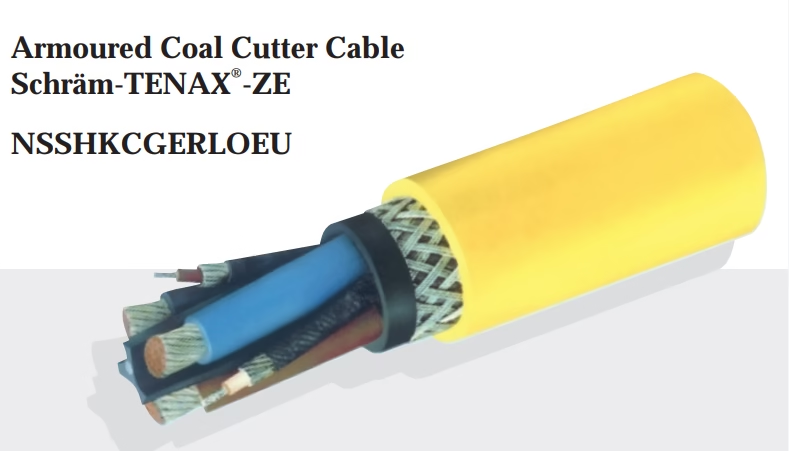
NSSHKCGERLOEU (Schräm-TENAX -ZE) — это специализированный бронированный гибкий кабель, разработанный для подключения мобильных машин, работающих в условиях чрезвычайно высоких механических нагрузок. Кабель предназначен преимущественно для горнодобывающей промышленности, в частности для угольных комбайнов типа Schräm (Schräm-Maschinen), и соответствует требованиям международного стандарта DIN VDE 0250, часть 812.

Бронированный кабель для угольных комбайнов

NSSHKCGERLOEU, Schräm-TENAX -ZE, бронированный кабель для угольных комбайнов, кабель NSSHKCGERLOEU, кабель для комбайна, гибкий шахтный кабель, горнодобывающий кабель, кабель для добычи угля, кабель устойчивый к сдавливанию, кабель стальная оплетка, кабель для LHD, намоточный кабель, кабель DIN VDE 0250-812, кабель DIN VDE 0472-818, огнестойкий шахтный кабель, маслостойкий кабель, кабель EPR изоляция, кабель 0.6/1 kV, морозостойкий шахтный кабель, кабель для угольного комбайна, кабель для очистного комбайна, кабель для проходческого комбайна, кабель с пилотными жилами, кабель обнаружение повреждений, кабель замыкание на землю, armoured coal cutter cable, mining flexible cable, coal shearer cable, LHD reeling cable, squeezing resistant cable, 煤機電纜, 鎧裝採煤機電纜, 礦用電纜, 鏟運機電纜, 安徽飛純電纜, Anhui Feichun cable, China mining cable manufacturer
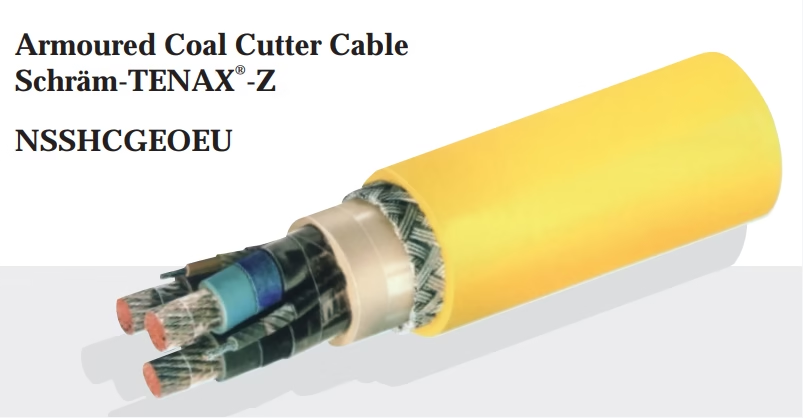
NSSHCGEOEU — это специализированный бронированный гибкий кабель, предназначенный для подключения мобильных машин, эксплуатируемых в условиях экстремальных механических нагрузок, преимущественно в горнодобывающей промышленности. Кабель разработан в соответствии с международным стандартом DIN VDE 0250, часть 812, который устанавливает требования к конструкции, электрическим характеристикам и механической прочности кабелей для угольных комбайнов.

Schräm-TENAX® -Z NSSHCGEOEU

бронированный кабель для угольных комбайнов, кабель NSSHCGEOEU, кабель для горнодобывающего оборудования, кабель для угольных шахт, гибкий шахтный кабель, кабель для комбайна, резиновый кабель для шахт, кабель EPR изоляция, кабель 0.6/1 kV горный, кабель для LHD погрузчика, кабель медно-стальная броня, кабель концентрический экран, силовой кабель для шахт