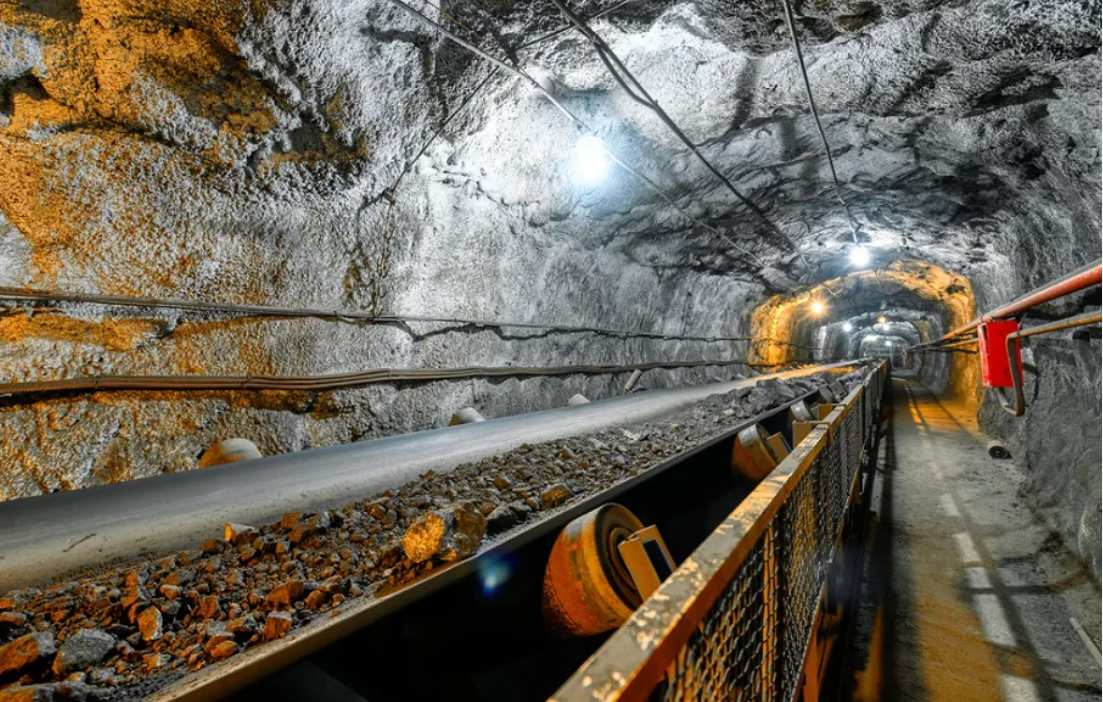
IT earthing system cable

Regulatory & Logistical Reality—European Cable Import Barriers: Pre-2022: Russian mining operations routinely imported VDE 0250-compliant trailing cables from German/Austrian suppliers (e.g., Lappkabel, Elka, Sark) via standard EU-Russia trade channels. Post-2022 sanctions regime: (1) EU supply chain restrictions on "dual-use" high-voltage cables (designation as potential military-relevant infrastructure), (2) Banking/payment system complications (SWIFT alternative systems cumbersome, payment settlement 6–12 month delays), (3) Long lead times (European suppliers prioritizing EU/NATO markets, Russia queued behind 18+ month backlogs), (4) Cost escalation (freight via Central Asia +150–200% vs pre-2022 rates, tariff uncertainty), (5) Technical certification bottlenecks (European factories revoked Russian QA partner access, verification documentation no longer issued). Net result: European VDE cables become 3–4× more expensive + 12–18 month delivery vs domestic alternative 6–8 weeks, $200–300 K/km. Russian Strategic Response—Импортозамещение (Import Substitution): Russian industrial policy (decree 2014 onward, accelerated 2022+) mandates "import substitution" (Импортозамещение): preference for domestic suppliers where technically feasible. Mining sector specifically: Federal mining companies (Gazprom, UMMC, Rosneft, state-owned regional operators) directed to prioritize domestic cable sourcing. Consequence: Korean, Chinese, Turkish cable suppliers also increasingly sidelined (foreign ownership concerns). Genuine GOST-standard Russian manufacturers (Kamkabel, Sibkabel, Roskabel, etc.) now de facto monopoly suppliers with government implicit backing. For procurement officers: domestic GOST cable sourcing is NOT a "compromise"—it is strategic mandate + technical feasibility combined.

Import Substitution: VDE 0250 (N)TSCGEWÖU to GOST КГЭ-ХЛ 6/10kV Russian Mining Cable

Regulatory & Logistical Reality—European Cable Import Barriers: Pre-2022: Russian mining operations routinely imported VDE 0250-compliant trailing cables from German/Austrian suppliers (e.g., Lappkabel, Elka, Sark) via standard EU-Russia trade channels. Post-2022 sanctions regime: (1) EU supply chain restrictions on “dual-use” high-voltage cables (designation as potential military-relevant infrastructure), (2) Banking/payment system complications (SWIFT alternative systems cumbersome, payment settlement 6–12 month delays), (3) Long lead times (European suppliers prioritizing EU/NATO markets, Russia queued behind 18+ month backlogs), (4) Cost escalation (freight via Central Asia +150–200% vs pre-2022 rates, tariff uncertainty), (5) Technical certification bottlenecks (European factories revoked Russian QA partner access, verification documentation no longer issued). Net result: European VDE cables become 3–4× more expensive + 12–18 month delivery vs domestic alternative 6–8 weeks, $200–300 K/km. Russian Strategic Response—Импортозамещение (Import Substitution): Russian industrial policy (decree 2014 onward, accelerated 2022+) mandates “import substitution” (Импортозамещение): preference for domestic suppliers where technically feasible. Mining sector specifically: Federal mining companies (Gazprom, UMMC, Rosneft, state-owned regional operators) directed to prioritize domestic cable sourcing. Consequence: Korean, Chinese, Turkish cable suppliers also increasingly sidelined (foreign ownership concerns). Genuine GOST-standard Russian manufacturers (Kamkabel, Sibkabel, Roskabel, etc.) now de facto monopoly suppliers with government implicit backing. For procurement officers: domestic GOST cable sourcing is NOT a “compromise”—it is strategic mandate + technical feasibility combined.
Direct Answer: Standard VDE 0.6/1kV cables are not suitable for Australian 1000V IT earthing systems. The cable will be overstressed during single-phase earth fault conditions and will likely fail, creating safety hazards and equipment damage. Australian law and engineering practice mandate 1.1/1.1kV or equivalent rated cables for this application. Using undersized cables violates workplace safety regulations and manufacturer warranties. 直接答案:标准VDE 0.6/1kV电缆不适合澳洲1000V IT接地系统。在单相接地故障条件下,电缆会受到过应力,并可能失效,造成安全隐患和设备损坏。澳洲法律和工程实践要求在这种应用中使用1.1/1.1kV或等效额定值的电缆。使用规格不足的电缆违反工作场所安全法规和制造商保修。 Why? The answer lies in how Australian systems define voltage stress during fault conditions. When a single-phase earth fault occurs on an Australian IT earthing system, the insulation of a 0.6/1kV cable experiences 1000V stress—far exceeding its 600V phase-to-earth design rating. Insulation breakdown follows within minutes.

Can I Use a 0.6/1kV VDE Cable on a 1000V Australian System? Spoiler: Why 1.1/1.1kV is Required

Direct Answer: Standard VDE 0.6/1kV cables are not suitable for Australian 1000V IT earthing systems. The cable will be overstressed during single-phase earth fault conditions and will likely fail, creating safety hazards and equipment damage. Australian law and engineering practice mandate 1.1/1.1kV or equivalent rated cables for this application. Using undersized cables violates workplace safety regulations and manufacturer warranties. 直接答案:标准VDE 0.6/1kV电缆不适合澳洲1000V IT接地系统。在单相接地故障条件下,电缆会受到过应力,并可能失效,造成安全隐患和设备损坏。澳洲法律和工程实践要求在这种应用中使用1.1/1.1kV或等效额定值的电缆。使用规格不足的电缆违反工作场所安全法规和制造商保修。 Why? The answer lies in how Australian systems define voltage stress during fault conditions. When a single-phase earth fault occurs on an Australian IT earthing system, the insulation of a 0.6/1kV cable experiences 1000V stress—far exceeding its 600V phase-to-earth design rating. Insulation breakdown follows within minutes.
Sandvik Load-Haul-Dump (LHD) underground loaders represent the workhorse of modern Australian coal mining operations. Models including the LH514E, LH621E, and larger variants operate 24/7 in underground environments, continuously loading ore or coal into fixed haulage systems. These electrically powered machines (increasingly replacing diesel engines) require reliable power delivery through trailing cables that can withstand continuous reeling, mechanical shock from ore impact, and the harsh underground environment. 山特维克装运卸(LHD)井下铲运机代表现代澳洲煤矿运营的主力军。包括LH514E、LH621E和更大型号的车型在地下环境中24/7运行,持续将矿石或煤炭装入固定运输系统。这些电动机械(越来越多地替代柴油发动机)需要可靠的电力传输,通过能够承受连续卷筒、矿石冲击机械冲击和恶劣地下环境的拖曳电缆。

Sandvik Underground Loaders: Sourcing 3.3/3.3kV European Trailing Cables for Australian Coal Mines

Sandvik Load-Haul-Dump (LHD) underground loaders represent the workhorse of modern Australian coal mining operations. Models including the LH514E, LH621E, and larger variants operate 24/7 in underground environments, continuously loading ore or coal into fixed haulage systems. These electrically powered machines (increasingly replacing diesel engines) require reliable power delivery through trailing cables that can withstand continuous reeling, mechanical shock from ore impact, and the harsh underground environment. 山特维克装运卸(LHD)井下铲运机代表现代澳洲煤矿运营的主力军。包括LH514E、LH621E和更大型号的车型在地下环境中24/7运行,持续将矿石或煤炭装入固定运输系统。这些电动机械(越来越多地替代柴油发动机)需要可靠的电力传输,通过能够承受连续卷筒、矿石冲击机械冲击和恶劣地下环境的拖曳电缆。
For New Zealand TBM (Tunnel Boring Machine) and underground infrastructure projects, specifying cables presents a critical engineering decision: use European VDE-standard cables (readily available from major suppliers like Prysmian, Nexans) or specify local AS/NZS-compliant equivalents. The (N)TSCGECEWÖU 3x50+3x25/3 6.6/6.6kV cable from German manufacturers represents excellent European engineering, but direct application in New Zealand requires technical translation to local regulatory standards. 对于新西兰盾构机(TBM)和地下基础设施项目,规范电缆规格呈现关键工程决策:使用欧洲VDE标准电缆(易从Prysmian、Nexans等主要供应商获得)或规范本地AS/NZS兼容等效品。德国制造商的(N)TSCGECEWÖU 3x50+3x25/3 6.6/6.6kV电缆代表卓越的欧洲工程,但在新西兰的直接应用需要技术转化为当地监管标准。

New Zealand TBMs: Equivalent Specs for (N)TSCGECEWÖU 3×50+3×25/3 6.6/6.6kV Tunneling Cable

For New Zealand TBM (Tunnel Boring Machine) and underground infrastructure projects, specifying cables presents a critical engineering decision: use European VDE-standard cables (readily available from major suppliers like Prysmian, Nexans) or specify local AS/NZS-compliant equivalents. The (N)TSCGECEWÖU 3×50+3×25/3 6.6/6.6kV cable from German manufacturers represents excellent European engineering, but direct application in New Zealand requires technical translation to local regulatory standards. 对于新西兰盾构机(TBM)和地下基础设施项目,规范电缆规格呈现关键工程决策:使用欧洲VDE标准电缆(易从Prysmian、Nexans等主要供应商获得)或规范本地AS/NZS兼容等效品。德国制造商的(N)TSCGECEWÖU 3×50+3×25/3 6.6/6.6kV电缆代表卓越的欧洲工程,但在新西兰的直接应用需要技术转化为当地监管标准。
The voltage rating notation on electrical cables follows a standard international convention established by IEC and VDE standards. When you see a cable rated 6.6/6.6kV, this notation encodes two critical electrical parameters that determine the cable's safe operating limits. 电气电缆上的电压额定值标识遵循由IEC和VDE标准确定的标准国际约定。当您看到电缆额定为6.6/6.6kV时,此标识编码了两个关键电气参数,这些参数决定了电缆的安全工作限制。 Uo (Phase-to-Earth Voltage): The first number in the Uo/U notation represents the maximum phase-to-earth voltage (voltage between a phase conductor and ground or metal shielding) that the cable insulation is designed to withstand continuously. For a 6.6/6.6kV cable, Uo = 6.6kV phase-to-earth. U (Phase-to-Phase Voltage): The second number represents the maximum phase-to-phase voltage (voltage between any two phase conductors) the cable can handle. For a 6.6/6.6kV cable, U = 6.6kV phase-to-phase. Standard Relationship in TN Systems: In conventional European TN earthing systems (where the neutral is directly grounded at low impedance), the relationship between Uo and U is: Uo = U/√3 ≈ 0.577U. Therefore, a standard 6.6kV system would normally use 3.8/6.6kV cables (since 6.6/√3 ≈ 3.8kV). However, Australian mining cables specify 6.6/6.6kV, indicating a fundamentally different earthing system design.

Phase-to-Earth Voltage: Decoding “Uo” Rating on Australian (N)TSKCGEWÖU 6.6/6.6kV BOMs

phase-to-earth voltage, Uo rating 6.6kV, TSKCGEWOU cable, 6.6/6.6kV medium voltage, Australian mining cable BOM, IT earthing system cable, AS/NZS 1802 trailing cable, earth fault protection cable, cable voltage rating notation, reeling cable specifications, medium voltage cable parameters, EPR 3GI3 insulation, 5GM5 outer sheath, heavy duty reeling cable, dragline cable, bucket wheel cable, port machinery cable, cable short circuit rating, tensile strength cable, bending radius reeling, torsional stress cable, cable mechanical properties, Class 5 stranded copper, mining equipment power cable, industrial rubber cable, cable ampacity derating, cable traveling speed, cable test voltage, earth continuity monitoring cable, high voltage mining cable, cable outer diameter dimensions, cable weight specifications, copper conductor cable, cable cost specification, cable procurement BOM, cable technical datasheet, cable supplier Australia, reeling drum cable, cable design standard VDE, cable design standard AS/NZS, cable engineering calculation, cable field installation, cable commissioning test, cable reliability mining, cable durability harsh environment, cable supply chain, cable logistics freight, cable inventory management
When international project managers or equipment procurement teams inquire whether they can use standard European VDE 6/10kV medium-voltage cables in Australian tunnel, underground mining, or infrastructure projects, the regulatory answer is typically no—unless the project secures a formal engineering dispensation from the relevant Australian safety authority. This is not a preference for local products or protectionist regulation. It is a reflection of fundamental differences in how Australian underground infrastructure projects approach electrical safety, earthing philosophy, and protective system design. 当国际项目经理或设备采购团队询问他们是否可以在澳洲隧道、地下采矿或基础设施项目中使用标准欧洲VDE 6/10kV中压电缆时,监管答案通常是否定的——除非项目从相关澳洲安全部门获得正式的工程豁免。这不是本地产品偏好或保护主义监管。这反映了澳洲地下基础设施项目在电气安全、接地哲学和保护系统设计方面的根本差异。

6.6/6.6kV vs 6/10kV: Can I Use VDE Standard Medium Voltage Cables in Australian Tunnels?

When international project managers or equipment procurement teams inquire whether they can use standard European VDE 6/10kV medium-voltage cables in Australian tunnel, underground mining, or infrastructure projects, the regulatory answer is typically no—unless the project secures a formal engineering dispensation from the relevant Australian safety authority. This is not a preference for local products or protectionist regulation. It is a reflection of fundamental differences in how Australian underground infrastructure projects approach electrical safety, earthing philosophy, and protective system design. 当国际项目经理或设备采购团队询问他们是否可以在澳洲隧道、地下采矿或基础设施项目中使用标准欧洲VDE 6/10kV中压电缆时,监管答案通常是否定的——除非项目从相关澳洲安全部门获得正式的工程豁免。这不是本地产品偏好或保护主义监管。这反映了澳洲地下基础设施项目在电气安全、接地哲学和保护系统设计方面的根本差异。
Complete Technical Analysis: Why Australian Port Terminals, Heavy Industrial Sites, and STS/RTG Crane Operations Require NSHTÖU Cables Rated at 1.1/1.1kV (Uo=U) Instead of Standard European 0.6/1kV Specifications. IT Earthing System Philosophy for Continuous Port Operations, Earth Fault Voltage Stress Analysis, VFD Drive Compatibility, Symmetrical Earth Conductor Configuration, Heavy-Duty PCP Sheath Materials, Tinned Copper Conductor Specifications, DIN VDE 0295 Class 5 Strand Flexibility, 5GM5 Rubber Compound Durability, AS/NZS Regulatory Compliance, Real-World Port Machinery Applications, Procurement Verification Protocols.

NSHTÖU 1.1/1.1kV vs 0.6/1kV: Why Australian Port Cranes Require Uo=U Voltage Rating

Complete Technical Analysis: Why Australian Port Terminals, Heavy Industrial Sites, and STS/RTG Crane Operations Require NSHTÖU Cables Rated at 1.1/1.1kV (Uo=U) Instead of Standard European 0.6/1kV Specifications. IT Earthing System Philosophy for Continuous Port Operations, Earth Fault Voltage Stress Analysis, VFD Drive Compatibility, Symmetrical Earth Conductor Configuration, Heavy-Duty PCP Sheath Materials, Tinned Copper Conductor Specifications, DIN VDE 0295 Class 5 Strand Flexibility, 5GM5 Rubber Compound Durability, AS/NZS Regulatory Compliance, Real-World Port Machinery Applications, Procurement Verification Protocols.