indoor installation

BASKET SPREADER 750: Next-Generation Hoisting Cable Architecture The BASKET SPREADER 750 (3GSLTOE) represents a fundamental advancement in hoisting control cable design, specifically engineered for next-generation automated port crane systems operating under extreme environmental and operational constraints. Unlike the BASKET SPREADER 740's 300/500V AC specification, the 750 operates at 0.6/1kV AC with dual-voltage DC capability (0.9/1.8 kV)—a classification shift that enables: Higher power capacity – 2–3× greater amperage per conductor, enabling longer cable runs with lower voltage drop Medium-voltage infrastructure compatibility – Direct integration with port substation power distribution systems (0.6 kV = 600V three-phase industrial standard) DC dual-voltage operation – Simultaneous support for AC motor control and DC feedback/signaling circuits (0.9/1.8 kV DC margins) Extreme temperature capability – Operating range −50°C to +80°C (vs. SPREADER 740's −20°C to +60°C), addressing Arctic port terminals and tropical high-ambient scenarios Advanced insulation chemistry – GAALTHERM® 530 thermoplastic compound replaces standard PVC/PUR, delivering superior chemical resistance and thermal stability This cable bridges the gap between standard control cables (300/500V, limited temperature) and heavy industrial medium-voltage distribution cables, creating a purpose-built solution for modern automated gantry crane systems in global port terminals.

Что такое ÖLFLEX® INSTRUM RE-Y(ST)YRY: инженерный анализ армированного heat resistant PVC кабеля с общим экраном

ÖLFLEX® INSTRUM RE-Y(ST)YRY — это армированный heat resistant PVC instrumentation/data cable с PVC (V-90HT) core insulation, overall screen, PVC inner sheath, galvanized steel wire armour and PVC outer sheath. Кабель предназначен для communication, data and voice transmission signal в industrial process manufacturing plants, Oil and Gas industry and petrochemical industry. По предоставленным данным он основан на EN 50288-7, имеет flame retardance according to IEC 60332-3-24, stranded plain annealed copper wires according to BS 6360 / IEC 60228 Class 2, aluminium polyester tape collective screen, tinned copper drain wire, black PVC inner sheath and black or blue PVC outer sheath.
LIFT-2S (European) vs. LIFT-1S UL (North American): LIFT-2S characteristics: Voltage: 300/500V (European standard, lower voltage) Temperature: −40°C to +70°C (moderate range) Standards: VDE 0482 part 265-2-1, EN 50265-2-1, IEC 60332-1-2 Design philosophy: Safety by material redundancy (2 steel cores) Steel cores: 2× cores provide mechanical backup Conductor: Class 6 (European, ~150–200 wires per mm²) Cost: Lower (proven European manufacturing) Market: Europe, Asia-Pacific, most of world LIFT-1S UL characteristics: Voltage: 600V (North American standard, higher voltage) Temperature: −25°C to +105°C (extreme range, high-temp optimized) Standards: UL 2562, UL 62, CSA C22.2 No.210.2 Design philosophy: Safety by certification (single core + redundant control) Steel core: 1× core (sufficient with nylon covering) Conductor: Class M (UL, extra fine ~300+ wires per mm²) Cost: Higher (UL testing, certification documentation) Market: North America (USA, Canada), Mexico UL 2562 specialty certification: UL 2562 scope: Elevator and Dumbwaiter Cables Specific requirements: 1. Pendant cable design (cable hangs freely, no duct support) 2. Vertical orientation (designed for gravity-loaded suspension) 3. Repeated flex cycles (cable moves up/down frequently) 4. Safety-critical function (failure = personnel risk) Consequence: More stringent than general-purpose cables Testing includes: Bend cycle fatigue, heat aging, compression resistance Test procedures (unique to UL 2562): Bend cycle test: 1,000+ cycles at minimum bending radius Cable must pass insulation resistance after cycling Heat aging: 500+ hours at 105°C continuous Tensile strength retention minimum 70% Compression: 1,000+ hours under sustained compression Cable cross-section must not exceed 5% permanent deformation LIFT-2S (no UL 2562): Tests per VDE are less stringent on fatigue/cycling Assumes cable mostly static, not repeated flex Adequate for European elevator duty (lower speed, fewer cycles) LIFT-1S UL: All UL 2562 tests passed (proven for North American elevators) Faster cycle times, more frequent motion → more fatigue stress Extra testing ensures reliability under North American elevator duty Market requirement (regulatory): Europe/International: CE mark required (European conformity) VDE/EN/IEC standards sufficient No UL certification needed (not recognized in EU) LIFT-2S is sufficient North America (USA, Canada): UL certification mandatory for elevators UL 2562 specifically for elevator cables CSA dual certification required in Canada LIFT-2S NOT acceptable (lacks UL 2562) LIFT-1S UL mandatory Cost implication: UL certification: ~$5,000–15,000 per product per region Testing duration: 3–6 months per model Documentation: Comprehensive test reports, technical files Result: LIFT-1S UL 20–30% higher cost than equivalent European cable

Что такое ÖLFLEX® INSTRUM RE-2X(ST)YRY: инженерный анализ армированного инструментального кабеля с XLPE изоляцией и общим экраном

ÖLFLEX® INSTRUM RE-2X(ST)YRY — это armoured instrumentation cable с XLPE core insulation, overall screen, PVC inner sheath, galvanized steel wire armour and PVC outer sheath. Кабель предназначен для communication, data and voice transmission signal в industrial process manufacturing plants, Oil and Gas industry and petrochemical industry. По предоставленным данным он основан на EN 50288-7, имеет flame retardance according to IEC 60332-3-24, stranded plain annealed copper wires according to BS 6360 / IEC 60228 Class 2, aluminium polyester tape collective screen, tinned copper drain wire, black PVC inner sheath and black or blue PVC outer sheath.
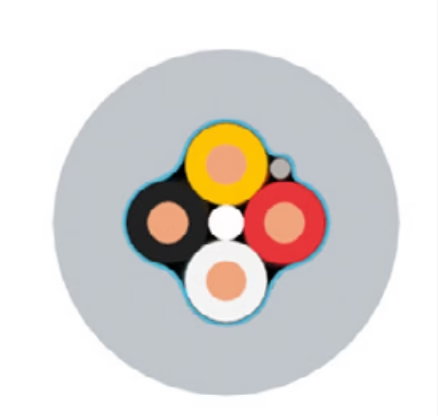
Germany's DIN VDE 0815 standard contains specifications for wiring cables designed for telecommunications and data processing systems in indoor residential and commercial telecommunications installations. It is issued by the certification bodies VDE and DIN under the banner of the DKE (Deutsche Kommission Elektrotechnik), the German Commission for Electrical, Electronic and Information Technologies.

What is DIN VDE 0815 Cable?

DIN VDE 0815, VDE 0815 cable, J-Y(St)Y cable, telephone cable, telecommunications cable, twisted pair cable, indoor telephone cable, data transmission cable, signal cable, German telecom cable, screened telephone cable, foil screen cable, DIN VDE 0815, DIN 57815, VDE 0815, VDE 0295, IEC 60228, DIN VDE 0207-2, DKE standard, German telecom standard, VDE certified cable, DIN certified cable, European telecom standard
Whilst low voltage generally refers to cables under 1kV voltage, the 1.9/3.3kV cables are often classified within this banding too. These cables represent the upper boundary of the "extended low voltage" classification and are primarily manufactured in accordance with British Standards BS5467 and BS6724. The 1.9/3.3kV rating indicates cables designed for systems where the phase-to-earth voltage is 1.9kV and phase-to-phase voltage is 3.3kV, with a maximum system voltage (Um) of 3.6kV.

What is 1.9/3.3kV Cable?

1.9/3.3kV cable, 3.3kV cable, BS5467, BS6724, LSZH cable, SWA cable, armoured cable, XLPE cable, low voltage cable, SANS Type 63, mining trailing cable, steel wire armour, aluminium wire armour, copper conductor, PVC sheath, low smoke zero halogen, flame retardant, direct burial cable, industrial wiring, mains distribution, current rating, IEE Wiring Regulations, thermosetting insulated, BASEC approved, CPR compliant, 3.6/6kV comparison, IEC 60502-1, 1.9/3.3kV cable, 3.3kV cable, 3300V cable, BS5467 cable, BS6724 cable, LSZH cable, SWA cable, armoured cable, XLPE cable, low voltage armoured cable, 3.3kV power cable