flame retardant reeling cable

GAALFLEX® VFD NYCWY: 600V/1000V European Standard Power Cable with Concentric Copper Conductor Shielding, Underground Direct-Burial Installation Capability, Frequency Converter Integration, Control Impulse & Test Data Transmission, 2–4 Cores, 10–240 mm² Solid/Stranded Red Copper, PVC DIV4 Insulation, Corrugated Copper Wire + Tape Screening, Self-Extinguishing Flame-Retardant, DIN VDE 0276/IEC 60502 Compliance, Utility Substation & Subscriber Network Deployment | European Underground Utility VFD Power Cable UL-certified European standard 600V/1000V underground direct-burial power cable with unique concentric copper conductor shielding combining solid or stranded red copper with PVC DIV4 insulation, corrugated copper wire + tape concentric shielding, and professional utility-grade grounding continuity—addressing underground direct-burial specification (subscriber networks, power stations), dual-voltage power distribution (600V/1000V), frequency converter system integration, control signal and test data transmission, utility substation infrastructure, and comprehensive European underground power distribution infrastructure simultaneously.

What is TROMMELFLEX PUR-HF D12Y11YU11Y: An In-Depth Engineering Analysis of the Halogen-Free PUR Low Voltage Reeling Cable

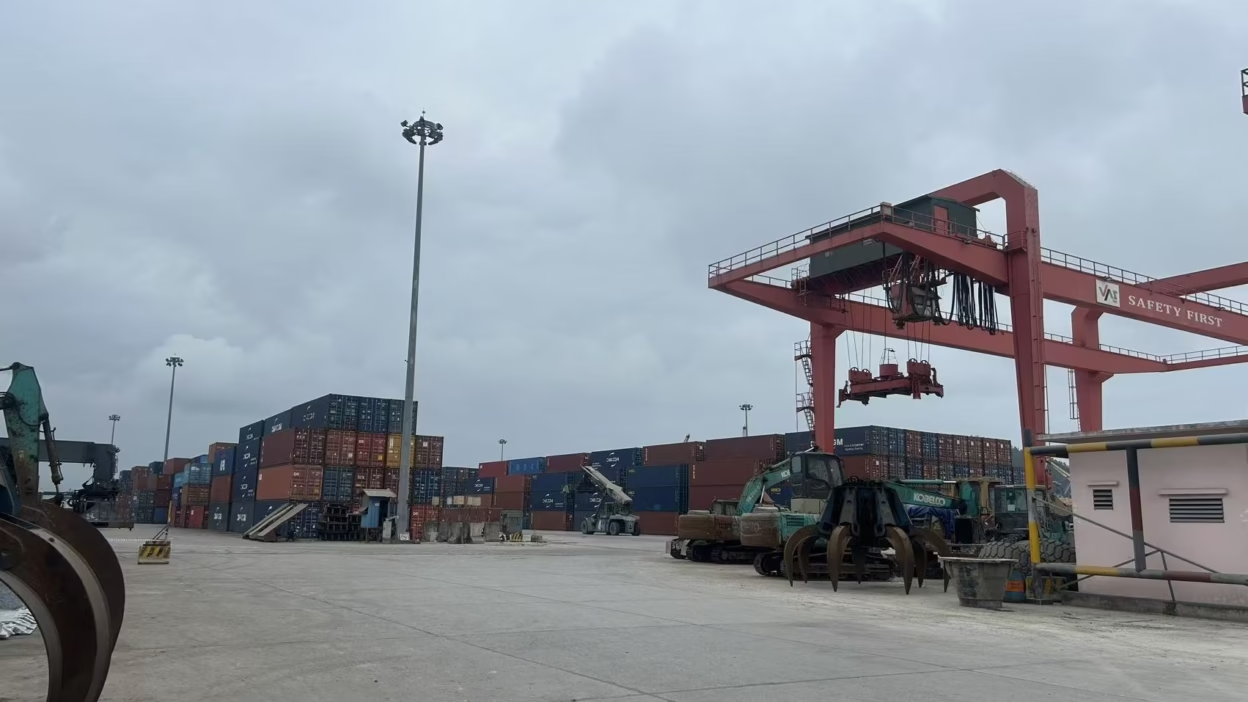
TROMMELFLEX PUR-HF D12Y11YU11Y-J/O is a flexible 0.6/1 kV low voltage reeling cable for high mechanical stress applications. Its engineering value is not only the voltage rating, but the combination of class 5 flexible plain copper conductors, halogen-free polyester-based insulation, a central textile carrier unit, short-length core lay, PUR inner sheath, open support braiding and black halogen-free flame-retardant polyurethane outer sheath. For port cranes, ship loaders, festoon systems, mobile machines and wet outdoor cable routes, the design targets a rare performance window: 25 N/mm² tensile load, ±50°/m torsional stress, 6×D minimum bending radius, 90°C conductor operation and permanent use in water up to 50 m diving depth.
FABER® PUR Reeling (UL) is a 0.6/1 kV multi-core polyurethane reeling cable engineered by Anhui Feichun Special Cable Co., Ltd. that simultaneously achieves five performance extremes rarely found together in a single cable: −50°C arctic cold rating for fixed installations in polar environments, 200 m/min operating speed for the fastest motorized reels in modern industry, 6× OD dynamic bending radius that equals the static rating of most competitors, up to 49 cores in a single cable for maximum signal and power density, and explosive environment suitability for deployment in ATEX-classified areas where ordinary cables are prohibited.

FABER® PUR Reeling (UL)

FABER® PUR Reeling (UL) is a 0.6/1 kV multi-core polyurethane reeling cable engineered by Anhui Feichun Special Cable Co., Ltd. that simultaneously achieves five performance extremes rarely found together in a single cable: −50°C arctic cold rating for fixed installations in polar environments, 200 m/min operating speed for the fastest motorized reels in modern industry, 6× OD dynamic bending radius that equals the static rating of most competitors, up to 49 cores in a single cable for maximum signal and power density, and explosive environment suitability for deployment in ATEX-classified areas where ordinary cables are prohibited.
Full equivalent to Prysmian TROMMELFLEX® / Draka NSHTÖU-J (also searched as NSHTOEU-J or NSHTOU-J) 4G95 0.6/1 kV — heavy-duty LV reeling cable for STS/RTG port cranes, bridge/gantry cranes, grab operations, steel mills, mining plants. Letter-by-letter decoding of NSHTÖU-J per DIN VDE 0250-814. Specs: 4×95 mm² (3L+PE), OD 47–51.5 mm, weight ~5,200 kg/km, Cu ~3,648 kg/km, current 296 A (30°C), short-circuit 11.59 kA (1s), bend 10–12×OD, speed 120 m/min, tensile ~5,700 N, -25/+80°C. Tinned Cu class 5, EPR ≥3GI3, chloroprene 5GM5 sheath. Derating factors for multi-layer winding per VDE 0298-4. Pricing: Prysmian €18–35/m vs Feichun FC-TRM €8–16/m (50–60% savings). Ships 3–7 days from stock (confirmed March 2026). EAC, GOST-R, CE.

Китайский аналог Draka/Prysmian: барабанный кабель NSHTÖU-J 4G95 0.6/1 kV в наличии — расшифровка, характеристики, цена

Full equivalent to Prysmian TROMMELFLEX® / Draka NSHTÖU-J (also searched as NSHTOEU-J or NSHTOU-J) 4G95 0.6/1 kV — heavy-duty LV reeling cable for STS/RTG port cranes, bridge/gantry cranes, grab operations, steel mills, mining plants. Letter-by-letter decoding of NSHTÖU-J per DIN VDE 0250-814. Specs: 4×95 mm² (3L+PE), OD 47–51.5 mm, weight ~5,200 kg/km, Cu ~3,648 kg/km, current 296 A (30°C), short-circuit 11.59 kA (1s), bend 10–12×OD, speed 120 m/min, tensile ~5,700 N, -25/+80°C. Tinned Cu class 5, EPR ≥3GI3, chloroprene 5GM5 sheath. Derating factors for multi-layer winding per VDE 0298-4. Pricing: Prysmian €18–35/m vs Feichun FC-TRM €8–16/m (50–60% savings). Ships 3–7 days from stock (confirmed March 2026). EAC, GOST-R, CE.
The maximum pulling tension for NSHTÖU-J 5G16 0.6/1kV cable is absolutely limited to 1,200 newtons of axial tensile load under the VDE 0250-814 standard specification. This maximum is calculated as 15 N/mm² tensile stress multiplied by the total cross-sectional area of the five main copper conductors (five cores × 16 mm² = 80 mm² total), yielding 15 × 80 = 1,200 newtons. This is not a casual guideline or general recommendation—it is the absolute mechanical failure point beyond which the copper conductors begin plastic deformation and eventual rupture. For practical field deployment, however, the safe operating pulling tension should be substantially lower, typically in the range of 600–900 newtons depending on the specific installation scenario, representing a safety factor of 1.3–2.0 applied against the 1,200 newton absolute maximum. The reasoning is straightforward: you never want to operate consistently at the edge of mechanical failure, where even small unanticipated additional loads could cause catastrophic failure. Instead, you design systems to operate comfortably within safe margins where occasional transient overloads can be tolerated without damage.

Maximum Pulling Tension: What is the exact maximum safe pulling load and tensile strength specification for NSHTÖU-J 5G16 0.6/1kV low-voltage reeling cables in heavy machinery and port crane applications?

The maximum pulling tension for NSHTÖU-J 5G16 0.6/1kV cable is absolutely limited to 1,200 newtons of axial tensile load under the VDE 0250-814 standard specification. This maximum is calculated as 15 N/mm² tensile stress multiplied by the total cross-sectional area of the five main copper conductors (five cores × 16 mm² = 80 mm² total), yielding 15 × 80 = 1,200 newtons. This is not a casual guideline or general recommendation—it is the absolute mechanical failure point beyond which the copper conductors begin plastic deformation and eventual rupture. For practical field deployment, however, the safe operating pulling tension should be substantially lower, typically in the range of 600–900 newtons depending on the specific installation scenario, representing a safety factor of 1.3–2.0 applied against the 1,200 newton absolute maximum. The reasoning is straightforward: you never want to operate consistently at the edge of mechanical failure, where even small unanticipated additional loads could cause catastrophic failure. Instead, you design systems to operate comfortably within safe margins where occasional transient overloads can be tolerated without damage.
The continuous current carrying capacity of an (N)TSCGEWÖU 3x50+3x25/3 12/20kV cable wound in three compacted layers on a standard industrial reel is approximately 85 to 110 amperes depending on ambient temperature, mechanical stress conditions, and reel cooling characteristics. This represents a significant reduction from the cable's reference rating of 202 amperes, which is established under ideal laboratory conditions (30°C ambient, single conductor run in free air, no mechanical tension or twisting). The dramatic derating from 202 A to 85–110 A reflects the thermal constraint imposed by the compact three-layer geometry, where the inner layers of wound cable are thermally insulated by outer layers, preventing efficient dissipation of I²R resistive losses to the surrounding environment. The cable features three 50 mm² Class 2 stranded tinned copper main power conductors and a symmetrical 3×25 mm² grounding conductor architecture (the "3+3" design), weighing approximately 1,850 kg/km of copper content and 3,550–3,650 kg/km total weight, with proven torsional twist resistance to ±100°/m and maximum tensile load capability of 3,000 newtons per phase conductor.

Derating Factors: Current carrying capacity of (N)TSCGEWÖU 3×50+3×25/3 12/20kV wound in 3 layers on a reel

The continuous current carrying capacity of an (N)TSCGEWÖU 3×50+3×25/3 12/20kV cable wound in three compacted layers on a standard industrial reel is approximately 85 to 110 amperes depending on ambient temperature, mechanical stress conditions, and reel cooling characteristics. This represents a significant reduction from the cable’s reference rating of 202 amperes, which is established under ideal laboratory conditions (30°C ambient, single conductor run in free air, no mechanical tension or twisting). The dramatic derating from 202 A to 85–110 A reflects the thermal constraint imposed by the compact three-layer geometry, where the inner layers of wound cable are thermally insulated by outer layers, preventing efficient dissipation of I²R resistive losses to the surrounding environment. The cable features three 50 mm² Class 2 stranded tinned copper main power conductors and a symmetrical 3×25 mm² grounding conductor architecture (the “3+3” design), weighing approximately 1,850 kg/km of copper content and 3,550–3,650 kg/km total weight, with proven torsional twist resistance to ±100°/m and maximum tensile load capability of 3,000 newtons per phase conductor.
In the Nexans handling cable catalog, yellow outer sheaths are predominantly used for low-voltage (0.6/1 kV) RHEYCORD® series cables, while red outer sheaths identify medium-voltage (3–30 kV) RHEYFIRM® series cables. This color differentiation serves as a critical visual safety indicator for voltage level identification in industrial environments. 在耐克森搬运电缆目录中,黄色外护套主要用于低压(0.6/1 kV) RHEYCORD®系列电缆,而红色外护套用于标识中压(3–30 kV) RHEYFIRM®系列电缆。这种颜色区分是工业环境中电压等级识别的重要视觉安全指标。

Yellow vs. Red Sheath: Decoding Nexans RHEYFIRM® Color Codes

In the Nexans handling cable catalog, yellow outer sheaths are predominantly used for low-voltage (0.6/1 kV) RHEYCORD® series cables, while red outer sheaths identify medium-voltage (3–30 kV) RHEYFIRM® series cables. This color differentiation serves as a critical visual safety indicator for voltage level identification in industrial environments. 在耐克森搬运电缆目录中,黄色外护套主要用于低压(0.6/1 kV) RHEYCORD®系列电缆,而红色外护套用于标识中压(3–30 kV) RHEYFIRM®系列电缆。这种颜色区分是工业环境中电压等级识别的重要视觉安全指标。
The RHEYFIRM® series represents Nexans' premium line of flexible high-voltage and medium-voltage reeling cables, engineered specifically for demanding industrial applications requiring exceptional mechanical stress resistance combined with reliable electrical performance. These cables are manufactured according to the stringent requirements of DIN VDE 0250 Part 813, which governs trailing cables with rated voltages from 0.6/1 kV up to 20/35 kV. RHEYFIRM®系列是耐克森公司的高端柔性高压和中压卷筒电缆产品线,专门针对需要卓越机械应力耐受性和可靠电气性能的苛刻工业应用而设计。这些电缆按照DIN VDE 0250第813部分的严格要求制造,该标准规定了额定电压从0.6/1 kV至20/35 kV的拖曳电缆技术规范。

Voltage Ratings: RHEYFIRM® 30kV — Can Generic (N)TSCGEWÖU Match Nexans’ 20/35kV Rating?

The RHEYFIRM® series represents Nexans’ premium line of flexible high-voltage and medium-voltage reeling cables, engineered specifically for demanding industrial applications requiring exceptional mechanical stress resistance combined with reliable electrical performance. These cables are manufactured according to the stringent requirements of DIN VDE 0250 Part 813, which governs trailing cables with rated voltages from 0.6/1 kV up to 20/35 kV. RHEYFIRM®系列是耐克森公司的高端柔性高压和中压卷筒电缆产品线,专门针对需要卓越机械应力耐受性和可靠电气性能的苛刻工业应用而设计。这些电缆按照DIN VDE 0250第813部分的严格要求制造,该标准规定了额定电压从0.6/1 kV至20/35 kV的拖曳电缆技术规范。
In modern port operations and heavy machinery applications, reeling cable performance at high speeds has become a critical factor for operational efficiency and equipment reliability. This technical analysis examines whether generic (N)TSCGEWÖU cables can achieve the same performance standards as Nexans RHEYFIRM® cables, particularly at the 240 meters per minute (m/min) reeling speed threshold. 在现代港口作业和重型机械应用中,高速卷取电缆性能已成为运行效率和设备可靠性的关键因素。本技术分析检验了通用(N)TSCGEWÖU电缆能否达到与Nexans RHEYFIRM®电缆相同的性能标准,特别是在240米/分钟(m/min)卷取速度阈值下。

Speed Rating: Can Generic (N)TSCGEWÖU Match the 240m/min Reeling Speed Capability of Nexans RHEYFIRM®?

In modern port operations and heavy machinery applications, reeling cable performance at high speeds has become a critical factor for operational efficiency and equipment reliability. This technical analysis examines whether generic (N)TSCGEWÖU cables can achieve the same performance standards as Nexans RHEYFIRM® cables, particularly at the 240 meters per minute (m/min) reeling speed threshold. 在现代港口作业和重型机械应用中,高速卷取电缆性能已成为运行效率和设备可靠性的关键因素。本技术分析检验了通用(N)TSCGEWÖU电缆能否达到与Nexans RHEYFIRM®电缆相同的性能标准,特别是在240米/分钟(m/min)卷取速度阈值下。