cold weather cable

Ethylene Propylene Rubber (EPR) insulated cables represent the professional approach to flexible electrical distribution—cables engineered to accommodate dynamic deployment, repetitive coiling/uncoiling, temperature variation, and mechanical stress inherent in portable and industrial equipment applications. Unlike fixed-installation cables optimized for stationary performance, EPR cables balance electrical performance, mechanical flexibility, environmental durability, and cost-effectiveness required for equipment requiring frequent relocation or deployment flexibility. Fundamental Design Philosophy: EPR cables employ elastomeric insulation material (ethylene propylene rubber) selected specifically for flexibility maintenance across wide temperature range. This material provides sustained flexibility even at cold temperatures (−40°C minimum), maintains electrical properties across elevated temperature range (continuous operation to +100°C), and demonstrates superior resistance to ozone, UV radiation, and environmental contamination characteristic of portable equipment deployment. Conductor Architecture for Flexibility: Rather than single-strand conductors (rigid, prone to breaking under flex stress), EPR cables employ multi-strand conductor design—typically 7, 19, 37, or 61 individual wires woven together. This multi-strand architecture enables smooth bending without conductor fracture, distributes mechanical stress across multiple strands preventing single-point failure, and maintains consistent electrical performance through tens of thousands of flex cycles. Voltage Rating & Safety Margin: Standard 0.6/1KV rating provides nominal 600V operating margin with 1000V safety ceiling—appropriate for most industrial equipment, portable power systems, and temporary installations. The dual rating nomenclature indicates 0.6KV continuous operating voltage with 1KV maximum transient voltage tolerance, providing balanced safety margin against impulse transients and surge events.

Ethylene Propylene Rubber (EPR) Insulated Cable Family

Ethylene Propylene Rubber (EPR) insulated cables represent the professional approach to flexible electrical distribution—cables engineered to accommodate dynamic deployment, repetitive coiling/uncoiling, temperature variation, and mechanical stress inherent in portable and industrial equipment applications. Unlike fixed-installation cables optimized for stationary performance, EPR cables balance electrical performance, mechanical flexibility, environmental durability, and cost-effectiveness required for equipment requiring frequent relocation or deployment flexibility. Fundamental Design Philosophy: EPR cables employ elastomeric insulation material (ethylene propylene rubber) selected specifically for flexibility maintenance across wide temperature range. This material provides sustained flexibility even at cold temperatures (−40°C minimum), maintains electrical properties across elevated temperature range (continuous operation to +100°C), and demonstrates superior resistance to ozone, UV radiation, and environmental contamination characteristic of portable equipment deployment. Conductor Architecture for Flexibility: Rather than single-strand conductors (rigid, prone to breaking under flex stress), EPR cables employ multi-strand conductor design—typically 7, 19, 37, or 61 individual wires woven together. This multi-strand architecture enables smooth bending without conductor fracture, distributes mechanical stress across multiple strands preventing single-point failure, and maintains consistent electrical performance through tens of thousands of flex cycles. Voltage Rating & Safety Margin: Standard 0.6/1KV rating provides nominal 600V operating margin with 1000V safety ceiling—appropriate for most industrial equipment, portable power systems, and temporary installations. The dual rating nomenclature indicates 0.6KV continuous operating voltage with 1KV maximum transient voltage tolerance, providing balanced safety margin against impulse transients and surge events.
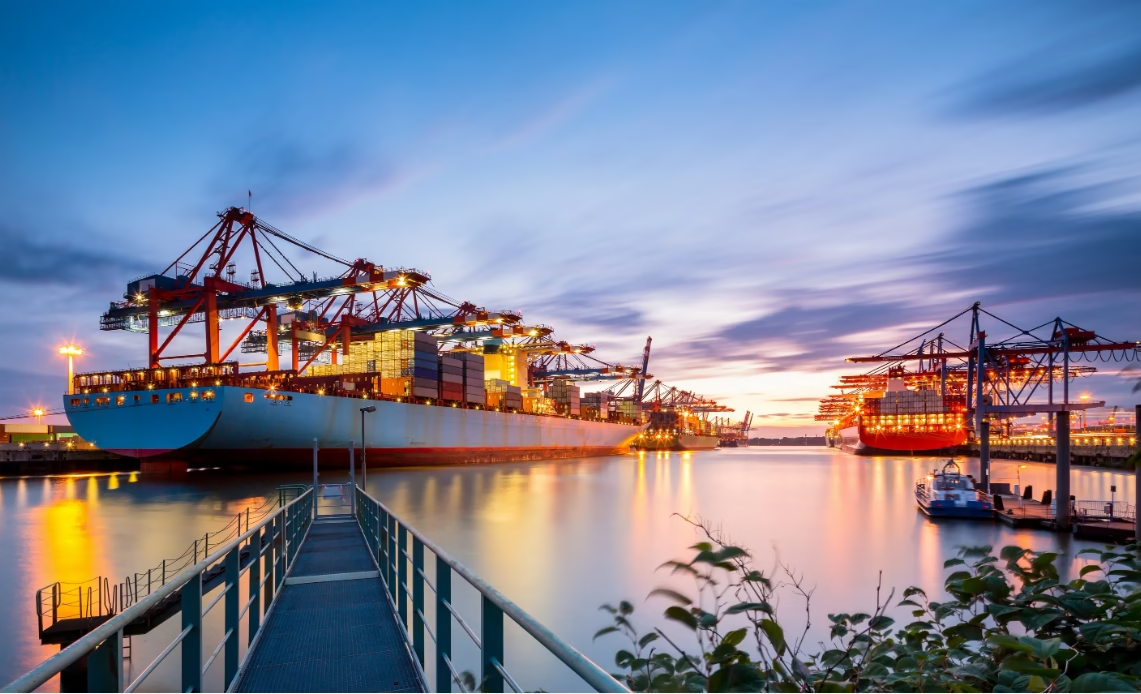
PNCT-R high-voltage reel cables represent an advanced evolution in portable power distribution—engineered specifically for container cranes, ship unloaders, cargo handling systems, and bulk terminal equipment where electrical power must be delivered dynamically through mechanically spooled cable reels. Unlike stationary cable installations with fixed routing and stress patterns, reel-deployed cables experience continuous repetitive flex-cycling, abrupt acceleration/deceleration forces, and environmental exposure across multiple geographic locations and climate conditions. Fundamental Design Challenge: Traditional high-voltage cables designed for fixed installations fail catastrophically when deployed on mechanical reels. The repetitive flex-cycling—where individual cable cross-sections bend and straighten thousands of times per shift—creates progressive internal stress concentration and insulation degradation. External mechanical stresses from reel spooling, retraction, equipment vibration, and wind loading accelerate conductor separation and sheath cracking. Standard copper braiding provides insufficient tensile support for repeated dynamic loads. Engineering Solution — Kevlar-Reinforced Architecture: PNCT-R cables integrate specialized Kevlar aramid fiber reinforcement layers—a material system engineered to absorb mechanical stress and prevent internal conductor displacement during dynamic cycling. Rather than relying solely on copper or aluminum tensile components, Kevlar fibers provide sustained tensile support through tens of thousands of flex cycles, maintaining conductor geometry integrity and preventing the progressive insulation failure characteristic of standard high-voltage cables deployed on reels. Feichun engineers have developed proprietary Kevlar weaving methodologies that integrate the reinforcement material within the cable architecture—not as external wrapping (which adds excessive weight), but as strategically positioned internal tensile layers coordinated with specialized sheath formulations. This integrated architecture enables PNCT-R cables to withstand 2+ million repetitive flex cycles at full operational stress without performance degradation.

PNCT-R High-Voltage Reel Cable Family

PNCT-R high-voltage reel cables represent an advanced evolution in portable power distribution—engineered specifically for container cranes, ship unloaders, cargo handling systems, and bulk terminal equipment where electrical power must be delivered dynamically through mechanically spooled cable reels. Unlike stationary cable installations with fixed routing and stress patterns, reel-deployed cables experience continuous repetitive flex-cycling, abrupt acceleration/deceleration forces, and environmental exposure across multiple geographic locations and climate conditions. Fundamental Design Challenge: Traditional high-voltage cables designed for fixed installations fail catastrophically when deployed on mechanical reels. The repetitive flex-cycling—where individual cable cross-sections bend and straighten thousands of times per shift—creates progressive internal stress concentration and insulation degradation. External mechanical stresses from reel spooling, retraction, equipment vibration, and wind loading accelerate conductor separation and sheath cracking. Standard copper braiding provides insufficient tensile support for repeated dynamic loads. Engineering Solution — Kevlar-Reinforced Architecture: PNCT-R cables integrate specialized Kevlar aramid fiber reinforcement layers—a material system engineered to absorb mechanical stress and prevent internal conductor displacement during dynamic cycling. Rather than relying solely on copper or aluminum tensile components, Kevlar fibers provide sustained tensile support through tens of thousands of flex cycles, maintaining conductor geometry integrity and preventing the progressive insulation failure characteristic of standard high-voltage cables deployed on reels. Feichun engineers have developed proprietary Kevlar weaving methodologies that integrate the reinforcement material within the cable architecture—not as external wrapping (which adds excessive weight), but as strategically positioned internal tensile layers coordinated with specialized sheath formulations. This integrated architecture enables PNCT-R cables to withstand 2+ million repetitive flex cycles at full operational stress without performance degradation.
Type SHD-GC 3/C 250 MCM 25kV trailing cable is rated for 400 amperes in controlled free-air environments and 320 amperes under typical mining duty cycles, with an outer diameter of 104 to 110 millimeters and total weight of approximately 10,500 to 11,500 kilograms per kilometer. The cable features three 250 MCM (approximately 127 mm²) phase conductors plus dedicated ground-check and grounding conductors, EPR insulation rated for 90°C continuous operation, and an outer sheath formulation in either heavy-duty CPE (chlorinated polyethylene) or upgraded TPU (polyurethane) designed for abrasion and tear resistance. However, the direct engineering answer to whether this cable can "handle" continuous granite dragging without supplementary protection is not a simple affirmation. Sharp granite and quartzite surfaces act as natural cutting tools under the sustained dragging loads of 3,000 to 8,000 newtons that are typical in dragline and shovel mining operations, and will progressively abrade even the most robust elastomer sheath formulations. Even cables featuring premium TPU jackets offering five times the abrasion resistance of standard CPE will experience significantly accelerated wear rates when dragged continuously across sharp granite compared to smoother surfaces. Therefore, the realistic answer requires an important qualification: the Type SHD-GC 3/C 250 MCM 25kV cable can indeed survive granite dragging operations, but only when supplemented with active protective strategies including cable handlers that minimize ground contact, polyurethane guard sleeves in high-wear sections, operational derating to reduce thermal stress that compounds mechanical wear, and proper cable routing that avoids the sharpest rock concentrations. Without these supplementary measures, the cable's service life in granite mining environments is reduced from the 5 to 10 years typical in moderate operating conditions to perhaps 2 to 3 years of intensive dragging. With proper protection strategies implemented from the outset, service life can be extended to 4 to 7 years—representing a substantial return on the modest investment in protective equipment and engineering attention.

Draglines & Shovels: Can Type SHD-GC 3/C 250 MCM 25kV Handle Continuous Dragging on Sharp Granite Rocks?

Type SHD-GC 3/C 250 MCM 25kV trailing cable is rated for 400 amperes in controlled free-air environments and 320 amperes under typical mining duty cycles, with an outer diameter of 104 to 110 millimeters and total weight of approximately 10,500 to 11,500 kilograms per kilometer. The cable features three 250 MCM (approximately 127 mm²) phase conductors plus dedicated ground-check and grounding conductors, EPR insulation rated for 90°C continuous operation, and an outer sheath formulation in either heavy-duty CPE (chlorinated polyethylene) or upgraded TPU (polyurethane) designed for abrasion and tear resistance. However, the direct engineering answer to whether this cable can “handle” continuous granite dragging without supplementary protection is not a simple affirmation. Sharp granite and quartzite surfaces act as natural cutting tools under the sustained dragging loads of 3,000 to 8,000 newtons that are typical in dragline and shovel mining operations, and will progressively abrade even the most robust elastomer sheath formulations. Even cables featuring premium TPU jackets offering five times the abrasion resistance of standard CPE will experience significantly accelerated wear rates when dragged continuously across sharp granite compared to smoother surfaces. Therefore, the realistic answer requires an important qualification: the Type SHD-GC 3/C 250 MCM 25kV cable can indeed survive granite dragging operations, but only when supplemented with active protective strategies including cable handlers that minimize ground contact, polyurethane guard sleeves in high-wear sections, operational derating to reduce thermal stress that compounds mechanical wear, and proper cable routing that avoids the sharpest rock concentrations. Without these supplementary measures, the cable’s service life in granite mining environments is reduced from the 5 to 10 years typical in moderate operating conditions to perhaps 2 to 3 years of intensive dragging. With proper protection strategies implemented from the outset, service life can be extended to 4 to 7 years—representing a substantial return on the modest investment in protective equipment and engineering attention.
Type SHD-GC 3/C 4/0 AWG 8kV trailing cable, rated for 321 to 327 amperes continuous current at sea level (0 meters) assuming typical mining conditions with natural air cooling, experiences substantial reduction in current-carrying capacity when deployed at 4,000 meters elevation in the Andes Mountains. At 4,000 meters, the atmospheric pressure is only approximately 60 percent of sea-level pressure, and air density is reduced proportionally. This thin-air environment reduces the cable's cooling efficiency dramatically, resulting in derated ampacity of approximately 185 to 210 amperes—a reduction of 40 to 45 percent compared to sea-level capacity. This derating is not optional or conservative—it is physically necessary to prevent the cable conductor from exceeding the maximum allowable operating temperature of 90°C under continuous load. If a cable rated at 321A at sea level were operated at full sea-level ampacity while installed at 4,000 meters elevation, the conductor temperature would rise to approximately 120°C to 140°C or higher, severely accelerating insulation degradation and risking catastrophic failure within months. The derating magnitude is driven by fundamental thermodynamic principles: as altitude increases and air density decreases, the convective heat transfer coefficient that governs how efficiently the cable surface transfers heat to the surrounding air decreases proportionally. The relationship between air density and cooling efficiency is not linear—it follows approximately the 0.6 power relationship, meaning that reducing air density to 60 percent of sea-level value reduces cooling efficiency to approximately 70 percent. Additionally, in high-altitude Andes mining regions where ambient temperatures reach 25°C to 35°C in tropical regions or 40°C to 50°C in equipment enclosures, the combined effect of altitude derating plus temperature derating can reduce ampacity to values as low as 150 to 160 amperes—less than half the sea-level rating. Understanding and properly accounting for altitude derating in equipment selection, protection device settings, and operational procedures is essential for safe and reliable operation of power distribution systems at high-altitude mining facilities.

High-Altitude Ampacity Derating: How Does Operating at 4,000m in the Andes Mountains Affect Type SHD-GC 3/C 4/0 AWG 8kV Cable Current Capacity?

Type SHD-GC 3/C 4/0 AWG 8kV trailing cable, rated for 321 to 327 amperes continuous current at sea level (0 meters) assuming typical mining conditions with natural air cooling, experiences substantial reduction in current-carrying capacity when deployed at 4,000 meters elevation in the Andes Mountains. At 4,000 meters, the atmospheric pressure is only approximately 60 percent of sea-level pressure, and air density is reduced proportionally. This thin-air environment reduces the cable’s cooling efficiency dramatically, resulting in derated ampacity of approximately 185 to 210 amperes—a reduction of 40 to 45 percent compared to sea-level capacity. This derating is not optional or conservative—it is physically necessary to prevent the cable conductor from exceeding the maximum allowable operating temperature of 90°C under continuous load. If a cable rated at 321A at sea level were operated at full sea-level ampacity while installed at 4,000 meters elevation, the conductor temperature would rise to approximately 120°C to 140°C or higher, severely accelerating insulation degradation and risking catastrophic failure within months. The derating magnitude is driven by fundamental thermodynamic principles: as altitude increases and air density decreases, the convective heat transfer coefficient that governs how efficiently the cable surface transfers heat to the surrounding air decreases proportionally. The relationship between air density and cooling efficiency is not linear—it follows approximately the 0.6 power relationship, meaning that reducing air density to 60 percent of sea-level value reduces cooling efficiency to approximately 70 percent. Additionally, in high-altitude Andes mining regions where ambient temperatures reach 25°C to 35°C in tropical regions or 40°C to 50°C in equipment enclosures, the combined effect of altitude derating plus temperature derating can reduce ampacity to values as low as 150 to 160 amperes—less than half the sea-level rating. Understanding and properly accounting for altitude derating in equipment selection, protection device settings, and operational procedures is essential for safe and reliable operation of power distribution systems at high-altitude mining facilities.
To understand why Type 450-FO composite cables represent such a significant advancement for stacker-reclaimer applications, we first need to appreciate what makes these cables different from traditional power or communication cables. Think of a Type 450-FO composite cable as a sophisticated integration of two fundamentally different technologies working together in harmony within a single protective structure. The designation "450-FO" tells us important information about this cable's design: the "450" typically indicates the voltage rating in volts for the power conductors, while "FO" stands for Fiber Optic, signaling that optical fibers are integrated within the same cable assembly alongside the copper power conductors. 要理解为什么Type 450-FO复合电缆代表了堆取料机应用的重大进步,我们首先需要了解是什么使这些电缆与传统的电力或通信电缆不同。将Type 450-FO复合电缆想象为两种根本不同技术的复杂集成,在单个保护结构内和谐地协同工作。"450-FO"名称告诉我们有关这种电缆设计的重要信息:"450"通常表示电力导体的额定电压(以伏特为单位),而"FO"代表光纤,表示光纤与铜电力导体一起集成在同一电缆组件中。

Integrated Fiber Optics: Advantages of Type 450-FO Composite Cables for Remote-Controlled Stacker-Reclaimers

To understand why Type 450-FO composite cables represent such a significant advancement for stacker-reclaimer applications, we first need to appreciate what makes these cables different from traditional power or communication cables. Think of a Type 450-FO composite cable as a sophisticated integration of two fundamentally different technologies working together in harmony within a single protective structure. The designation “450-FO” tells us important information about this cable’s design: the “450” typically indicates the voltage rating in volts for the power conductors, while “FO” stands for Fiber Optic, signaling that optical fibers are integrated within the same cable assembly alongside the copper power conductors. 要理解为什么Type 450-FO复合电缆代表了堆取料机应用的重大进步,我们首先需要了解是什么使这些电缆与传统的电力或通信电缆不同。将Type 450-FO复合电缆想象为两种根本不同技术的复杂集成,在单个保护结构内和谐地协同工作。”450-FO”名称告诉我们有关这种电缆设计的重要信息:”450″通常表示电力导体的额定电压(以伏特为单位),而”FO”代表光纤,表示光纤与铜电力导体一起集成在同一电缆组件中。
CSA C22.2 NO. 96:23 - Portable Power Cables Comprehensive Technical Analysis and Application Guide

CSA C22.2 NO. 96:23 – Portable Power Cables

CSA C22.2 NO. 96:23 represents the twelfth edition of the Canadian portable power cable standard, published as a National Standard of Canada by CSA Group under the Canadian Electrical Code, Part II. This standard supersedes all previous editions dating back to 1951, with the 2023 edition incorporating significant technical updates and expanded cable categories to address evolving industrial requirements.
SANS 1520 Feichun Cable

CU/XLPE/LSZH/SWA/LSZH-SANS 1507 0.6/1KVBlack Sheath with White Strip Cable

The CU/XLPE/LSZH/SWA/LSZH-SANS 1507 0.6/1KV cable with black sheath and white identification strip represents a significant advancement in industrial power transmission technology. This specialized cable combines the robust mechanical protection of steel wire armour (SWA) with the critical safety features of Low Smoke Zero Halogen (LSZH) materials, making it an optimal choice for demanding applications in mining operations, petrochemical facilities, and infrastructure projects across South Africa and internationally.