cable lifecycle management

A comprehensive technical article for port electrical engineers, terminal maintenance managers, crane OEM integrators, and procurement specialists covering: the electrochemical mechanism of salt-fog corrosion in copper conductors and its acceleration under cyclic mechanical stress; FC-FLX™ ultra-fine N₂-annealed tinned copper conductor technology with Tongling Cu-CATH-1 traceability; FC-ASB™ aramid/polyester anti-torsion braid for catenary load distribution; marine-grade 5GM5 polychloroprene vs. standard 5GM3 sheath chemistry; halogen-free polyurethane alternatives for enclosed environments; IEC 60068-2-52 cyclic salt-mist validation methodology; comparative benchmarking against Semoflex® Drum (Lapp), CORDAFLEX® (Prysmian), RHEYFIRM® (Nexans), and NSHTÖU commodity equivalents; application engineering for STS gantry cranes, RTG and RMG container cranes, stacker-reclaimers, ship unloaders, and shore-power systems.

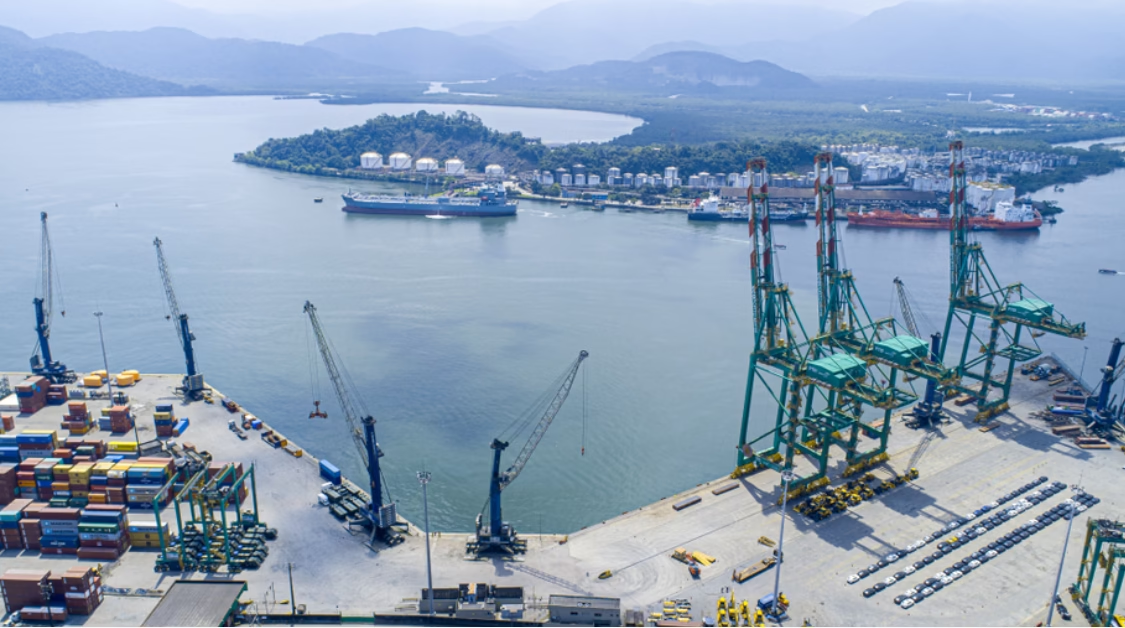
Salt-Fog Resistant Port Crane Reeling Cables: Advanced Anti-Corrosion Engineering with FC-FLX™ Ultra-Fine Copper, FC-ASB™ Aramid Reinforcement, and Marine-Grade 5GM5 Sheath for Coastal Terminal Environments

A comprehensive technical article for port electrical engineers, terminal maintenance managers, crane OEM integrators, and procurement specialists covering: the electrochemical mechanism of salt-fog corrosion in copper conductors and its acceleration under cyclic mechanical stress; FC-FLX™ ultra-fine N₂-annealed tinned copper conductor technology with Tongling Cu-CATH-1 traceability; FC-ASB™ aramid/polyester anti-torsion braid for catenary load distribution; marine-grade 5GM5 polychloroprene vs. standard 5GM3 sheath chemistry; halogen-free polyurethane alternatives for enclosed environments; IEC 60068-2-52 cyclic salt-mist validation methodology; comparative benchmarking against Semoflex® Drum (Lapp), CORDAFLEX® (Prysmian), RHEYFIRM® (Nexans), and NSHTÖU commodity equivalents; application engineering for STS gantry cranes, RTG and RMG container cranes, stacker-reclaimers, ship unloaders, and shore-power systems.
FABER® (N)3GHSSYCY cable solves the pit equipment power distribution challenge through two integrated innovations: Galvanized Steel Wire Braid Armor (75% minimum coverage): Resists puncture from sharp rocks, crushing from equipment treads (500+ tonne axle loads), and abrasion from rocky terrain. Service life extended 3–5× vs. unarmored cables in identical pit conditions. Integrated Monitoring Core: Continuously measures insulation resistance, detecting degradation 4–8 weeks before insulation failure becomes critical. This early warning enables planned maintenance before unexpected equipment shutdown.

FABER® (N)3GHSSYCY

(N)3GHSSYCY is the integrated copper wire monitoring core spun on the first inner sheath. This dedicated conductor continuously measures insulation resistance between phase conductors and ground reference, enabling early warning of insulation degradation. Three-Stage Insulation Degradation Detection Stage 1 – Incipient Degradation (4–8 weeks before failure): Insulation resistance drops from >1000 MΩ to 100–500 MΩ range. Monitoring systems alert maintenance teams; scheduled cable replacement planned during next equipment maintenance window. Stage 2 – Advanced Degradation (1–4 weeks before failure): Resistance drops to 10–50 MΩ. Equipment operations reduced; high-priority replacement initiated (completed within 1–7 days). Stage 3 – Critical Failure (imminent): Resistance drops below 1 MΩ. Equipment immediately shut down; emergency cable replacement executed (8–12 hours typical). Monitoring Core Measurement Technology The monitoring core interfaces to pit electrical control systems via standard 24 VDC measurement electronics. A precision insulation resistance tester (1000 V minimum) measures leakage current across the monitoring core at 30-minute intervals, recording continuous insulation resistance trending. This trending data provides quantitative assessment of cable aging, enabling predictive maintenance planning based on actual cable condition rather than calendar time.
(N)TSCGEWÖU cable type represents a specialized category of medium-voltage power cables designed for demanding applications in mining, tunneling, harbor cranes, and heavy-duty industrial environments. These cables feature 3GI3 grade Ethylene-Propylene Rubber (EPR) insulation, which must maintain dielectric integrity under extreme mechanical stress, moisture exposure, and electrical field conditions. Understanding the aging behavior of the dielectric loss factor (tan delta, tan δ) is critical for predictive maintenance and ensuring operational safety in these mission-critical applications.

Tan Delta Aging: How does the dielectric loss factor (Tan Delta) of 3GI3 insulation in (N)TSCGEWÖU cables change with long-term aging?

(N)TSCGEWÖU cable type represents a specialized category of medium-voltage power cables designed for demanding applications in mining, tunneling, harbor cranes, and heavy-duty industrial environments. These cables feature 3GI3 grade Ethylene-Propylene Rubber (EPR) insulation, which must maintain dielectric integrity under extreme mechanical stress, moisture exposure, and electrical field conditions. Understanding the aging behavior of the dielectric loss factor (tan delta, tan δ) is critical for predictive maintenance and ensuring operational safety in these mission-critical applications.
FEICHUN Reeling cable

What is RELCT (MV) Reeling Cables for Container Cranes?

RELCT (MV) reeling cables serve a critical function in container crane electrification systems. Specifically, these cables are deployed to deliver electrical power from fixed power supply systems to the rotating reel mechanisms and traveling components of container handling cranes. The cable must accommodate continuous mechanical stressing from repetitive coiling and uncoiling operations while maintaining electrical integrity and safety performance.