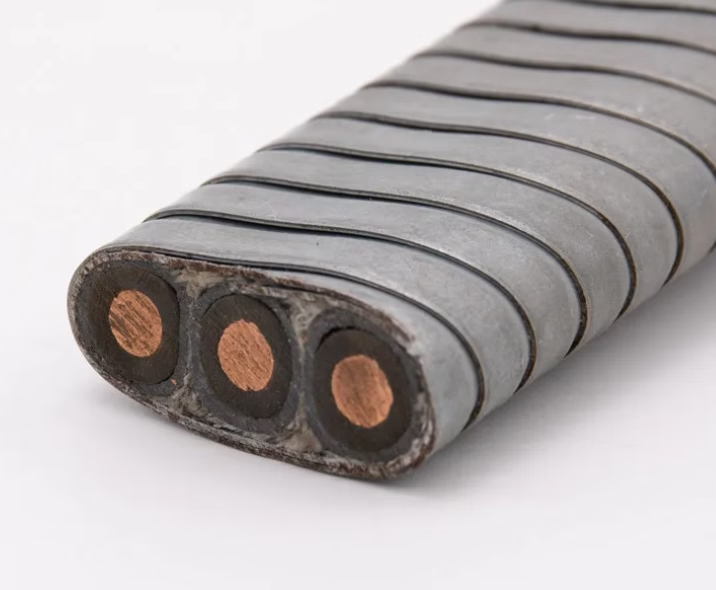
borehole cable

Underground mining is the most electrically hazardous industrial environment on Earth. Mobile machines — coal cutting machines, continuous miners, longwall shearers, load-haul-dump (LHD) vehicles, drill jumbos, raise borers, and shotcrete sprayers — operate in confined, wet, and potentially explosive atmospheres while dragging power cables through tunnels, over rough rock surfaces, around tight corners, and through cable handlers (protection chains) that subject the cable to extreme tensile, crushing, and impact forces. A single insulation failure in this environment can cause electric shock to mine personnel standing in conductive water, or an arcing fault that ignites methane or coal dust.

(N)SSHCGEOU V — Steel Wire Armoured Underground Mining Cable

Underground mining is the most electrically hazardous industrial environment on Earth. Mobile machines — coal cutting machines, continuous miners, longwall shearers, load-haul-dump (LHD) vehicles, drill jumbos, raise borers, and shotcrete sprayers — operate in confined, wet, and potentially explosive atmospheres while dragging power cables through tunnels, over rough rock surfaces, around tight corners, and through cable handlers (protection chains) that subject the cable to extreme tensile, crushing, and impact forces. A single insulation failure in this environment can cause electric shock to mine personnel standing in conductive water, or an arcing fault that ignites methane or coal dust.
Иерархия электроэнергии в подземной угольной шахте — почему 6/10кВ магистраль необходима: Типичная архитектура: (1) Наземная главная подстанция (ГПП): базирующейся на поверхности шахты, обычно 35 кВ или 110 кВ питание от региональной электросети. ГПП содержит мощный трансформатор 35/6 кВ (трансформация высокого напряжения в среднее), главный выключатель, защитные реле. (2) Магистральный кабель 6/10 кВ (TENAX-V NSSHCGEOEU-V или КГЭЖ 6/10кВ): спускается вертикально (или наклонно) из ГПП на поверхности вниз через ствол шахты на глубину 200–1,500 метров (в зависимости от глубины выработок). Длина магистрали: 500–3,000 м типичная. Магистраль прокладывается в защитной трубе или канале (каналы "кабелепровод" железобетонные с зазорами для вентиляции). Магистраль питает несколько подземных трансформаторных подстанций. (3) Подземные трансформаторные подстанции (ТП): расположены на разных уровнях выработок (каждый уровень добычи может иметь свою ТП). Трансформатор 6/0.66 кВ (или реже 6/0.4 кВ) понижает напряжение. ТП обычно содержит: входной масляный выключатель 6 кВ, трансформатор с естественным охлаждением масло-воздух (Power rating 250–630 кВА, зависит от количества комбайнов), выходные выключатели 0.66 кВ, система защиты (реле расстояния, дифференциальные реле). (4) Локальные распределительные кабели 0.6/1.0 кВ: от ТП идут отдельные кабели (низковольтные КГЭШм 1.14кВ, как обсуждалось в предыдущей статье) к комбайнам, лебёдкам, конвейерам. Следствие: магистраль 6/10 кВ являет "хребтом" подземного электроснабжения. Потеря или отказ магистрали = полное отключение всех устройств низкого напряжения в той зоне выработок, что она питает. Поэтому надёжность магистрального кабеля критична. Замена магистрали требует полной остановки шахты на несколько дней, стоимость простоя: миллионы в сутки. Это объясняет, почему локализация магистрального TENAX-V имеет стратегическое значение для русских операторов.

TENAX-V NSSHCGEOEU-V 6/10кВ: немецкий магистральный кабель и КГЭЖ 6/10кВ русский эквивалент для подземного электроснабжения

Иерархия электроэнергии в подземной угольной шахте — почему 6/10кВ магистраль необходима: Типичная архитектура: (1) Наземная главная подстанция (ГПП): базирующейся на поверхности шахты, обычно 35 кВ или 110 кВ питание от региональной электросети. ГПП содержит мощный трансформатор 35/6 кВ (трансформация высокого напряжения в среднее), главный выключатель, защитные реле. (2) Магистральный кабель 6/10 кВ (TENAX-V NSSHCGEOEU-V или КГЭЖ 6/10кВ): спускается вертикально (или наклонно) из ГПП на поверхности вниз через ствол шахты на глубину 200–1,500 метров (в зависимости от глубины выработок). Длина магистрали: 500–3,000 м типичная. Магистраль прокладывается в защитной трубе или канале (каналы “кабелепровод” железобетонные с зазорами для вентиляции). Магистраль питает несколько подземных трансформаторных подстанций. (3) Подземные трансформаторные подстанции (ТП): расположены на разных уровнях выработок (каждый уровень добычи может иметь свою ТП). Трансформатор 6/0.66 кВ (или реже 6/0.4 кВ) понижает напряжение. ТП обычно содержит: входной масляный выключатель 6 кВ, трансформатор с естественным охлаждением масло-воздух (Power rating 250–630 кВА, зависит от количества комбайнов), выходные выключатели 0.66 кВ, система защиты (реле расстояния, дифференциальные реле). (4) Локальные распределительные кабели 0.6/1.0 кВ: от ТП идут отдельные кабели (низковольтные КГЭШм 1.14кВ, как обсуждалось в предыдущей статье) к комбайнам, лебёдкам, конвейерам. Следствие: магистраль 6/10 кВ являет “хребтом” подземного электроснабжения. Потеря или отказ магистрали = полное отключение всех устройств низкого напряжения в той зоне выработок, что она питает. Поэтому надёжность магистрального кабеля критична. Замена магистрали требует полной остановки шахты на несколько дней, стоимость простоя: миллионы в сутки. Это объясняет, почему локализация магистрального TENAX-V имеет стратегическое значение для русских операторов.
Geographic & Operational Context: Chuquicamata (Codelco) is transitioning from the world's largest open-pit copper mine to underground block caving (autonomous underground mining system). Depths: 700–1,500 meters below surface (Phase 1), expanding to 2,500+ meters (long-term). El Teniente (Codelco) is already operating at extreme depths: primary block caving at 2,000–2,500 m elevation below surface. Both mines employ: (1) Block caving gravity feed (fragmented ore flows down to cave level), (2) Mobile equipment (diesel-electric LHDs—Load-Haul-Dump vehicles, 30–50 ton capacity), (3) Fixed hoisting infrastructure (vertical shafts, incline decline haulage), (4) Extensive underground electrical distribution: 11 kV primary feeders, 6.6 kV secondaries, 3.3 kV distribution to mobile substations. 楚基卡马塔(国铜矿公司Codelco)正在从全球最大露天铜矿向地下自然崩落法(自主地下采矿系统)转型。深度:地表以下700-1,500米(第1阶段),长期扩展至2,500+米。El Teniente(Codelco)已在极端深度运营:地表下2,000-2,500m主自然崩落区。两座矿山采用:(1)重力进给式自然崩落(碎矿由高处流下至崩落区)、(2)移动设备(柴油-电动LHD-装-运-卸车、30-50吨容量)、(3)固定提升基础设施(竖井、倾斜下降运输)、(4)广泛的地下电气配电:11 kV一级馈电、6.6 kV二级、3.3 kV配电至移动变电站。 Type 2S Selection Rationale: Underground fixed-installation feeders (in contrast to dragline/shovel trailing cables) experience: (1) Rock fall hazard (loose fragments falling from roof, occasional collapses), (2) Equipment impact (LHD vehicles occasionally strike cable trays during positioning), (3) Long service life (5–10+ years without planned removal), (4) Static or semi-static routing (no continuous reel cycling). Type 2S SWA (Steel Wire Armoured) is optimal because: (1) Mechanical armour (galvanized steel wire spiral) provides exceptional impact protection, (2) Symmetrical earth architecture supports high-impedance grounded distribution systems, (3) Heavy construction (11 ton/km total weight) means higher copper content → lower resistance → reduced voltage drop over long feeder runs.

AS/NZS 1972 Type 2S 11kV 3x185mm² SWA Armoured Feeder Cable for Chile Underground Copper Mines

Geographic & Operational Context: Chuquicamata (Codelco) is transitioning from the world’s largest open-pit copper mine to underground block caving (autonomous underground mining system). Depths: 700–1,500 meters below surface (Phase 1), expanding to 2,500+ meters (long-term). El Teniente (Codelco) is already operating at extreme depths: primary block caving at 2,000–2,500 m elevation below surface. Both mines employ: (1) Block caving gravity feed (fragmented ore flows down to cave level), (2) Mobile equipment (diesel-electric LHDs—Load-Haul-Dump vehicles, 30–50 ton capacity), (3) Fixed hoisting infrastructure (vertical shafts, incline decline haulage), (4) Extensive underground electrical distribution: 11 kV primary feeders, 6.6 kV secondaries, 3.3 kV distribution to mobile substations. 楚基卡马塔(国铜矿公司Codelco)正在从全球最大露天铜矿向地下自然崩落法(自主地下采矿系统)转型。深度:地表以下700-1,500米(第1阶段),长期扩展至2,500+米。El Teniente(Codelco)已在极端深度运营:地表下2,000-2,500m主自然崩落区。两座矿山采用:(1)重力进给式自然崩落(碎矿由高处流下至崩落区)、(2)移动设备(柴油-电动LHD-装-运-卸车、30-50吨容量)、(3)固定提升基础设施(竖井、倾斜下降运输)、(4)广泛的地下电气配电:11 kV一级馈电、6.6 kV二级、3.3 kV配电至移动变电站。 Type 2S Selection Rationale: Underground fixed-installation feeders (in contrast to dragline/shovel trailing cables) experience: (1) Rock fall hazard (loose fragments falling from roof, occasional collapses), (2) Equipment impact (LHD vehicles occasionally strike cable trays during positioning), (3) Long service life (5–10+ years without planned removal), (4) Static or semi-static routing (no continuous reel cycling). Type 2S SWA (Steel Wire Armoured) is optimal because: (1) Mechanical armour (galvanized steel wire spiral) provides exceptional impact protection, (2) Symmetrical earth architecture supports high-impedance grounded distribution systems, (3) Heavy construction (11 ton/km total weight) means higher copper content → lower resistance → reduced voltage drop over long feeder runs.
Standards Clarification: AS/NZS 1972 defines Type 9 explicitly as a gas non-transmission cable, specifically engineered for flameproof (Ex d) electrical equipment enclosures. Type 9 cables are typically small-diameter, multi-core control or monitoring cables (0.5 mm², 1.5 mm², etc.)—never large power conductors like 3×95 mm². 标准澄清:AS/NZS 1972明确定义Type 9为防气体传输电缆,特别是为了防爆(Ex d)电气设备外壳而设计。Type 9电缆通常是小径、多芯的控制或监测电缆(0.5 mm²、1.5 mm²等)——绝对不是大功率导体如3×95 mm²。 Why the Confusion? The numbering system in AS/NZS 1972 progresses from Type 1 (fixed installation) through Type 8 (vertical shaft DWA cables). Type 9's designation comes last but reflects a specialized application (flameproof enclosures) rather than advancement in power capacity. Engineers sometimes assume higher type numbers equal higher voltage/current capacity—this assumption is incorrect for Type 9.

Tensile Load Limits: Calculating Maximum Suspension Depth for AS/NZS 1972 Mining Cables

Standards Clarification: AS/NZS 1972 defines Type 9 explicitly as a gas non-transmission cable, specifically engineered for flameproof (Ex d) electrical equipment enclosures. Type 9 cables are typically small-diameter, multi-core control or monitoring cables (0.5 mm², 1.5 mm², etc.)—never large power conductors like 3×95 mm². 标准澄清:AS/NZS 1972明确定义Type 9为防气体传输电缆,特别是为了防爆(Ex d)电气设备外壳而设计。Type 9电缆通常是小径、多芯的控制或监测电缆(0.5 mm²、1.5 mm²等)——绝对不是大功率导体如3×95 mm²。 Why the Confusion? The numbering system in AS/NZS 1972 progresses from Type 1 (fixed installation) through Type 8 (vertical shaft DWA cables). Type 9’s designation comes last but reflects a specialized application (flameproof enclosures) rather than advancement in power capacity. Engineers sometimes assume higher type numbers equal higher voltage/current capacity—this assumption is incorrect for Type 9.Standards Clarification: AS/NZS 1972 defines Type 9 explicitly as a gas non-transmission cable, specifically engineered for flameproof (Ex d) electrical equipment enclosures. Type 9 cables are typically small-diameter, multi-core control or monitoring cables (0.5 mm², 1.5 mm², etc.)—never large power conductors like 3×95 mm². 标准澄清:AS/NZS 1972明确定义Type 9为防气体传输电缆,特别是为了防爆(Ex d)电气设备外壳而设计。Type 9电缆通常是小径、多芯的控制或监测电缆(0.5 mm²、1.5 mm²等)——绝对不是大功率导体如3×95 mm²。 Why the Confusion? The numbering system in AS/NZS 1972 progresses from Type 1 (fixed installation) through Type 8 (vertical shaft DWA cables). Type 9’s designation comes last but reflects a specialized application (flameproof enclosures) rather than advancement in power capacity. Engineers sometimes assume higher type numbers equal higher voltage/current capacity—this assumption is incorrect for Type 9.
When a heavy high-voltage cable is suspended vertically in a deep mine shaft (depths ranging from 500 to 2,000+ meters), it experiences mechanical stresses fundamentally different from horizontal installation. The single most critical issue is torsional stress from the cable's own weight acting upon the helical armor structure. 当沉重的高压电缆垂直悬挂在深矿井中(深度范围从500到2,000多米)时,它经历的机械应力与水平安装根本不同。最关键的单一问题是电缆自身重量作用在螺旋铠装结构上产生的扭转应力。 The Single-Wire Armor Problem: A standard SWA (single-wire armour) cable features a helical layer of galvanized steel wires wound around the insulation in one direction (typically right-hand helix). When the cable hangs vertically and experiences the entire weight of its length below it, the helical geometry creates a mechanical disadvantage. The steel wire winding naturally wants to "unwind" or rotate under the extreme tensile load, generating enormous torsional stress throughout the cable.

Double Wire Armour (DWA): Why Type 8 11kV Cables Require Dual Armor for Vertical Mine Shaft Suspension

When a heavy high-voltage cable is suspended vertically in a deep mine shaft (depths ranging from 500 to 2,000+ meters), it experiences mechanical stresses fundamentally different from horizontal installation. The single most critical issue is torsional stress from the cable’s own weight acting upon the helical armor structure. 当沉重的高压电缆垂直悬挂在深矿井中(深度范围从500到2,000多米)时,它经历的机械应力与水平安装根本不同。最关键的单一问题是电缆自身重量作用在螺旋铠装结构上产生的扭转应力。 The Single-Wire Armor Problem: A standard SWA (single-wire armour) cable features a helical layer of galvanized steel wires wound around the insulation in one direction (typically right-hand helix). When the cable hangs vertically and experiences the entire weight of its length below it, the helical geometry creates a mechanical disadvantage. The steel wire winding naturally wants to “unwind” or rotate under the extreme tensile load, generating enormous torsional stress throughout the cable.
The dielectric constant of the 3GI3 elastomeric insulation used in (N)3GHSSYCY 3x150+3x25/3 cable is approximately 6.2 to 6.8 at standard reference frequency of 1 kHz, with typical measured value around 6.5 for new cable material. The insulation breakdown voltage (also called dielectric strength or withstand voltage) exceeds 30 kV when measured under controlled laboratory conditions on fresh cable samples with 8 mm insulation thickness, typically achieving 32–38 kV before electrical breakdown occurs.

Dielectric Constant Specs: What is the exact dielectric constant and insulation breakdown voltage for (N)3GHSSYCY 3×150+3×25/3 medium-voltage cable in long VFD motor runs? 

The dielectric constant of the 3GI3 elastomeric insulation used in (N)3GHSSYCY 3×150+3×25/3 cable is approximately 6.2 to 6.8 at standard reference frequency of 1 kHz, with typical measured value around 6.5 for new cable material. The insulation breakdown voltage (also called dielectric strength or withstand voltage) exceeds 30 kV when measured under controlled laboratory conditions on fresh cable samples with 8 mm insulation thickness, typically achieving 32–38 kV before electrical breakdown occurs.
Submersible and pump cables are specialized electrical cables designed for permanent operation underwater, connecting electrical motor equipment in both process and potable water applications. According to IEC standards and VDE specifications, these cables must demonstrate exceptional water resistance, flexibility under pressure, and chemical compatibility with their operating environment. The cables support diverse industries from food processing to water treatment, mining, and aquatic installations.

What are Submersible & Pump Cables?

(N)SHÖU O/J 0.6/1kV, NSSHÖU O/J 0.6/1kV, NSSHÖU 3E 0.6/1kV, NSSHÖU 3E + ST 0.6/1kV, (N)SSCHÖU-J 0.6/1kV, (N)TSCGECEWÖU 3.6/6kV, (N)TSCGECEWÖU 6/10kV, (N)TSCGECEWÖU 8.7/15kV, (N)TSCGECEWÖU 12/20kV (N)TSCGEWÖU 3.6/6kV, (N)TSCGEWÖU 6/10kV, (N)TSCGEWÖU 8.7/15kV, (N)TSCGEWÖU 12/20kV, H07RN-8-F (10m), Pump Cable 300 (300m), Drincable 600 (600m), Drincable 600 Flat (600m), Drincable 800 (800m)