AS/NZS mining cable

This distinction is not academic. Every year, mining operations, port facilities, and industrial plants experience cable failures because an engineer or procurement team specified a trailing cable where a reeling cable was needed, or vice versa. The cables may share similar voltage ratings, conductor sizes, and even visual appearance—but they are engineered to solve fundamentally different mechanical problems. A trailing cable installed on a reeling drum will fatigue and fail within weeks. A reeling cable dragged across a mine floor will be cut, crushed, and destroyed within days. Understanding the engineering rationale behind each cable type is essential for anyone involved in cable specification, procurement, or installation for mining and heavy industrial applications. 这一区别绝非学术问题。每年都有矿山、港口和工业厂房因在需要卷筒电缆的场合错误使用了拖曳电缆(或反之)而发生电缆失效。两种电缆可能共享相似的电压等级、导体截面甚至外观——但它们的工程设计解决的是截然不同的机械问题。将拖曳电缆安装在卷筒上会在数周内导致疲劳断裂;将卷筒电缆在矿井地面拖拽会在数天内被切割和压碎。 This article provides the complete engineering foundation for understanding the differences. It is written for electrical engineers, mine electrical supervisors, procurement specialists, and equipment operators who must select the correct cable type for their specific application. Every comparison, every specification value, and every material choice described below is grounded in the physical reality of how these cables operate—and fail—in the field.

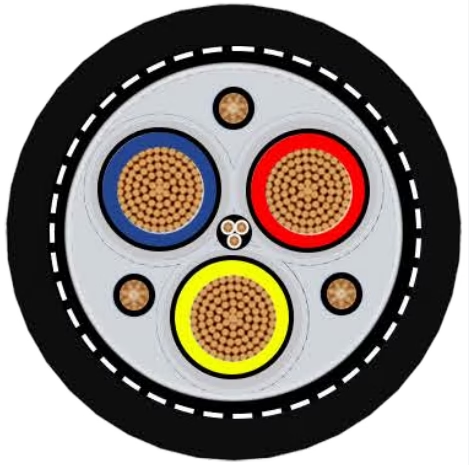
Reeling Cable vs Trailing Cable: Complete Engineering Comparison for Mining & Heavy Industry

This distinction is not academic. Every year, mining operations, port facilities, and industrial plants experience cable failures because an engineer or procurement team specified a trailing cable where a reeling cable was needed, or vice versa. The cables may share similar voltage ratings, conductor sizes, and even visual appearance—but they are engineered to solve fundamentally different mechanical problems. A trailing cable installed on a reeling drum will fatigue and fail within weeks. A reeling cable dragged across a mine floor will be cut, crushed, and destroyed within days. Understanding the engineering rationale behind each cable type is essential for anyone involved in cable specification, procurement, or installation for mining and heavy industrial applications. 这一区别绝非学术问题。每年都有矿山、港口和工业厂房因在需要卷筒电缆的场合错误使用了拖曳电缆(或反之)而发生电缆失效。两种电缆可能共享相似的电压等级、导体截面甚至外观——但它们的工程设计解决的是截然不同的机械问题。将拖曳电缆安装在卷筒上会在数周内导致疲劳断裂;将卷筒电缆在矿井地面拖拽会在数天内被切割和压碎。 This article provides the complete engineering foundation for understanding the differences. It is written for electrical engineers, mine electrical supervisors, procurement specialists, and equipment operators who must select the correct cable type for their specific application. Every comparison, every specification value, and every material choice described below is grounded in the physical reality of how these cables operate—and fail—in the field.
When specifying medium-voltage mining cables for international projects, engineers frequently encounter seemingly incompatible voltage ratings between European VDE standards and Commonwealth AS/NZS standards. A common point of confusion arises when comparing the 3.6/6kV rating found in DIN VDE 0250-813 flexible mining cables with the 3.3/3.3kV rating specified for AS/NZS 2802 Type 441 cables used extensively in Australian, New Zealand, and South African mining operations. 在为国际项目指定中压矿用电缆时,工程师经常遇到欧洲VDE标准与英联邦AS/NZS标准之间看似不兼容的电压等级。一个常见的困惑点是比较DIN VDE 0250-813柔性矿用电缆中的3.6/6kV额定电压与澳大利亚、新西兰和南非采矿作业广泛使用的AS/NZS 2802 Type 441电缆规定的3.3/3.3kV额定电压。

Voltage Rating Comparison: How Does the 3.6/6kV Rating in VDE 0250 Standards Compare to the 3.3/3.3kV Rating Used for Type 441 Cables in Commonwealth Mining?

When specifying medium-voltage mining cables for international projects, engineers frequently encounter seemingly incompatible voltage ratings between European VDE standards and Commonwealth AS/NZS standards. A common point of confusion arises when comparing the 3.6/6kV rating found in DIN VDE 0250-813 flexible mining cables with the 3.3/3.3kV rating specified for AS/NZS 2802 Type 441 cables used extensively in Australian, New Zealand, and South African mining operations. 在为国际项目指定中压矿用电缆时,工程师经常遇到欧洲VDE标准与英联邦AS/NZS标准之间看似不兼容的电压等级。一个常见的困惑点是比较DIN VDE 0250-813柔性矿用电缆中的3.6/6kV额定电压与澳大利亚、新西兰和南非采矿作业广泛使用的AS/NZS 2802 Type 441电缆规定的3.3/3.3kV额定电压。
Mining, drilling, and tunnelling cables represent the most demanding category of industrial cables, designed to operate in some of the harshest environments on earth. These heavy-duty power, control, and instrumentation cables serve mine operators worldwide for both static infrastructure and dynamic equipment applications. Manufactured in accordance with international standards including IEC 60502, BS EN 60332, BS EN 60811, BS EN 60754, and VDE 0295, mining cables must withstand mechanical stress, oil and grease exposure, water immersion, and in underground applications, provide critical fire safety through reduced smoke and fume emissions.

What are Mining, Drilling & Tunnelling Cables?

NSSHÖU cable, NSSHOU cable, NSHÖU cable, NSHOU cable, NSSCHOU cable, NSHTÖU cable, NTSCGEWÖU cable, NTSCGEWOU cable, NTMCGEWÖU cable, N3GHSSYCY cable, N3GHSSHCH cable,Type 61 cable, Type 63 cable, Type 611 cable, Type 622 cable, Type 633 cable, Type 66 cable,Type 240 cable, Type 241 cable, Type 245 cable, Type 450 cable, Type 455 cable, Type 260 cable, Type 275 cable, Type 409 cable, Type 440 cable, Type 441 cable,
PROTOLON(M) R-(N)TSCGEWOEU represents a sophisticated class of medium voltage flexible reeling cables specifically engineered for the most demanding applications in open-cast mining and material handling operations. These cables are designed to power large mobile equipment including excavators, dumpers, mobile crushers, and bucket-wheel excavators under extreme mechanical stresses. This comprehensive technical guide examines the construction, specifications, standards compliance, applications, and operational characteristics of this specialized cable system manufactured by Anhui Feichun Special Cable Co., Ltd.

PROTOLON(M) R-(N)TSCGEWOEU 6 kV – 35 kV: The Ultimate Flexible MV Reeling Cable for Heavy Mining Equipment

ROTOLON(M) R-(N)TSCGEWOEU cable designation follows the standardized German nomenclature system established under DIN VDE 0250 Part 813, which specifically addresses medium voltage reeling cables for mining and heavy industrial applications. The designation breaks down as follows: (N) – Indicates the presence of a concentric conductor arrangement with integrated earth conductors T – Tinned copper conductors for enhanced corrosion resistance S – Semiconductive screening layers for electric field control C – Cradle separator core arrangement for structural integrity G – EPR (Ethylene Propylene Rubber) insulation compound E – EPR-based inner sheath W – Anti-torsion woven braid reinforcement O – Oil-resistant outer sheath E – Enhanced elastomer outer sheath material U – Reinforced construction for extreme mechanical loads According to industry specifications from Reeling Cable, these cables are rated for voltage ranges from 3.6/6 kV up to 18/30 kV (with some variants reaching 20/35 kV), making them suitable for a comprehensive range of mining equipment power requirements.