
直埋电缆

When you look at a cable from the outside, you see a smooth, round cylinder. This simple appearance conceals a complex engineering challenge. Inside that cylindrical exterior are multiple insulated conductors of various sizes arranged together. Without proper design, these internal components would naturally create an irregular, lumpy cross-section rather than the uniform circular shape we expect from a professional cable. This is where rubber fillers play their essential role, and understanding their function requires us to think about the geometric and mechanical realities of cable construction.

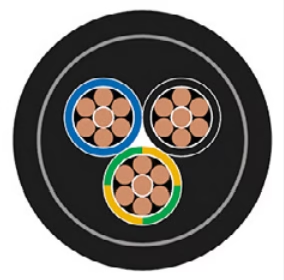
Rubber Filler Role: Understanding How Fillers Maintain Cylindrical Shape in NSSHÖU Cables Under Crushing Loads

When you look at a cable from the outside, you see a smooth, round cylinder. This simple appearance conceals a complex engineering challenge. Inside that cylindrical exterior are multiple insulated conductors of various sizes arranged together. Without proper design, these internal components would naturally create an irregular, lumpy cross-section rather than the uniform circular shape we expect from a professional cable. This is where rubber fillers play their essential role, and understanding their function requires us to think about the geometric and mechanical realities of cable construction.
(N)TSKCGEWÖU specifications. This protective layer serves multiple critical functions within the cable assembly, with mechanical stress redistribution being among its most important roles. According to research published by Sibelco, the bedding compound is defined as the material applied around insulated conductors to maintain their position and provide bedding for protective armoring.[1] This layer functions as an intermediary component positioned between the laid-up cores and the metallic armor, creating what cable engineers describe as a separation sheath that fundamentally alters how mechanical forces are distributed throughout the cable structure.

Inner Sheath Function: Mechanical Stress Redistribution in (N)TSKCGEWÖU Cables

(N)TSKCGEWÖU specifications. This protective layer serves multiple critical functions within the cable assembly, with mechanical stress redistribution being among its most important roles. According to research published by Sibelco, the bedding compound is defined as the material applied around insulated conductors to maintain their position and provide bedding for protective armoring.[1] This layer functions as an intermediary component positioned between the laid-up cores and the metallic armor, creating what cable engineers describe as a separation sheath that fundamentally alters how mechanical forces are distributed throughout the cable structure.
NF C32-322 is a French national standard (Norme Française) that specifies requirements for armoured low voltage power cables. These cables, commonly designated as U-1000 RVFV (copper conductor) and U-1000 ARVFV (aluminium conductor), are widely used rigid industrial cables designed for installations requiring mechanical protection. They represent the armoured equivalent of the NF C32-321 unarmoured cables.

What is NF C32-322 Cable?

NF C32-322, U-1000 RVFV, U-1000 ARVFV, U-1000 XAV, NF C32 322, RVFV cable, ARVFV cable, French standard armoured cable, 0.6/1kV cable, 1kV armoured cable, 600/1000V cable, low voltage armoured cable, LV power cable, 1000V industrial cable, NF C32-322 standard, NF C32-070 C2, IEC 60502-1, IEC 60228, IEC 60332-1-2, French cable standard, Norme Française cable, AFNOR cable standard, flame retardant cable,低压电缆, 低壓電纜, 铠装电缆, 鎧裝電纜, 交联聚乙烯电缆, 交聯聚乙烯電纜, 钢带铠装, 鋼帶鎧裝, 法国标准电缆, 法國標準電纜, 工业电缆, 工業電纜, 直埋电缆, 直埋電纜