Other special cables

FLEXIDRUM® SPECIAL R 702 представляет собой поколение универсальных кабельных решений, которые охватывают весь спектр применений от вертикальной прокладки в высотных зданиях до использования на тяжелом промышленном оборудовании. В отличие от специализированных кабелей, которые оптимизированы под одно конкретное применение, R 702 разработан как гибридное решение, которое может одновременно служить несколькими целями: доставлять высокую мощность и низкое управляющее напряжение в одном кабеле, выдерживать механические нагрузки вертикальной прокладки, и сохранять компактность даже при большом количестве проводников. Центральный элемент из Kevlar — материала, известного по его использованию в бронежилетах и защитном оборудовании — является ключевым инновационным решением, которое позволяет R 702 достичь этого баланса. Kevlar обеспечивает исключительную прочность на растяжение при минимальном весе, что особенно важно для вертикальных приложений, где кабель должен выдержать собственный вес и дополнительную механическую нагрузку. Одновременно, использование Kevlar вместо традиционного текстиля позволяет более плотно упаковать многочисленные проводники, не опасаясь их просадки и деформации. История развития FLEXIDRUM показывает постепенное совершенствование конструкций. Предыдущие модели использовали текстильные волокна для поддержки, которые были надежны, но имели ограничения при экстремальных температурах и влажности. R 702 преодолевает эти ограничения, внедряя передовой материал, который был успешно применен в авиационной и космической промышленности, где требования к надежности и долговечности максимальны.

FLEXIDRUM® SPECIAL R 702

FLEXIDRUM® SPECIAL R 702 представляет собой поколение универсальных кабельных решений, которые охватывают весь спектр применений от вертикальной прокладки в высотных зданиях до использования на тяжелом промышленном оборудовании. В отличие от специализированных кабелей, которые оптимизированы под одно конкретное применение, R 702 разработан как гибридное решение, которое может одновременно служить несколькими целями: доставлять высокую мощность и низкое управляющее напряжение в одном кабеле, выдерживать механические нагрузки вертикальной прокладки, и сохранять компактность даже при большом количестве проводников. Центральный элемент из Kevlar — материала, известного по его использованию в бронежилетах и защитном оборудовании — является ключевым инновационным решением, которое позволяет R 702 достичь этого баланса. Kevlar обеспечивает исключительную прочность на растяжение при минимальном весе, что особенно важно для вертикальных приложений, где кабель должен выдержать собственный вес и дополнительную механическую нагрузку. Одновременно, использование Kevlar вместо традиционного текстиля позволяет более плотно упаковать многочисленные проводники, не опасаясь их просадки и деформации. История развития FLEXIDRUM показывает постепенное совершенствование конструкций. Предыдущие модели использовали текстильные волокна для поддержки, которые были надежны, но имели ограничения при экстремальных температурах и влажности. R 702 преодолевает эти ограничения, внедряя передовой материал, который был успешно применен в авиационной и космической промышленности, где требования к надежности и долговечности максимальны.
FLEXIDRUM® R 702 представляет собой значительный технический скачок в истории разработки кабелей FLEXIDRUM, потому что это первый кабель в этой линейке, который использует Kevlar в качестве центрального структурного элемента. Kevlar — это материал с научно-фантастическими свойствами, впервые разработанный компанией DuPont в 1965 году, и сегодня известный как материал, используемый в бронежилетах и шлемах. Его исключительная прочность при растяжении, низкая плотность и стабильность при высоких температурах делают его идеальным материалом для структурной поддержки электрического кабеля, когда цель состоит в минимизации диаметра и веса кабеля, но максимизации его прочности. Когда вы сравниваете спецификации R 702 с предыдущим FLEXIDRUM R 700, вы заметите, что R 702 часто имеет меньший наружный диаметр для того же или даже большего количества проводников. Например, конфигурация 49G1 (49 жилы по 1 мм²) имеет наружный диаметр всего 25 мм. Это является явным результатом использования Kevlar в качестве центрального элемента, который обеспечивает структурную поддержку более эффективно, чем традиционный текстиль, позволяя проводникам быть упакованными плотнее без их просадки под их собственным весом или механическим напряжением. R 702 является особенно ценным для применений, где пространство критично. В современных зданиях, кораблях и промышленных установках, электрические каналы и пути кабелей часто переполнены. Способность использовать один кабель меньшего диаметра, который доставляет то же количество проводников, что и традиционный кабель большего диаметра, может означать разницу между возможностью прокладки кабеля в доступный путь и необходимостью переделки инфраструктуры для размещения кабеля большего размера.

FLEXIDRUM® R 702

FLEXIDRUM® R 702 представляет собой значительный технический скачок в истории разработки кабелей FLEXIDRUM, потому что это первый кабель в этой линейке, который использует Kevlar в качестве центрального структурного элемента. Kevlar — это материал с научно-фантастическими свойствами, впервые разработанный компанией DuPont в 1965 году, и сегодня известный как материал, используемый в бронежилетах и шлемах. Его исключительная прочность при растяжении, низкая плотность и стабильность при высоких температурах делают его идеальным материалом для структурной поддержки электрического кабеля, когда цель состоит в минимизации диаметра и веса кабеля, но максимизации его прочности. Когда вы сравниваете спецификации R 702 с предыдущим FLEXIDRUM R 700, вы заметите, что R 702 часто имеет меньший наружный диаметр для того же или даже большего количества проводников. Например, конфигурация 49G1 (49 жилы по 1 мм²) имеет наружный диаметр всего 25 мм. Это является явным результатом использования Kevlar в качестве центрального элемента, который обеспечивает структурную поддержку более эффективно, чем традиционный текстиль, позволяя проводникам быть упакованными плотнее без их просадки под их собственным весом или механическим напряжением. R 702 является особенно ценным для применений, где пространство критично. В современных зданиях, кораблях и промышленных установках, электрические каналы и пути кабелей часто переполнены. Способность использовать один кабель меньшего диаметра, который доставляет то же количество проводников, что и традиционный кабель большего диаметра, может означать разницу между возможностью прокладки кабеля в доступный путь и необходимостью переделки инфраструктуры для размещения кабеля большего размера.
FLEXIDRUM® R 701 UL представляет собой значительный стратегический шаг для Anhui Feichun Special Cable Co., Ltd., который демонстрирует глубокое понимание международных рынков. Если вы проанализируете все предыдущие FLEXIDRUM продукты, которые мы обсуждали, они в основном были сертифицированы в соответствии с европейскими стандартами DIN VDE, IEC и EN. Это имеет смысл, поскольку большая часть мировой кабельной индустрии исторически следовала европейским стандартам. Однако в Северной Америке (Соединенные Штаты и Канада) существует совершенно другая система стандартизации, которая настолько отличается от европейской, что кабель, отвечающий европейским стандартам, может не считаться приемлемым в Северной Америке без дополнительной сертификации. FLEXIDRUM R 701 UL был разработан с полным пониманием этой реальности. Его буква "UL" не просто означает, что кабель был испытан; она означает, что кабель был испытан и сертифицирован двумя организациями-регулирующими: Underwriters Laboratories (UL) в Соединенных Штатах и Canadian Standards Association (CSA) в Канаде. Получение обоих этих сертификатов одновременно требует осторожного инженерного проектирования, потому что UL и CSA, хотя и похожи в своих целях, имеют различные требования, критерии тестирования и стандарты напряжения. R 701 UL был специально разработан таким образом, чтобы он мог соответствовать обоим наборам требований в одном кабеле, что делает его исключительно универсальным для североамериканского рынка. Это представляет собой большое коммерческое преимущество. Производители и установщики в Северной Америке могут теперь использовать один кабель (R 701 UL), который удовлетворит требования как для федеральных норм США (UL), так и для провинциальных норм Канады (CSA), вместо того чтобы нужно было sourcing двух разных кабелей для двух разных рынков.

FLEXIDRUM® R 701 UL

FLEXIDRUM® R 701 UL представляет собой значительный стратегический шаг для Anhui Feichun Special Cable Co., Ltd., который демонстрирует глубокое понимание международных рынков. Если вы проанализируете все предыдущие FLEXIDRUM продукты, которые мы обсуждали, они в основном были сертифицированы в соответствии с европейскими стандартами DIN VDE, IEC и EN. Это имеет смысл, поскольку большая часть мировой кабельной индустрии исторически следовала европейским стандартам. Однако в Северной Америке (Соединенные Штаты и Канада) существует совершенно другая система стандартизации, которая настолько отличается от европейской, что кабель, отвечающий европейским стандартам, может не считаться приемлемым в Северной Америке без дополнительной сертификации. FLEXIDRUM R 701 UL был разработан с полным пониманием этой реальности. Его буква “UL” не просто означает, что кабель был испытан; она означает, что кабель был испытан и сертифицирован двумя организациями-регулирующими: Underwriters Laboratories (UL) в Соединенных Штатах и Canadian Standards Association (CSA) в Канаде. Получение обоих этих сертификатов одновременно требует осторожного инженерного проектирования, потому что UL и CSA, хотя и похожи в своих целях, имеют различные требования, критерии тестирования и стандарты напряжения. R 701 UL был специально разработан таким образом, чтобы он мог соответствовать обоим наборам требований в одном кабеле, что делает его исключительно универсальным для североамериканского рынка. Это представляет собой большое коммерческое преимущество. Производители и установщики в Северной Америке могут теперь использовать один кабель (R 701 UL), который удовлетворит требования как для федеральных норм США (UL), так и для провинциальных норм Канады (CSA), вместо того чтобы нужно было sourcing двух разных кабелей для двух разных рынков.
FLEXIDRUM® R 700 представляет собой значительный скачок в разработке кабелей, потому что он переориентирует приоритеты разработки в сторону безопасности и соответствия нормам, а не просто экономической эффективности или производительности мощности. Когда вы работаете с электрическими системами внутри зданий, на кораблях или в туннелях, основной риск не является внезапным отказом кабеля из-за механического напряжения, как это может быть в мобильных приложениях. Вместо этого основной риск заключается в том, что если кабель загорается, какие токсичные газы он будет выделять, и как быстро огонь будет распространяться по кабелю. Традиционно, многие стандартные электрические кабели покрыты изоляцией из ПВХ (поливинилхлорида). ПВХ имеет некоторые превосходные свойства как кабельное покрытие: он экономичен, имеет хорошую механическую прочность, и может быть легко обработан. Однако ПВХ имеет критический недостаток: если он загорается, он выделяет хлороводород (HCl), хлор и другие галогеносодержащие газы. Эти газы чрезвычайно токсичны и коррозионны. Если пожар происходит в закрытом пространстве, таком как здание, корабль или туннель, эти токсичные газы могут быстро распространяться через воздуховоды и стать причиной смерти людей задолго до того, как они потеряют сознание от дыма или теплоты. Это именно то, что R 700 был разработан для решения. Используя безгалогенные материалы для изоляции и покрытия, R 700 гарантирует, что в маловероятном случае пожара, электрические кабели не будут генерировать дополнительный риск отравления токсичными галогеносодержащими газами. Более того, огнестойкие свойства кабеля означают, что он сопротивляется распространению пламени, содержа любой потенциальный пожар в локальном районе и предоставляя время для людей в здании или судне, чтобы эвакуировать.

FLEXIDRUM® R 700

FLEXIDRUM® R 700 представляет собой значительный скачок в разработке кабелей, потому что он переориентирует приоритеты разработки в сторону безопасности и соответствия нормам, а не просто экономической эффективности или производительности мощности. Когда вы работаете с электрическими системами внутри зданий, на кораблях или в туннелях, основной риск не является внезапным отказом кабеля из-за механического напряжения, как это может быть в мобильных приложениях. Вместо этого основной риск заключается в том, что если кабель загорается, какие токсичные газы он будет выделять, и как быстро огонь будет распространяться по кабелю. Традиционно, многие стандартные электрические кабели покрыты изоляцией из ПВХ (поливинилхлорида). ПВХ имеет некоторые превосходные свойства как кабельное покрытие: он экономичен, имеет хорошую механическую прочность, и может быть легко обработан. Однако ПВХ имеет критический недостаток: если он загорается, он выделяет хлороводород (HCl), хлор и другие галогеносодержащие газы. Эти газы чрезвычайно токсичны и коррозионны. Если пожар происходит в закрытом пространстве, таком как здание, корабль или туннель, эти токсичные газы могут быстро распространяться через воздуховоды и стать причиной смерти людей задолго до того, как они потеряют сознание от дыма или теплоты. Это именно то, что R 700 был разработан для решения. Используя безгалогенные материалы для изоляции и покрытия, R 700 гарантирует, что в маловероятном случае пожара, электрические кабели не будут генерировать дополнительный риск отравления токсичными галогеносодержащими газами. Более того, огнестойкие свойства кабеля означают, что он сопротивляется распространению пламени, содержа любой потенциальный пожар в локальном районе и предоставляя время для людей в здании или судне, чтобы эвакуировать.
FLEXIDRUM® R 502 представляет собой исключительный инженерный достижение, которое решает одну из самых сложных задач в индустрии кабелей: как создать электрический кабель, который одновременно мал по размеру и весу, но при этом достаточно прочен для питания самого тяжелого оборудования. Это может показаться парадоксальным. Обычно, чем больше мощность и прочность кабеля, тем больше его диаметр и вес. Но R 502 нарушает это предположение благодаря инновационной конструкции, которая оптимизирует каждый аспект кабеля для достижения этого двойного назначения. Когда мы говорим о "компактности", важно понимать, почему это имеет значение. Представьте себе электрическую катушку-лебедку, используемую в строительстве или промышленности. Эта лебедка должна быть мобильной, переносимой и легкой в использовании. Кабель питания для лебедки должен быть достаточно длинным для достижения различных высот и расстояний, но если кабель слишком толстый или тяжелый, весь блок становится непрактичным для мобильного использования. R 502 решает эту проблему, предоставляя кабель, который занимает меньше места на катушке, но при этом может передавать столько же мощности, сколько кабель, который был бы намного больше в конструкции прошлого поколения. Аналогично, в сельскохозяйственных транспортных средствах и мобильных моторах, компактное электроснабжение критично. Фермеры нуждаются в оборудовании, которое может работать эффективно, но которое не требует огромное пространство для электрического оборудования. R 502 позволяет производителям оборудования создавать более компактные и эффективные системы, которые по-прежнему имеют достаточную мощность для требуемой работы.

FLEXIDRUM® R 502

FLEXIDRUM® R 502 представляет собой исключительный инженерный достижение, которое решает одну из самых сложных задач в индустрии кабелей: как создать электрический кабель, который одновременно мал по размеру и весу, но при этом достаточно прочен для питания самого тяжелого оборудования. Это может показаться парадоксальным. Обычно, чем больше мощность и прочность кабеля, тем больше его диаметр и вес. Но R 502 нарушает это предположение благодаря инновационной конструкции, которая оптимизирует каждый аспект кабеля для достижения этого двойного назначения. Когда мы говорим о “компактности”, важно понимать, почему это имеет значение. Представьте себе электрическую катушку-лебедку, используемую в строительстве или промышленности. Эта лебедка должна быть мобильной, переносимой и легкой в использовании. Кабель питания для лебедки должен быть достаточно длинным для достижения различных высот и расстояний, но если кабель слишком толстый или тяжелый, весь блок становится непрактичным для мобильного использования. R 502 решает эту проблему, предоставляя кабель, который занимает меньше места на катушке, но при этом может передавать столько же мощности, сколько кабель, который был бы намного больше в конструкции прошлого поколения. Аналогично, в сельскохозяйственных транспортных средствах и мобильных моторах, компактное электроснабжение критично. Фермеры нуждаются в оборудовании, которое может работать эффективно, но которое не требует огромное пространство для электрического оборудования. R 502 позволяет производителям оборудования создавать более компактные и эффективные системы, которые по-прежнему имеют достаточную мощность для требуемой работы.
FLEXIDRUM® R 501 представляет собой кульминацию инженерных разработок, предназначенных специально для одного из самых требовательных окружений в электротехнике — подземных горных и туннельных операций. Когда вы работаете на глубине сотен метров под землей, окружены острыми камнями, абразивной пылью и потенциально взрывоопасными газами, обычные кабели просто не выживают. R 501 был разработан с пониманием того, что в горной добыче и туннелировании безопасность и надежность не являются роскошью, они буквально являются вопросом жизни и смерти. Характерной чертой FLEXIDRUM R 501 является его инновационная двойная система изоляции, которая отличает его от всех других кабелей в линейке FLEXIDRUM. Вместо использования единой изолирующей системы для всех проводников, R 501 использует специализированное резиновое соединение EPR для фазных проводников, которые несут основную нагрузку мощности, и сшитый полиэтилен XLPE для заземляющих проводников. Эта дифференцированная архитектура основана на том принципе, что различные функции требуют различных материалов. Чтобы понять, почему это важно, нужно понимать условия в горных и туннельных операциях. Мобильное оборудование в этих окружениях постоянно подвергается механическому напряжению. Буровые установки применяют извилистые движения, вентиляционные системы работают при вибрации, кабели протягиваются через острые края оборудования. Одновременно температуры могут быть экстремальными, варьируясь от холода в верхних выработках до потенциального тепла вблизи некоторого оборудования. Влажность подземных окружений и химическая агрессивность различных веществ также создают стрессы, которые обычный кабель не может выдержать длительный период. Двойная система изоляции: EPR и XLPE

FLEXIDRUM® R 501

FLEXIDRUM® R 501 представляет собой кульминацию инженерных разработок, предназначенных специально для одного из самых требовательных окружений в электротехнике — подземных горных и туннельных операций. Когда вы работаете на глубине сотен метров под землей, окружены острыми камнями, абразивной пылью и потенциально взрывоопасными газами, обычные кабели просто не выживают. R 501 был разработан с пониманием того, что в горной добыче и туннелировании безопасность и надежность не являются роскошью, они буквально являются вопросом жизни и смерти. Характерной чертой FLEXIDRUM R 501 является его инновационная двойная система изоляции, которая отличает его от всех других кабелей в линейке FLEXIDRUM. Вместо использования единой изолирующей системы для всех проводников, R 501 использует специализированное резиновое соединение EPR для фазных проводников, которые несут основную нагрузку мощности, и сшитый полиэтилен XLPE для заземляющих проводников. Эта дифференцированная архитектура основана на том принципе, что различные функции требуют различных материалов. Чтобы понять, почему это важно, нужно понимать условия в горных и туннельных операциях. Мобильное оборудование в этих окружениях постоянно подвергается механическому напряжению. Буровые установки применяют извилистые движения, вентиляционные системы работают при вибрации, кабели протягиваются через острые края оборудования. Одновременно температуры могут быть экстремальными, варьируясь от холода в верхних выработках до потенциального тепла вблизи некоторого оборудования. Влажность подземных окружений и химическая агрессивность различных веществ также создают стрессы, которые обычный кабель не может выдержать длительный период. Двойная система изоляции: EPR и XLPE
FLEXIDRUM® R 500 представляет собой особый вариант в линейке FLEXIDRUM, предназначенный для клиентов, которым нужна высокая производительность, но не требуется максимальная скорость развертывания или Kevlar технология более дорогих моделей. Буква "R" в названии указывает на использование красной меди вместо луженой меди, что является важным техническим выбором, который мы объясним подробно. Название "500" указывает на компактность конструкции и оптимизацию для эффективности стоимости. Этот кабель предназначен для рынка, который ценит надежность и долговечность, но где стоимость является существенным фактором. Это не означает, что качество ниже. Напротив, использование красной меди, инновационной изоляции GAALTHERM® и полиуретанового покрытия создает кабель, который может выходить на поле в тяжелых условиях и доказывать свою надежность день за днем. Во многих отношениях FLEXIDRUM R 500 является идеальным компромиссом между производительностью и экономичностью для среднего строительного проекта или промышленного приложения.

FLEXIDRUM® R 500

FLEXIDRUM® R 500 представляет собой особый вариант в линейке FLEXIDRUM, предназначенный для клиентов, которым нужна высокая производительность, но не требуется максимальная скорость развертывания или Kevlar технология более дорогих моделей. Буква “R” в названии указывает на использование красной меди вместо луженой меди, что является важным техническим выбором, который мы объясним подробно. Название “500” указывает на компактность конструкции и оптимизацию для эффективности стоимости. Этот кабель предназначен для рынка, который ценит надежность и долговечность, но где стоимость является существенным фактором. Это не означает, что качество ниже. Напротив, использование красной меди, инновационной изоляции GAALTHERM® и полиуретанового покрытия создает кабель, который может выходить на поле в тяжелых условиях и доказывать свою надежность день за днем. Во многих отношениях FLEXIDRUM R 500 является идеальным компромиссом между производительностью и экономичностью для среднего строительного проекта или промышленного приложения.
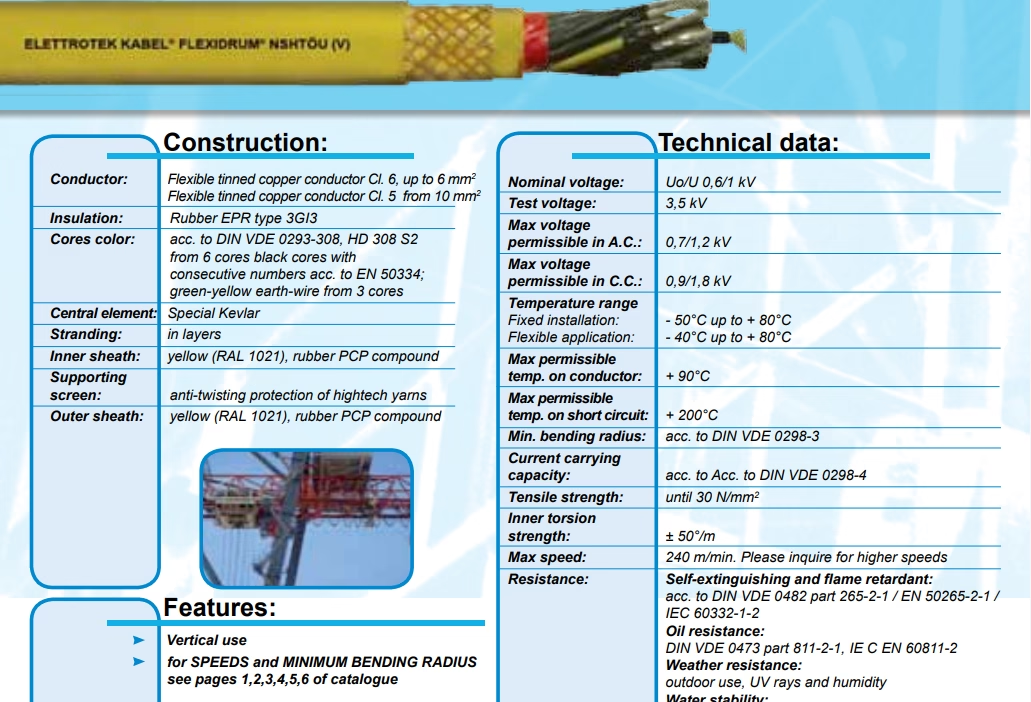
FLEXIDRUM® NSHTÖU (V) представляет собой новое поколение гибких кабелей на катушках, специально разработанное для самых требовательных приложений, где обычные кабели не справляются. Буква "V" в названии обозначает версию повышенной производительности, которая превосходит стандартную линию FLEXIDRUM по нескольким ключевым параметрам. Главное инновационное решение в этом кабеле — использование Kevlar центрального элемента, усиленного волокна, которое известно своей исключительной прочностью и долговечностью. Применение Kevlar в центре кабеля решает одну из наиболее острых проблем, с которой сталкиваются пользователи мобильных кабелей на катушках: повреждение при частом скручивании, перекручивании и механическом напряжении. Kevlar обеспечивает дополнительную жесткость, которая помогает предотвратить внутренние скручивания кабеля, даже при очень высоких скоростях развертывания. Это означает, что кабель FLEXIDRUM (V) может работать на скоростях до 240 м/мин без риска повреждения, что на треть выше, чем у стандартной версии. Кроме того, желтый цвет покрытия (RAL 1021) не является просто эстетическим выбором. Яркий желтый цвет значительно повышает видимость кабеля на строительных площадках и в промышленных условиях, что улучшает безопасность работ и снижает риск несчастных случаев, связанных с спотыканием о кабель.

FLEXIDRUM® NSHTÖU (V)

FLEXIDRUM® NSHTÖU (V) представляет собой новое поколение гибких кабелей на катушках, специально разработанное для самых требовательных приложений, где обычные кабели не справляются. Буква “V” в названии обозначает версию повышенной производительности, которая превосходит стандартную линию FLEXIDRUM по нескольким ключевым параметрам. Главное инновационное решение в этом кабеле — использование Kevlar центрального элемента, усиленного волокна, которое известно своей исключительной прочностью и долговечностью. Применение Kevlar в центре кабеля решает одну из наиболее острых проблем, с которой сталкиваются пользователи мобильных кабелей на катушках: повреждение при частом скручивании, перекручивании и механическом напряжении. Kevlar обеспечивает дополнительную жесткость, которая помогает предотвратить внутренние скручивания кабеля, даже при очень высоких скоростях развертывания. Это означает, что кабель FLEXIDRUM (V) может работать на скоростях до 240 м/мин без риска повреждения, что на треть выше, чем у стандартной версии. Кроме того, желтый цвет покрытия (RAL 1021) не является просто эстетическим выбором. Яркий желтый цвет значительно повышает видимость кабеля на строительных площадках и в промышленных условиях, что улучшает безопасность работ и снижает риск несчастных случаев, связанных с спотыканием о кабель.
Кабель FLEXIDRUM® NSHTÖU представляет собой современное решение в области гибких электрических кабелей на катушках, специально разработанное для применений, где требуется максимальная гибкость, простота развертывания и надежность. Основное назначение FLEXIDRUM — обеспечение временного или мобильного электроснабжения на строительных площадках, промышленных объектах, в портовых сооружениях, при проведении аварийных работ и в других условиях, где стационарную проводку невозможно использовать. Кабель на катушках существенно отличается от кабелей, используемых в стационарных установках. Во-первых, они должны быть легко переносимыми и быстро развертываемыми, что требует высокой гибкости. Во-вторых, они подвергаются частым механическим воздействиям, включая изгибы, скручивания и работу на высоких скоростях размотки. В-третьих, они часто находятся в условиях с высокой влажностью, воздействием масел, химических веществ и ультрафиолетового излучения. FLEXIDRUM кабель разработан с учетом всех этих требований, предоставляя надежное и безопасное решение для мобильного электроснабжения. Компания Anhui Feichun Special Cable Co., Ltd. производит данный кабель в полном соответствии с немецким стандартом DIN VDE 0250 часть 814, что гарантирует его высокое качество и надежность.

FLEXIDRUM® NSHTÖU

Кабель FLEXIDRUM® NSHTÖU представляет собой современное решение в области гибких электрических кабелей на катушках, специально разработанное для применений, где требуется максимальная гибкость, простота развертывания и надежность. Основное назначение FLEXIDRUM — обеспечение временного или мобильного электроснабжения на строительных площадках, промышленных объектах, в портовых сооружениях, при проведении аварийных работ и в других условиях, где стационарную проводку невозможно использовать. Кабель на катушках существенно отличается от кабелей, используемых в стационарных установках. Во-первых, они должны быть легко переносимыми и быстро развертываемыми, что требует высокой гибкости. Во-вторых, они подвергаются частым механическим воздействиям, включая изгибы, скручивания и работу на высоких скоростях размотки. В-третьих, они часто находятся в условиях с высокой влажностью, воздействием масел, химических веществ и ультрафиолетового излучения. FLEXIDRUM кабель разработан с учетом всех этих требований, предоставляя надежное и безопасное решение для мобильного электроснабжения. Компания Anhui Feichun Special Cable Co., Ltd. производит данный кабель в полном соответствии с немецким стандартом DIN VDE 0250 часть 814, что гарантирует его высокое качество и надежность.
Кабель RHEYFIRM®(SI) NTMCGCWOEUS представляет собой современное решение в области гибких однопроводных кабелей высокого напряжения. Данный кабель разработан специально для применений, требующих гибкости, надежности и стойкости к внешним воздействиям. Основная область применения — коротких соединений между высоковольтными выключателями и мобильными трансформаторами в энергетических системах, промышленных установках и распределительных сетях. Исторически кабели этого класса использовались в европейской электроэнергетике и зарекомендовали себя как надежные системы, способные обеспечить безопасность при передаче высокого напряжения. RHEYFIRM кабель продолжает эту традицию, добавляя инновационные материалы и конструкции, которые повышают производительность и безопасность. Компания Anhui Feichun Special Cable Co., Ltd. предлагает данный кабель в соответствии со всеми международными и немецкими стандартами DIN VDE, обеспечивая высокое качество и надежность каждого производимого изделия.

RHEYFIRM®(SI) NTMCGCWOEUS

Кабель RHEYFIRM®(SI) NTMCGCWOEUS представляет собой современное решение в области гибких однопроводных кабелей высокого напряжения. Данный кабель разработан специально для применений, требующих гибкости, надежности и стойкости к внешним воздействиям. Основная область применения — коротких соединений между высоковольтными выключателями и мобильными трансформаторами в энергетических системах, промышленных установках и распределительных сетях. Исторически кабели этого класса использовались в европейской электроэнергетике и зарекомендовали себя как надежные системы, способные обеспечить безопасность при передаче высокого напряжения. RHEYFIRM кабель продолжает эту традицию, добавляя инновационные материалы и конструкции, которые повышают производительность и безопасность. Компания Anhui Feichun Special Cable Co., Ltd. предлагает данный кабель в соответствии со всеми международными и немецкими стандартами DIN VDE, обеспечивая высокое качество и надежность каждого производимого изделия.
Hoist Cable Architecture & Lifting Equipment Design Purpose & Specialized Application Scope: Hoist cable represents the engineered solution for elevator wiring, building hoists, cranes, and mobile lifting equipment requiring integrated mechanical reinforcement combined with reliable electrical power distribution. Unlike standard power cables relying on external structural support, hoist cables integrate strength-supporting messenger wires directly into the cable structure—providing simultaneous electrical power distribution and mechanical load support during lifting operations. This integrated dual-function design enables practical lift equipment engineering where single cable provides both power and structural support. Core Engineering Philosophy: Hoist cable design combines reliable electrical power distribution with integrated mechanical load-carrying capability through reinforced messenger wire design. Synthetic rubber-modified PVC sheathing provides superior flexibility and bend resistance enabling repeated bending cycles during lifting equipment operation. Class 5 ultra-flexible stranding enables practical cable routing through equipment and around mechanical obstacles without damage. This integrated engineering approach creates cables capable of supporting demanding lifting equipment requirements simultaneously handling electrical power and mechanical loads. Lifting Equipment Market Position: Hoist cables provide specialized solutions for elevator manufacturers, crane operators, and lifting equipment designers worldwide. The combination of electrical distribution and mechanical reinforcement enables practical lift equipment engineering simplifying cable integration and enabling efficient equipment design. Proven reliability across decades of lift equipment operation establishes hoist cables as the industry standard for demanding lifting applications.

600V Hoist Cable — Elevator & Lifting Equipment Power Distribution

Hoist Cable Architecture & Lifting Equipment Design Purpose & Specialized Application Scope: Hoist cable represents the engineered solution for elevator wiring, building hoists, cranes, and mobile lifting equipment requiring integrated mechanical reinforcement combined with reliable electrical power distribution. Unlike standard power cables relying on external structural support, hoist cables integrate strength-supporting messenger wires directly into the cable structure—providing simultaneous electrical power distribution and mechanical load support during lifting operations. This integrated dual-function design enables practical lift equipment engineering where single cable provides both power and structural support. Core Engineering Philosophy: Hoist cable design combines reliable electrical power distribution with integrated mechanical load-carrying capability through reinforced messenger wire design. Synthetic rubber-modified PVC sheathing provides superior flexibility and bend resistance enabling repeated bending cycles during lifting equipment operation. Class 5 ultra-flexible stranding enables practical cable routing through equipment and around mechanical obstacles without damage. This integrated engineering approach creates cables capable of supporting demanding lifting equipment requirements simultaneously handling electrical power and mechanical loads. Lifting Equipment Market Position: Hoist cables provide specialized solutions for elevator manufacturers, crane operators, and lifting equipment designers worldwide. The combination of electrical distribution and mechanical reinforcement enables practical lift equipment engineering simplifying cable integration and enabling efficient equipment design. Proven reliability across decades of lift equipment operation establishes hoist cables as the industry standard for demanding lifting applications.
SWA Cable Architecture & Engineering Design Strategy Purpose & Application Scope: Steel Wire Armored (SWA) cables represent the engineering solution for power distribution where mechanical protection, fire safety, and environmental resistance create absolute requirements. Unlike conventional cables relying solely on conduit or external protection, SWA cables integrate mechanical armoring as an integral structural component, offering permanent protection against physical damage, burrowing animals, excavation equipment, and external mechanical stress. Core Engineering Philosophy: SWA cable design employs multi-layer engineering architecture combining XLPE insulation excellence with steel wire mechanical protection and halogen-free outer sheathing. This integrated approach eliminates the need for external conduit in most underground, outdoor, and hazardous-area applications—reducing installation cost, complexity, and maintenance requirements while providing superior long-term reliability. Market Position & Regulatory Compliance: SWA cables comply with IEC 60502-1 international standards and equivalent national specifications including KS C specifications. These cables specifically address the requirements of the EN 50288 and equivalent standards covering cables with protective conductors and armored configurations. The combination of XLPE insulation with halogen-free sheathing provides automatic compliance with fire safety codes adopted across Europe, Asia, and industrial facilities worldwide where smoke emission and toxic fume generation create liability concerns.

0.6/1kV XLPE Insulated Halogen-Free Steel Wire Armored Cable

SWA Cable Architecture & Engineering Design Strategy Purpose & Application Scope: Steel Wire Armored (SWA) cables represent the engineering solution for power distribution where mechanical protection, fire safety, and environmental resistance create absolute requirements. Unlike conventional cables relying solely on conduit or external protection, SWA cables integrate mechanical armoring as an integral structural component, offering permanent protection against physical damage, burrowing animals, excavation equipment, and external mechanical stress. Core Engineering Philosophy: SWA cable design employs multi-layer engineering architecture combining XLPE insulation excellence with steel wire mechanical protection and halogen-free outer sheathing. This integrated approach eliminates the need for external conduit in most underground, outdoor, and hazardous-area applications—reducing installation cost, complexity, and maintenance requirements while providing superior long-term reliability. Market Position & Regulatory Compliance: SWA cables comply with IEC 60502-1 international standards and equivalent national specifications including KS C specifications. These cables specifically address the requirements of the EN 50288 and equivalent standards covering cables with protective conductors and armored configurations. The combination of XLPE insulation with halogen-free sheathing provides automatic compliance with fire safety codes adopted across Europe, Asia, and industrial facilities worldwide where smoke emission and toxic fume generation create liability concerns.
K 60227 IEC 02 (KIV) single-core flexible vinyl insulated wire represents the professional-grade approach to electrical building wiring and power distribution—engineered for flexibility, color-coded identification, extended conductor range, and reliability in indoor electrical installations. The KIV designation (Korean standard KS C designation for vinyl insulated flexible wire) indicates specific construction combining Class 5 flexible stranded copper conductors with polyvinyl chloride (PVC) insulation optimized for professional electrical work. Fundamental Design Philosophy: Unlike multi-core cords which consolidate multiple circuits into single assemblies, KIV single-core wires are designed as individual conductors enabling flexible circuit design in building electrical distribution systems. Electricians can select individual wires in appropriate colors and sizes, combining them according to specific installation requirements. This modular approach enables optimal cost and performance optimization for each application. Core Voltage Rating: 450/750V: The 450/750V rating indicates higher voltage capacity than consumer cords (300/500V)—appropriate for professional building wiring where 380–415V three-phase distribution or 230V single-phase supplies are standard. The 750V maximum overvoltage tolerance provides safety margin against transient surges and switching transients characteristic of professional electrical systems. Extended Conductor Range: KIV wires are available in conductor sizes 1.5–240 sq mm—substantially broader range than consumer cords. This extended sizing enables optimal specification from small auxiliary circuits (1.5 sq mm) through large primary power feeders (240 sq mm) within single product family.

KIV Single-Core Flexible Vinyl Insulated Wire

K 60227 IEC 02 (KIV) single-core flexible vinyl insulated wire represents the professional-grade approach to electrical building wiring and power distribution—engineered for flexibility, color-coded identification, extended conductor range, and reliability in indoor electrical installations. The KIV designation (Korean standard KS C designation for vinyl insulated flexible wire) indicates specific construction combining Class 5 flexible stranded copper conductors with polyvinyl chloride (PVC) insulation optimized for professional electrical work. Fundamental Design Philosophy: Unlike multi-core cords which consolidate multiple circuits into single assemblies, KIV single-core wires are designed as individual conductors enabling flexible circuit design in building electrical distribution systems. Electricians can select individual wires in appropriate colors and sizes, combining them according to specific installation requirements. This modular approach enables optimal cost and performance optimization for each application. Core Voltage Rating: 450/750V: The 450/750V rating indicates higher voltage capacity than consumer cords (300/500V)—appropriate for professional building wiring where 380–415V three-phase distribution or 230V single-phase supplies are standard. The 750V maximum overvoltage tolerance provides safety margin against transient surges and switching transients characteristic of professional electrical systems. Extended Conductor Range: KIV wires are available in conductor sizes 1.5–240 sq mm—substantially broader range than consumer cords. This extended sizing enables optimal specification from small auxiliary circuits (1.5 sq mm) through large primary power feeders (240 sq mm) within single product family.
60227 KS IEC 53 (VCTF) vinyl sheath cords represent the industry-standard approach to consumer and commercial electrical power distribution—cords engineered for flexibility, durability, and cost-effectiveness in indoor applications. The VCTF designation (Vinyl Cord Twist Flexible) indicates the specific construction standard combining polyvinyl chloride (PVC) insulation with PVC sheath, multi-strand flexible conductors, and optimized designs for appliances, commercial equipment, audio systems, and lighting fixtures. Fundamental Design Philosophy: VCTF cords prioritize flexibility, ease of use, and cost-effectiveness for consumer and commercial markets. Unlike fixed-installation cables optimized for stationary deployment, VCTF cords must accommodate frequent coiling, uncoiling, movement, and mechanical stress inherent in portable and temporary equipment. The PVC material system provides excellent balance of electrical performance, mechanical flexibility, environmental resistance, and manufacturing economy. Core Voltage Rating: 300/500V: The 300/500V rating indicates nominal 300V continuous operating voltage (typical single-phase consumer power supply) with 500V maximum transient overvoltage tolerance. This moderate voltage rating optimizes cost and safety for consumer applications—substantially lower than industrial cables, yet providing adequate safety margin for typical household and commercial electrical systems. Temperature Operating Limit: 70°C: Maximum continuous conductor temperature limited to 70°C (158°F), appropriate for consumer appliances and indoor commercial equipment where elevated temperature operation is not anticipated. This 70°C rating represents industry-standard performance for general-purpose indoor cords—higher temperature ratings available for specialized applications through engineered variants.

VCTF Vinyl Sheath Cord Family (300/500V)

60227 KS IEC 53 (VCTF) vinyl sheath cords represent the industry-standard approach to consumer and commercial electrical power distribution—cords engineered for flexibility, durability, and cost-effectiveness in indoor applications. The VCTF designation (Vinyl Cord Twist Flexible) indicates the specific construction standard combining polyvinyl chloride (PVC) insulation with PVC sheath, multi-strand flexible conductors, and optimized designs for appliances, commercial equipment, audio systems, and lighting fixtures. Fundamental Design Philosophy: VCTF cords prioritize flexibility, ease of use, and cost-effectiveness for consumer and commercial markets. Unlike fixed-installation cables optimized for stationary deployment, VCTF cords must accommodate frequent coiling, uncoiling, movement, and mechanical stress inherent in portable and temporary equipment. The PVC material system provides excellent balance of electrical performance, mechanical flexibility, environmental resistance, and manufacturing economy. Core Voltage Rating: 300/500V: The 300/500V rating indicates nominal 300V continuous operating voltage (typical single-phase consumer power supply) with 500V maximum transient overvoltage tolerance. This moderate voltage rating optimizes cost and safety for consumer applications—substantially lower than industrial cables, yet providing adequate safety margin for typical household and commercial electrical systems. Temperature Operating Limit: 70°C: Maximum continuous conductor temperature limited to 70°C (158°F), appropriate for consumer appliances and indoor commercial equipment where elevated temperature operation is not anticipated. This 70°C rating represents industry-standard performance for general-purpose indoor cords—higher temperature ratings available for specialized applications through engineered variants.
Ethylene Propylene Rubber (EPR) insulated cables represent the professional approach to flexible electrical distribution—cables engineered to accommodate dynamic deployment, repetitive coiling/uncoiling, temperature variation, and mechanical stress inherent in portable and industrial equipment applications. Unlike fixed-installation cables optimized for stationary performance, EPR cables balance electrical performance, mechanical flexibility, environmental durability, and cost-effectiveness required for equipment requiring frequent relocation or deployment flexibility. Fundamental Design Philosophy: EPR cables employ elastomeric insulation material (ethylene propylene rubber) selected specifically for flexibility maintenance across wide temperature range. This material provides sustained flexibility even at cold temperatures (−40°C minimum), maintains electrical properties across elevated temperature range (continuous operation to +100°C), and demonstrates superior resistance to ozone, UV radiation, and environmental contamination characteristic of portable equipment deployment. Conductor Architecture for Flexibility: Rather than single-strand conductors (rigid, prone to breaking under flex stress), EPR cables employ multi-strand conductor design—typically 7, 19, 37, or 61 individual wires woven together. This multi-strand architecture enables smooth bending without conductor fracture, distributes mechanical stress across multiple strands preventing single-point failure, and maintains consistent electrical performance through tens of thousands of flex cycles. Voltage Rating & Safety Margin: Standard 0.6/1KV rating provides nominal 600V operating margin with 1000V safety ceiling—appropriate for most industrial equipment, portable power systems, and temporary installations. The dual rating nomenclature indicates 0.6KV continuous operating voltage with 1KV maximum transient voltage tolerance, providing balanced safety margin against impulse transients and surge events.

Ethylene Propylene Rubber (EPR) Insulated Cable Family

Ethylene Propylene Rubber (EPR) insulated cables represent the professional approach to flexible electrical distribution—cables engineered to accommodate dynamic deployment, repetitive coiling/uncoiling, temperature variation, and mechanical stress inherent in portable and industrial equipment applications. Unlike fixed-installation cables optimized for stationary performance, EPR cables balance electrical performance, mechanical flexibility, environmental durability, and cost-effectiveness required for equipment requiring frequent relocation or deployment flexibility. Fundamental Design Philosophy: EPR cables employ elastomeric insulation material (ethylene propylene rubber) selected specifically for flexibility maintenance across wide temperature range. This material provides sustained flexibility even at cold temperatures (−40°C minimum), maintains electrical properties across elevated temperature range (continuous operation to +100°C), and demonstrates superior resistance to ozone, UV radiation, and environmental contamination characteristic of portable equipment deployment. Conductor Architecture for Flexibility: Rather than single-strand conductors (rigid, prone to breaking under flex stress), EPR cables employ multi-strand conductor design—typically 7, 19, 37, or 61 individual wires woven together. This multi-strand architecture enables smooth bending without conductor fracture, distributes mechanical stress across multiple strands preventing single-point failure, and maintains consistent electrical performance through tens of thousands of flex cycles. Voltage Rating & Safety Margin: Standard 0.6/1KV rating provides nominal 600V operating margin with 1000V safety ceiling—appropriate for most industrial equipment, portable power systems, and temporary installations. The dual rating nomenclature indicates 0.6KV continuous operating voltage with 1KV maximum transient voltage tolerance, providing balanced safety margin against impulse transients and surge events.
PNCT-R high-voltage reel cables represent an advanced evolution in portable power distribution—engineered specifically for container cranes, ship unloaders, cargo handling systems, and bulk terminal equipment where electrical power must be delivered dynamically through mechanically spooled cable reels. Unlike stationary cable installations with fixed routing and stress patterns, reel-deployed cables experience continuous repetitive flex-cycling, abrupt acceleration/deceleration forces, and environmental exposure across multiple geographic locations and climate conditions. Fundamental Design Challenge: Traditional high-voltage cables designed for fixed installations fail catastrophically when deployed on mechanical reels. The repetitive flex-cycling—where individual cable cross-sections bend and straighten thousands of times per shift—creates progressive internal stress concentration and insulation degradation. External mechanical stresses from reel spooling, retraction, equipment vibration, and wind loading accelerate conductor separation and sheath cracking. Standard copper braiding provides insufficient tensile support for repeated dynamic loads. Engineering Solution — Kevlar-Reinforced Architecture: PNCT-R cables integrate specialized Kevlar aramid fiber reinforcement layers—a material system engineered to absorb mechanical stress and prevent internal conductor displacement during dynamic cycling. Rather than relying solely on copper or aluminum tensile components, Kevlar fibers provide sustained tensile support through tens of thousands of flex cycles, maintaining conductor geometry integrity and preventing the progressive insulation failure characteristic of standard high-voltage cables deployed on reels. Feichun engineers have developed proprietary Kevlar weaving methodologies that integrate the reinforcement material within the cable architecture—not as external wrapping (which adds excessive weight), but as strategically positioned internal tensile layers coordinated with specialized sheath formulations. This integrated architecture enables PNCT-R cables to withstand 2+ million repetitive flex cycles at full operational stress without performance degradation.

PNCT-R High-Voltage Reel Cable Family

PNCT-R high-voltage reel cables represent an advanced evolution in portable power distribution—engineered specifically for container cranes, ship unloaders, cargo handling systems, and bulk terminal equipment where electrical power must be delivered dynamically through mechanically spooled cable reels. Unlike stationary cable installations with fixed routing and stress patterns, reel-deployed cables experience continuous repetitive flex-cycling, abrupt acceleration/deceleration forces, and environmental exposure across multiple geographic locations and climate conditions. Fundamental Design Challenge: Traditional high-voltage cables designed for fixed installations fail catastrophically when deployed on mechanical reels. The repetitive flex-cycling—where individual cable cross-sections bend and straighten thousands of times per shift—creates progressive internal stress concentration and insulation degradation. External mechanical stresses from reel spooling, retraction, equipment vibration, and wind loading accelerate conductor separation and sheath cracking. Standard copper braiding provides insufficient tensile support for repeated dynamic loads. Engineering Solution — Kevlar-Reinforced Architecture: PNCT-R cables integrate specialized Kevlar aramid fiber reinforcement layers—a material system engineered to absorb mechanical stress and prevent internal conductor displacement during dynamic cycling. Rather than relying solely on copper or aluminum tensile components, Kevlar fibers provide sustained tensile support through tens of thousands of flex cycles, maintaining conductor geometry integrity and preventing the progressive insulation failure characteristic of standard high-voltage cables deployed on reels. Feichun engineers have developed proprietary Kevlar weaving methodologies that integrate the reinforcement material within the cable architecture—not as external wrapping (which adds excessive weight), but as strategically positioned internal tensile layers coordinated with specialized sheath formulations. This integrated architecture enables PNCT-R cables to withstand 2+ million repetitive flex cycles at full operational stress without performance degradation.
SC-PNCT/SC-PNCT(S) multi-core cables represent the ultimate expression of flexible cable engineering—enabling single-cable power distribution for equipment with multiple independent motor systems, control circuits, and auxiliary equipment. Rather than requiring parallel single-core or dual-core cables with associated routing complexity and installation challenges, multi-core cables consolidate entire power distribution systems into a single, managed cable assembly. Fundamental Design Challenge: Multi-core cable design requires balancing multiple competing objectives. Maximum conductor count (10+ independent cores) demands significant outer diameter. Compact outer diameter (compatible with standard equipment hookups) limits conductor count. Electromagnetic shielding protects against interference but adds weight and cost. Each design decision trades off against others. Engineering Solution — 36 Configuration Matrix: Rather than offering a single "universal" multi-core cable, Feichun engineers 36 distinct configurations addressing different optimization priorities. Equipment designers can select from: • Simple configurations (3×1, 4×1, 5×1): Single conductor cores for basic multi-circuit distribution with minimal outer diameter • Intermediate configurations (2×3, 2×4, 3×3, 2×5, 3×4, 4×4): Multi-core groups for moderate circuit complexity • Advanced configurations (3×8, 3×9, 3×10): Maximum conductor counts for extremely complex equipment requiring 24–30 independent circuits This matrix approach enables optimal cable specification for each unique application—not compromising on weight, size, or cost for equipment that doesn't require ultimate complexity.

SC-PNCT/SC-PNCT(S) Multi-Core Cable Family

SC-PNCT/SC-PNCT(S) multi-core cables represent the ultimate expression of flexible cable engineering—enabling single-cable power distribution for equipment with multiple independent motor systems, control circuits, and auxiliary equipment. Rather than requiring parallel single-core or dual-core cables with associated routing complexity and installation challenges, multi-core cables consolidate entire power distribution systems into a single, managed cable assembly. Fundamental Design Challenge: Multi-core cable design requires balancing multiple competing objectives. Maximum conductor count (10+ independent cores) demands significant outer diameter. Compact outer diameter (compatible with standard equipment hookups) limits conductor count. Electromagnetic shielding protects against interference but adds weight and cost. Each design decision trades off against others. Engineering Solution — 36 Configuration Matrix: Rather than offering a single “universal” multi-core cable, Feichun engineers 36 distinct configurations addressing different optimization priorities. Equipment designers can select from: • Simple configurations (3×1, 4×1, 5×1): Single conductor cores for basic multi-circuit distribution with minimal outer diameter • Intermediate configurations (2×3, 2×4, 3×3, 2×5, 3×4, 4×4): Multi-core groups for moderate circuit complexity • Advanced configurations (3×8, 3×9, 3×10): Maximum conductor counts for extremely complex equipment requiring 24–30 independent circuits This matrix approach enables optimal cable specification for each unique application—not compromising on weight, size, or cost for equipment that doesn’t require ultimate complexity.
Feichun's comprehensive port equipment cable portfolio encompasses two primary cable family streams engineered for fundamentally different equipment operating environments, each with multiple reinforcement, shielding, and configuration variants optimized for specific applications. Design Philosophy: Rather than attempting to create a single universal cable for all port applications, Feichun engineers cables within two distinct families, each optimized for its operational environment. High-tension cables prioritize tensile strength and mechanical robustness for reel-mounted applications. Festoon cables prioritize bending flexibility and environmental durability for suspended overhead systems. Within each family, reinforcement, shielding, and configuration options address specialized requirements. Two Core Cable Families: 1. High-Tension Reel Cables (HT-PNCT Family) — Engineered for equipment where cables wind onto rotating reels including ship unloaders, stackers, reclaimers, and mobile cranes. Optimized for extreme tensile stress, intensive bending cycles, and long unsupported spans. 2. Festoon Suspended Cables (FC-PNCT Family) — Engineered for equipment with suspended overhead power distribution including container cranes, gantry cranes, and overhead bridge systems. Optimized for gentle bending, environmental durability, and multi-circuit power distribution. Within each family, variants address specialized requirements through reinforcement (enhanced tensile strength and service life), electromagnetic shielding (protection for VFD systems and automation electronics), and flexible configuration options (3–30 conductor cores, three conductor sizes).

Feichun Port Equipment Cable Portfolio

Feichun’s comprehensive port equipment cable portfolio encompasses two primary cable family streams engineered for fundamentally different equipment operating environments, each with multiple reinforcement, shielding, and configuration variants optimized for specific applications. Design Philosophy: Rather than attempting to create a single universal cable for all port applications, Feichun engineers cables within two distinct families, each optimized for its operational environment. High-tension cables prioritize tensile strength and mechanical robustness for reel-mounted applications. Festoon cables prioritize bending flexibility and environmental durability for suspended overhead systems. Within each family, reinforcement, shielding, and configuration options address specialized requirements. Two Core Cable Families: 1. High-Tension Reel Cables (HT-PNCT Family) — Engineered for equipment where cables wind onto rotating reels including ship unloaders, stackers, reclaimers, and mobile cranes. Optimized for extreme tensile stress, intensive bending cycles, and long unsupported spans. 2. Festoon Suspended Cables (FC-PNCT Family) — Engineered for equipment with suspended overhead power distribution including container cranes, gantry cranes, and overhead bridge systems. Optimized for gentle bending, environmental durability, and multi-circuit power distribution. Within each family, variants address specialized requirements through reinforcement (enhanced tensile strength and service life), electromagnetic shielding (protection for VFD systems and automation electronics), and flexible configuration options (3–30 conductor cores, three conductor sizes).
FC-PNCT-R and FC-PNCT(S)-R reinforced festoon cables represent the premium tier of overhead power distribution technology, engineered for next-generation crane systems demanding superior electrical performance, extended service life, electromagnetic compatibility, and multi-circuit power distribution capabilities. Reinforced festoon cables incorporate a fundamentally different architecture compared to standard festoon cables—adding mechanical reinforcement (braid-tape structure), overall electromagnetic shielding (in the shielded variant), and optimized multi-core configurations supporting independent circuit distribution. These enhancements address the operational requirements of modern automated port equipment, VFD-driven crane systems, and advanced cargo handling machinery. Key Design Innovations: • Integrated Reinforcement Layer: A tape-braid composite structure carrying a portion of mechanical stress, extending insulation life and reducing temperature rise during operation • Overall Screen Shielding: Tinned copper braid surrounding the entire cable assembly (in FC-PNCT(S)-R variant) providing complete electromagnetic protection • Multi-Core Architecture: 3–30 independent conductor cores enabling single-cable distribution for complex equipment with multiple independent motor systems • Size Flexibility: Three conductor size options (1.5, 2.5, 4.0) scaled to specific application requirements and current demands These innovations enable reinforced festoon cables to deliver 7–10 year service intervals in demanding applications—approximately 40–60% longer than standard festoon cables. For terminal operators prioritizing equipment reliability and minimizing replacement downtime, the premium investment in reinforced cables delivers outstanding value.

FC-PNCT-R/FC-PNCT(S)-R Reinforced Festoon Cables

FC-PNCT-R and FC-PNCT(S)-R reinforced festoon cables represent the premium tier of overhead power distribution technology, engineered for next-generation crane systems demanding superior electrical performance, extended service life, electromagnetic compatibility, and multi-circuit power distribution capabilities. Reinforced festoon cables incorporate a fundamentally different architecture compared to standard festoon cables—adding mechanical reinforcement (braid-tape structure), overall electromagnetic shielding (in the shielded variant), and optimized multi-core configurations supporting independent circuit distribution. These enhancements address the operational requirements of modern automated port equipment, VFD-driven crane systems, and advanced cargo handling machinery. Key Design Innovations: • Integrated Reinforcement Layer: A tape-braid composite structure carrying a portion of mechanical stress, extending insulation life and reducing temperature rise during operation • Overall Screen Shielding: Tinned copper braid surrounding the entire cable assembly (in FC-PNCT(S)-R variant) providing complete electromagnetic protection • Multi-Core Architecture: 3–30 independent conductor cores enabling single-cable distribution for complex equipment with multiple independent motor systems • Size Flexibility: Three conductor size options (1.5, 2.5, 4.0) scaled to specific application requirements and current demands These innovations enable reinforced festoon cables to deliver 7–10 year service intervals in demanding applications—approximately 40–60% longer than standard festoon cables. For terminal operators prioritizing equipment reliability and minimizing replacement downtime, the premium investment in reinforced cables delivers outstanding value.
Festoon cables (also called curtain cables or loop cables) are specialized power distribution cables designed for overhead, suspended installations where the cable hangs in loops from fixed support points while a moving trolley or crane pulls the cable along beneath it. The term "festoon" derives from the architectural practice of hanging decorative swags between fixed points—a metaphor that accurately describes how these cables are installed in crane systems. FC-PNCT festoon cables serve as the primary power supply for overhead equipment including container cranes, gantry cranes, overhead bridge cranes, and related port equipment. The cable hangs in a series of gentle loops from fixed hanger points spaced approximately 5–10 meters apart. As the crane moves along the runway, the moving trolley pulls the cable along with it, creating a smooth, coordinated motion that maintains electrical contact between fixed shore power and the moving equipment. Festoon cables experience fundamentally different stresses compared to reel-mounted high-tension cables: • Repetitive bending cycles as the cable forms and reforms loops—but at a slower rate than reel cables • Lower tensile stress because the cable hangs relatively stationary between support points • Environmental exposure to saltwater spray, UV radiation, and thermal cycling—same as reel cables • Gentle, predictable bending geometry with consistent bend radii determined by hanger spacing • Lower operational temperature due to reduced mechanical stress and typically lower current demands These differences necessitate a distinctly different cable design optimized specifically for festoon applications. Festoon cables prioritize superior bending flexibility, excellent environmental resistance, and long-term durability under repetitive but gentle mechanical stress.

FC-PNCT Korean Standard Festoon Cables

Festoon cables (also called curtain cables or loop cables) are specialized power distribution cables designed for overhead, suspended installations where the cable hangs in loops from fixed support points while a moving trolley or crane pulls the cable along beneath it. The term “festoon” derives from the architectural practice of hanging decorative swags between fixed points—a metaphor that accurately describes how these cables are installed in crane systems. FC-PNCT festoon cables serve as the primary power supply for overhead equipment including container cranes, gantry cranes, overhead bridge cranes, and related port equipment. The cable hangs in a series of gentle loops from fixed hanger points spaced approximately 5–10 meters apart. As the crane moves along the runway, the moving trolley pulls the cable along with it, creating a smooth, coordinated motion that maintains electrical contact between fixed shore power and the moving equipment. Festoon cables experience fundamentally different stresses compared to reel-mounted high-tension cables: • Repetitive bending cycles as the cable forms and reforms loops—but at a slower rate than reel cables • Lower tensile stress because the cable hangs relatively stationary between support points • Environmental exposure to saltwater spray, UV radiation, and thermal cycling—same as reel cables • Gentle, predictable bending geometry with consistent bend radii determined by hanger spacing • Lower operational temperature due to reduced mechanical stress and typically lower current demands These differences necessitate a distinctly different cable design optimized specifically for festoon applications. Festoon cables prioritize superior bending flexibility, excellent environmental resistance, and long-term durability under repetitive but gentle mechanical stress.
Japanese Standard High Tension (HT) cables with Kevlar® reinforcement represent the pinnacle of specialized power distribution technology for demanding marine port applications. Engineered to conform to Japanese Industrial Standards (JIS C 3317, JIS C 3350), these cables incorporate integrated aramid reinforced layers that dramatically enhance tensile strength while maintaining the flexibility required for reel-mounted equipment operation. The term "high tension" in Japanese maritime engineering refers specifically to the mechanical tension and longitudinal stress experienced by cables subjected to extreme operational demands—including extended unsupported spans, repetitive reel cycling, heavy dynamic loading, and sustained exposure to marine environments. Unlike standard port cables, Japanese Standard HT cables with Kevlar® reinforcement are engineered for applications where: • Unsupported cable spans exceed 40–60 meters between ship and shore equipment or between reel stations • Combined electrical load and mechanical tension create dual stress conditions requiring advanced material science • Long service life expectancy (7–10+ years) justifies premium reinforcement material investment • Environmental exposure to saltwater aerosol, UV radiation, and thermal cycling demands superior polymer formulation • High-availability terminal operations cannot tolerate premature cable failure and operational downtime The integration of Kevlar® aramid reinforcement layers represents a fundamental departure from conventional cable design. Rather than relying solely on rubber insulation and polymer sheathing to provide mechanical strength, Kevlar-reinforced cables employ a specialized tension layer that carries a portion of the cable's weight and operational stress, thereby reducing stress on the insulation and extending overall cable service life by 40–60% compared to unreinforced designs.

Japanese Standard High Tension Cables with Kevlar® Reinforcement

Japanese Standard High Tension (HT) cables with Kevlar® reinforcement represent the pinnacle of specialized power distribution technology for demanding marine port applications. Engineered to conform to Japanese Industrial Standards (JIS C 3317, JIS C 3350), these cables incorporate integrated aramid reinforced layers that dramatically enhance tensile strength while maintaining the flexibility required for reel-mounted equipment operation. The term “high tension” in Japanese maritime engineering refers specifically to the mechanical tension and longitudinal stress experienced by cables subjected to extreme operational demands—including extended unsupported spans, repetitive reel cycling, heavy dynamic loading, and sustained exposure to marine environments. Unlike standard port cables, Japanese Standard HT cables with Kevlar® reinforcement are engineered for applications where: • Unsupported cable spans exceed 40–60 meters between ship and shore equipment or between reel stations • Combined electrical load and mechanical tension create dual stress conditions requiring advanced material science • Long service life expectancy (7–10+ years) justifies premium reinforcement material investment • Environmental exposure to saltwater aerosol, UV radiation, and thermal cycling demands superior polymer formulation • High-availability terminal operations cannot tolerate premature cable failure and operational downtime The integration of Kevlar® aramid reinforcement layers represents a fundamental departure from conventional cable design. Rather than relying solely on rubber insulation and polymer sheathing to provide mechanical strength, Kevlar-reinforced cables employ a specialized tension layer that carries a portion of the cable’s weight and operational stress, thereby reducing stress on the insulation and extending overall cable service life by 40–60% compared to unreinforced designs.
High Tension (HT) cables are specialized power distribution cables designed for reel-mounted applications in port equipment—primarily unloaders, stackers, reclaimers, and gantry cranes. The term "high tension" does not refer to electrical voltage (HT cables are 0.6/1 kV, standard port equipment voltage); instead, it refers to the mechanical tension and stress that these cables experience when wound on reels and unwound during equipment operation. HT-PNCT cables serve as the primary power supply line running from the equipment's fixed power source (shore power or generator) to the reel-mounted slip ring assembly on moving equipment. During operation, these cables are repeatedly wound onto and unwound from rotating reels, experiencing: • Tensile stress from the cable's own weight as it hangs from the reel to the equipment • Bending stress each time the cable wraps around the reel drum • Mechanical abrasion from friction against the reel surface and cable guides • Environmental exposure to saltwater spray, UV radiation, and thermal cycling Standard festoon cables (like FC-PNCT) are optimized for relatively stationary installations. HT-PNCT cables are engineered specifically for reel-wound, dynamic applications where these mechanical stresses dominate the cable's service life.

HT-PNCT High Tension Cables

High Tension (HT) cables are specialized power distribution cables designed for reel-mounted applications in port equipment—primarily unloaders, stackers, reclaimers, and gantry cranes. The term “high tension” does not refer to electrical voltage (HT cables are 0.6/1 kV, standard port equipment voltage); instead, it refers to the mechanical tension and stress that these cables experience when wound on reels and unwound during equipment operation. HT-PNCT cables serve as the primary power supply line running from the equipment’s fixed power source (shore power or generator) to the reel-mounted slip ring assembly on moving equipment. During operation, these cables are repeatedly wound onto and unwound from rotating reels, experiencing: • Tensile stress from the cable’s own weight as it hangs from the reel to the equipment • Bending stress each time the cable wraps around the reel drum • Mechanical abrasion from friction against the reel surface and cable guides • Environmental exposure to saltwater spray, UV radiation, and thermal cycling Standard festoon cables (like FC-PNCT) are optimized for relatively stationary installations. HT-PNCT cables are engineered specifically for reel-wound, dynamic applications where these mechanical stresses dominate the cable’s service life.
KSC 3317 Standard (Korean Industrial Standard C 3317: "Rubber Insulated Flexible Cables — 0.6/1kV") is the authoritative technical specification for cabtyre and flexible power cables used throughout industrial Korea and the international markets where Korean engineering standards are recognized. Adopted as a modification of IEC 60502-1, the KSC 3317 standard defines comprehensive requirements for: Conductor materials and stranding patterns • Insulation thickness and composition • Sheath material and durability requirements • Electrical performance at rated voltage • Mechanical properties including tensile strength and elongation • Temperature operating ranges and chemical resistance • Test methods for verification and certification For port crane and ship unloader applications, cables manufactured to KSC 3317 represent the consensus engineering standard across Asia-Pacific maritime terminals. Korean container terminal operators in Busan, Incheon, and Gwangyang port complexes universally specify KSC 3317-compliant cables for all festoon, cableveyor, and hoist systems. The standard's adoption by major STS crane manufacturers (including Liebherr, Konecranes, and Kalmar) has made KSC 3317 the de facto global specification for Japanese-compatible port crane cables.

KSC 3317 Port Crane & Ship Unloader Cables

KSC 3317 Standard (Korean Industrial Standard C 3317: “Rubber Insulated Flexible Cables — 0.6/1kV”) is the authoritative technical specification for cabtyre and flexible power cables used throughout industrial Korea and the international markets where Korean engineering standards are recognized. Adopted as a modification of IEC 60502-1, the KSC 3317 standard defines comprehensive requirements for: Conductor materials and stranding patterns • Insulation thickness and composition • Sheath material and durability requirements • Electrical performance at rated voltage • Mechanical properties including tensile strength and elongation • Temperature operating ranges and chemical resistance • Test methods for verification and certification For port crane and ship unloader applications, cables manufactured to KSC 3317 represent the consensus engineering standard across Asia-Pacific maritime terminals. Korean container terminal operators in Busan, Incheon, and Gwangyang port complexes universally specify KSC 3317-compliant cables for all festoon, cableveyor, and hoist systems. The standard’s adoption by major STS crane manufacturers (including Liebherr, Konecranes, and Kalmar) has made KSC 3317 the de facto global specification for Japanese-compatible port crane cables.
6600V 3PNCT cable, manufactured to the Japanese Industrial Standard JIS C 4353 Class 3, is the purpose-built high voltage cable solution for these demanding applications. It combines the same fundamental material technologies proven in the 600V 2PNCT family—EP rubber insulation, polychloroprene rubber sheathing, tinned copper conductors, tinned copper/cotton yarn braid shielding, and Kevlar® para-aramid fibre braided tensile reinforcement—but with substantially enhanced insulation systems and construction techniques required for safe, reliable operation at 6,600V. The cable features a semiconductive stress-grading layer at the conductor/insulation interface, 5.0–5.5 mm thick EP rubber insulation (compared to 0.8–2.5 mm in 600V cables), a metallic braid shield for electric field containment, and a dual-layer polychloroprene sheath with an intermediate reinforcement layer for maximum mechanical protection.

6600V 3PNCT Kevlar®-Reinforced High Voltage Crane Cable

6600V 3PNCT cable, manufactured to the Japanese Industrial Standard JIS C 4353 Class 3, is the purpose-built high voltage cable solution for these demanding applications. It combines the same fundamental material technologies proven in the 600V 2PNCT family—EP rubber insulation, polychloroprene rubber sheathing, tinned copper conductors, tinned copper/cotton yarn braid shielding, and Kevlar® para-aramid fibre braided tensile reinforcement—but with substantially enhanced insulation systems and construction techniques required for safe, reliable operation at 6,600V. The cable features a semiconductive stress-grading layer at the conductor/insulation interface, 5.0–5.5 mm thick EP rubber insulation (compared to 0.8–2.5 mm in 600V cables), a metallic braid shield for electric field containment, and a dual-layer polychloroprene sheath with an intermediate reinforcement layer for maximum mechanical protection.
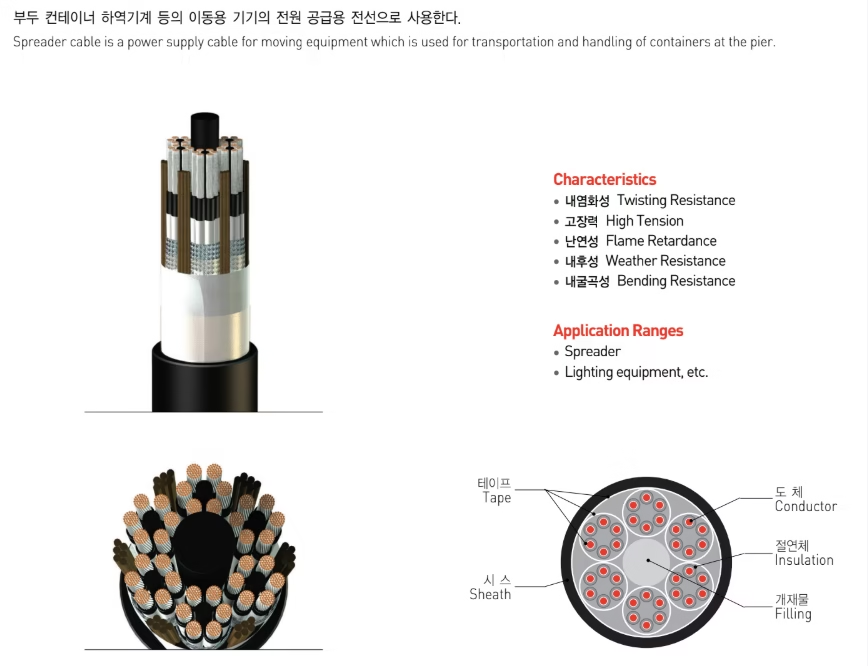
WS-SPRD-2PNCT was engineered specifically for this unforgiving application. It combines high-core-count construction (30, 36, or 42 cores at 3.5 mm²) to carry the full complement of spreader control and signal circuits in a single cable, steel-wire-stranded conductors for tension resistance under self-weight suspension, chloroprene rubber sheathing for oil, ozone, and UV resistance in coastal port environments, and a cable geometry specifically optimised for the continuous lateral bending and catenary formation cycles unique to gravity collector basket systems. Manufactured to dual standards — JIS C 3327 (rubber-insulated machinery cables) and VDE 0250-813 (flexible cables) — the WS-SPRD-2PNCT represents dedicated engineering for a niche but mission-critical application. A failed spreader basket cable means a stopped crane, a grounded spreader, and halted container operations. There is no redundancy — the cable is the sole electrical lifeline between the crane's trolley and the spreader that grips the containers.

WALSREEN® WS-SPRD-2PNCT Spreader Basket System Flexible Cable

WS-SPRD-2PNCT was engineered specifically for this unforgiving application. It combines high-core-count construction (30, 36, or 42 cores at 3.5 mm²) to carry the full complement of spreader control and signal circuits in a single cable, steel-wire-stranded conductors for tension resistance under self-weight suspension, chloroprene rubber sheathing for oil, ozone, and UV resistance in coastal port environments, and a cable geometry specifically optimised for the continuous lateral bending and catenary formation cycles unique to gravity collector basket systems. Manufactured to dual standards — JIS C 3327 (rubber-insulated machinery cables) and VDE 0250-813 (flexible cables) — the WS-SPRD-2PNCT represents dedicated engineering for a niche but mission-critical application. A failed spreader basket cable means a stopped crane, a grounded spreader, and halted container operations. There is no redundancy — the cable is the sole electrical lifeline between the crane’s trolley and the spreader that grips the containers.
FSTN-OFNCT is a high-performance optical fiber flexible cable designed specifically for signal and data transmission on port cranes, ship unloaders, container gantry cranes, and heavy-duty material handling equipment. Unlike conventional industrial fibre optic cables that rely on standard polymer or steel-wire tensile members, the WS-FSTN-OFNCT incorporates a Kevlar® (para-aramid) fibre reinforcement layer—the same ballistic-grade material used in bulletproof vests and military-grade protective equipment—braided in a proprietary pattern that delivers exceptional tensile strength while preserving the cable's full flexibility under continuous reeling and festoon operation.

Kevlar® Aramid Fibre Reinforced Optical Fiber Flexible Cable with Specially Braided Tensile Layer for Signal and Data Transmission on Port Cranes, Ship Unloaders, Container Gantry Cranes, and Heavy-Duty Material Handling Equipment — Engineered for Cable Reel Systems, Festoon Systems, and Continuous Flexing Applications with Graded Index 50/125, 62.5/125, and Singlemode E9/125 Fibre Options

FSTN-OFNCT is a high-performance optical fiber flexible cable designed specifically for signal and data transmission on port cranes, ship unloaders, container gantry cranes, and heavy-duty material handling equipment. Unlike conventional industrial fibre optic cables that rely on standard polymer or steel-wire tensile members, the WS-FSTN-OFNCT incorporates a Kevlar® (para-aramid) fibre reinforcement layer—the same ballistic-grade material used in bulletproof vests and military-grade protective equipment—braided in a proprietary pattern that delivers exceptional tensile strength while preserving the cable’s full flexibility under continuous reeling and festoon operation.
Feltoflex® LED Self-Luminous Single Core Cable addresses this application niche with revolutionary integration of electromagnetic induction self-powered LED illumination into a premium single-core cable architecture. Unlike three-phase mining cables designed for kilometre-long trunk distribution, Feltoflex LED cables serve the critical short-distance interconnection role—where visibility, flexibility, durability, and compact form factor are paramount. Switchgear rooms and transformer chambers are typically underground or in poorly lit industrial areas. When technicians need to work on cable terminations, identify connection points, or troubleshoot equipment, they currently rely on portable lamps, headlamps, or external lighting. The Feltoflex LED cable illuminates itself as it carries power, providing integrated visibility that enhances safety, accelerates maintenance procedures, and requires zero external infrastructure.

Feltoflex® LED Self-Luminous Single Core Cable

Feltoflex® LED Self-Luminous Single Core Cable addresses this application niche with revolutionary integration of electromagnetic induction self-powered LED illumination into a premium single-core cable architecture. Unlike three-phase mining cables designed for kilometre-long trunk distribution, Feltoflex LED cables serve the critical short-distance interconnection role—where visibility, flexibility, durability, and compact form factor are paramount. Switchgear rooms and transformer chambers are typically underground or in poorly lit industrial areas. When technicians need to work on cable terminations, identify connection points, or troubleshoot equipment, they currently rely on portable lamps, headlamps, or external lighting. The Feltoflex LED cable illuminates itself as it carries power, providing integrated visibility that enhances safety, accelerates maintenance procedures, and requires zero external infrastructure.
Mining operations present unique challenges unlike any other industrial environment. Workers operate deep underground in near-total darkness, often hundreds of metres below the surface where natural light cannot penetrate. Traditional lighting systems rely on external power sources—separate electrical circuits, portable lamps, headlamps—adding cost, complexity, and dependency on supplementary infrastructure. A single power outage can plunge the entire mining operation into complete darkness, creating dangerous working conditions. The SUPREMINE® LED Self-Luminous Mining Cable introduces a paradigm shift in mining cable technology. By integrating advanced electromagnetic induction self-powered LED illumination directly into the cable structure, SUPREMINE LED delivers continuous, self-sustaining illumination wherever the cable is deployed—with zero reliance on external power sources, no additional wiring, and zero maintenance overhead. The cable itself becomes the light source. As electrical power flows through the medium voltage conductors (6–30 kV), the resulting magnetic field is converted through proprietary electromagnetic induction circuitry into LED illumination along the entire cable length. The innovation combines DIN VDE 0250-813 mining cable compliance with breakthrough photonic energy harvesting technology, creating an indispensable safety and visibility solution for the world's most demanding underground mining applications.

SUPREMINE® LED Self-Luminous Mining Cable

Mining operations present unique challenges unlike any other industrial environment. Workers operate deep underground in near-total darkness, often hundreds of metres below the surface where natural light cannot penetrate. Traditional lighting systems rely on external power sources—separate electrical circuits, portable lamps, headlamps—adding cost, complexity, and dependency on supplementary infrastructure. A single power outage can plunge the entire mining operation into complete darkness, creating dangerous working conditions. The SUPREMINE® LED Self-Luminous Mining Cable introduces a paradigm shift in mining cable technology. By integrating advanced electromagnetic induction self-powered LED illumination directly into the cable structure, SUPREMINE LED delivers continuous, self-sustaining illumination wherever the cable is deployed—with zero reliance on external power sources, no additional wiring, and zero maintenance overhead. The cable itself becomes the light source. As electrical power flows through the medium voltage conductors (6–30 kV), the resulting magnetic field is converted through proprietary electromagnetic induction circuitry into LED illumination along the entire cable length. The innovation combines DIN VDE 0250-813 mining cable compliance with breakthrough photonic energy harvesting technology, creating an indispensable safety and visibility solution for the world’s most demanding underground mining applications.
ShoreLink® LED-illuminated shore power cable represents a fundamental shift in maritime electrification architecture. Modern vessels—from 200,000+ TEU container ships to 10,000+ passenger cruise ships—increasingly require high-capacity onshore electrical power supply while docked, replacing onboard diesel generators and reducing port emissions. This transition demands specialized cables engineered around maritime-specific operational features that differ fundamentally from industrial power cables.

ShoreLink® LED-Illuminated Shore Power Cable

ShoreLink® LED-illuminated shore power cable represents a fundamental shift in maritime electrification architecture. Modern vessels—from 200,000+ TEU container ships to 10,000+ passenger cruise ships—increasingly require high-capacity onshore electrical power supply while docked, replacing onboard diesel generators and reducing port emissions. This transition demands specialized cables engineered around maritime-specific operational features that differ fundamentally from industrial power cables.
AquaGlow® LED-illuminated trailing cable is engineered specifically for the practical realities of dredging operations, floating platform power systems, and submersible pump installation. Unlike theoretical self-powered LED solutions, AquaGlow is designed around real-world operational features: cables are dragged across gravel and rocky bottoms, bent repeatedly around pulleys and drums, exposed to saltwater spray and corrosive sewage chemicals, and must remain functional after years of intense mechanical stress.

AquaGlow® LED-Illuminated Trailing Cable

AquaGlow® LED-illuminated trailing cable is engineered specifically for the practical realities of dredging operations, floating platform power systems, and submersible pump installation. Unlike theoretical self-powered LED solutions, AquaGlow is designed around real-world operational features: cables are dragged across gravel and rocky bottoms, bent repeatedly around pulleys and drums, exposed to saltwater spray and corrosive sewage chemicals, and must remain functional after years of intense mechanical stress.
EL-Min® self-luminous mining cable represents a breakthrough in industrial safety engineering. Unlike conventional industrial cables that require separate lighting infrastructure or external power systems to mark their locations and identify operational status, the EL-Min cable generates its own illumination continuously while transmitting electrical power. This dual-function capability—power transmission combined with self-powered luminescence—is achieved through advanced electromagnetic induction technology embedded directly into the cable's construction.

EL-Min® Self-Luminous Mining Cable

Revolutionary Self-Powered Cable Safety Innovation: Advanced Electromagnetic Induction Converts Transmitted Power into Real-Time LED Illumination Without External Power Supply, Integrated Multi-Fiber Optic Monitoring for Remote Diagnostics, Tinned Copper Corrosion-Resistant Conductors, Class 5 Very Flexible Stranding for Underground Installation, DIN VDE 0250-813 Compliance, Comprehensive Cable Route Visibility, Emergency Location Detection, Personnel Safety Enhancement in Darkness, and Universal Compatibility with Modern Mining Infrastructure and Hazardous Zone Applications
The PRYSMIAN Protolon® (SMK-200)-LWL cable eliminates this bottleneck through ultra-high-speed monospiral reeling capability at 200 metres per minute (one-way operation). This 2–4× speed increase over conventional cables enables: Reduced Deployment Time: A 10-kilometre umbilical deploys to 5000-metre depth in 50 hours (vs. 100–200 hours), cutting deployment cycle time in half or more. Lower Vessel Operating Costs: 2–4 day reduction in vessel time on station translates to $200,000–800,000 operational savings per deployment, plus enabling multiple deployment cycles per vessel contract. Increased Project Throughput: Offshore wind farms can install subsea cables 2–3× faster, enabling completion of larger farm capacity in shorter timeframes, accelerating wind energy deployment. Emergency Response Capability: Subsea equipment failures can be addressed rapidly; intervention vessels can deploy repair umbilicals in hours instead of days.

PRYSMIAN Protolon® (SMK-200)-LWL

The PRYSMIAN Protolon® (SMK-200)-LWL cable eliminates this bottleneck through ultra-high-speed monospiral reeling capability at 200 metres per minute (one-way operation). This 2–4× speed increase over conventional cables enables: Reduced Deployment Time: A 10-kilometre umbilical deploys to 5000-metre depth in 50 hours (vs. 100–200 hours), cutting deployment cycle time in half or more. Lower Vessel Operating Costs: 2–4 day reduction in vessel time on station translates to $200,000–800,000 operational savings per deployment, plus enabling multiple deployment cycles per vessel contract. Increased Project Throughput: Offshore wind farms can install subsea cables 2–3× faster, enabling completion of larger farm capacity in shorter timeframes, accelerating wind energy deployment. Emergency Response Capability: Subsea equipment failures can be addressed rapidly; intervention vessels can deploy repair umbilicals in hours instead of days.