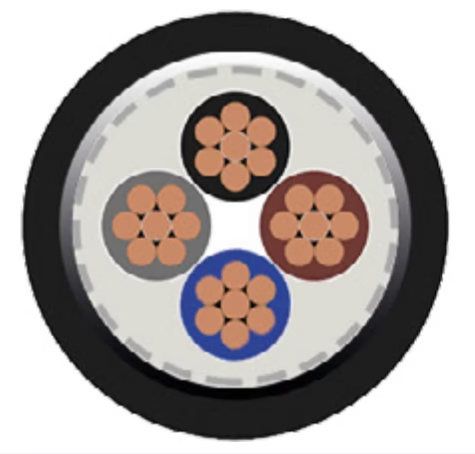
PVC cable

The ÖLFLEX CLASSIC 115 CY 4G1.5 cable represents a precision-engineered control cable where every dimensional and electrical specification has been optimized through extensive testing and field validation across diverse industrial applications. The 8.2-millimeter outer diameter establishes the space requirements for cable routing in panel layouts, cable trays, and conduit systems. To understand this specification in practical terms, consider that 8.2 millimeters is approximately the width of a standard pencil—this compact size enables routing through narrow spaces between equipment, through small penetrations in enclosure walls, and through dense cable bundles where space is precious. The 4G1.5 designation specifies that the cable contains four conductors, each with a 1.5 square millimeter cross-sectional area, meaning each conductor is composed of fine copper wire strands twisted together in a flexible Class 5 stranding pattern. One of these four conductors is the distinctive green-yellow (dual-color) protective earth/ground conductor, while the other three are typically color-coded according to VDE 0293-308 standards (often black, brown, and grey for three-phase applications, or black, brown, and blue for single-phase applications). The current carrying capacity is approximately 18 amperes under standard conditions (30°C ambient air temperature, cables routed in free air rather than enclosed in conduit or cable trays), establishing the maximum safe electrical load for any single conductor. The voltage rating of 300/500V classifies this as a control-voltage cable rather than a high-voltage power cable, appropriate for control circuits, instrumentation systems, and signaling applications rather than main power distribution.

VDE Cross-Reference: Drop-in Alternative for ÖLFLEX CLASSIC 115 CY 4G1.5 VDE 0250

The ÖLFLEX CLASSIC 115 CY 4G1.5 cable represents a precision-engineered control cable where every dimensional and electrical specification has been optimized through extensive testing and field validation across diverse industrial applications. The 8.2-millimeter outer diameter establishes the space requirements for cable routing in panel layouts, cable trays, and conduit systems. To understand this specification in practical terms, consider that 8.2 millimeters is approximately the width of a standard pencil—this compact size enables routing through narrow spaces between equipment, through small penetrations in enclosure walls, and through dense cable bundles where space is precious. The 4G1.5 designation specifies that the cable contains four conductors, each with a 1.5 square millimeter cross-sectional area, meaning each conductor is composed of fine copper wire strands twisted together in a flexible Class 5 stranding pattern. One of these four conductors is the distinctive green-yellow (dual-color) protective earth/ground conductor, while the other three are typically color-coded according to VDE 0293-308 standards (often black, brown, and grey for three-phase applications, or black, brown, and blue for single-phase applications). The current carrying capacity is approximately 18 amperes under standard conditions (30°C ambient air temperature, cables routed in free air rather than enclosed in conduit or cable trays), establishing the maximum safe electrical load for any single conductor. The voltage rating of 300/500V classifies this as a control-voltage cable rather than a high-voltage power cable, appropriate for control circuits, instrumentation systems, and signaling applications rather than main power distribution.
(N)TSKCGEWÖU specifications. This protective layer serves multiple critical functions within the cable assembly, with mechanical stress redistribution being among its most important roles. According to research published by Sibelco, the bedding compound is defined as the material applied around insulated conductors to maintain their position and provide bedding for protective armoring.[1] This layer functions as an intermediary component positioned between the laid-up cores and the metallic armor, creating what cable engineers describe as a separation sheath that fundamentally alters how mechanical forces are distributed throughout the cable structure.

Inner Sheath Function: Mechanical Stress Redistribution in (N)TSKCGEWÖU Cables

(N)TSKCGEWÖU specifications. This protective layer serves multiple critical functions within the cable assembly, with mechanical stress redistribution being among its most important roles. According to research published by Sibelco, the bedding compound is defined as the material applied around insulated conductors to maintain their position and provide bedding for protective armoring.[1] This layer functions as an intermediary component positioned between the laid-up cores and the metallic armor, creating what cable engineers describe as a separation sheath that fundamentally alters how mechanical forces are distributed throughout the cable structure.
IEC 60502 is an international standard published by the International Electrotechnical Commission (IEC) that sets out the specification for power cables with extruded insulation. The standard covers cables with voltage ratings from 1 kV (Um = 1.2 kV) up to 30 kV (Um = 36 kV), designed for fixed installations such as distribution networks and industrial installations. This widely recognized standard serves as a primary reference for cable manufacturers worldwide and forms the basis for numerous national and regional cable standards.

What is IEC 60502 Cable?

IEC 60502 對導體類型、絕緣材料和護套化合物提供了詳細規格。絕緣材料包括 PVC(最高溫度 70°C)、XLPE、EPR 和 HEPR(均為最高 90°C)。導體類別包括第 1 類(實心)、第 2 類(絞合)和第 5 類(柔性),尺寸範圍從 1.5 mm² 到 1600 mm²。護套化合物包括 PVC、PE 和用於防火敏感區域的無鹵素材料。XLPE 絕緣的標稱厚度從 0.6/1 kV 的 1.0 mm 到 18/30 kV 的 8.0 mm 不等。