oil resistant PUR cable

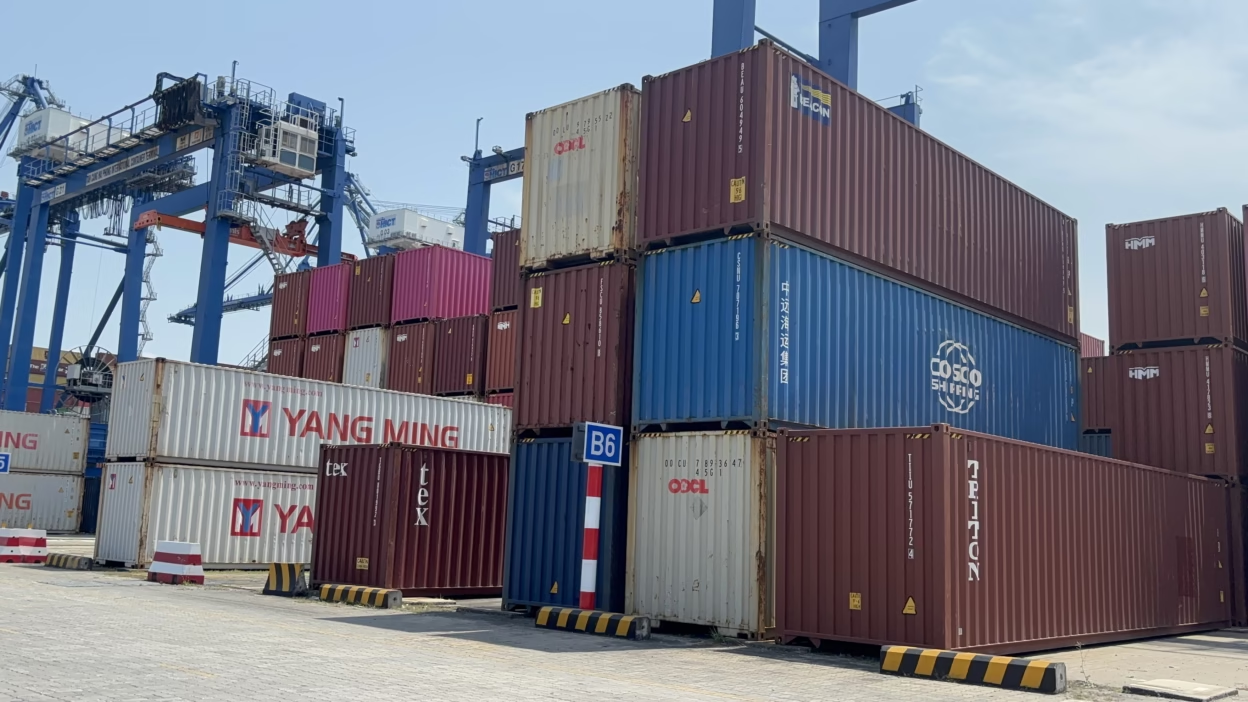
3GSLTOE has been a staple in port automation for years, the XPRT designation signifies a modern evolution in the cable's outer Polyurethane (PUR) sheath and internal slip-layers. When terminal operators are pushing Megamax Ship-to-Shore (STS) cranes to their absolute maximum cycles, the cable must coil into the basket flawlessly, hour after hour, without the outer jacket generating friction, heat, or static cling.

SPREADERFLEX BSKT XPRT3GSLTOE

3GSLTOE has been a staple in port automation for years, the XPRT designation signifies a modern evolution in the cable’s outer Polyurethane (PUR) sheath and internal slip-layers. When terminal operators are pushing Megamax Ship-to-Shore (STS) cranes to their absolute maximum cycles, the cable must coil into the basket flawlessly, hour after hour, without the outer jacket generating friction, heat, or static cling.
Spreaderflex® 3GSLTOE

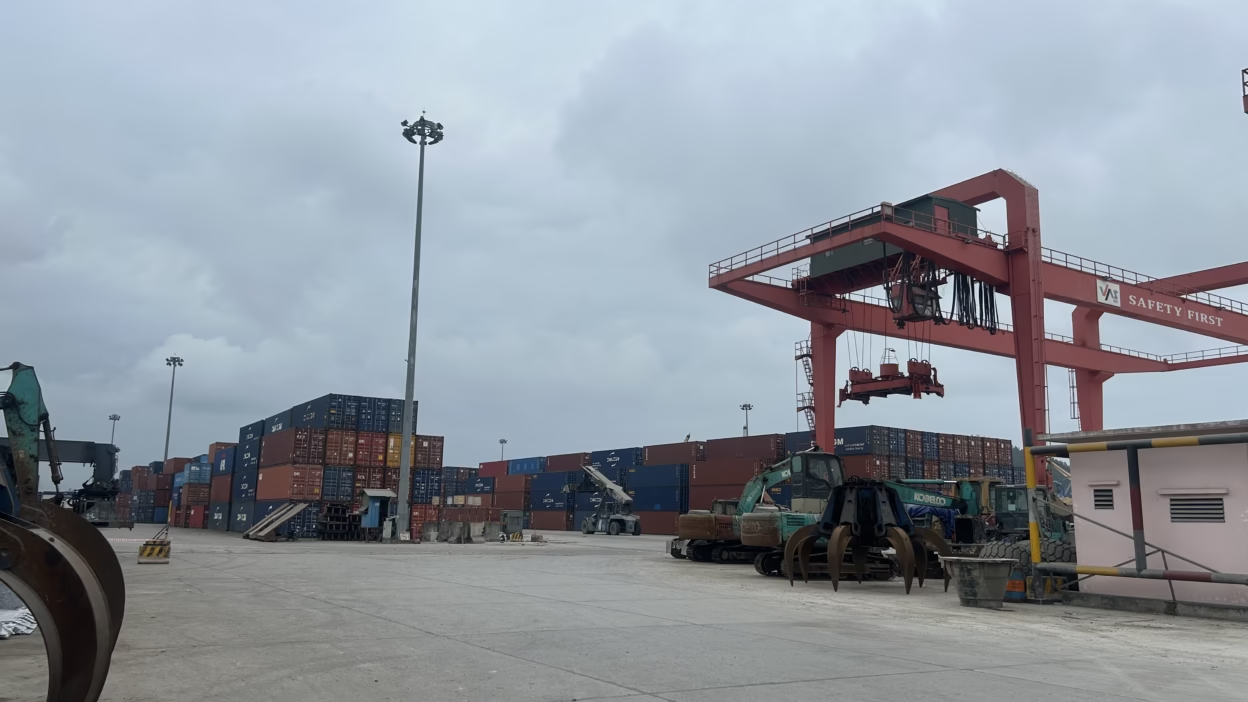
Spreaderflex® 3GSLTOE is the most technologically complete basket cable in the Feichun port crane portfolio—the cable that integrates every innovation developed for vertical basket festoon operation into a single, unified structure. Where the SPREADERFLEX BSKT XPRT SYSLTOE FO adds fiber optics but uses thermoplastic insulation, and the TRATOSCOILFLEX uses rubber construction but omits screening—the 3GSLTOE combines lead-ball aramid self-supporting (for wind-proof plumb drop and zero-elongation suspension), bundle stranding (for zero-twist coiling), tinned copper braid EMC screening (for VFD noise immunity), Class FS ultra-flexible conductors (for millions of basket fold cycles), EPR 3GI3 rubber insulation (for the most robust dielectric performance), and PUR outer sheath (for the widest temperature range and lowest surface friction)—all in one cable.
FABER® Reelingflex Premium is a 0.6/1 kV polyurethane-sheathed, XLPE-insulated, aramid self-supporting mining reeling cable engineered by Anhui Feichun Special Cable Co., Ltd. for the most mechanically violent cable application in all of industrial engineering: powering mobile mining equipment through monospiral cable reels in underground tunnels, open-cast pits, quarries, and large-scale civil engineering operations.

FABER® Reelingflex Premium

FABER® Reelingflex Premium is a 0.6/1 kV polyurethane-sheathed, XLPE-insulated, aramid self-supporting mining reeling cable engineered by Anhui Feichun Special Cable Co., Ltd. for the most mechanically violent cable application in all of industrial engineering: powering mobile mining equipment through monospiral cable reels in underground tunnels, open-cast pits, quarries, and large-scale civil engineering operations.
Engineered for Robotic Drag Chains (E-Chains), Spring-Operated and Motorized Reels, Transfer Cars, CNC Machine Tools, Gantry Robots, AGVs/AMRs, Automated Warehouses, Packaging Lines, and Every High-Speed Industrial Automation System Where Conductor Fatigue and Jacket Abrasion Destroy Ordinary Cables

RHEYCORD®-PUR R

Engineered for Robotic Drag Chains (E-Chains), Spring-Operated and Motorized Reels, Transfer Cars, CNC Machine Tools, Gantry Robots, AGVs/AMRs, Automated Warehouses, Packaging Lines, and Every High-Speed Industrial Automation System Where Conductor Fatigue and Jacket Abrasion Destroy Ordinary Cables
Engineered for High-Voltage Single-Phase Routing Inside Space-Restricted Switchgear Cabinets, Mobile and Containerised Transformer Substations, Temporary Mine and Rail MV Jumper Connections, Festoon Systems, and Any Application Where Maximum Power Must Pass Through Minimum Space with Zero Termination Failures

BUFLEX®-SC

Engineered for High-Voltage Single-Phase Routing Inside Space-Restricted Switchgear Cabinets, Mobile and Containerised Transformer Substations, Temporary Mine and Rail MV Jumper Connections, Festoon Systems, and Any Application Where Maximum Power Must Pass Through Minimum Space with Zero Termination Failures
Engineered for Ship-to-Shore Cranes, RTG/RMG Gantry Cranes, Grab Unloaders, Tunnel Boring Machines, and Smart Port Electrification Systems Demanding Maximum Power and Data Density in the Smallest Possible Cable Diameter

BUFLEX® SEM OFE

Engineered for Ship-to-Shore Cranes, RTG/RMG Gantry Cranes, Grab Unloaders, Tunnel Boring Machines, and Smart Port Electrification Systems Demanding Maximum Power and Data Density in the Smallest Possible Cable Diameter
Electromagnetic compatibility shielding is one of the most misunderstood concepts in industrial cable specification, because understanding it requires integrating knowledge from physics, electrical engineering, materials science, and practical manufacturing. Let me build your understanding of this critical topic from first principles, starting with the fundamental question: what problem does shielding actually solve? In industrial factories, electrical equipment generates electromagnetic noise constantly. Variable frequency drives (VFDs) switching high current on and off create radio-frequency interference. Motors create electromagnetic fields as magnetic flux patterns change. Welding equipment creates severe high-frequency noise. Radio frequency heating systems generate intense electromagnetic energy. This electromagnetic energy radiates outward from all these equipment sources, filling the factory air with invisible electromagnetic waves traveling at the speed of light. Now imagine control cables routed through this electrically noisy environment—cables carrying sensitive information such as sensor measurements, position feedback from encoders, or safety interlock status. When this unshielded cable passes through the electromagnetic noise field, the noise energy couples directly onto the conductor wires inside the cable. The effect is like trying to hear someone whisper in a crowded, loud nightclub—the noise overwhelms the desired signal. A shielded cable solves this problem by surrounding the inner conductors with a conductive barrier—a braid of copper wires—that intercepts the electromagnetic noise before it can couple onto the signal conductors. The shielding acts like a physical wall, or more precisely, like a Faraday cage (a complete electrical enclosure that blocks external electromagnetic fields). However, a Faraday cage is only effective if it has complete coverage—if there are gaps, electromagnetic energy penetrates through the gaps and reaches the inner contents. This is precisely why braid coverage percentage matters so profoundly: it directly determines whether the shielding provides near-complete electromagnetic protection or whether gaps allow significant noise penetration. A cable with 50 percent braid coverage has gaps that allow substantial electromagnetic energy to penetrate. A cable with 85 percent braid coverage has much smaller gaps that allow minimal penetration. The coverage percentage directly determines the shielding effectiveness, measured in decibels, which quantifies how much electromagnetic interference is blocked. Understanding this relationship—how coverage percentage translates into shielding effectiveness—is essential for electrical engineers selecting cables and designing systems that will operate reliably in electromagnetically noisy environments.

EMC Shielding Specs: Tinned Copper Braid Coverage on LAPP ÖLFLEX FD 855 CP 36G0.75

Electromagnetic compatibility shielding is one of the most misunderstood concepts in industrial cable specification, because understanding it requires integrating knowledge from physics, electrical engineering, materials science, and practical manufacturing. Let me build your understanding of this critical topic from first principles, starting with the fundamental question: what problem does shielding actually solve? In industrial factories, electrical equipment generates electromagnetic noise constantly. Variable frequency drives (VFDs) switching high current on and off create radio-frequency interference. Motors create electromagnetic fields as magnetic flux patterns change. Welding equipment creates severe high-frequency noise. Radio frequency heating systems generate intense electromagnetic energy. This electromagnetic energy radiates outward from all these equipment sources, filling the factory air with invisible electromagnetic waves traveling at the speed of light. Now imagine control cables routed through this electrically noisy environment—cables carrying sensitive information such as sensor measurements, position feedback from encoders, or safety interlock status. When this unshielded cable passes through the electromagnetic noise field, the noise energy couples directly onto the conductor wires inside the cable. The effect is like trying to hear someone whisper in a crowded, loud nightclub—the noise overwhelms the desired signal. A shielded cable solves this problem by surrounding the inner conductors with a conductive barrier—a braid of copper wires—that intercepts the electromagnetic noise before it can couple onto the signal conductors. The shielding acts like a physical wall, or more precisely, like a Faraday cage (a complete electrical enclosure that blocks external electromagnetic fields). However, a Faraday cage is only effective if it has complete coverage—if there are gaps, electromagnetic energy penetrates through the gaps and reaches the inner contents. This is precisely why braid coverage percentage matters so profoundly: it directly determines whether the shielding provides near-complete electromagnetic protection or whether gaps allow significant noise penetration. A cable with 50 percent braid coverage has gaps that allow substantial electromagnetic energy to penetrate. A cable with 85 percent braid coverage has much smaller gaps that allow minimal penetration. The coverage percentage directly determines the shielding effectiveness, measured in decibels, which quantifies how much electromagnetic interference is blocked. Understanding this relationship—how coverage percentage translates into shielding effectiveness—is essential for electrical engineers selecting cables and designing systems that will operate reliably in electromagnetically noisy environments.