mining cable supplier Australia

Australian mining operations—particularly surface mining and port material handling equipment—rely on festoon systems for continuous power delivery to mobile equipment. A festoon system consists of a stationary overhead cable strung on support structures, with a traveling contact (festoon carriage) that maintains electrical contact with the cable while moving horizontally. The cable must be engineered for continuous flexing, high mechanical stress, and reliable power delivery across distances of 100–500 meters. 澳洲采矿运营——特别是露天采矿和港口物料搬运设备——依赖滑车系统为移动设备提供连续电力。滑车系统由静止的架空电缆组成,支撑在支撑结构上,移动接触件(滑车架)在水平移动时保持与电缆的电气接触。电缆必须设计为可连续弯曲、承受高机械应力、跨越100-500米距离可靠供电。 Continuous Reeling Environment: Unlike trailing cables deployed once and left in place, festoon cables are continuously reeled—moving forward during equipment operation and retracted for repositioning. This creates 10,000–30,000 flex cycles annually. Cable design must accommodate both continuous forward motion (requiring low tension) and rapid retraction (requiring high-speed reeling capacity and mechanical strength).

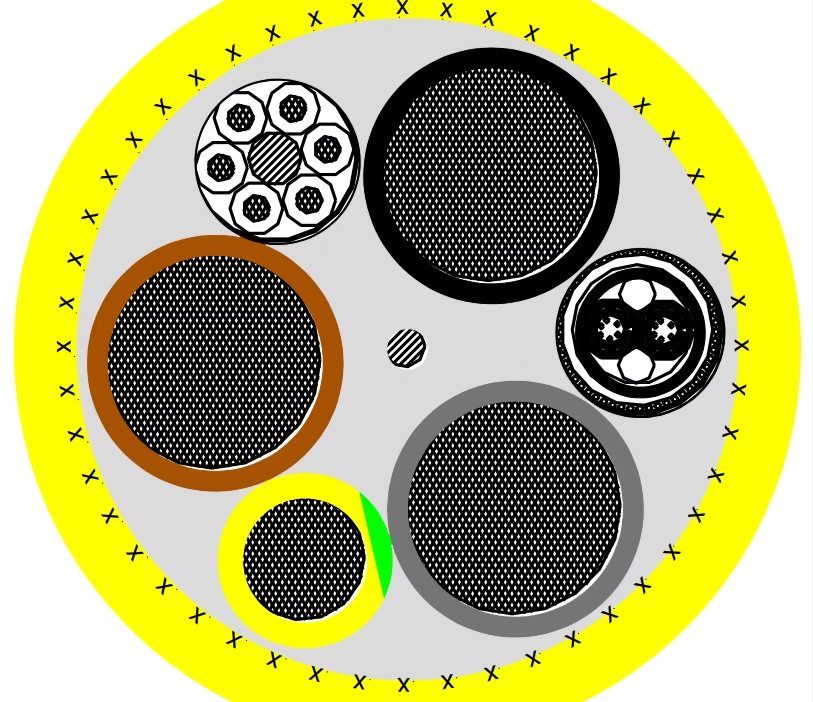
AS/NZS Upgraded Festoons: Sizing (N)TSFLCGEWÖU 4×120 3.3/3.3kV Flat Reeling Cables

Australian mining operations—particularly surface mining and port material handling equipment—rely on festoon systems for continuous power delivery to mobile equipment. A festoon system consists of a stationary overhead cable strung on support structures, with a traveling contact (festoon carriage) that maintains electrical contact with the cable while moving horizontally. The cable must be engineered for continuous flexing, high mechanical stress, and reliable power delivery across distances of 100–500 meters. 澳洲采矿运营——特别是露天采矿和港口物料搬运设备——依赖滑车系统为移动设备提供连续电力。滑车系统由静止的架空电缆组成,支撑在支撑结构上,移动接触件(滑车架)在水平移动时保持与电缆的电气接触。电缆必须设计为可连续弯曲、承受高机械应力、跨越100-500米距离可靠供电。 Continuous Reeling Environment: Unlike trailing cables deployed once and left in place, festoon cables are continuously reeled—moving forward during equipment operation and retracted for repositioning. This creates 10,000–30,000 flex cycles annually. Cable design must accommodate both continuous forward motion (requiring low tension) and rapid retraction (requiring high-speed reeling capacity and mechanical strength).
When German-manufactured mining equipment—whether a dragline excavator, tunnel boring machine (TBM), or electric shovel—arrives in Australia, it typically specifies power cable ratings according to German VDE standards, most commonly the (N)TSCGEWÖU 12/20kV trailing cable per DIN VDE 0250-813. However, Australian mining networks typically operate at 11/11kV (in IT earthing—isolated or high-impedance grounded neutral systems). This apparent voltage mismatch—12/20kV German specification versus 11/11kV Australian network—creates immediate questions: Can German 12/20kV cables be used directly on Australian 11/11kV systems? What is the technical equivalence? How are AS/NZS 2802 Type 241 and Type 275 cables related to German specifications? 当德国制造的采矿设备——无论是挖掘机、隧道掘进机(TBM)还是电动铲斗——抵达澳洲时,它通常根据德国VDE标准规定电源电缆等级,最常见的是DIN VDE 0250-813的(N)TSCGEWÖU 12/20kV拖曳电缆。然而,澳洲采矿网络通常在11/11kV下运行(在IT接地——隔离或高阻接地中性系统中)。这种表面上的电压不匹配——12/20kV德国规范与11/11kV澳洲网络——立即引发问题:德国12/20kV电缆是否可以直接在澳洲11/11kV系统上使用?技术等效性是什么?AS/NZS 2802 Type 241和Type 275电缆与德国规范有什么关系?

European Machinery in Australia: Sourcing 11/11kV Equivalents for 12/20kV German Trailing Cables

When German-manufactured mining equipment—whether a dragline excavator, tunnel boring machine (TBM), or electric shovel—arrives in Australia, it typically specifies power cable ratings according to German VDE standards, most commonly the (N)TSCGEWÖU 12/20kV trailing cable per DIN VDE 0250-813. However, Australian mining networks typically operate at 11/11kV (in IT earthing—isolated or high-impedance grounded neutral systems). This apparent voltage mismatch—12/20kV German specification versus 11/11kV Australian network—creates immediate questions: Can German 12/20kV cables be used directly on Australian 11/11kV systems? What is the technical equivalence? How are AS/NZS 2802 Type 241 and Type 275 cables related to German specifications? 当德国制造的采矿设备——无论是挖掘机、隧道掘进机(TBM)还是电动铲斗——抵达澳洲时,它通常根据德国VDE标准规定电源电缆等级,最常见的是DIN VDE 0250-813的(N)TSCGEWÖU 12/20kV拖曳电缆。然而,澳洲采矿网络通常在11/11kV下运行(在IT接地——隔离或高阻接地中性系统中)。这种表面上的电压不匹配——12/20kV德国规范与11/11kV澳洲网络——立即引发问题:德国12/20kV电缆是否可以直接在澳洲11/11kV系统上使用?技术等效性是什么?AS/NZS 2802 Type 241和Type 275电缆与德国规范有什么关系?
TYPE 260 Heavy-Duty Mining Cable: Comprehensive Technical Analysis

TYPE 260 Heavy-Duty Mining Cable: Comprehensive Technical Analysis

TYPE 260 mining cable represents a pinnacle of engineering excellence in the domain of heavy-duty electrical power transmission for mining operations. This pliable armoured cable, designed in strict accordance with Australian and New Zealand standards AS/NZS 1802:2003 and AS/NZS 2802:2000, serves as a critical feeder cable in demanding mining environments where exceptional impact resistance and mechanical durability are paramount operational requirements.