low capacitance cable

Cycle life testing is one of the most critical but least understood quality metrics in industrial cable specification, because understanding it requires integrating knowledge from polymer chemistry, mechanical engineering, and materials science. Let me build your understanding from first principles. When a cable is installed in a drag chain system on a CNC machine or automated assembly line, it experiences repeated mechanical stress: the cable bends when the chain moves in one direction, then straightens when the chain reverses. If the equipment operates continuously, the cable might experience tens of thousands of these bend-unbend cycles per day. Over weeks or months of continuous operation, the cable accumulates millions of stress cycles. Now here is the crucial insight: a cable might tolerate a single application of very high stress without visible damage, yet that same cable fails after just thousands of cycles of moderate stress. This phenomenon of fatigue failure is fundamentally different from static failure and requires understanding at a molecular level. When a polyurethane cable sheath is bent repeatedly, the polymer chains at the outer surface of the bend are stretched (tensioned). As the cable straightens, these chains relax back toward their original configuration. With each bend-straighten cycle, the chains experience stretching and relaxation. This cyclic deformation accumulates micro-scale damage: small tears appear at defects in the material, cracks begin forming at stress concentrations, and these cracks slowly grow with each successive cycle. Eventually, after millions of cycles, cracks that started microscopically become large enough to propagate rapidly and catastrophically fail the cable. Cycle life testing measures exactly this: how many complete bend-straighten cycles can the cable withstand before cracks form and grow to the point of failure. The ÖLFLEX CHAIN 896 P is rated for 10 million cycles, validated through rigorous laboratory testing. This rating means that cables have been tested by bending them to their minimum specified radius, fully straightening them, and repeating this sequence 10 million times while continuously monitoring for electrical opens (breaks in continuity), insulation resistance degradation, or mechanical failure. Only cables that survive this entire test sequence without failure receive the 10 million cycle rating. Generic polyurethane cables, by contrast, might fail this same test after only 1 to 3 million cycles because their polyurethane formulation lacks the specialized engineering that enables extended fatigue resistance. The difference between 3 million and 10 million cycles translates directly to equipment operating life and cable replacement frequency, making cycle life testing a fundamentally important quality metric.

Cycle Life Testing: Does Generic PUR Match 10-Million Cycles of LAPP ÖLFLEX CHAIN 896 P?

Cycle life testing is one of the most critical but least understood quality metrics in industrial cable specification, because understanding it requires integrating knowledge from polymer chemistry, mechanical engineering, and materials science. Let me build your understanding from first principles. When a cable is installed in a drag chain system on a CNC machine or automated assembly line, it experiences repeated mechanical stress: the cable bends when the chain moves in one direction, then straightens when the chain reverses. If the equipment operates continuously, the cable might experience tens of thousands of these bend-unbend cycles per day. Over weeks or months of continuous operation, the cable accumulates millions of stress cycles. Now here is the crucial insight: a cable might tolerate a single application of very high stress without visible damage, yet that same cable fails after just thousands of cycles of moderate stress. This phenomenon of fatigue failure is fundamentally different from static failure and requires understanding at a molecular level. When a polyurethane cable sheath is bent repeatedly, the polymer chains at the outer surface of the bend are stretched (tensioned). As the cable straightens, these chains relax back toward their original configuration. With each bend-straighten cycle, the chains experience stretching and relaxation. This cyclic deformation accumulates micro-scale damage: small tears appear at defects in the material, cracks begin forming at stress concentrations, and these cracks slowly grow with each successive cycle. Eventually, after millions of cycles, cracks that started microscopically become large enough to propagate rapidly and catastrophically fail the cable. Cycle life testing measures exactly this: how many complete bend-straighten cycles can the cable withstand before cracks form and grow to the point of failure. The ÖLFLEX CHAIN 896 P is rated for 10 million cycles, validated through rigorous laboratory testing. This rating means that cables have been tested by bending them to their minimum specified radius, fully straightening them, and repeating this sequence 10 million times while continuously monitoring for electrical opens (breaks in continuity), insulation resistance degradation, or mechanical failure. Only cables that survive this entire test sequence without failure receive the 10 million cycle rating. Generic polyurethane cables, by contrast, might fail this same test after only 1 to 3 million cycles because their polyurethane formulation lacks the specialized engineering that enables extended fatigue resistance. The difference between 3 million and 10 million cycles translates directly to equipment operating life and cable replacement frequency, making cycle life testing a fundamentally important quality metric.
N3GHSSYCY — это экранированный высоковольтный гибкий кабель промышленного класса, специально разработанный для подключения мобильного оборудования в шахтах и подземных выработках со взрывоопасной средой. Кабель соответствует международному стандарту DIN VDE 0250, часть 605 и выпускается в двух номинальных напряжениях: 3.6/6 кВ и 6/10 кВ. Особенностью конструкции является наличие фазоконцентрического заземляющего проводника и общего концентрического экрана мониторинга, которые в сочетании со схемой высоковольтной защиты позволяют контролировать кабель на наличие дефектов изоляции и повреждений от внешних воздействий.

N3GHSSYCY — Экранированный Высоковольтный Кабель с Резиновой Изоляцией и ПВХ Оболочкой

N3GHSSYCY кабель, высоковольтный кабель, экранированный кабель, кабель с резиновой изоляцией, кабель с ПВХ оболочкой, кабель DIN VDE 0250-605, кабель 3.6/6 кВ, кабель 6/10 кВ, горнодобывающий кабель высокого напряжения, кабель для шахт, кабель для подземных выработок, кабель для взрывоопасных зон, кабель EPR изоляция, кабель с экраном мониторинга, кабель с заземляющим экраном, кабель со стальной бронёй, кабель с контрольными жилами, кабель с литыми терминациями, гибкий высоковольтный кабель, кабель для тоннелестроения, кабель для трансформаторов, кабель низкой ёмкости, кабель для сетей 10 кВ, кабель для сетей 5 кВ, кабель тройной экструзии, кабель с медной оплёткой, кабель с оцинкованной стальной бронёй, красный кабель ПВХ YM5, кабель 3×25 N3GHSSYCY, кабель 3×35 N3GHSSYCY, кабель 3×50 N3GHSSYCY, кабель 3×70 N3GHSSYCY, кабель 3×95 N3GHSSYCY, кабель с фазоконцентрическим заземлением, кабель для мобильного оборудования, кабель для контейнерной укладки, высоковольтный кабель для горнодобычи, кабель для подземных работ СНГ, экранированный силовой кабель, кабель с двойным экраном, кабель мониторинга изоляции, высоковольтный резиновый кабель, кабель для опасных сред, промышленный высоковольтный кабель, кабель для передвижных установок, кабель Россия, кабель Казахстан, кабель Беларусь, китайский производитель высоковольтного кабеля, Anhui Feichun кабель, кабель ГОСТ 16442, кабель IEC 60502
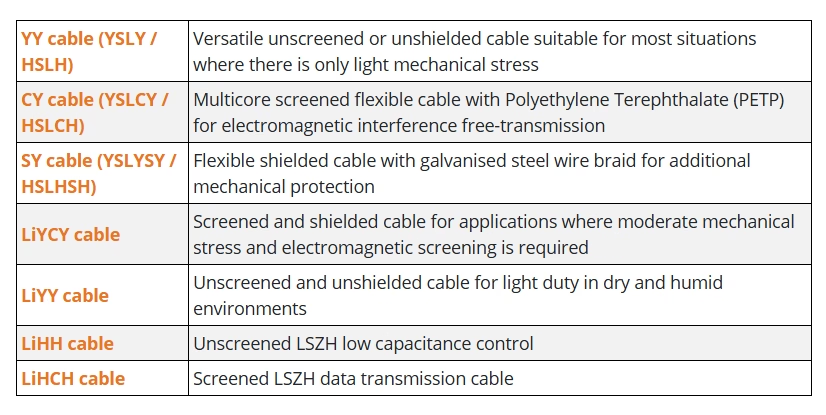
High-speed, high-quality end-to-end data transmission cables for communication technology applications including data transfer, sound and video communications, signalling and instrumentation. Our range covers EIA-232, EIA-422, EIA-423 and EIA-485 standards with LSF, LSZH, PE and PVC sheathing options offering superior performance characteristics.

Belden and Alternative / Equivalent Cables

Belden 9841, Belden 9842, Belden 9843, Belden 9844, Belden 8723, Belden 8728, Belden 8777, Belden 8778, Belden 9501, Belden 9502, Belden 9503, Belden 9504, Belden 9506, Belden 9508, Belden 9510, Belden 8760, Belden 8761, Belden 8762, Belden 8102, Belden 8103, Belden 8104, Belden 8105, Belden 8106, Belden 8162, Belden 8163, Belden 1502R, Belden 8770, Belden 9927, Belden 9929, Belden 9934, Belden 9936
DIN VDE 0812 is a German national standard issued in 1988 that contains specifications for equipment wires and stranded equipment wires used within telecommunications and data processing systems. The standard covers flexible, multi-conductor cables designed for electronic control system connections, voice frequency transmission, and signal communications in fixed installations. These cables represent popular European alternatives to American-style data and control cables, featuring cores twisted into pairs to reduce crosstalk and electromagnetic interference.

What is DIN VDE 0812 Cable?

DIN VDE 0812 cables are designed for electronic control system connections, voice frequency transmission, and signal communications in fixed installations. They are widely used across various industries where reliable data and signal transmission is required in environments requiring flexibility and compact cable routing.
CEI 20-27 CENELEC HD361 Cable

What is CEI 20-27 CENELEC HD361 Cable?

CEI 20-27 CENELEC HD361 represents a standardized cable designation system developed by the European Committee for Electrotechnical Standardisation (CENELEC) to provide uniform identification and classification of harmonized power cables and cords across European markets. This systematic coding methodology enables engineers, procurement specialists, and electrical contractors to precisely identify cable specifications including voltage ratings, insulation materials, conductor types, and sheathing compounds through a structured alphanumeric designation format.