high bend cycle cable

Port crane festoon cables endure conditions that few other industrial cables ever face. A single cable suspended in a festoon system supporting an STS (Ship-To-Shore) crane—or running through a cableveyor transport mechanism—must simultaneously: Support its own weight across spans of 50–100+ meters. Flex continuously as the crane trolley or transport carriage moves back and forth, experiencing tens of thousands of bend cycles per year. Resist mechanical abrasion from guide rollers, sheaves, fairleads, and cable troughs. Survive saltwater spray and UV exposure common to marine terminal environments. Conduct electrical power reliably while maintaining dielectric integrity under all dynamic stress conditions. This multi-hazard environment creates a specific failure mode that conventional cables struggle to handle: self-weight mechanical fatigue. As the cable hangs under its own weight, the copper conductors experience a catenary load distribution. The top of the cable bears the cumulative weight of the entire cable length below it. When the crane moves and the cable flexes, this catenary load creates internal mechanical stress—tension applied directly to the copper strands without a mechanism to distribute or absorb the force. Over time, typically 3–5 years, the copper conductors begin to work-harden and fracture. Electrical resistance increases. Localized corrosion begins. Eventually, the cable fails not because of insulation breakdown or sheath perforation, but because the mechanical integrity of the conductor system has been compromised by repeated tension and flexure cycles.
Kevlar®-Reinforced Port Crane & Ship Unloader Cables

Port crane festoon cables endure conditions that few other industrial cables ever face. A single cable suspended in a festoon system supporting an STS (Ship-To-Shore) crane—or running through a cableveyor transport mechanism—must simultaneously: Support its own weight across spans of 50–100+ meters. Flex continuously as the crane trolley or transport carriage moves back and forth, experiencing tens of thousands of bend cycles per year. Resist mechanical abrasion from guide rollers, sheaves, fairleads, and cable troughs. Survive saltwater spray and UV exposure common to marine terminal environments. Conduct electrical power reliably while maintaining dielectric integrity under all dynamic stress conditions. This multi-hazard environment creates a specific failure mode that conventional cables struggle to handle: self-weight mechanical fatigue. As the cable hangs under its own weight, the copper conductors experience a catenary load distribution. The top of the cable bears the cumulative weight of the entire cable length below it. When the crane moves and the cable flexes, this catenary load creates internal mechanical stress—tension applied directly to the copper strands without a mechanism to distribute or absorb the force. Over time, typically 3–5 years, the copper conductors begin to work-harden and fracture. Electrical resistance increases. Localized corrosion begins. Eventually, the cable fails not because of insulation breakdown or sheath perforation, but because the mechanical integrity of the conductor system has been compromised by repeated tension and flexure cycles.
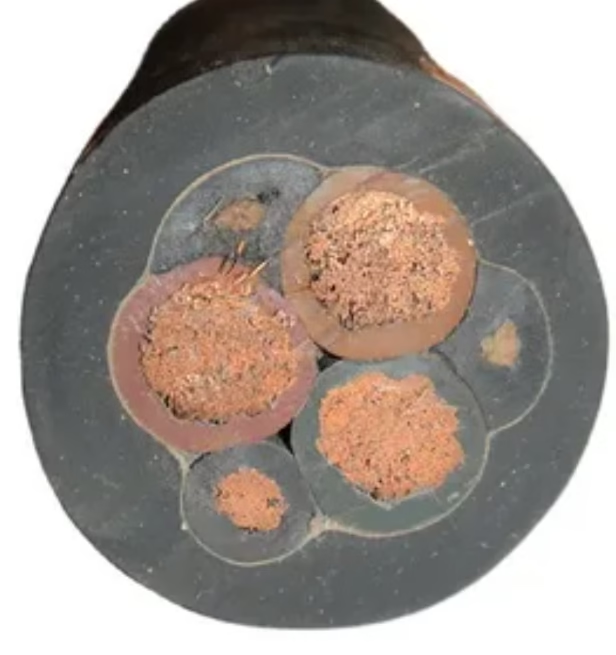
Кабели марки КОГРВЭШ предназначены для присоединения шахтного бурильного электроинструмента на номинальное переменное напряжение 660В частоты 50 Гц с изолированной нейтралью. Кабели могут эксплуатироваться в подземных помещениях и шахтах с повышенной влажностью воздуха, в которых возможно длительное наличие воды или частая конденсация влаги. Электропроводящие экраны по изоляции жил обеспечивают опережающее отключение системы электроснабжения при повреждении кабеля, предупреждая возможный взрыв метана в шахтах.

КОГРВЭШ & КОГРВЭШ-Т

КОГРВЭШ, КОГРВЭШ-Т, KOGRVESH, KOGRVESH-T, кабель КОГРВЭШ, кабель КОГРВЭШ-Т, шахтный буровой кабель, mining drill cable, drilling equipment cable, гибкий шахтный кабель КОГРВЭШ, экранированный буровой кабель, шахтный электроинструмент кабель, 矿用钻机电缆, 礦用鑽機電纜, КОГРВЭШ 3×1.5, КОГРВЭШ 3×2.5, КОГРВЭШ 3×4, КОГРВЭШ 3×6