DNV approved cable

AmerCable 37-102VFD 2kV is the industry-recognized optimal choice for offshore top drive system service loops, meeting or exceeding all critical performance requirements that standard Type P cables cannot reliably provide. The cable features Gexol XLPO cross-linked insulation rated for 110°C continuous conductor operation and transient temperatures to 250°C during fault conditions, providing superior thermal stability under VFD operating stress. The cable's defining characteristic is its symmetrical three-core grounding design—three symmetrically placed insulated ground lines instead of the single ground typically found in standard power cables—which provides balanced harmonic return paths that prevent the high-frequency ground currents responsible for bearing current damage in top drive motors. AmerCable 37-102VFD features 100 percent tinned copper braid shielding with aluminum foil providing surface transfer impedance below 50 milliohms at 10 MHz, enabling effective electromagnetic interference suppression in the electrically noisy drilling platform environment. Current-carrying capacity ranges from 170 amperes (3×1/0 AWG) to 580 amperes (3×777 kcmil) depending on conductor size, with all ratings based on free-air installation at 45°C ambient and 110°C conductor temperature per IEEE 45 and IEEE 1580 standards. The cable achieves industry approvals including IEEE 1580 Type P, UL 1309, CSA 245 Type X110, ABS, DNV, Lloyd's Register, and USCG certification, meeting or exceeding all major offshore drilling regulatory frameworks. The distinction between AmerCable 37-102VFD and standard Type P cables is not simply academic—field experience from thousands of offshore drilling installations demonstrates that improper cable selection results in bearing current damage to top drive motors (estimated cost per incident: 150,000 to 300,000 US dollars for motor replacement and rig downtime), high-frequency noise coupling into drilling platform control systems causing PLC errors and sensor malfunction, and accelerated cable degradation from sustained electrical overstress. For any offshore top drive system powered by variable frequency drives—whether 600V, 1200V, or 2400V architecture—AmerCable 37-102VFD 2kV cables represent the only specification that provides comprehensive protection against the full spectrum of electrical, thermal, and mechanical stresses present in modern offshore drilling operations.

Top Drive Systems: Is AmerCable 37-102VFD 2kV the Right Choice for Offshore Top Drive Service Loops?

AmerCable 37-102VFD 2kV is the industry-recognized optimal choice for offshore top drive system service loops, meeting or exceeding all critical performance requirements that standard Type P cables cannot reliably provide. The cable features Gexol XLPO cross-linked insulation rated for 110°C continuous conductor operation and transient temperatures to 250°C during fault conditions, providing superior thermal stability under VFD operating stress. The cable’s defining characteristic is its symmetrical three-core grounding design—three symmetrically placed insulated ground lines instead of the single ground typically found in standard power cables—which provides balanced harmonic return paths that prevent the high-frequency ground currents responsible for bearing current damage in top drive motors. AmerCable 37-102VFD features 100 percent tinned copper braid shielding with aluminum foil providing surface transfer impedance below 50 milliohms at 10 MHz, enabling effective electromagnetic interference suppression in the electrically noisy drilling platform environment. Current-carrying capacity ranges from 170 amperes (3×1/0 AWG) to 580 amperes (3×777 kcmil) depending on conductor size, with all ratings based on free-air installation at 45°C ambient and 110°C conductor temperature per IEEE 45 and IEEE 1580 standards. The cable achieves industry approvals including IEEE 1580 Type P, UL 1309, CSA 245 Type X110, ABS, DNV, Lloyd’s Register, and USCG certification, meeting or exceeding all major offshore drilling regulatory frameworks. The distinction between AmerCable 37-102VFD and standard Type P cables is not simply academic—field experience from thousands of offshore drilling installations demonstrates that improper cable selection results in bearing current damage to top drive motors (estimated cost per incident: 150,000 to 300,000 US dollars for motor replacement and rig downtime), high-frequency noise coupling into drilling platform control systems causing PLC errors and sensor malfunction, and accelerated cable degradation from sustained electrical overstress. For any offshore top drive system powered by variable frequency drives—whether 600V, 1200V, or 2400V architecture—AmerCable 37-102VFD 2kV cables represent the only specification that provides comprehensive protection against the full spectrum of electrical, thermal, and mechanical stresses present in modern offshore drilling operations.
The nominal overall diameter (O.D.) of a Nexans AmerCable 37-102594BS 2/C #4 AWG 600/1000V bronze armored and sheathed marine power cable is approximately 28.45 mm (1.120 inches), with a standard tolerance window of ±1.0–1.5 mm producing a permissible range of 26.95–29.95 mm. The cable features two parallel Class 5 tinned copper main power conductors each rated for 4 AWG (approximately 21.2 mm² cross-section), with a Gexol® XLPO (cross-linked polyolefin) insulation system providing superior low-frequency and high-frequency electrical integrity for 600/1000V marine applications. The outer protective architecture comprises a high-density bronze wire braid armor layer (approximately 1.5–2.0 mm thickness) specifically engineered to resist saltwater corrosion and mechanical abuse, overlaid with an arctic-grade halogen-free thermosetting rubber jacket (approximately 2.0–2.5 mm thickness) providing extreme durability in harsh offshore, subsea, and deep-freeze industrial environments. The approximate total weight is ~1,380 kg/km (927 lbs/1000 ft), with pure copper content approximately 380 kg/km. This cable achieves IEEE 1580 Type P certification, meeting or exceeding all critical flame-retardance, electrical stress distribution, and mechanical protection requirements for offshore drilling platforms, large vessel power systems, subsea equipment power distribution, and Class I Division 1 hazardous zone installations where conventional industrial cables cannot operate safely.

What is the Overall Diameter (O.D.) of AmerCable 37-102594BS 2/C #4 AWG Bronze Armored Cable?

The nominal overall diameter (O.D.) of a Nexans AmerCable 37-102594BS 2/C #4 AWG 600/1000V bronze armored and sheathed marine power cable is approximately 28.45 mm (1.120 inches), with a standard tolerance window of ±1.0–1.5 mm producing a permissible range of 26.95–29.95 mm. The cable features two parallel Class 5 tinned copper main power conductors each rated for 4 AWG (approximately 21.2 mm² cross-section), with a Gexol® XLPO (cross-linked polyolefin) insulation system providing superior low-frequency and high-frequency electrical integrity for 600/1000V marine applications. The outer protective architecture comprises a high-density bronze wire braid armor layer (approximately 1.5–2.0 mm thickness) specifically engineered to resist saltwater corrosion and mechanical abuse, overlaid with an arctic-grade halogen-free thermosetting rubber jacket (approximately 2.0–2.5 mm thickness) providing extreme durability in harsh offshore, subsea, and deep-freeze industrial environments. The approximate total weight is ~1,380 kg/km (927 lbs/1000 ft), with pure copper content approximately 380 kg/km. This cable achieves IEEE 1580 Type P certification, meeting or exceeding all critical flame-retardance, electrical stress distribution, and mechanical protection requirements for offshore drilling platforms, large vessel power systems, subsea equipment power distribution, and Class I Division 1 hazardous zone installations where conventional industrial cables cannot operate safely.
BFOU 0.6/1kV P5/P12 fire-resistant offshore power cable with 3 × 95 mm² tinned copper conductors is approximately 45 mm (1.77 inches), with a standard tolerance window of ±2.0 mm producing a permissible range of 43.0–47.0 mm. This specification is critical for cable gland selection because offshore and marine cable glands are manufactured with specific bore diameters engineered to accommodate this dimensional range. The approximate total weight of this cable is 4,950 kg/km (3,330 lbs/1000 ft), with copper content approximately 3,350 kg/km. It features three 95 mm² Class 2 tinned copper main power conductors, a halogen-free EPR insulation system, a critical mica tape fire-resistance layer rated for 830°C continuous operation (IEC 60331 certified), tinned copper wire braid armor providing mechanical protection and electromagnetic shielding, and an SHF2 halogen-free thermosetting outer sheath rated for extreme marine and subsea conditions.

Cable Gland Sizing: Finding the OD Tolerance for BFOU 0.6/1kV P5/P12 3×95 mm² Offshore Power Cable

BFOU 0.6/1kV P5/P12 fire-resistant offshore power cable with 3 × 95 mm² tinned copper conductors is approximately 45 mm (1.77 inches), with a standard tolerance window of ±2.0 mm producing a permissible range of 43.0–47.0 mm. This specification is critical for cable gland selection because offshore and marine cable glands are manufactured with specific bore diameters engineered to accommodate this dimensional range. The approximate total weight of this cable is 4,950 kg/km (3,330 lbs/1000 ft), with copper content approximately 3,350 kg/km. It features three 95 mm² Class 2 tinned copper main power conductors, a halogen-free EPR insulation system, a critical mica tape fire-resistance layer rated for 830°C continuous operation (IEC 60331 certified), tinned copper wire braid armor providing mechanical protection and electromagnetic shielding, and an SHF2 halogen-free thermosetting outer sheath rated for extreme marine and subsea conditions.
The designation BFOU(c) is not arbitrary—it is a highly structured labeling system derived from the NEK 606 Norwegian marine standard that encodes critical information about the cable's construction, safety properties, and intended application. By understanding what each letter represents, you gain immediate insight into the cable's fundamental characteristics and whether it is suitable for your specific marine environment. BFOU(c) 代号是从 NEK 606 挪威海洋标准派生的高度结构化标签系统,编码了电缆的关键安全特性和预期应用。

Datasheet & Specs: Technical Specifications for BFOU(c) 150/250V S4/S8 4x2x1.5 mm² Marine Instrumentation Cable

The designation BFOU(c) is not arbitrary—it is a highly structured labeling system derived from the NEK 606 Norwegian marine standard that encodes critical information about the cable’s construction, safety properties, and intended application. By understanding what each letter represents, you gain immediate insight into the cable’s fundamental characteristics and whether it is suitable for your specific marine environment. BFOU(c) 代号是从 NEK 606 挪威海洋标准派生的高度结构化标签系统,编码了电缆的关键安全特性和预期应用。
The selection of industrial power cables represents one of the most critical engineering decisions in drilling operations, whether on land or offshore. Two cable types dominate this application space: the Type SHD-GC (重型屏蔽接地检查电缆), designed primarily for mobile mining and terrestrial drilling equipment, and the Type P (海洋平台电缆), engineered specifically for harsh offshore and fixed platform environments. Though both cables operate at similar voltage ratings, they embody fundamentally different design philosophies that reflect the distinct mechanical, electrical, and safety demands of their respective application domains.

Type SHD-GC vs. Type P: Selecting the Right Trailing Cable for Land and Offshore Drilling 

The selection of industrial power cables represents one of the most critical engineering decisions in drilling operations, whether on land or offshore. Two cable types dominate this application space: the Type SHD-GC (重型屏蔽接地检查电缆), designed primarily for mobile mining and terrestrial drilling equipment, and the Type P (海洋平台电缆), engineered specifically for harsh offshore and fixed platform environments. Though both cables operate at similar voltage ratings, they embody fundamentally different design philosophies that reflect the distinct mechanical, electrical, and safety demands of their respective application domains.
Shipwiring and offshore platform cables represent a specialized category of marine cables designed to perform reliably in the most demanding environments on earth—at sea. These cables must withstand extreme temperature variations (from Arctic cold to engine room heat), constant exposure to humidity, salt water, oils, acids, and drilling muds, while maintaining electrical integrity for power, control, signal, instrumentation, and communication applications. The primary international standards governing these cables include NEK 606 (Norwegian standard for offshore floating platforms), IEC 60092 (electrical installations in ships), BS 6883 (fixed wiring in offshore units), and BS 7917 (fire resistant cables for offshore applications).

What are Shipwiring & Offshore Platform Cables?

NEK 606 cable, BFOU cable, RFOU cable, NEK 606 BFOU, NEK 606 RFOU, offshore platform cable, MUD resistant cable, Norwegian offshore cable, floating platform cable, FPSO cable, marine cable, offshore cable, shipwiring cable, ship cable, offshore platform cable, marine power cable, ship electrical cable, naval cable, maritime cable, at-sea cable,RFOU P101, BFOU P105, RFOU S101, RFOU S102, BFOU S103, BFOU S104, UX P108, RFOU P102, RFOU P103, RFOU P104, RFOU P112, RFOU P113
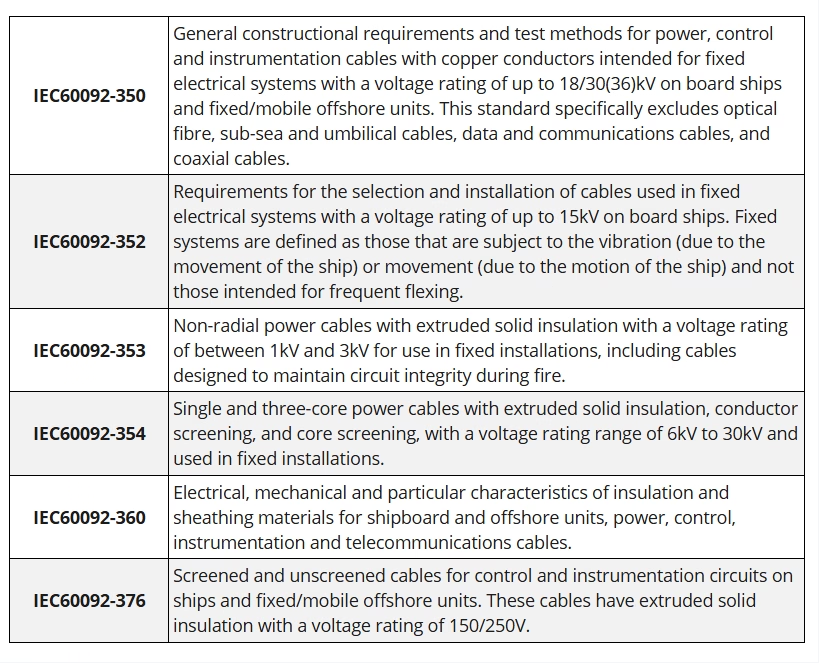
IEC 60092 is the international standard for electrical installations in ships and fixed/mobile marine applications. Ship wiring is covered by various national standards such as BS 6883 (British) and NEK 606 (Norwegian), and subject to third-party accreditations including Lloyd's Register, DNV (Det Norske Veritas), and ABS (American Bureau of Shipping). As an international standard, IEC 60092 covers power and instrumentation cables for use on ships and in mobile marine environments.

What is IEC 60092 Cable?

IEC 60092 cable, marine cable, shipboard cable, offshore cable, BS 6883 cable, NEK 606 cable, BFOU cable, RFOU cable, 657TQ cable, 658TQ cable, fire resistant marine cable, flame retardant cable, ship wiring, offshore platform cable, Lloyd’s Register approved, DNV certified, halogen free cable, LSZH marine cable, MUD resistant cable, IEC 60092-353, IEC 60092-354, IEC 60092-376, SW4 cable, EPR insulated, TCWB armoured, instrumentation cable, control cable, emergency power cable, oil rig cable, Feichun cable
The International Electrotechnical Commission (IEC) is the world's leading independent non-profit international standard-setting organization for electrical, electronic, and related technologies. Founded in 1906 with British Scientist Lord Kelvin as its first president, the IEC has over a century of expertise in developing international standards that form the basis for national and international standardization. All IEC standards are consensus-based and represent the needs of key stakeholders, with every member country having an equal vote.

What is IEC Cable?

IEC cable, IEC standard cable, IEC power cable, International Electrotechnical Commission cable, IEC 60228, IEC 60502, IEC 60331, IEC 60332, IEC cable standards, IEC compliant cable, international standard cable, IEC certified cable, IEC 60228, IEC 60228:2023, IEC 60228 conductor, IEC 60228 class 1, IEC 60228 class 2, IEC 60228 class 5, IEC 60228 class 6, IEC 60502, IEC 60502-1, IEC 60502-2, IEC 60502-4, IEC 60502-1:2021, IEC 60331, IEC 60331-1, IEC 60331-2, IEC 60331-21, IEC 60331-31, IEC 60332, IEC 60332-1, IEC 60332-1-2, IEC 60332-2, IEC 60332-3, IEC 60332-3-22, IEC 60332-3-23, IEC 60332-3-24, IEC 60332-3-25, IEC 61034, IEC 60754, IEC 60754-1, IEC 60754-2, IEC 60092, IEC 60702, IEC 60811, IEC 61158, IEC 60840
DNV (Det Norske Veritas) is an international accredited registrar and classification society headquartered in Høvik, Norway. As one of the world's leading classification societies, DNV provides certification, verification, and risk management services for the maritime, oil & gas, renewable energy, and other industries. DNV approved cables are electrical cables that have been tested, verified, and certified by DNV to meet stringent safety, quality, and performance standards for use in marine and offshore applications.

What is DNV Approved Cable?

offshore platform cable, drilling platform cable, oil rig cable, FPSO cable, jackup rig cable, semi-submersible cable, drillship cable, offshore wind farm cable, wind turbine cable, subsea cable, underwater cable, shipboard wiring cable, ship electrical cable, naval vessel cable, cruise ship cable, ferry cable, offshore substation cable, offshore power distribution, marine electrical installation