3 core armoured cable

Overland conveyor systems represent critical infrastructure for bulk material handling across mining, quarrying, and heavy industrial operations. When these systems extend beyond 5 kilometers, the selection of appropriate power distribution cables becomes a paramount engineering decision that directly impacts operational reliability, maintenance costs, and system longevity. According to industry standards published by the International Electrotechnical Commission, power cables for such applications must meet rigorous mechanical and electrical performance criteria to withstand the demanding operational environment. This technical analysis examines two primary cable architectures utilized in extended overland conveyor applications: armoured cables and flexible cables. Each design philosophy addresses specific operational requirements, with armoured configurations prioritizing mechanical protection for fixed installations, while flexible designs accommodate dynamic loading and continuous motion requirements. The selection between these cable types fundamentally depends on installation methodology, environmental conditions, mechanical stress profiles, and long-term operational economics.

Overland Conveyor Systems: Armoured vs. Flexible Cables for 5km+ Power Distribution

Overland conveyor systems represent critical infrastructure for bulk material handling across mining, quarrying, and heavy industrial operations. When these systems extend beyond 5 kilometers, the selection of appropriate power distribution cables becomes a paramount engineering decision that directly impacts operational reliability, maintenance costs, and system longevity. According to industry standards published by the International Electrotechnical Commission, power cables for such applications must meet rigorous mechanical and electrical performance criteria to withstand the demanding operational environment. This technical analysis examines two primary cable architectures utilized in extended overland conveyor applications: armoured cables and flexible cables. Each design philosophy addresses specific operational requirements, with armoured configurations prioritizing mechanical protection for fixed installations, while flexible designs accommodate dynamic loading and continuous motion requirements. The selection between these cable types fundamentally depends on installation methodology, environmental conditions, mechanical stress profiles, and long-term operational economics.
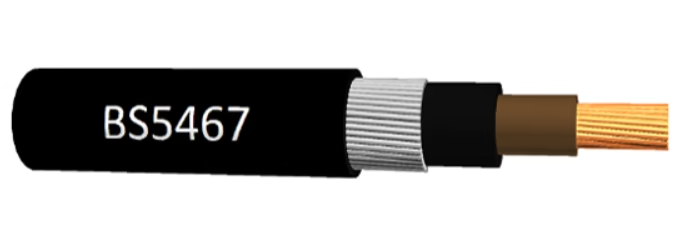
British Standard BS5467 specifies the requirements for low voltage armoured cables with thermosetting insulation rated at 600/1000V for fixed installations. These cables feature galvanised steel wire armour (SWA) for multi-core configurations and non-magnetic aluminium wire armour (AWA) for single-core applications. The standard encompasses cables with 1 to 48 cores, utilizing either plain annealed stranded copper (Class 2) or solid aluminium (Class 1) conductors per BS 6360/IEC 60228. The cross-linked polyethylene (XLPE) insulation ensures stable operation at maximum conductor temperatures of 90°C continuous and 250°C during short-circuit conditions.

What is BS5467 Cable?

BS5467 cable, BS5467 armoured cable, BS5467 SWA cable, SWA power cable, XLPE armoured cable, 0.6/1kV cable, low voltage armoured cable, steel wire armoured cable, AWA cable, underground burial cable, direct burial power cable, industrial power cable, British Standard cable, IEC 60502-1, BASEC approved, thermosetting insulation cable, PVC sheathed cable, UV resistant cable, mechanical protection cable, mains distribution cable, 3 core armoured cable, 4 core armoured cable, multi-core power cable, copper conductor cable, BS5467 cable specifications, BS5467 current rating, cable for mining, construction site cable, infrastructure cable, outdoor installation cable, BS5467電纜, 鋼絲鎧裝電纜, XLPE電纜, 低壓電力電纜, 直埋電纜, 工業電纜, 安徽飛純電纜, 特種電纜