Портовый высокогибкий кабель FEICHUN с защитой от соляного тумана: технологическая платформа для STS, RTG и RMG-кранов морских контейнерных терминалов
Углублённый инженерный анализ собственной разработки FEICHUN — серии портовых высокогибких кабелей с многоуровневой системой защиты от хлоридной коррозии, гидролиза полимерной оболочки и комбинированных циклических механических воздействий, характерных для эксплуатации на открытых причалах морских контейнерных и наливных терминалов. Технология включает четырёхступенчатую антикоррозионную систему: токопроводящую жилу из лужёной меди, полупроводящий разделительный слой, особо плотную изоляцию EPDM с пероксидной сшивкой и наружную оболочку из гидролизостойкого полиэфирного полиуретана (PE-PUR) с пакетом UV/HALS/антифунгальных стабилизаторов. Документ предназначен для инженеров портовой инфраструктуры, специалистов по эксплуатации перегрузочной техники, проектных организаций и технических служб контейнерных терминалов.
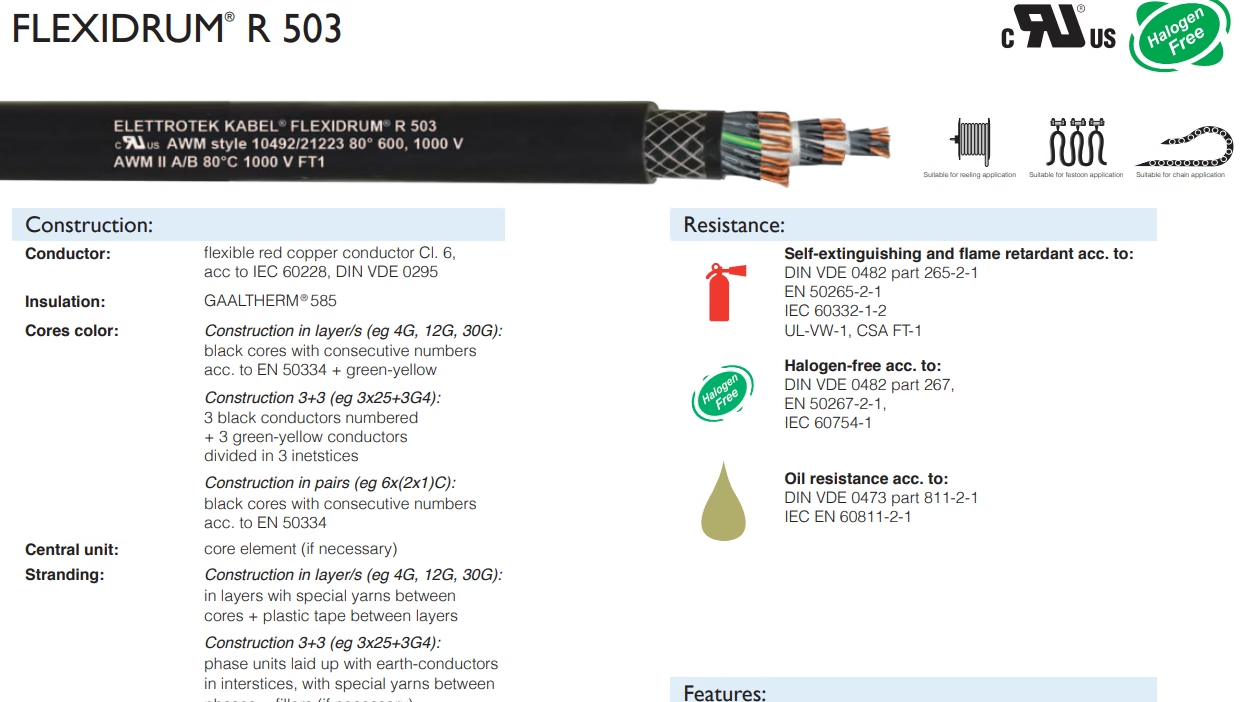
![Feichun FC-CRANE PUR:Высокогибкий Антикоррозионный Кабельдля Портовых Кранов и Перегружателей 2 FLEXIDRUM® R 503 employs GAALTHERM® 585—a proprietary synthetic elastomer compound developed by FeiChun and exclusive to this cable family. Unlike standard EPR or XLPE, GAALTHERM® 585 is a specialized nitrile-based elastomer (NBR) with engineered cross-link architecture optimized for extreme thermal and mechanical stress. 1.1 GAALTHERM® 585 Molecular Composition & Architecture The base polymer is Acrylonitrile-Butadiene Rubber (NBR) with proprietary dopants: Base Polymer: NBR (Acrylonitrile-Butadiene Rubber) Acrylonitrile content: 26–34 wt% (determines polarity and resistance to nonpolar oils) Butadiene content: 66–74 wt% Backbone: −[CH₂−CH=CH−CH₂]ₙ− (polybutadiene) with −CH(CN)− nitrile branches GAALTHERM® 585 Dopants (proprietary): 1. Polar nitrile groups (−CN): impart oil resistance, increase dielectric strength 2. Carboxylic acid groups (COOH): enable hydrogen bonding with adjacent chains, reducing chain mobility and increasing thermal stability (Tg ~−25°C vs −50°C std NBR) 3. Hindered phenolic antioxidants: 2–3 wt% load 4. Phosphite-based synergists: suppress thermo-oxidative degradation 5. Metal oxide fillers (MgO): enhance thermal aging resistance, improve modulus Cross-Link System: Sulfur-cured (not peroxide) with accelerators (TMTD, ZDEC) Cross-Link Density: 2.5–3.5 mol/cm³ (higher than standard NBR ~1.5 mol/cm³) Vulcanization Mechanism: Polysulfidic bridges (−S−, −S₂−, −S₃−) form between unsaturated C=C bonds in butadiene backbone](https://feichuncables.com/blog/wp-content/uploads/image-1417-1242x702.avif)