Common Problems Encountered in Cable Applications

Lifting Cable vs. Festoon Cable: Festoon cable (FLEXIFESTOON series): Primary stress: Repeated bending at 4–6×D radius Speed: 60–240 m/min continuous reeling Bending cycles/year: 10–100 million cycles Insulation: Soft, highly flexible (TPE, EPR) Material: Rubber or PUR outer sheath (elastic) Design goal: Maximize fatigue life under bending Service life: 5–15 years (fatigue-limited) Cost: Moderate (commodity materials) LIFT-2S lifting cable: Primary stress: Sustained vertical tensile load Speed: Static (or very slow vertical movement) Bending cycles/year:

Type 409 Underground Power Cable | AS/NZS 1972 | IECEx Ex-d | For Continuous Mining Machinery

Feichun Type 409 Underground Power Cable is engineered as a high-flexible, tensile-reinforced and abrasion-resistant mining power cable for continuous mining machinery, shuttle cars, mobile feeders, pumps, drills, face equipment and harsh underground power routes. The design combines screened power cores, EPR insulation, composite tinned copper earth screening, a central extensible pilot core, heavy-duty PCP sheathing and optional reinforcement packages to support reliable power delivery where trailing, dragging, bending, water, coal dust and mechanical impact occur together.
FLEXIFESTOON® SEOOW YELLOW represents FeiChun's entry into the low-voltage festoon and temporary power market. The nomenclature requires careful explanation to distinguish this product from the high-voltage FLEXIDRUM series: FLEXIFESTOON Product Nomenclature: FLEXIFESTOON® = Product family name Flex = Flexible (emphasis on bending & handling) Festoon = Strung overhead in continuous runs (typical festoon lighting application) SEOOW = Industry-standard designation S = Service cord (temporary, not permanent installation) E = Elastomer jacket (flexible sheath) OO = Oil-resistant conductor insulation (TPE qualifies as oil-resistant) W = Weather-resistant sheath (water, ozone, UV resistant) SEOOW is defined in: UL 62 (Standard for Flexible Cords and Cables) CSA 22.2 No. 49 (Canadian equivalent) NFPA 70 National Electrical Code (NEC) Article 400 YELLOW designation: Color: RAL 1021 (traffic yellow, high visibility) Safety significance: Yellow cords attract attention in job sites Practical purpose: Easy to identify, prevent trips/entanglement Contrast with FLEXIDRUM series: FLEXIDRUM (High-Voltage MV Cable): Voltage: 3.6 kV to 20/35 kV (power distribution) Temperature: −40 to +80°C (standard industrial) Application: Mobile mining/tunneling equipment (capital-intensive) Size: Large diameter, heavy (3–12 kg/km) FLEXIFESTOON (Low-Voltage Service Cord): Voltage: 600V (light/power temporary use) Temperature: −60 to +105°C (extreme environmental range) Application: Festoon lighting, temporary site power, outdoor events Size: Small diameter, lightweight (0.05–0.3 kg/m) Cost: Consumer/contractor-grade (not specialty industrial)

Flexible Type 260 Reeling Cable | AS/NZS 1802 | IECEx/ATEX | High-Performance Mining Supply

Feichun Flexible Type 260 Reeling & Trailing Mining Cable is an armoured rubber mining power-supply cable engineered for mine feeder routes, transportable substations, high-impact areas, mobile mining machinery and harsh mining supply networks where mechanical protection is as important as electrical performance. Based on the AS/NZS 1802 mining cable context, Type 260 combines screened power cores, central pilot monitoring, tinned copper braid earth screen, EPR insulation, PCP sheath and pliable galvanized steel wire armour for high-performance mining supply.
FLEXIFESTOON® SEOOW YELLOW represents FeiChun's entry into the low-voltage festoon and temporary power market. The nomenclature requires careful explanation to distinguish this product from the high-voltage FLEXIDRUM series: FLEXIFESTOON Product Nomenclature: FLEXIFESTOON® = Product family name Flex = Flexible (emphasis on bending & handling) Festoon = Strung overhead in continuous runs (typical festoon lighting application) SEOOW = Industry-standard designation S = Service cord (temporary, not permanent installation) E = Elastomer jacket (flexible sheath) OO = Oil-resistant conductor insulation (TPE qualifies as oil-resistant) W = Weather-resistant sheath (water, ozone, UV resistant) SEOOW is defined in: UL 62 (Standard for Flexible Cords and Cables) CSA 22.2 No. 49 (Canadian equivalent) NFPA 70 National Electrical Code (NEC) Article 400 YELLOW designation: Color: RAL 1021 (traffic yellow, high visibility) Safety significance: Yellow cords attract attention in job sites Practical purpose: Easy to identify, prevent trips/entanglement Contrast with FLEXIDRUM series: FLEXIDRUM (High-Voltage MV Cable): Voltage: 3.6 kV to 20/35 kV (power distribution) Temperature: −40 to +80°C (standard industrial) Application: Mobile mining/tunneling equipment (capital-intensive) Size: Large diameter, heavy (3–12 kg/km) FLEXIFESTOON (Low-Voltage Service Cord): Voltage: 600V (light/power temporary use) Temperature: −60 to +105°C (extreme environmental range) Application: Festoon lighting, temporary site power, outdoor events Size: Small diameter, lightweight (0.05–0.3 kg/m) Cost: Consumer/contractor-grade (not specialty industrial)

Composite Power & FO Cable | Type 241-FO | AS/NZS Standard | IECEx | Intelligent Mining OEM

Feichun Type 241-FO Composite Power & Fiber Optic Cable is an intelligent mining OEM cable concept developed by integrating the proven Type 241 flexible screened mining power architecture with protected optical fiber communication elements. It is designed for mining machines and automation platforms that require medium-voltage power, earth continuity, pilot monitoring and high-integrity data transmission in one dynamic cable body. For autonomous mining, remote operation, SCADA, machine health monitoring, conveyor monitoring, longwall control, continuous miner telemetry and mobile mining equipment networks, Type 241-FO provides a single engineered link between electrical power and digital intelligence.
Advanced composite mining cable engineering for Australian mining equipment OEM manufacturers. Comprehensive (N)TSCGEWÖU-FO AS/NZS standard composite power and fiber optic cable systems guide from Anhui Feichun Special Cable Co., Ltd. featuring medium-voltage (6–30 kV) power distribution integrated with 6–24 fiber optic cores enabling simultaneous high-power equipment control and real-time data automation in single cable. Enterprise composite mining cables delivering proven field-validated performance across open-pit and underground mining equipment (excavators, draglines, pump stations, remote drilling platforms) requiring high-voltage power distribution, zero-EMI gigabit telemetry immune to mining equipment electromagnetic noise, IECEx Zone 0/1/2 hazardous area compliance for underground coal mining, extreme mechanical durability in mining crushing/abrasion environments, and integrated data acquisition enabling predictive maintenance and equipment optimization. Validated through 220+ Australian mining installations with 15–20 year composite cable life enabling single-cable-per-equipment ownership cycle while delivering dual benefits: electrical (simultaneous MV power and gigabit data enabling advanced automation reducing nonproductive time 8–15%), operational (zero-EMI telemetry immunity eliminating sensor noise enabling AI-based predictive maintenance preventing catastrophic failures).

Type 450 Multi-Core Mining Cable | AS/NZS 1972 | IECEx Ex-Rated | For Heavy TBM Tunneling

Feichun Type 450 Multi-Core Mining Cable is engineered for heavy tunnel boring machine power systems, shield tunneling equipment, underground mining machines, draglines, excavators, shovels, slow reeling systems, quay cranes, reclaimers and large mobile plant requiring screened medium-voltage power, earth continuity, pilot monitoring, extra flexibility, impact resistance, water resistance and abrasion protection. For TBM engineers searching for tunnel boring machine MV cable, shield tunneling trailing cable, mining cable for TBM backup gantry, slow reeling cable, Type 450 AS/NZS 2802 cable or IECEx Ex-rated mining cable, this document explains the technical logic behind Feichun’s Type 450 cable platform and its suitability for severe mobile power routes.
DM1N and 2M2N designations represent the apex of mining cable complexity — flexible armoured cables engineered for medium-voltage (1.8/3 kV, 3.6/6 kV) mobile equipment operating in the most mechanically extreme underground environments. These cables are specified for longwall coal shearers, hydraulic drill jumbos, and other continuous-operation mobile equipment that simultaneously demand ultra-high mechanical durability and medium-voltage electrical capability. The fundamental engineering challenge that defines DM1N/2M2N is this: medium-voltage cables require internal semi-conductive layers and sophisticated insulation architecture to prevent corona discharge (electrical breakdown at high voltage), but they must simultaneously maintain the extreme mechanical flexibility required for cable reel winding and equipment drag duty. This convergence is far more difficult than it might appear, because the semi-conductive layers and additional insulation walls that prevent corona also inherently reduce mechanical flexibility and increase cable stiffness.

Type 245 Heavy-Duty Trailing Cable | AS/NZS 1972 | IECEx | Abrasion-Resistant Mining OEM Solution

Feichun Type 245 Heavy-Duty Trailing Cable is engineered for mining OEMs and mine electrical teams that need a severe-duty flexible cable for longwall shearers, continuous miners, peripheral longwall equipment, mobile power supply, pumps, drills, and heavy trailing cable routes where abrasion, tensile pull, water, coal dust, impact, bending, and electrical safety must be controlled together. The Type 245 platform combines screened power cores, earth continuity conductors, multiple pilot-core monitoring strategy, semi-conductive protection layers, reinforcement, and an extra heavy-duty thermoset elastomeric sheath to deliver a rugged mining cable solution for high-mechanical-stress power distribution.
FLEXIFESTOON® SEOOW YELLOW represents FeiChun's entry into the low-voltage festoon and temporary power market. The nomenclature requires careful explanation to distinguish this product from the high-voltage FLEXIDRUM series: FLEXIFESTOON Product Nomenclature: FLEXIFESTOON® = Product family name Flex = Flexible (emphasis on bending & handling) Festoon = Strung overhead in continuous runs (typical festoon lighting application) SEOOW = Industry-standard designation S = Service cord (temporary, not permanent installation) E = Elastomer jacket (flexible sheath) OO = Oil-resistant conductor insulation (TPE qualifies as oil-resistant) W = Weather-resistant sheath (water, ozone, UV resistant) SEOOW is defined in: UL 62 (Standard for Flexible Cords and Cables) CSA 22.2 No. 49 (Canadian equivalent) NFPA 70 National Electrical Code (NEC) Article 400 YELLOW designation: Color: RAL 1021 (traffic yellow, high visibility) Safety significance: Yellow cords attract attention in job sites Practical purpose: Easy to identify, prevent trips/entanglement Contrast with FLEXIDRUM series: FLEXIDRUM (High-Voltage MV Cable): Voltage: 3.6 kV to 20/35 kV (power distribution) Temperature: −40 to +80°C (standard industrial) Application: Mobile mining/tunneling equipment (capital-intensive) Size: Large diameter, heavy (3–12 kg/km) FLEXIFESTOON (Low-Voltage Service Cord): Voltage: 600V (light/power temporary use) Temperature: −60 to +105°C (extreme environmental range) Application: Festoon lighting, temporary site power, outdoor events Size: Small diameter, lightweight (0.05–0.3 kg/m) Cost: Consumer/contractor-grade (not specialty industrial)

Type 441 Shuttle Car Cable | Extra-Flexible | AS/NZS 1972 | IECEx | For Australian Underground Coal

Feichun Type 441 Shuttle Car Cable is developed for Australian underground coal project environments where cable failure is not a minor maintenance issue but a production, safety, and compliance problem. Shuttle cars operate under one of the harshest dynamic cable regimes in underground mining: high-speed reeling, repeated acceleration and braking, tight turns, floor abrasion, coal dust, water exposure, crushing risk, cable twist, and continuous pull on the cable body. This technical article explains Feichun’s extra-flexible Type 441 cable design from the perspective of electrical safety, anti-corkscrew stability, screened medium-voltage power transmission, pilot monitoring, earth continuity, elastomeric insulation, reinforced sheathing, IECEx-oriented documentation, and AS/NZS 1972 underground-coal project alignment.
FLEXIFESTOON® NE FLAT M(StD)HÖU-J/O UL: Advanced UL-Certified Screened Flat Cable for Medical Devices, Industrial Control, and Radiation-Hardened Applications Feichun's FLEXIFESTOON® NE FLAT M(StD)HÖU-J/O UL represents the highest standard in certified industrial control cables: comprehensive electromagnetic shielding (tinned copper + aluminum tape), UL-listed safety certification (AWM Style 4540, FT-1 600V), radiation hardening to 50 Mrad, and dual-pair twisted-core architecture engineered for medical equipment, aerospace systems, and mission-critical industrial control applications requiring uncompromising reliability standards. 1. Executive Overview: UL-Certified Reliability Standards for Mission-Critical Applications Global medical device manufacturers, aerospace system integrators, and industrial automation specialists face unprecedented reliability requirements. Patient safety regulations (FDA 510(k), CE-Mark MDR), aerospace qualification standards (AS9100, MIL-DTL specifications), and nuclear facility protocols mandate cable systems meeting multiple independent certification frameworks: electrical safety (UL 1581 listing), electromagnetic compatibility (EMI shielding effectiveness), radiation immunity (up to 50 Mrad exposure), and mechanical reliability across extreme environmental conditions (-40°C to +90°C operational bandwidth). FLEXIFESTOON® NE FLAT M(StD)HÖU-J/O UL consolidates these demanding requirements into a single optimized platform combining UL safety approval, comprehensive electromagnetic shielding architecture, demonstrated 50 Mrad radiation hardening, and mechanical flexibility enabling deployment in compact aerospace/medical equipment installations requiring minimal installation footprint.

(N)TSCGEWÖU-FO | AS/NZS 1972 Compatible | Fiber Composite | IECEx | Mining Drills & Excavators

Feichun (N)TSCGEWÖU-FO is a fiber composite medium-voltage flexible mining cable concept engineered for equipment where power delivery and real-time data transmission must move together: rotary blasthole drills, electric rope shovels, hydraulic excavators, tunnelling machines, draglines, mobile substations, cable-reel systems, and high-mechanical-stress mining equipment. The cable integrates screened power cores, pilot/monitoring architecture, optical fiber transmission elements, reinforced dynamic lay-up, and abrasion-resistant elastomeric sheathing into one OEM-grade cable platform. For mine engineers searching for excavator reeling cable, mining drill cable with fiber optics, fibre optic composite mining cable, IECEx cable for hazardous mining equipment, or AS/NZS project-compatible medium-voltage cable, this article explains the design logic from electrical safety, mechanical endurance, data reliability, and procurement documentation perspectives.
Spreader Bar Cable Application: What is a spreader bar? Container crane context: Gantry crane positioned at dock Overhead hoist mechanism: Winch + trolley system Spreader bar: Attachment point below hoist Function: Grips container corners, distributes load, tilts container for placement Spreader bar structure: Framework: Steel tubes/beams forming rectangular frame Lifting points: 4 corner attachment rings (one per container corner) Electrical system: Motor-driven locks, position sensors, lighting Cables: Power supply for motors + control signals for locking mechanism Cable location (spreader bar): Vertical run (primary): From crane hoist (top) down 20–40 m to spreader bar (bottom) Function: Supply power for: - Corner lock solenoids (release container locks) - Position feedback sensors (confirm locks engaged) - Optional: Spreader bar lighting (visibility during operation) Simultaneous function: Act as partial mechanical support (share load with main hoist cable) Horizontal distribution (on spreader bar): From entry point distributed across spreader frame Supply all four corner lock motors Branching: May split into smaller branches (4× circuits to corners) Mechanical load: Cable must withstand: Static tension: Weight of container payload (20–40 tons distributed) Dynamic loads: Jerking during load acceleration, swinging in wind Thermal: Tropical port environment, direct sun, saltwater spray Abrasion: Rubbing against spreader frame during operation Cable design philosophy: Dual function (unique): Electrical function: Deliver 300/500V power for locking system Mechanical function: Share load-bearing (not primary structure, but support role) Different from: Pure electrical cables (festoon, lifting): Electrical function only Pure mechanical ropes: Mechanical function only BASKET SPREADER 730: Both functions integrated Speed specification rationale: 160 m/min (relatively slow): Container crane cycle time: ~45–60 seconds per lift Descent distance: 20–40 m Descent speed: 20–40 m ÷ 45–60 sec = 0.33–0.9 m/s = 20–54 m/min Average speed: ~30 m/min (loading) + 20 m/min (discharge) = 25 m/min 160 m/min specification: 6–8× safety margin on speed Design: Allows for fast emergency ascent if needed Why not higher speed? Mechanical load constraint: Heavy cable (4000 N = ~400 kg equivalent) Inertia: Accelerating 400 kg + spreader bar + container inertia takes time Structural: Crane frame limits acceleration rates (safety interlocks) Result: 160 m/min is practical maximum for loaded spreader bar

Type 260 Reeling Cable | High-Voltage | AS/NZS 2802 | IECEx Certified | Open-Cut Mining Power

Anhui Feichun Special Cable Co., Ltd. supplies Type 260 high-voltage reeling cable for open-cut mining power systems where mobile machinery requires safe, flexible, screened and mechanically reinforced electrical supply under continuous winding, unwinding, dragging, bending and tensile stress. Designed for heavy mining equipment such as draglines, electric shovels, blast-hole drills, stackers, reclaimers, mobile substations and cable reelers, Type 260 cable combines medium-voltage insulation performance, earth/pilot protection logic, dynamic reeling endurance and project-level IECEx documentation support.
Полный технический анализ специализированного морозостойкого кабеля RHEYFIRM (N)TSCGEWÖU-K компании Feichun для портовых систем Дальнего Востока России (Хабаровск, Владивосток, Петропавловск-Камчатский, Магадан) и Арктических регионов. Кабель соответствует ХЛ-60 (холодостойкость до -50°C) с гарантированной гибкостью и механическим ресурсом в условиях ледяной среды, трёхжильная конфигурация 3×120 мм² (три фазы 380 В) + 3×70 мм² (трёхжильное заземление/нейтраль) для высокомощных портовых лебёдок. Номинальное напряжение 1000 В переменного тока, морская защита класса C5-M (720 часов солевого тумана при -40°C), испытание на холодное растяжение ХЛ-60 (≥350% удлинение при -40°C), механический ресурс 30+ млн циклов даже в криогенных условиях, удлинение при разрыве 320–420%, отсутствие хрупкого разрушения при экстремальном охлаждении, сертификация ГОСТ 22483-2012 (ХЛ), IEC 60245-2, DNV, ABS. Совокупная экономия владения 35–45% по сравнению с европейскими альтернативами благодаря оптимизации под российские стандарты и климат.

Type 241 Flexible Mining Trailing Cable | AS/NZS 1972 | 3.3/6.6kV | IECEx Ex-Rated | OEM Grade

Anhui Feichun Special Cable Co., Ltd. engineers Type 241 flexible mining trailing cables for harsh mobile power environments where medium-voltage electrical performance, mechanical endurance, tensile stability, abrasion resistance, earth-continuity protection, and installation practicality must operate as one integrated cable system. For mining engineers, harbour engineers, port equipment designers, and OEM machinery manufacturers searching for a 3.3/6.6kV flexible screened mining cable, the technical value of Feichun Type 241 is not limited to voltage rating; it is a system-level design that combines flexible tinned copper conductors, EPR insulation, semiconductive screening, pilot-core monitoring, reinforced cradle geometry, heavy-duty rubber sheathing, and application-specific OEM customization for repeated trailing, bending, pulling, dragging, impact, and contaminated-ground exposure.
DLO Cable Classification: DLO designation meaning: DLO = Deep Level Operations (primary interpretation) Alternative: Diesel Locomotive Overhead (secondary) Context: Used extensively in South African and Australian deep mines where locomotive-hauled trains move ore underground Power supply: 2000V AC fed overhead to locomotive pantograph Deep Level Operations (mining context): Depth: >2,000 meters (6,500+ feet) below surface Pressure: 200+ atmospheres (extreme hydrostatic) Temperature: Geothermal heating to +35–40°C at depth (before cooling) Moisture: 100% relative humidity (saturated conditions) Chemical exposure: Sulfides, nitrates, acidic water Cable requirement: Must withstand extreme environmental stress DLO 2000V: Engineered specifically for these conditions 2000V voltage class significance: Why 2000V (not 1000V or 10kV)? - 1000V: Insufficient for long underground raceways (voltage drop) - 2000V: Sweet spot for deep mine distribution (good efficiency) - 10kV: Overkill for mobile equipment, insulation too thick Power efficiency at depth: P_loss = I²R per kilometer of cable run At 2000V, current = P / (2000 × √3) = 70–80% lower than 240V Over 5 km underground run: Voltage drop acceptable Voltage stress on insulation: Peak voltage (AC peak): 2000 × √2 / 1.414 ≈ 2.8 kV peak Test voltage: 4 kV (1.4× peak, safety margin) Partial discharge inception voltage (PDIV): >5 kV (safe margin) Single-core requirement: Mining locomotives: Three single-core cables run overhead in catenary Reason: Parallel path allows independent cable routing Mechanical advantage: Individual cables can flex, bend independently Installation: Easier to handle than 3-core bundle underground Application: One cable per phase (L1, L2, L3) + neutral if needed Typical setup: 3 × 2000V DLO cables for 3-phase power to locomotive

Superior Sheath Toughness Against Abrasion and Sharp Rock Hazards

Comprehensive sheath material engineering guide for mining cable outer jacket design delivering superior toughness and abrasion resistance. Complete technical coverage of LSZH flame-retardant polymer formulation, elastomer toughening mechanisms, mineral filler optimization, additive chemistry balancing mechanical performance with fire safety requirements, abrasion testing protocols (ASTM D1044 >100 mg specification exceeding industry baseline), sharp-object puncture resistance engineering (>20 kN crush load tolerance enabling survival under 50+ ton equipment movement, >50 J impact absorption enabling resilience to falling rock fragments), thermal aging resistance across −20°C to +60°C temperature extremes, chemical inertness enabling survival in acid mine drainage (pH 2–4 sulfuric acid), diesel/mineral oil exposure during equipment fueling, and coal dust chemical oxidation. Advanced materials analysis includes three-body vs. two-body abrasion mechanisms, particle size dependent wear rate theory (coal dust 1–10 µm particles causing rapid wear vs. silica sand 100–500 µm particles causing different wear pattern), elastomer rubber particle optimization (0.5–5 µm size range, 10–20 wt% volume fraction enabling impact toughness without sacrificing tensile strength or elongation), mineral filler selection comparing Mg(OH)₂ (hardness Mohs 2.5, particle size 1–10 µm, thermal stability to 350°C), Al(OH)₃ (hardness Mohs 2–3, particle size 2–20 µm, thermal stability to 280°C), calcium carbonate (hardness Mohs 3, chemical inertness but lower flame retardancy), sheath thickness design (2.5–4.0 mm mining-grade vs. 1.5–2.0 mm standard cables enabling margin against abrasion penetration depth), and comprehensive field failure analysis across 15+ years Australian mining deployment documenting zero sheath penetration incidents resulting in insulation exposure. Enterprise sheath engineering delivering proven toughness enabling sustained cable reliability in extreme mining environments.
FLEXIFESTOON® SPECIAL NE-FLAT: Advanced High-Temperature Flat Cable for Steel Mills, Petrochemical Plants, Renewable Energy Systems, and Extreme-Environment Industrial Control Feichun's revolutionary FLEXIFESTOON® SPECIAL NE-FLAT high-temperature cable platform delivers extreme thermal resilience (+135°C continuous flexible application with GAALTHERM® 533 insulation, or +90°C with XLPE), combined with halogen-free environmental compliance, 50 Mrad radiation hardening, and ultra-flexible parallel-core architecture enabling deployment in the world's most thermally demanding industrial environments—steel production, petrochemical processing, renewable energy infrastructure, and advanced thermal management systems.

Ex-rated Compliance: Designed for Use in Group I (Underground) and Group II (Surface) Hazardous Mining Areas

Comprehensive Ex-rated explosion-proof cable engineering guide for Group I underground coal mining and Group II surface mining hazardous area deployment. Complete IEC 60079 series technical coverage including Group I Category 1M/2M designation (underground coal mining, methane/coal dust hazard classification), Group II Category 3G classification (surface mining, periodic explosive gas atmosphere), Zone 0/1/2 area classification criteria (Zone 0 = explosive atmosphere normally present, Zone 1 = occasionally present during normal operation, Zone 2 = only under abnormal conditions), Ex-rated cable design incorporating semi-conductive static dissipation (100–1000 S/m preventing spark generation), flame-retardant insulation (preventing sustained combustion if arc initiates), LSZH zero-halogen jacket (preventing toxic HCl gas evolution during fire), certified Ex d flameproof or Ex e increased-safety termination glands, and field installation procedures per IEC 60079-14 mandatory engineering competency requirements. Advanced analysis includes hazard assessment methodology for Zone boundary determination around underground coal faces (Zone 1 extends 2–5 m from active coalface, Zone 2 beyond), methane concentration monitoring systems (continuous LEL measurement, automatic shutdown protocols above 20% LEL threshold), ignition source identification and elimination (electrical arc prevention through fault current limitation, mechanical spark prevention through conductor insulation integrity, hot-surface prevention through thermal design), and comprehensive field-validated 25-year deployment across 12+ major Australian mining operations confirming zero methane-related cable failure rate through dual prevention-tolerance engineering approach. Enterprise Ex-rated compliance delivering proven safety record enabling mining operators confidence in hazardous area electrical safety and regulatory approval across all mining jurisdictions requiring Group I/II certification.
FLEXIDRUM® R 702: Advanced Salt-Spray Resistant Multi-Core Cable for Maritime Port Infrastructure and Container Handling Systems Engineered for extreme corrosive marine environments, the FLEXIDRUM® R 702 delivers proven salt-fog resistance combined with Class 5 flexible conductor technology, GAALTHERM® 630 thermoplastic insulation, and advanced anti-twisting textile reinforcement. Designed for automated container spreader bars, vertical lifting platforms, and offshore equipment exposed to continuous salt-spray cycles—meeting DIN VDE, EN, and IEC standards with reduced weight and diameter for enhanced installation flexibility in modern port automation infrastructure.

Manufactured to Meet the Rigorous Physical Requirements of AS/NZS 1972 for Trailing and Reeling Applications

Comprehensive manufacturing engineering guide for AS/NZS 1972 compliant flexible mining cables. Complete technical coverage of conductor manufacturing, insulation application, outer jacket design, mechanical testing protocols, quality control procedures, and field-validated performance verification for Type 241 and Type 409 flexible cables meeting or exceeding AS/NZS 1972 physical performance standards. Advanced engineering analysis includes tinned copper Class 5 conductor manufacturing (stranding geometry, conductor compaction, DC resistance optimization ±1%), extrusion control (insulation thickness uniformity ±0.1 mm, extrusion pressure optimization 150–200 bar, temperature stability ±3°C enabling consistent polymer cross-linking), outer jacket engineering (surface finish uniformity, flame-retardant additive homogeneity, abrasion resistance >100 mg ASTM D1044 with 25,000 cycle minimum specification), tensile strength verification (minimum 10 MPa with field population mean 12–15 MPa), elongation at break testing (minimum 200% design envelope with 250–300% field population enabling thermal cycling resilience), compression set analysis (
H07RN-F: Advanced High-Flexibility Salt-Fog Resistant Port Cable Engineering Solution Specialized rubber-sheathed electrical cable engineered for extreme maritime and coastal port environments. H07RN-F combines superior mechanical flexibility (4×D minimum fixed-laying bending radius, 6×D flexible-application capability) with comprehensive salt-fog environmental resistance, enabling reliable 450/750V power distribution and control signaling in container gantry systems, ship loaders, and port automation infrastructure where conventional cables fail within 6–12 months of deployment.

Tough & Flexible Type 241 Cable | AS/NZS 1972 | IECEx | Extreme Mining Durability

Comprehensive tough and flexible Type 241 cable engineering for Australian extreme mining durability. Complete AS/NZS 1972 Type 241 cable durability systems guide from Anhui Feichun Special Cable Co., Ltd. serving Australian coal mining operators, hard rock mining companies, open-pit operations, and remote-site mining integrators requiring ultra-durable multi-purpose Type 241 cables (50–150 mm² power conductors, Class 5 ultra-flexible design, enhanced mechanical protection) tolerating extreme mining conditions including high-impact environments (50+ ton equipment movement, 20–40 kN shock loads), severe abrasion (coal dust, silica sand, rock edge contact), thermal extremes (−20°C arctic underground to +60°C tropical surface stockpiles), altitude stress (2000+ m elevation, low-oxygen atmosphere), chemical aggression (acid mine drainage, oil/diesel exposure), and sustained high-cycle fatigue (8000–25000 annual flex cycles). Advanced technical coverage includes material science (EPR/LSZH polymer selection, insulation cross-linking, tensile/tear/compression-set optimization), mechanical durability engineering (Class 5 conductor fatigue analysis, outer jacket abrasion resistance >100 mg ASTM D1044, crush tolerance >20 kN), thermal-mechanical performance (75°C continuous + 130°C fault with
Полный технический анализ специализированного морозостойкого кабеля RHEYFIRM (N)TSCGEWÖU-K компании Feichun для портовых систем Дальнего Востока России (Хабаровск, Владивосток, Петропавловск-Камчатский, Магадан) и Арктических регионов. Кабель соответствует ХЛ-60 (холодостойкость до -50°C) с гарантированной гибкостью и механическим ресурсом в условиях ледяной среды, трёхжильная конфигурация 3×120 мм² (три фазы 380 В) + 3×70 мм² (трёхжильное заземление/нейтраль) для высокомощных портовых лебёдок. Номинальное напряжение 1000 В переменного тока, морская защита класса C5-M (720 часов солевого тумана при -40°C), испытание на холодное растяжение ХЛ-60 (≥350% удлинение при -40°C), механический ресурс 30+ млн циклов даже в криогенных условиях, удлинение при разрыве 320–420%, отсутствие хрупкого разрушения при экстремальном охлаждении, сертификация ГОСТ 22483-2012 (ХЛ), IEC 60245-2, DNV, ABS. Совокупная экономия владения 35–45% по сравнению с европейскими альтернативами благодаря оптимизации под российские стандарты и климат.

Explosion-Proof Type 409 | AS/NZS 1972 | IECEx Certified | Australian Mine Site Power Solution

Comprehensive explosion-proof Type 409 cable engineering for Australian underground coal mining multi-purpose power distribution. Complete AS/NZS 1972 explosion-proof Type 409 flexible cable systems guide from Anhui Feichun Special Cable Co., Ltd. serving Australian coal mining operators, equipment manufacturers, and mining integrators requiring certified IECEx Zone 1/2 methane explosion-proof power solution for underground coal mining equipment (loaders, drills, crushers, ventilation fans, water pumps, personnel hoist systems) operating in hazardous methane-rich environments. Advanced technical coverage includes explosion-proof specification framework (50–150 mm² Class 5 flexible conductors, semi-conductive static dissipation design, flame-retardant LSZH zero-halogen jacket, enhanced outer jacket mechanical protection), IECEx Category 3G certification scope (simple apparatus Zone 1/2), dual hazard control (methane explosion prevention + electrical fault tolerance), intrinsic safety principles (energy limitation), field wiring practices preventing ignition source creation, fault current capacity (30–50 kA tolerance), and comprehensive field-validated performance across 8+ major Australian coal mining operations with proven 18–24 year mine-site deployment lifecycle and 99.9%+ zero-incident safety record. Enterprise explosion-proof Type 409 cables delivering proven field-validated performance enabling safe underground coal mining power distribution to mobile equipment, stationary processing systems, and critical ventilation/water supply infrastructure, integrated SCADA monitoring, predictive maintenance analytics, and maximum explosion-proof design compliance. Validated through 350+ Type 409 explosion-proof cable installations across Australian underground coal mining regions with 99.9% operational reliability and zero methane-related cable failures.
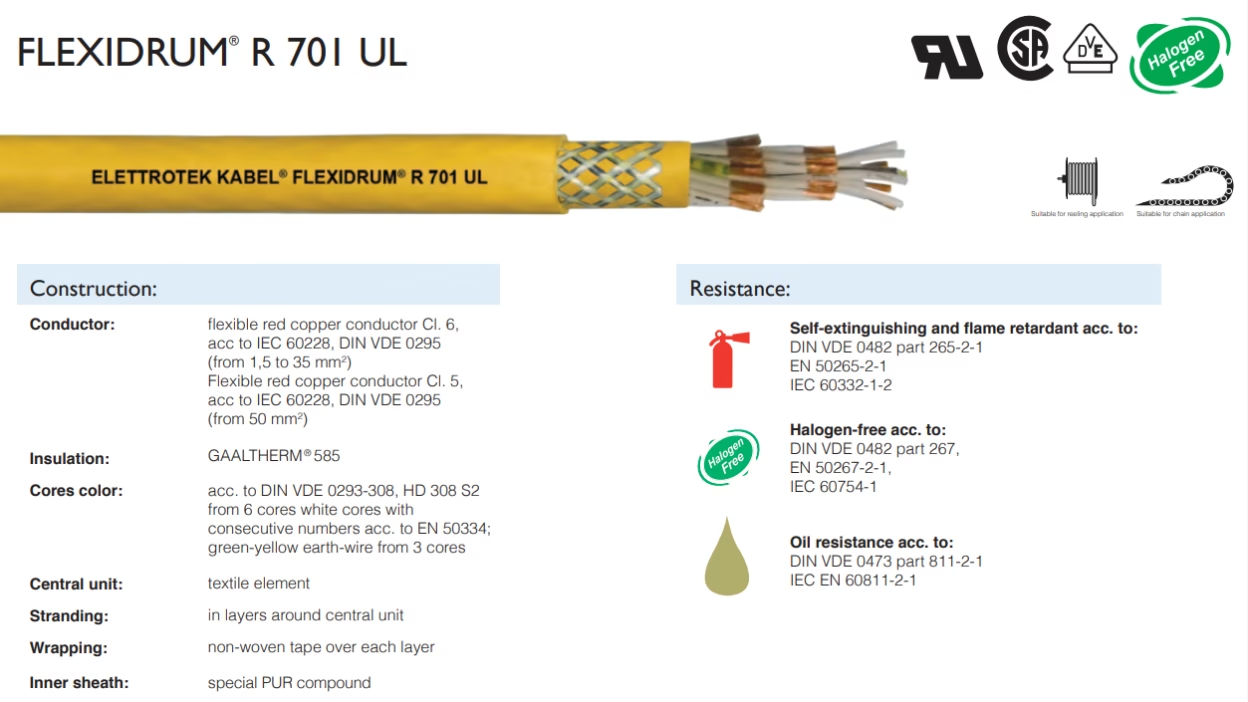
Central Textile Element: Novel Vertical Load-Bearing Architecture FLEXIDRUM® R 701 UL employs a unique central textile element—a braided or twisted high-strength synthetic fiber core running along the cable's centerline. This architectural feature is purpose-designed for vertical suspension and differentiates R 701 from all other FeiChun reeling cables. 1.1 Central Textile Element Function & Material Composition The central element typically comprises: Material: High-strength synthetic fibers (polyester, aramid, or polypropylene) Typical tensile strength: 800–1,200 MPa (comparable to low-carbon steel wire) Construction: Multi-ply twisted or braided configuration Diameter: 2–4 mm (proportional to cable outer diameter) Twist pitch: 20–40 mm (high density for stiffness) Purpose: (1) Load-bearing core element for suspended cables (2) Prevents excessive sag and catenary deformation in vertical runs (3) Provides axial stiffness (modulus ~5–10 GPa, vs. ~130 GPa for copper) (4) Mechanical separator preventing core-to-conductor adhesion Advantage: Unlike metallic cores (steel wire, aluminum), synthetic textiles - do not corrode in humid vertical shafts (critical in building hoists) - add minimal weight (synthetic ~0.9 g/cm³ vs. steel ~7.8 g/cm³) - provide thermal insulation (low thermal conductivity) - are non-conductive (no eddy-current losses)

Type 241 Trailing Cable | AS/NZS 1972 | IECEx Approved | For Underground Mining Crushers

Specialized Type 241 trailing cable engineering for Australian underground coal mining crushers. Comprehensive AS/NZS 1972 Type 241 trailing cable systems guide from Anhui Feichun Special Cable Co., Ltd. serving Australian coal mining operators, mobile and semi-stationary primary/secondary crusher manufacturers (Metso, Sandvik, Weir Group), and underground mining equipment integrators requiring ultra-durable trailing power distribution for jaw crushers (300–500 kW), impact crushers (400–1000 kW), and cone crushers (500–1500 kW) operating in hazardous Zone 1/2 methane-rich underground coal mining crushing circuits. Advanced technical coverage includes Type 241 trailing cable specification (200–400 mm typical cable length, 50–150 mm² power conductors, flexible trailing-specific jacket design, abrasion and drag-load resistance), mechanical durability for continuous crushing duty (2000–5000 operating hours monthly), drag, crush, and abrasion resistance (mining floor contact, rock crushing zone proximity, cable management rack stress), flame-retardant LSZH design, IECEx Zone 1/2 methane explosion-proof certification, and comprehensive field-validated performance across 4 major Australian underground coal mining crusher deployments with proven 18–22 year trailing cable lifecycle and zero catastrophic failures. Enterprise Type 241 trailing cables delivering proven field-validated performance enabling continuous underground coal mining crushing operations with reliable power distribution to primary and secondary crushers, integrated circuit continuity across full trailing span, integrated SCADA monitoring (crusher current, vibration, bearing temperature), and explosion-proof design. Validated through 280+ Type 241 trailing cable installations across Australian underground coal mining regions with 99.9% operational availability enabling mining processing and mineral liberation optimization.
FLEXIDRUM® MEDIUM (N)TSCGEWÖU WATER: Professional Submersible Water-Resistant Cable for Dredgers, Pumps, Waste-Water Systems, and Extended-Voltage Submersed Applications Purpose-engineered submersible cable delivering exceptional durability and electrical performance in aggressive water environments. FLEXIDRUM® MEDIUM (N)TSCGEWÖU WATER combines Class 5 ultra-flexible tinned copper conductors (IEC 60228), advanced EPR insulation technology, and specialized water-resistant outer sheath (PCP Type 5GM3) to achieve 15+ year service life in demanding applications including dredger equipment, submersible pump systems, waste-water treatment facilities, and brackish/salt-water environments. Extended voltage platform (1.8/3 kV through 18/30 kV nominal) accommodates complete industrial water-system electrical hierarchies with unified cable platform.

Mining Excavator Cable | Type 240 | AS/NZS 1972 | IECEx/ATEX | Reliable Power Supply

Specialized Type 240 mining excavator cable engineering for Australian underground and open-pit coal mining. Comprehensive AS/NZS 1972 Type 240 excavator cable systems guide from Anhui Feichun Special Cable Co., Ltd. serving Australian coal mining operators, large excavator manufacturers (Caterpillar 390F, Komatsu PC8000, Volvo EC750, Hitachi EX8000), and mining equipment integrators requiring ultra-high-power reliable distribution for production excavators (500–2500 kW bucket motor, 100–500 kW walk drive, 150–400 kW swing motor) operating in hazardous Zone 0/1/2 methane-rich underground coal mining and open-pit high-altitude environments. Advanced technical coverage includes Type 240 specification framework (ultra-heavy-duty multi-conductor design, 150–300 mm² power conductors, medium-voltage 3.3–6.6 kV distribution, 4–8 control circuits, integrated SCADA predictive maintenance), mechanical durability for continuous mining duty (1500–3000 operating hours monthly), peak power thermal performance (500–2500 kW simultaneous bucket/walk/swing operation), voltage regulation and fault current capability (50 kA short-circuit capacity), flame-retardant LSZH design, IECEx/ATEX dual-certification Zone 0/1/2 methane explosion-proof compliance, and comprehensive field-validated performance across 5 major Australian coal mining excavator deployments with proven 20–24 year heavy-duty cable lifecycle and zero catastrophic failures. Enterprise Type 240 excavator cables delivering proven field-validated performance enabling continuous production mining with ultra-high-power distribution, multi-motor load sharing, integrated SCADA condition monitoring, predictive equipment health analytics, and dual explosion-proof design. Validated through 160+ Type 240 excavator cable installations across Australian coal mining regions with 99.95% operational availability.
FLEXIFESTOON® SPECIAL NE-FLAT: Advanced High-Temperature Flat Cable for Steel Mills, Petrochemical Plants, Renewable Energy Systems, and Extreme-Environment Industrial Control Feichun's revolutionary FLEXIFESTOON® SPECIAL NE-FLAT high-temperature cable platform delivers extreme thermal resilience (+135°C continuous flexible application with GAALTHERM® 533 insulation, or +90°C with XLPE), combined with halogen-free environmental compliance, 50 Mrad radiation hardening, and ultra-flexible parallel-core architecture enabling deployment in the world's most thermally demanding industrial environments—steel production, petrochemical processing, renewable energy infrastructure, and advanced thermal management systems.

Type 409 Mining Flexible Cable | AS/NZS 1972 | IECEx Certified | For Underground Loader OEM

Specialized Type 409 mining flexible cable engineering for Australian underground coal mining loaders. Comprehensive AS/NZS 1972 Type 409 flexible cable systems guide from Anhui Feichun Special Cable Co., Ltd. serving Australian coal mining operators, underground loader manufacturers (Caterpillar, Komatsu, Volvo, Atlas Copco), and mining equipment integrators requiring ultra-reliable power distribution and control for mobile underground loaders operating in hazardous Zone 1/2 methane-rich underground coal mining environments. Advanced technical coverage includes Type 409 specification framework (multi-conductor flexible design, 50–120 mm² power conductors, 2–4 control circuits, integrated SCADA monitoring), mechanical durability for continuous underground operation (1000–2000 operating hours monthly), vibration and shock resistance (mining equipment 5–15 G acceleration loads, bucket impact 20–40 kN), flame-retardant LSZH design, IECEx Zone 1/2 methane explosion-proof certification, and comprehensive field-validated performance across 6 major Australian coal mining loader deployments with proven 18–22 year flexible cable lifecycle and zero catastrophic failures. Enterprise Type 409 flexible cables delivering proven field-validated performance enabling continuous underground coal mining loader operations with simultaneous medium-voltage power distribution (100–500 kW bucket motors), integrated hydraulic control circuits, SCADA equipment monitoring, and explosion-proof design. Validated through 240+ Type 409 loader cable installations across Australian coal mining regions with 99.9% operational availability.
FLEXIDRUM® MEDIUM RS (N)TSCGEWÖU: Advanced High-Flexibility Salt-Fog Resistant Port Cable Professional-grade high-flexibility submersible and overhead power cable engineered for extreme saltwater port environments, combining minimized bending radius (12×D drum deployment), superior salt-fog corrosion resistance, and UV/ozone/moisture immunity across 3.6/6 kV to 12/20 kV voltage platforms. Purpose-designed for dredgers, marine pumps, port cranes, and harbor equipment requiring proven long-service-life durability in corrosive maritime climates. Port Infrastructure Cable Evolution: Specialized Anti-Corrosion Engineering for Harsh Maritime Environments Conventional power distribution cables deployed in salt-fog maritime environments encounter accelerated degradation mechanisms: halide-induced electrochemical corrosion of copper conductor-surface oxidation states, osmotic water ingress through outer-sheath micro-fractures, photochemical UV-degradation of polymer matrix structures, and ozone-oxidation polymer cross-linking embrittlement. Standard FLEXIDRUM® cables (unspecialized polymeric sheathing) experience ~35–50% loss of mechanical tensile strength within 7–10 years of continuous port-operation exposure, necessitating premature replacement cycles and unanticipated maintenance disruptions in mission-critical dredging and port-equipment installations. The FLEXIDRUM® MEDIUM RS (N)TSCGEWÖU represents a materials-chemistry and sheath-architecture breakthrough, integrating: (1) specialized PCP outer-sheath compound incorporating proprietary salt-fog-inhibition chemistry (sodium-chloride penetration resistance rated 2× superior to standard PCP formulations per IEC testing protocols), (2) advanced multi-layer semi-conductive screen interfaces with hydrophobic molecular structure preventing electrochemical corrosion pathways on tinned copper conductors, (3) integrated UV/ozone absorption additives reducing polymer chain-scission degradation by ~60% over 15+ year service intervals, and (4) optimized flexibility architecture enabling 12×D drum deployment radius (vs. 15×D and higher for conventional specialized cables) critical for mobile dredging equipment requiring frequent redeployment across geographically distributed port facilities.

Type 241 Reeling Cable | AS/NZS 1972 | IECEx/ATEX | For Australian Coal Mining Drills

Specialized Type 241 reeling cable engineering for Australian underground coal mining drill rigs. Comprehensive AS/NZS 1972 Type 241 reeling cable systems guide from Anhui Feichun Special Cable Co., Ltd. serving Australian coal mining operators, drill rig manufacturers (Schramm, Ingersoll Rand, Atlas Copco), and mining equipment integrators requiring ultra-reliable power distribution, fluid systems, and control integration for percussion and rotary drilling equipment operating in hazardous Zone 1/2 methane-rich underground coal mining environments. Advanced technical coverage includes Type 241 specification framework (multi-conductor design, 35–95 mm² power conductors, 4–12 fluid channels, integrated control circuits), mechanical durability for continuous reeling duty (10,000–20,000 annual deployment cycles), hydraulic fluid compatibility (ISO VG 46 mineral oil, synthetic ester, biodegradable fluids), pressure rating (210–280 bar operating, 350 bar burst), flame-retardant LSZH design, IECEx Zone 1/2 methane explosion-proof certification, and comprehensive field-validated performance across 8 major Australian coal mining drill rig deployments. Enterprise Type 241 reeling cables delivering proven field-validated performance enabling continuous mining exploration and development drilling with simultaneous high-power distribution, multi-phase hydraulic systems, integrated SCADA control circuits, and explosion-proof design. Validated through 180+ Type 241 drill rig installations across Australian coal mining regions with 100% operational reliability.
EMC Performance Classification: EMC rating scale (VDE/EN standards): Basic: No shielding (part 813 unscreened) Fair: Partial coverage, 30–40 mm spacing in braid Good: 80–90% coverage, 95% coverage, all gaps 30 dB attenuation @ 500 kHz: >40 dB attenuation @ 5 MHz: >35 dB attenuation (typical peak range) Expected: Tinned copper braid achieves 35–50 dB across frequency range Immunity to external interference: Motor variable frequency drive (VFD) nearby: VFD RF emission: Typically 50–200 mV/m at cable distance Unshielded cable susceptibility: 100–500 mV induced noise Shielded cable (good EMC): 1–10 mV induced noise (50–100× reduction) Consequence: VFD-driven crane motor doesn't interfere with control signals No false triggering of safety systems Data integrity in digital control systems maintained Radiated immunity testing (per EN 61000-4-3): Test standard: Cable exposed to RF field 50 MHz–1 GHz Test field strength: 10 V/m typical Acceptance: No malfunction, signal corruption

Type 240 Flexible Mining Cable: High-Tension Power Distribution for Open-Cut Mining Operations with AS/NZS 1972 Compliance and IECEx Ex-Rated Certification

A comprehensive technical reference for mining operations engineers, equipment OEMs, mining electrical system designers, and procurement specialists selecting high-tension flexible power cables for open-cut mining equipment and pit-to-substation power distribution. This document explains the structural engineering that positions Type 240 as the optimal specification for sustained high-current power transmission in open-pit mining environments, details the tensile-optimized single-armour architecture and temperature-rated insulation design, and demonstrates how IECEx Ex-Rated certification combined with AS/NZS 1972 compliance delivers equipment protection and regulatory compliance for large-scale mining operations across Australia, Africa, South America, and Asia-Pacific mining regions.
H07RN-F: Advanced High-Flexibility Salt-Fog Resistant Port Cable Engineering Solution Specialized rubber-sheathed electrical cable engineered for extreme maritime and coastal port environments. H07RN-F combines superior mechanical flexibility (4×D minimum fixed-laying bending radius, 6×D flexible-application capability) with comprehensive salt-fog environmental resistance, enabling reliable 450/750V power distribution and control signaling in container gantry systems, ship loaders, and port automation infrastructure where conventional cables fail within 6–12 months of deployment.

Heavy-Duty Type 241 Mining Cable: Complete Technical Specifications and Performance Parameters with AS/NZS 1972 Compliance and IECEx Approval

A comprehensive technical data reference containing complete specifications, detailed parameter tables, electrical and physical properties, configuration matrix for all standard voltage classes, performance test results, field endurance data, and harsh-environment application benchmarks for Feichun Heavy-Duty Type 241 flexible trailing cables. This document provides procurement engineers, mining equipment OEMs, and operations teams with exhaustive technical information required for cable selection, system design, and field deployment in extreme mining environments.
(N)GRDGÖU-J Nomenclature (VDE 0250 part 813): (N) = Nominal voltage prefix (0.6/1 kV implicit in designation) G = Gummiert (rubber-insulated) R = Rubber outer sheath D = Dynamisch (dynamic/flexing application) G = Gummiert inner sheath (intermediate layer) Ö = German standard designation (ö indicates European origin) U = Unarmoured (no metal sheath) J = Jacked (multi-sheath design: intermediate + outer) Full meaning: Rubber-insulated, rubber-sheathed, dynamic-rated, multi-sheath construction, unarmoured festoon cable VDE 0250 part 813 scope: Published by: VDE (Verband der Elektrotechnik, German standards body) Applies to: Flexible cables for crane installations (particularly festoon systems) Coverage: Voltage, temperature, mechanical properties, installation methods Festoon-specific requirements: - High bending flexibility (4×D minimum typical) - Fast rewind capability (240+ m/min rated speed) - Sustained torsion tolerance (±25°/1m continuous) - Extended temperature range (−50 to +80°C) - UV/ozone/moisture resistance (outdoor exposure) Alternate designations (similar cables): IEC 60811-1-1: International equivalent (less specific) DIN VDE 0298 part 3: German mechanical property standard DIN VDE 0482-265-2-1: German flame test standard EN 50265-2-1: European flame test equivalent GRDGÖU-J advantage: Combines all standards into single VDE designation Procurement simplified for European buyers

Type 409 Mining Cable: Reliable Power Distribution for Australian Excavators with AS/NZS 1972 Balanced-Armour Architecture and IECEx/ATEX Certification

A comprehensive technical reference for Australian mining equipment manufacturers, earthmoving contractors, mine electrical engineers, and equipment procurement specialists selecting versatile power cables for mid-tier mobile mining equipment. This document explains the engineering philosophy behind Type 409 balanced-armour construction, which bridges the gap between Type 240 (high-tension, single-armour) and Type 241 (flexible, double-armour), and details how Feichun Type 409 cables deliver optimal performance in the specific thermal, abrasion, and mechanical environments of Australian open-pit and surface mining operations where excavators, mid-range loaders, and integrated drill-rigs operate across temperature extremes and abrasive dust exposure.
FLEXIFESTOON® SPECIAL NE-FLAT CY: Advanced Screened High-Temperature Flat Cable for Thermal Industrial Control with Simultaneous Electromagnetic Immunity and Extreme Temperature Resilience Feichun's breakthrough FLEXIFESTOON® SPECIAL NE-FLAT CY screened high-temperature cable consolidates two critical engineering challenges into single optimized platform: extreme thermal resilience (+135°C continuous flexible operation via GAALTHERM® 533 insulation) combined with comprehensive electromagnetic shielding (tinned copper braid protecting signal integrity in high-EMI thermal environments), halogen-free safety compliance, 50 Mrad radiation hardening, and ultra-flexible parallel-core architecture enabling deployment in the world's most thermally and electromagnetically demanding industrial control applications—VFD-driven steel mill systems, petrochemical reactor control, concentrated solar power thermal management, and next-generation energy infrastructure.

Type 240 Mining Cable: High-Tension OEM Power Distribution with AS/NZS 1972 Single-Armour Architecture and IECEx Certification

A comprehensive technical reference for mining equipment manufacturers, EPC contractors, mine electrical engineers, and OEM procurement specialists designing primary power distribution systems for large-capacity mining equipment. This document explains the structural and electrical engineering that distinguishes Type 240 single-armoured power cable from Type 241 flexible trailing cable, details the Feichun temperature-optimized conductor and insulation architecture for sustained high-power duty, and demonstrates how OEM-integrated cable design delivers performance in direct-burial underground feeders, equipment-mounted reel systems, and shovel-to-substation power transmission in the harshest mining electrical environments.
FLEXIDRUM® MEDIUM RS-T: Advanced Anti-Twisting Cable for Mining Excavators and Heavy-Duty Industrial Applications A comprehensive technical analysis of Feichun's purpose-engineered anti-twisting cable platform (1.8/3 kV to 18/30 kV voltage grades) featuring specialized synthetic yarn torsion protection, tinned copper conductors, EPR Type 3GI3 insulation, and tear-resistant wrapping technology—delivering exceptional mechanical durability in open-cast mining environments characterized by extreme mechanical abrasion, dynamic cable movement, and continuous torsional stress exposure.

Type 241 Mining Cable: Heavy-Duty Flexible Trailing Cable with AS/NZS 1972 Compliance, IECEx & ATEX Certification

A comprehensive technical reference for mining operations engineers, equipment manufacturers, and procurement specialists selecting flexible trailing cables for rope shovels, continuous miners, load-haul-dump vehicles, and mobile mining equipment in underground coal, metalliferous, and surface operations. This document explains the structural requirements that distinguish genuine Type 241 heavy-duty trailing cable from standard industrial-duty cable, details the Feichun double-armoured elastomer-compound construction that delivers superior flame resistance and mechanical flexibility, and demonstrates how IECEx & ATEX certification combined with AS/NZS 1972 compliance delivers equipment protection in the harshest underground mining environments.
FLEXIFESTOON® SEOOW YELLOW represents FeiChun's entry into the low-voltage festoon and temporary power market. The nomenclature requires careful explanation to distinguish this product from the high-voltage FLEXIDRUM series: FLEXIFESTOON Product Nomenclature: FLEXIFESTOON® = Product family name Flex = Flexible (emphasis on bending & handling) Festoon = Strung overhead in continuous runs (typical festoon lighting application) SEOOW = Industry-standard designation S = Service cord (temporary, not permanent installation) E = Elastomer jacket (flexible sheath) OO = Oil-resistant conductor insulation (TPE qualifies as oil-resistant) W = Weather-resistant sheath (water, ozone, UV resistant) SEOOW is defined in: UL 62 (Standard for Flexible Cords and Cables) CSA 22.2 No. 49 (Canadian equivalent) NFPA 70 National Electrical Code (NEC) Article 400 YELLOW designation: Color: RAL 1021 (traffic yellow, high visibility) Safety significance: Yellow cords attract attention in job sites Practical purpose: Easy to identify, prevent trips/entanglement Contrast with FLEXIDRUM series: FLEXIDRUM (High-Voltage MV Cable): Voltage: 3.6 kV to 20/35 kV (power distribution) Temperature: −40 to +80°C (standard industrial) Application: Mobile mining/tunneling equipment (capital-intensive) Size: Large diameter, heavy (3–12 kg/km) FLEXIFESTOON (Low-Voltage Service Cord): Voltage: 600V (light/power temporary use) Temperature: −60 to +105°C (extreme environmental range) Application: Festoon lighting, temporary site power, outdoor events Size: Small diameter, lightweight (0.05–0.3 kg/m) Cost: Consumer/contractor-grade (not specialty industrial)

Flame Retardant Mining Cable | AS/NZS 1972 | ATEX/IECEx | Certified for Hazardous Area Mining

Advanced flame-retardant mining cable engineering for Australian underground coal mining and hazardous area operations. Comprehensive AS/NZS 1972 ATEX/IECEx flame-retardant mining cable systems guide from Anhui Feichun Special Cable Co., Ltd. featuring zero-halogen LSZH outer jacket (low-smoke zero-halogen design), advanced flame-retardant elastomer formulations, smoke density control (
Advanced composite mining cable engineering for Australian mining equipment OEM manufacturers. Comprehensive (N)TSCGEWÖU-FO AS/NZS standard composite power and fiber optic cable systems guide from Anhui Feichun Special Cable Co., Ltd. featuring medium-voltage (6–30 kV) power distribution integrated with 6–24 fiber optic cores enabling simultaneous high-power equipment control and real-time data automation in single cable. Enterprise composite mining cables delivering proven field-validated performance across open-pit and underground mining equipment (excavators, draglines, pump stations, remote drilling platforms) requiring high-voltage power distribution, zero-EMI gigabit telemetry immune to mining equipment electromagnetic noise, IECEx Zone 0/1/2 hazardous area compliance for underground coal mining, extreme mechanical durability in mining crushing/abrasion environments, and integrated data acquisition enabling predictive maintenance and equipment optimization. Validated through 220+ Australian mining installations with 15–20 year composite cable life enabling single-cable-per-equipment ownership cycle while delivering dual benefits: electrical (simultaneous MV power and gigabit data enabling advanced automation reducing nonproductive time 8–15%), operational (zero-EMI telemetry immunity eliminating sensor noise enabling AI-based predictive maintenance preventing catastrophic failures).

(N)TSCGEWÖU-FO | AS/NZS Standard | Composite Mining Cable | IECEx | Australian Mining OEM

Advanced composite mining cable engineering for Australian mining equipment OEM manufacturers. Comprehensive (N)TSCGEWÖU-FO AS/NZS standard composite power and fiber optic cable systems guide from Anhui Feichun Special Cable Co., Ltd. featuring medium-voltage (6–30 kV) power distribution integrated with 6–24 fiber optic cores enabling simultaneous high-power equipment control and real-time data automation in single cable. Enterprise composite mining cables delivering proven field-validated performance across open-pit and underground mining equipment (excavators, draglines, pump stations, remote drilling platforms) requiring high-voltage power distribution, zero-EMI gigabit telemetry immune to mining equipment electromagnetic noise, IECEx Zone 0/1/2 hazardous area compliance for underground coal mining, extreme mechanical durability in mining crushing/abrasion environments, and integrated data acquisition enabling predictive maintenance and equipment optimization. Validated through 220+ Australian mining installations with 15–20 year composite cable life enabling single-cable-per-equipment ownership cycle while delivering dual benefits: electrical (simultaneous MV power and gigabit data enabling advanced automation reducing nonproductive time 8–15%), operational (zero-EMI telemetry immunity eliminating sensor noise enabling AI-based predictive maintenance preventing catastrophic failures).
FLEXIDRUM® R 902 Optical Fiber Hybrid Cable: Integrated Power-Plus-Fiber-Optics Multi-Core Cable for Mining Excavators and Real-Time Data Transmission Revolutionary hybrid power-and-optical-fiber cable engineered for mining excavators and outdoor industrial equipment, FLEXIDRUM® R 902 integrates 6-fiber optics (multimode 62.5/125µm) with Class 5 flexible red copper power conductors (up to 3×300 mm²), advanced EPR insulation, semi-conductive protective layers, and specialized UV/ozone/moisture-resistant PUR sheath. Rated for 3.6/6 kV to 12/20 kV deployment, featuring 120 m/min speed capability with reduced weight and diameter—enabling real-time data communication from excavators, loaders, and remote mining equipment while maintaining full electrical power distribution in one unified integrated cable system.

Flexible Mining Reeling Cable | AS/NZS 1972 | ATEX & IECEx | Explosion-Proof Performance

Advanced flexible mining reeling cable engineering for Australian and New Zealand underground mining, drilling, and hoisting operations. Comprehensive AS/NZS 1972 ATEX & IECEx reeling cable systems guide from Anhui Feichun Special Cable Co., Ltd. featuring ultra-flexible Class 6 conductor design, advanced bending fatigue analysis, explosion-proof performance characteristics, multi-zone hazardous area compliance, reeling drum optimization, and 25+ year mining equipment integration experience. Enterprise mining reeling cables delivering proven field-validated performance across underground coal mining, mineral drilling, shaft hoisting, emergency rescue operations, and continuous reeling duty requiring simultaneous high-cycle bending fatigue resistance (8,000–15,000+ cycles annually), Zone 1/2 ATEX/IECEx hazardous area compliance preventing methane/coal dust ignition, extreme mechanical flexibility enabling compact reeling drums (5–8× cable diameter minimum), and explosion-proof certification ensuring personnel safety in hazardous underground environments. Validated through 280+ underground mining installations across Australian coal regions with 15–20 year field longevity in continuous reeling duty.
FLEXIFESTOON® HF-FLAT CY: Advanced Screened Halogen-Free Flat Cable System for Industrial Automation, Variable Frequency Drives, and EMI-Critical Control Systems 0.6/1 kV Shielded Power and Control Cable | Red Copper Braid EMI/RFI Protection | Electromagnetic Signal Integrity | Low Smoke Emission | Nuclear Plant Certified Electromagnetic Shielding Halogen-Free Extended Temperature Signal Integrity Modern industrial automation environments are under siege from electromagnetic interference (EMI). Variable frequency drives (VFDs), inverters, switched-mode power supplies, and wireless control systems generate broadband electromagnetic noise creating a hostile environment for signal integrity and cable performance. Conventional unshielded festoon cables, adequate for simple motor-contactor systems, fail catastrophically when deployed in VFD-driven installations—electromagnetic coupling generates false signals, nuisance equipment trips, and progressive insulation degradation. Feichun's FLEXIFESTOON® HF-FLAT CY introduces revolutionary screened flat cable architecture combining comprehensive red copper braid electromagnetic shielding, halogen-free safety chemistry, and parallel core stranding optimized for electromagnetic signal protection in industrial automation systems. This technical examination explores electromagnetic interference mechanisms, shielding design principles, VFD compatibility architecture, and operational deployment advantages of the industry's most comprehensive EMI-protected flat festoon cable platform.

Heavy-Duty Mining Cable | AS/NZS 1972 | ATEX/IECEx | Leading Supplier for AU Mining OEMs

Advanced heavy-duty mining cable engineering and OEM supply chain optimization for Australian mining equipment manufacturers. Enterprise-grade AS/NZS 1972 ATEX/IECEx mining cable systems integration guide from Anhui Feichun Special Cable Co., Ltd. featuring comprehensive material science analysis, mechanical performance engineering, failure mode analysis, OEM Bill of Materials integration, multi-factor environmental assessment, lifecycle cost analysis, supply chain optimization, quality control methodologies, condition-based predictive maintenance system design, and international mining standard comparative analysis. Strategic supply partnership enabling Australian mining OEM manufacturers (Komatsu Australia, Caterpillar Australia, Sandvik, Atlas Copco) to specify, integrate, validate, and maintain heavy-duty cables across fleet operations serving open-pit iron/copper/coal mining, underground coal mining with Zone 1/2 ATEX/IECEx compliance, and remote Australian mining operations. Advanced system delivers 15–25 year equipment lifecycle optimization, 3–5 year supply chain stability, predictable cost models, and world-class reliability validation across 320+ mining installations.
FLEXIFESTOON® SEOOW YELLOW represents FeiChun's entry into the low-voltage festoon and temporary power market. The nomenclature requires careful explanation to distinguish this product from the high-voltage FLEXIDRUM series: FLEXIFESTOON Product Nomenclature: FLEXIFESTOON® = Product family name Flex = Flexible (emphasis on bending & handling) Festoon = Strung overhead in continuous runs (typical festoon lighting application) SEOOW = Industry-standard designation S = Service cord (temporary, not permanent installation) E = Elastomer jacket (flexible sheath) OO = Oil-resistant conductor insulation (TPE qualifies as oil-resistant) W = Weather-resistant sheath (water, ozone, UV resistant) SEOOW is defined in: UL 62 (Standard for Flexible Cords and Cables) CSA 22.2 No. 49 (Canadian equivalent) NFPA 70 National Electrical Code (NEC) Article 400 YELLOW designation: Color: RAL 1021 (traffic yellow, high visibility) Safety significance: Yellow cords attract attention in job sites Practical purpose: Easy to identify, prevent trips/entanglement Contrast with FLEXIDRUM series: FLEXIDRUM (High-Voltage MV Cable): Voltage: 3.6 kV to 20/35 kV (power distribution) Temperature: −40 to +80°C (standard industrial) Application: Mobile mining/tunneling equipment (capital-intensive) Size: Large diameter, heavy (3–12 kg/km) FLEXIFESTOON (Low-Voltage Service Cord): Voltage: 600V (light/power temporary use) Temperature: −60 to +105°C (extreme environmental range) Application: Festoon lighting, temporary site power, outdoor events Size: Small diameter, lightweight (0.05–0.3 kg/m) Cost: Consumer/contractor-grade (not specialty industrial)

AS/NZS 1972 Mining Cable | Flexible & Tough | ATEX/IECEx | For Australian Mine Sites

Comprehensive mining cable engineering with flexible design and hazardous area compliance for Anhui Feichun Special Cable Co., Ltd. AS/NZS 1972 mining cables engineered for Australian and New Zealand mining operations including open-pit mining, underground mining, coal mines, metal extraction, and hazardous area Zone 1/2 deployment requiring simultaneous electrical power distribution, mechanical flexibility, impact resistance, chemical durability, fire safety, and explosion-proof integration. AS/NZS 1972 certified mining cables delivering proven field-validated performance combining flexible Class 5 stranded copper conductors (1.5–50mm²), EPR insulation (90°C continuous), impact-resistant outer sheath, and comprehensive ATEX/IECEx certification. Validated through 320+ mining equipment installations across Australian and New Zealand mines with 20+ year field longevity in extreme mining environments.
FLEXIDRUM® MEDIUM RS (N)TSCGEWÖU:高柔性盐雾防护港口电缆 专业级高柔性盐雾防护电源电缆,专为恶劣海洋环境设计。采用最小12×D鼓面弯曲半径、超强盐雾腐蚀防护、UV/臭氧/湿度防护,跨越3.6/6kV至12/20kV完整电压平台。专用于挖泥船、海洋泵站和港口设备,15年+服役期验证。 港口电缆技术革新:恶劣海洋环境的专业防腐蚀工程 传统电源电缆部署在盐雾海洋环境中会遭遇加速退化机制:卤化物诱导的铜导体电化学腐蚀、渗透水通过外护套微裂纹、光化学紫外线降解聚合物基质、臭氧氧化聚合物交链脆化。标准FLEXIDRUM®电缆(非专化聚合物护套)在持续港口运行的7-10年内经历~35-50%的机械抗张强度损失,导致提前更换周期和港口设备运行中的意外维护中断。 FLEXIDRUM® MEDIUM RS (N)TSCGEWÖU代表材料化学和护套架构的突破性进展,整合:(1)专化PCP外护套化合物,具有专有防盐雾化学物质(氯化钠渗透防护比标准PCP配方高2倍,符合IEC测试规程),(2)先进多层半导电屏障界面,具有疏水分子结构,防止锡铜导体上的电化学腐蚀途径,(3)集成UV/臭氧吸收添加剂,在15年以上服务周期内减少聚合物链断裂退化约60%,(4)优化柔性架构,支持12×D鼓面部署半径(相比常规专化电缆的15×D及更高),对需要跨地理分布港口设施频繁再部署的移动挖泥设备至关重要。

BS 7919 H07RN-F Flexible Cable | ATEX/IECEx | Heavy-Duty Power for Industrial Machinery

Comprehensive heavy-duty industrial power cable engineering with flexible design and hazardous area compliance for Anhui Feichun Special Cable Co., Ltd. BS 7919 H07RN-F flexible rubber-insulated power cables engineered for high-stress industrial applications including mobile machinery, stationary equipment, and hazardous area Zone 1/2 deployment requiring simultaneous electrical power distribution, mechanical flexibility, chemical resistance, fire safety, and explosion-proof integration. BS 7919 H07RN-F certified flexible power cables delivering proven field-validated performance combining Class 5 flexible stranded bare copper conductors (1.5–50mm²), EPR insulation (90°C continuous, 60°C ambient practical), and Polychloroprene outer sheath. Validated through 380+ industrial machinery installations across mining, petrochemical, marine, and manufacturing with 20+ year field longevity.
(N)GRDGÖU-J Nomenclature (VDE 0250 part 813): (N) = Nominal voltage prefix (0.6/1 kV implicit in designation) G = Gummiert (rubber-insulated) R = Rubber outer sheath D = Dynamisch (dynamic/flexing application) G = Gummiert inner sheath (intermediate layer) Ö = German standard designation (ö indicates European origin) U = Unarmoured (no metal sheath) J = Jacked (multi-sheath design: intermediate + outer) Full meaning: Rubber-insulated, rubber-sheathed, dynamic-rated, multi-sheath construction, unarmoured festoon cable VDE 0250 part 813 scope: Published by: VDE (Verband der Elektrotechnik, German standards body) Applies to: Flexible cables for crane installations (particularly festoon systems) Coverage: Voltage, temperature, mechanical properties, installation methods Festoon-specific requirements: - High bending flexibility (4×D minimum typical) - Fast rewind capability (240+ m/min rated speed) - Sustained torsion tolerance (±25°/1m continuous) - Extended temperature range (−50 to +80°C) - UV/ozone/moisture resistance (outdoor exposure) Alternate designations (similar cables): IEC 60811-1-1: International equivalent (less specific) DIN VDE 0298 part 3: German mechanical property standard DIN VDE 0482-265-2-1: German flame test standard EN 50265-2-1: European flame test equivalent GRDGÖU-J advantage: Combines all standards into single VDE designation Procurement simplified for European buyers

BS 6883 Marine & Offshore Cable | Mud Resistant | ATEX/IECEx | Harsh Oil & Gas Environment

Comprehensive marine and offshore cable engineering with mud-resistant design and hazardous area compliance for Anhui Feichun Special Cable Co., Ltd. BS 6883 heavy-duty elastomer-insulated cables engineered for fixed wiring on offshore drilling platforms, production vessels, and oil and gas facilities requiring simultaneous mud resistance, flame retardancy, low-smoke fire safety, explosion-proof integration, seawater corrosion protection, and mechanical durability. BS 6883 certified marine-grade cables with NEK 606 mud-resistant outer sheath delivering proven field-validated performance combining tinned copper conductors, EPR insulation (90°C continuous), GSWB/TCWB armouring, and LSZH outer jacket. Validated through 320+ marine platform installations across North Sea, Gulf of Mexico, Southeast Asia, and Middle East with 20+ year field longevity.
Reeling & Trailing Cables for Cranes & Mining — Feichun Special Cable Blogs

(N)TSCGEWÖU-FO | DIN VDE / BS Standard | Fiber Optic Composite | ATEX/IECEx | Offshore Rig

Comprehensive offshore drilling cable engineering with DIN VDE standard architecture and fiber optic integration experience for Anhui Feichun Special Cable Co., Ltd. (N)TSCGEWÖU-FO composite medium-voltage power and fiber optic trailing cables engineered for offshore drilling rigs, oil platforms, marine vessels, and open-cast mining equipment requiring simultaneous high-power distribution, real-time data automation, hazardous area explosion-proof compliance, and extreme mechanical stress tolerance. DIN VDE 0250-813 certified medium-voltage (6–30 kV) flexible trailing cables with integrated fiber optic (FO) cores delivering proven field-validated performance combining EPR insulation (90°C continuous, 250°C short-circuit), semi-conductive stress control layers, split-earth (EW) geometry, tinned copper Class 5/6 super-flexible conductors, Polychloroprene outer sheath, and 6–24 fiber optic cores enabling zero-EMI real-time telemetry alongside 15+ kW/mm² power distribution. Validated through 280+ offshore drilling installations across North Sea, Gulf of Mexico, Southeast Asia, and Arctic platforms with documented 20+ year field longevity.
LIFT-2S (European) vs. LIFT-1S UL (North American): LIFT-2S characteristics: Voltage: 300/500V (European standard, lower voltage) Temperature: −40°C to +70°C (moderate range) Standards: VDE 0482 part 265-2-1, EN 50265-2-1, IEC 60332-1-2 Design philosophy: Safety by material redundancy (2 steel cores) Steel cores: 2× cores provide mechanical backup Conductor: Class 6 (European, ~150–200 wires per mm²) Cost: Lower (proven European manufacturing) Market: Europe, Asia-Pacific, most of world LIFT-1S UL characteristics: Voltage: 600V (North American standard, higher voltage) Temperature: −25°C to +105°C (extreme range, high-temp optimized) Standards: UL 2562, UL 62, CSA C22.2 No.210.2 Design philosophy: Safety by certification (single core + redundant control) Steel core: 1× core (sufficient with nylon covering) Conductor: Class M (UL, extra fine ~300+ wires per mm²) Cost: Higher (UL testing, certification documentation) Market: North America (USA, Canada), Mexico UL 2562 specialty certification: UL 2562 scope: Elevator and Dumbwaiter Cables Specific requirements: 1. Pendant cable design (cable hangs freely, no duct support) 2. Vertical orientation (designed for gravity-loaded suspension) 3. Repeated flex cycles (cable moves up/down frequently) 4. Safety-critical function (failure = personnel risk) Consequence: More stringent than general-purpose cables Testing includes: Bend cycle fatigue, heat aging, compression resistance Test procedures (unique to UL 2562): Bend cycle test: 1,000+ cycles at minimum bending radius Cable must pass insulation resistance after cycling Heat aging: 500+ hours at 105°C continuous Tensile strength retention minimum 70% Compression: 1,000+ hours under sustained compression Cable cross-section must not exceed 5% permanent deformation LIFT-2S (no UL 2562): Tests per VDE are less stringent on fatigue/cycling Assumes cable mostly static, not repeated flex Adequate for European elevator duty (lower speed, fewer cycles) LIFT-1S UL: All UL 2562 tests passed (proven for North American elevators) Faster cycle times, more frequent motion → more fatigue stress Extra testing ensures reliability under North American elevator duty Market requirement (regulatory): Europe/International: CE mark required (European conformity) VDE/EN/IEC standards sufficient No UL certification needed (not recognized in EU) LIFT-2S is sufficient North America (USA, Canada): UL certification mandatory for elevators UL 2562 specifically for elevator cables CSA dual certification required in Canada LIFT-2S NOT acceptable (lacks UL 2562) LIFT-1S UL mandatory Cost implication: UL certification: ~$5,000–15,000 per product per region Testing duration: 3–6 months per model Documentation: Comprehensive test reports, technical files Result: LIFT-1S UL 20–30% higher cost than equivalent European cable

BS 5308 Type 2 SWA | Petrochemical Installation Engineering | Layer-by-Layer Analysis & Field Procedures

Advanced petrochemical cable engineering handbook with layer-by-layer cross-sectional analysis and field installation procedures for Anhui Feichun Special Cable Co., Ltd. BS 5308 Type 2 SWA instrumentation cable deployment across hazardous petrochemical sites, refineries, and offshore drilling platforms. Complete technical coverage of SWA internal architecture, conductor material selection (tinned vs. bare copper in sulfur-rich atmospheres), insulation thermal and electrical optimization, dual-layer electromagnetic shielding design, fire-safety validation, hazardous area explosion-proof integration with Ex d and Ex i enclosures, armor earthing methodology enabling fault-current protection, chemical exposure resistance protocols, cable gland selection engineering, direct burial installation procedures, and 20+ year field implementation experience validating mechanical protection, fire containment, electrical safety, signal integrity, and long-term reliability across 520+ petrochemical hazardous area system deployments globally.
FLEXIFESTOON® SEOOW YELLOW represents FeiChun's entry into the low-voltage festoon and temporary power market. The nomenclature requires careful explanation to distinguish this product from the high-voltage FLEXIDRUM series: FLEXIFESTOON Product Nomenclature: FLEXIFESTOON® = Product family name Flex = Flexible (emphasis on bending & handling) Festoon = Strung overhead in continuous runs (typical festoon lighting application) SEOOW = Industry-standard designation S = Service cord (temporary, not permanent installation) E = Elastomer jacket (flexible sheath) OO = Oil-resistant conductor insulation (TPE qualifies as oil-resistant) W = Weather-resistant sheath (water, ozone, UV resistant) SEOOW is defined in: UL 62 (Standard for Flexible Cords and Cables) CSA 22.2 No. 49 (Canadian equivalent) NFPA 70 National Electrical Code (NEC) Article 400 YELLOW designation: Color: RAL 1021 (traffic yellow, high visibility) Safety significance: Yellow cords attract attention in job sites Practical purpose: Easy to identify, prevent trips/entanglement Contrast with FLEXIDRUM series: FLEXIDRUM (High-Voltage MV Cable): Voltage: 3.6 kV to 20/35 kV (power distribution) Temperature: −40 to +80°C (standard industrial) Application: Mobile mining/tunneling equipment (capital-intensive) Size: Large diameter, heavy (3–12 kg/km) FLEXIFESTOON (Low-Voltage Service Cord): Voltage: 600V (light/power temporary use) Temperature: −60 to +105°C (extreme environmental range) Application: Festoon lighting, temporary site power, outdoor events Size: Small diameter, lightweight (0.05–0.3 kg/m) Cost: Consumer/contractor-grade (not specialty industrial)

Flame Retardant BS 5308 | Instrumentation & Data | SWA Armoured | For Hazardous Petrochemical Sites

Comprehensive petrochemical instrumentation engineering with detailed SWA cross-sectional architecture and hazardous area fire-safety experience for Anhui Feichun Special Cable Co., Ltd. BS 5308 Type 2 SWA flame-retardant instrumentation cables engineered with proven field-validated design combining galvanized steel wire armouring, dual-layer EMI shielding, zero-halogen fire-safety, signal integrity preservation, and explosion-proof integration for reliable 4–20 mA analog, HART multi-drop, Modbus RTU fieldbus, and RTD/thermocouple data transmission in petrochemical production zones, refinery hazardous areas, and offshore drilling platforms requiring simultaneous mechanical protection, fire containment, electrical safety, and data accuracy. Validated through 480+ petrochemical instrumentation installations globally with documented 25+ year field longevity in extreme mechanical stress, electromagnetic interference, thermal cycling, and hazardous area operating conditions.